

Quick Answer: What Happens During the 15 Days of Chinese New Year?
Chinese New Year’s fifteen-day festive period runs from the first day of the first lunar month through its fifteenth day. A useful way to follow it is:
- Days 1–3: New Year greetings and family visits, with quieter arrangements in some households.
- Days 4–9: Community-specific milestones involving returning deities, renewed business activity and shared celebrations.
- Days 10–15: Local observances and lantern festivities leading to the traditional closing celebration.
These are editorial groupings, not a compulsory schedule. Practices vary by family and community; wishes for prosperity or protection express cultural beliefs rather than proven effects.
Does New Year’s Eve count as the first day? Why do some families mark Day 7 or Day 9, while others do little differently? This guide maps Chinese New Year days 1 to 15 and explains how local customs fit the calendar.
How to Count the 15 Days
Zhengyue (正月, zhēngyuè) is the first month of the traditional Chinese calendar. Day 1 means its first day. Chuxi (除夕, chúxī), or New Year’s Eve, belongs to the previous year and falls before this sequence.
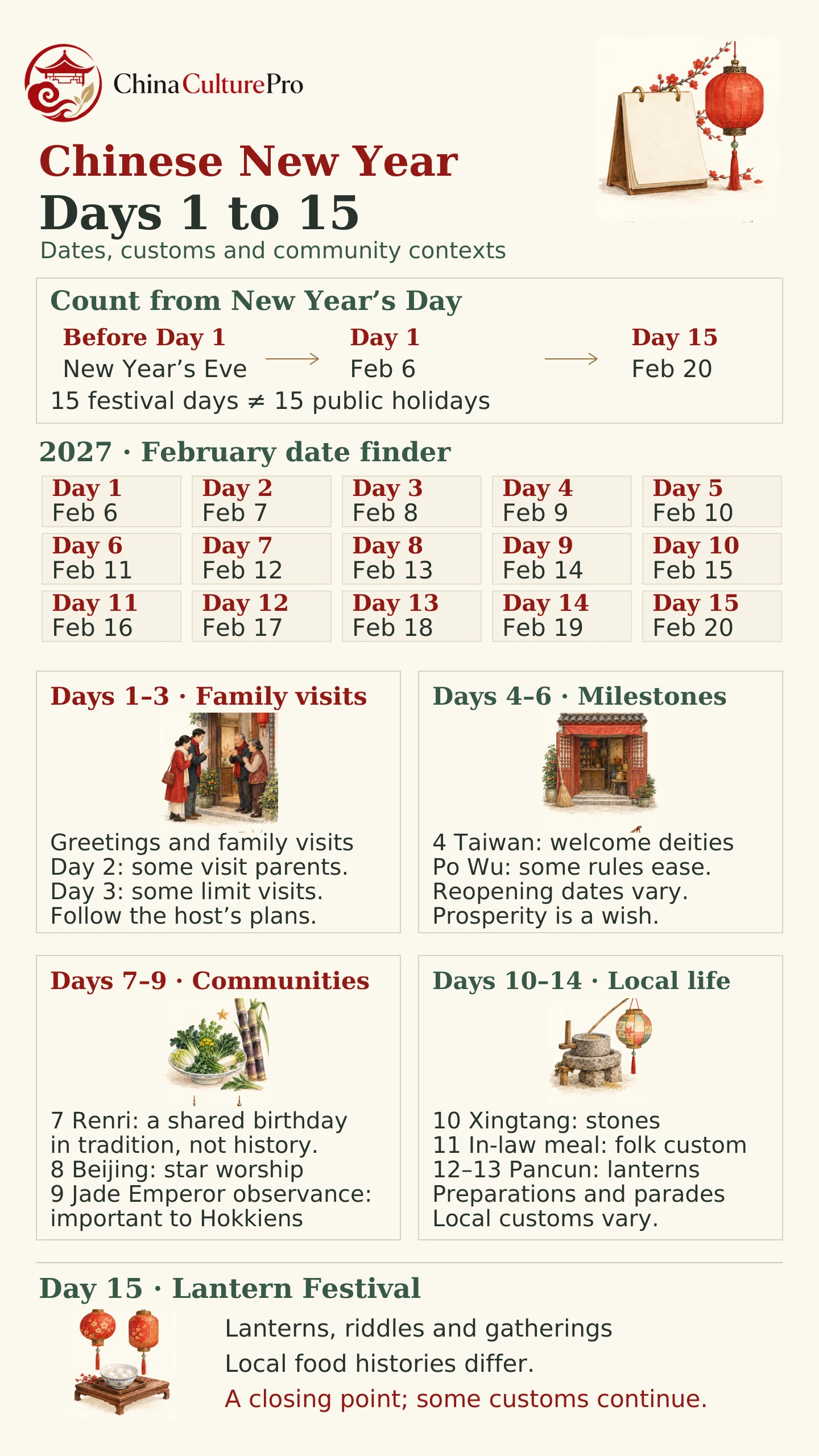
In 2027, Day 1 is February 6 and Day 15 is February 20. Count February 6 itself as the first day: the endpoint is fourteen days later, giving fifteen dates in total. The table below uses this single year as its example. [1]
The wider Chinese New Year celebration also includes preparations before Day 1. Its cultural calendar does not specify fifteen days off work, a school break or a universal reopening date.
Chinese New Year Days 1 to 15 at a Glance
All dates below are in February 2027. Customs are selected examples, not duties assigned to every Chinese household. The Gregorian dates come from the calendar conversion; a date beside a custom does not confirm a public event that year. [1]
| Lunar day | February 2027 | Custom or cultural association | Scope or limit |
|---|---|---|---|
| 1 · 初一 | 6 | Bainian (拜年, bàinián): exchanging New Year greetings and visits | Family visiting arrangements differ. |
| 2 · 初二 | 7 | Married daughters visiting their parents | An established practice in some families, not a universal obligation. |
| 3 · 初三 | 8 | Red Mouth Day (赤口, chìkǒu), associated with avoiding arguments | Some households limit visits; others do not. [2] |
| 4 · 初四 | 9 | Jieshen (接神, jiēshén): welcoming deities back | Recorded in Taiwan; participation depends on belief. [3] |
| 5 · 初五 | 10 | Po Wu (破五, pòwǔ); welcoming the God of Wealth (迎财神, yíng Cáishén) | Local ritual and business traditions, not guaranteed prosperity. |
| 6 · 初六 | 11 | Sending away poverty (送穷, sòngqióng) or reopening shops | Recorded dates differ; historical Beijing accounts mention reopening. [4] |
| 7 · 初七 | 12 | Renri (人日, rénrì), traditionally humanity’s birthday | Food customs differ among Chinese Singaporean communities. [2] |
| 8 · 初八 | 13 | Shunxing (顺星, shùnxīng), associated with star worship | One historical Beijing observance, not a national daily requirement. [4] |
| 9 · 初九 | 14 | Bai Tiangong (拜天公, bài Tiāngōng), honouring the Jade Emperor (玉皇大帝, Yùhuáng Dàdì) | Particularly important in Hokkien tradition. [5] |
| 10 · 初十 | 15 | A traditional birthday of stones | Documented in Xingtang, Hebei; not a nationwide holiday. [6] |
| 11 · 十一 | 16 | Son-in-Law Day (子婿日, zǐxù rì), involving an invitation to a meal | A recorded folk custom, not a rule for every family. [7] |
| 12 · 十二 | 17 | Lantern preparations in some communities | Pancun, Guangdong, records preparations before its procession. |
| 13 · 十三 | 18 | Lantern raising and processions in Pancun, Kaiping | A specific local tradition, not a confirmed 2027 programme. [8] |
| 14 · 十四 | 19 | The approach to the next day’s lantern celebration | Displays and gatherings follow local arrangements. |
| 15 · 十五 | 20 | Lantern Festival (元宵节, Yuánxiāo Jié), a traditional closing celebration | Lantern viewing, riddles and family gatherings vary. [9] |
Days 1–3: Greetings, Family Visits and a Quieter Day
The early days put relationships at the centre of the celebration. Visiting relatives can express respect, renew contact and allow different generations to spend time together. The order may follow household expectations, but it should not be read as one universal ranking of relatives. Traditional accounts describe close-family visits first, with other relatives and friends visited afterwards. [9]
Day 2’s association with married daughters visiting their parents reflects a particular family-visiting tradition. It does not mean daughters are forbidden to visit on other dates, or that every couple must divide their celebrations in the same way. A family may keep the date, move its meal or arrange several gatherings. The practical question for an invited guest is which gathering the host has actually planned.
Day 3 illustrates how a belief can affect a schedule without becoming a general prohibition. Red Mouth Day carries an association with quarrelling, leading some families to avoid visits. This describes a customary concern, not evidence that disagreements are more likely on that date. [2] If a host invites you on Day 3, the invitation is more useful guidance than a generic online warning. A quieter day is an option, not a requirement for all families.
Days 4–6: Welcoming Deities, Po Wu and Returning to Routine
These dates show why ritual milestones and everyday schedules need to be kept separate. In Taiwan, Day 4 is associated with receiving returning deities. A New Taipei record of observances in 2026 identifies it as a day for welcoming the gods. That establishes a local example; it does not mean every Chinese household performs the same ritual, or that its details apply elsewhere. [3]
Po Wu is often translated as “breaking the fifth.” It marks the lifting of certain early-New-Year restrictions in some traditions. Welcoming wealth deities can form part of the day, while the emphasis may fall on renewed work, cleaning or business activity. The wishes concern prosperity; they do not determine income or commercial success. A local Xingtang account connects Day 5 with returning to work and trade. [6]
Other accounts place shop reopening on Day 6. A historical description of Beijing’s first lunar month links Day 5’s symbolic sending away of poverty with reopening the following day. [4] These different dates are useful evidence of variation. They cannot establish when a modern employer resumes work. If you need to visit a shop, attend an appointment or meet someone, check that organisation’s actual schedule rather than calculating it from a folk calendar.
Days 7–9: Renri, Star Customs and the Jade Emperor’s Birthday
Renri treats Day 7 as humanity’s shared birthday. Its creation stories are legends, not accounts of human origins. In Singapore, yusheng (鱼生, yúshēng), a festive fish salad, is associated with Renri; Teochew families have a recorded seven-vegetable food tradition. These are community-specific examples rather than a universal menu. [2]
Day 8 provides a different kind of example. Shunxing belongs to traditions of star worship, including historical observances recorded for Beijing. Lamps and wishes expressed a relationship with the heavens within that belief system. It would be misleading to present this as a ceremony all families still perform, or to merge every story about Day 8 into a single national festival. [4]
Day 9 is especially significant in Hokkien religious tradition as the Jade Emperor’s birthday. Singapore Hokkien accounts include sugarcane offerings and a legend explaining their importance. The legend is a cultural explanation, not verified evidence of the custom’s original event. [5] Recognising the Hokkien setting makes the date easier to understand without claiming that no other community honours the Jade Emperor. Participation depends on religious practice and household choice; a calendar label does not make worship an obligation for guests.
Days 10–14: Local Observances and the Approach to Lantern Festival
The later dates are particularly vulnerable to overtidy explanations. In Xingtang, Hebei, Day 10 is described as a birthday of stones, connected with the importance of stone tools and structures. Some practices have faded with the declining use of stone implements. This is a local example, not a rule for all northern villages. [6]
Day 11’s invitation to a son-in-law is another recorded folk association. Its presence in a calendar does not demonstrate that every family across a broad southern region holds such a meal, or that northern families never do. [7]
Pancun offers a firmer place-and-date example for the lantern period. Its documented custom includes preparations on Day 12 and lantern raising and processions on Day 13. [8] This shows that lantern celebrations can precede Day 15. It establishes neither a national lamp-lighting date nor a particular event programme in 2027.
Day 15: The Lantern Festival and a Traditional Closing Point
The Lantern Festival is a traditional closing point for the New Year season. Lantern viewing, riddles and gatherings give the date a celebratory character distinct from the first day’s greetings. [9]
Round rice foods such as tangyuan (汤圆, tāngyuán) and yuanxiao (元宵, yuánxiāo) are familiar associations. In Xingtang, eating yuanxiao is described as a newer local practice; another observance falls on Day 16. [6]
“Closing point” therefore describes the festival’s cultural role. It does not set every family’s final visit, every display’s removal date or everyone’s return to work. The lunar date is associated with the full moon, without specifying the exact astronomical moment.
FAQs About the 15 Days of Chinese New Year
Does Chinese New Year’s Eve Count as Day 1?
No. New Year’s Eve is the previous lunar year’s final day. The fifteen-day sequence starts on the first day of the first lunar month and counts that date as Day 1.
Are All 15 Days Public Holidays?
No. Fifteen days describes a customary festival period, not a universal entitlement to leave. Public holidays, school breaks and individual workplace schedules must be checked separately for the relevant location and year.
Does Every Day Have a Fixed Chinese New Year Tradition?
No single daily schedule covers every Chinese community. Some dates have widely recognised associations; others carry particular local meanings. Families may observe selected customs, adjust their plans or omit them entirely.
Does Chinese New Year End on Day 5?
Po Wu can mark a change in certain local customs, including the easing of restrictions or renewed business activity. It does not replace Day 15 as the familiar traditional closing celebration.
Why Does Chinese New Year End with the Lantern Festival?
The fifteenth day traditionally closes the New Year season with lantern celebrations. This is a cultural convention, not a deadline: local observances may continue afterwards, while ordinary work may resume earlier.
Sources
[1] Hong Kong Observatory. Gregorian-Lunar Calendar Conversion Table of 2027
[2] Singapore Chinese Cultural Centre. Chinese New Year
[3] New Taipei City Government. 大年初四接神 侯友宜土城、中和及永和參香祈福
[4] Palace Museum. 民间庆正月
[5] National Library Board Singapore. Hokkien community
[6] Xingtang County Government. 行唐的其他节日
[7] Huairou District Government. 年俗丨正月十一 · 子婿日
[8] Kaiping City Shuikou Town Government. 正月十三,“龙”重“灯”场,就在泮村!赏灯前必看
[9] Columbia University, Asia for Educators. The Lunar New Year: Rituals and Legends