

Quick Answer: What Is Jiangnan Culture?
Jiangnan (江南, Jiāngnán) culture brings together the arts, trades and everyday practices associated with the lower Yangtze’s southern landscapes and cities. Gardens and landscape painting are prominent expressions, alongside literary traditions, silk crafts and food. It is a historical cultural region, rather than a province.[1]
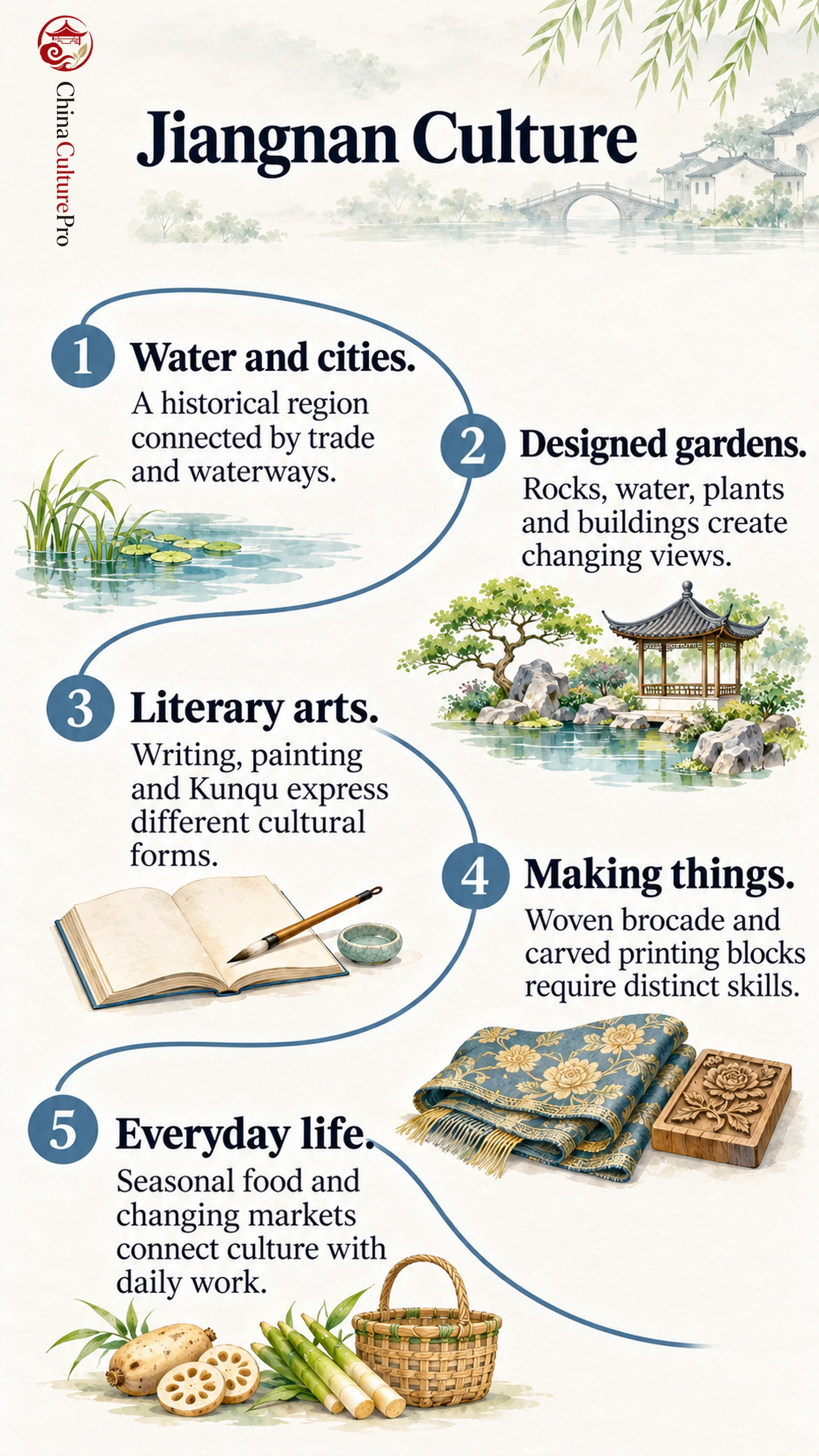
- Setting: Waterways, agricultural land and cities developed in relation to one another.
- Arts: Gardens, literature, painting and theatre offer different ways to interpret place.
- Daily life: Making textiles, producing books and buying seasonal food connect culture with work.
The name does not supply one permanent boundary, a single local cuisine or an unchanging way of life.
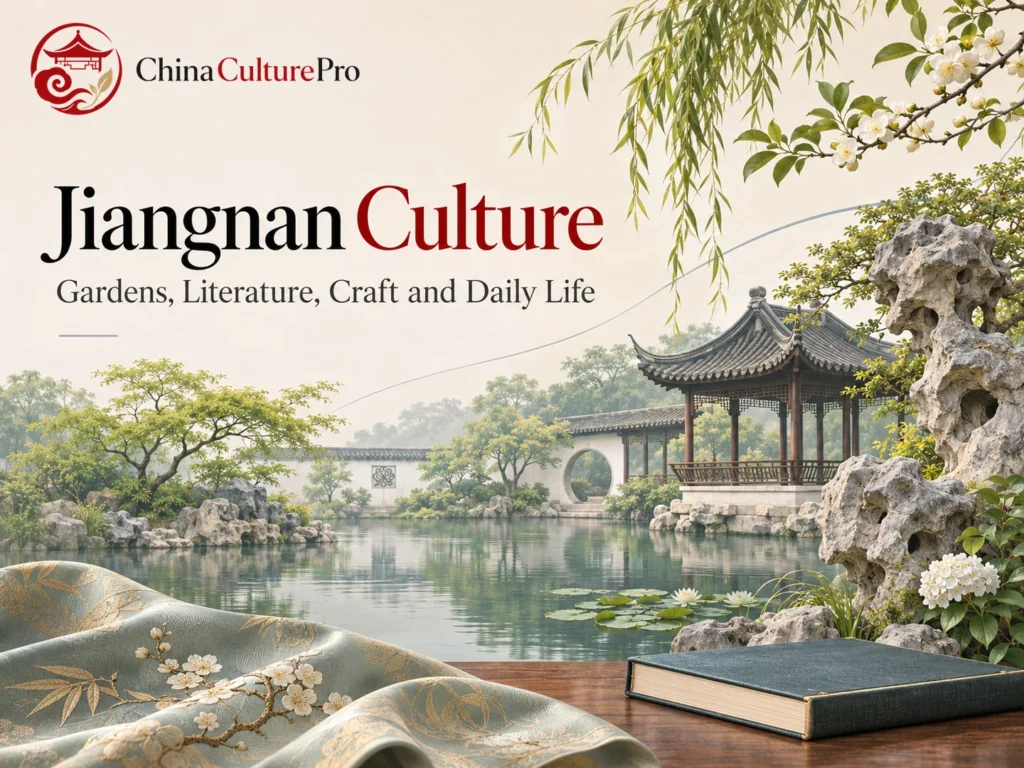
A garden view, a printed page and a market basket reveal different sides of Jiangnan. Looking at how people designed spaces, represented their surroundings and made useful things explains more than treating the region as a collection of picturesque water towns.
A Historical Region Connected by Water and Cities
The literal meaning is “south of the river,” with the Yangtze understood in this name. Cultural discussions commonly center on the lower Yangtze and cities such as Suzhou, Hangzhou and Nanjing. The useful scope depends on the historical period and subject, rather than every place south of the river belonging to one culture.[1]
Natural waterways linked fields, settlements and trading cities. The Grand Canal (大运河, Dà Yùnhé) connected this wider landscape with long-distance transport and grain movement. Water was an infrastructure for exchange as well as a subject for art.[10]
A regional culture can cross present administrative boundaries. Compare a garden, a book workshop and a food market at their own local scale: they illuminate connections without turning Jiangnan into one uniform city or province.
Gardens as Designed Landscapes and Literary Spaces
The Classical Gardens of Suzhou (苏州古典园林, Sūzhōu gǔdiǎn yuánlín) combine rocks, water, plants and buildings within carefully composed spaces. Their design draws on landscape painting and literary imagination. Paths, openings and changing viewpoints make a small area feel spatially varied.[2]
The World Heritage property comprises nine selected gardens, with surviving designs associated with the 11th to 19th centuries. Inscription began in 1997 and the property was extended in 2000. This is a particular group of Suzhou gardens, rather than every garden in the city.[2]
Reading garden design involves more than identifying attractive plants. A pavilion organizes a place to pause; a framed view directs attention; names and inscriptions connect a setting with texts and ideas. Residential space, craftsmanship and cultivated nature work together. A residential garden reflects the resources and tastes of its owners; it does not represent every historical household.[2]
Literature, Painting and Kunqu Theatre
Literature helped create the region’s cultural geography. Early writers represented its cities, scenery and local histories through different genres. Zuo Si’s rhapsody on the Wu capital described the area’s places and cultural life, while Lu Ji contributed both literary writing and criticism. Such texts shaped how a region could be imagined as well as described.[3]
The relationship between writing and landscape painting helps explain why a garden or a painted riverscape can carry more than a record of physical scenery. An artwork is a selected representation: its composition and references deserve attention alongside the place it evokes.
Kunqu (昆曲, Kūnqǔ) brings literary language into embodied performance. Singing, recitation, patterned movement and martial action work with instrumental accompaniment to tell a story. Flutes, strings and percussion have different musical roles. The form was proclaimed a UNESCO Masterpiece in 2001 and incorporated into the Representative List in 2008; these are different stages of recognition.[4]
Silk, Brocade and the Crafts of Making Books
Craft workshops joined artistic design to specialized labor. Silk production connects a finished textile with the skills and work behind it.
In Nanjing, Yunjin brocade (云锦, yúnjǐn) incorporates its motifs into the woven structure. Two artisans cooperate on a large wooden loom, handling different parts of the process. This weaving practice differs from embroidery, where stitches are added to a textile. Modern scarves and brooches show one route from court-associated textile traditions to contemporary objects.[5]
Engraved block printing (雕版印刷, diāobǎn yìnshuā) links craftsmanship with the circulation of texts. Characters and images are carved into wooden blocks, then inked and transferred to paper. Calligraphers, carvers and printers perform different jobs. Hangzhou was among the cities associated with accomplished publishing in the Ming and Qing periods. A printed page is therefore evidence of coordinated skills as well as an author’s words.[6]
Food, Markets and Changing Daily Life
Food has its own literary life. Jiangnan writers used meals and ingredients to evoke locality, memory and cultivated taste. The Qing writer Yuan Mei’s food writing connected gastronomic judgments with literary references and place. These texts made local meals part of a wider culture of reading and discussion.[7]
Local Jiangsu and Zhejiang food traditions provide more precise comparisons than assuming a single Jiangnan flavor. Aquatic vegetables such as lotus root, water bamboo and water celery connect market offerings with the region’s watery environments. A July 2026 Hangzhou market account described these foods through their seasonal availability, rather than a fixed year-round menu.[8]
Contemporary daily life also changes the setting. An August 2026 account of Jiangnan Market in Tonglu described restaurants and small bars alongside fresh-food shopping. That combination places new forms of dining within an everyday market. Cultural continuity can involve adaptation in how spaces are used, as well as the preservation of an old building or craft.[9]
FAQs About Jiangnan Culture
Is Jiangnan a province?
No. It is a historical and cultural regional name. Its scope varies with the period and the subject being discussed.
Does Jiangnan culture mean only water towns?
No. Cities, farms, workshops, literature and trade are part of the picture, alongside canal settlements and waterways.
Are classical gardens simply decorative parks?
No. Their layouts, buildings and literary references create designed environments for viewing, movement and social life.
Is Kunqu the same as Peking opera?
No. They are different theatrical traditions. Kunqu has its own vocal style, repertory and performance conventions.
Sources
[1] Cleveland Museum of Art. China’s Southern Paradise: Treasures from the Lower Yangzi Delta
[2] UNESCO World Heritage Centre. Classical Gardens of Suzhou
[3] Xu Guoyuan, Soochow University. Early Jiangnan Literature and the Construction of Cultural Geography
[4] China Intangible Cultural Heritage Network. Kunqu
[5] Meng Jiaxin, China Today. Nanjing Yunjin Brocade Weaving Technique
[6] China.org.cn. China Engraved Block Printing Technique
[7] Thomas DuBois. Jiangnan Cuisine: How the Ancient Literati Wrote About It
[8] Hangzhou Information Office. Eight Water Delicacies Hit Summer Markets
[9] Hangzhoufeel, Hangzhou Information Office. Tonglu Market Offers Fresh Food and Dining
[10] UNESCO World Heritage Centre. The Grand Canal