
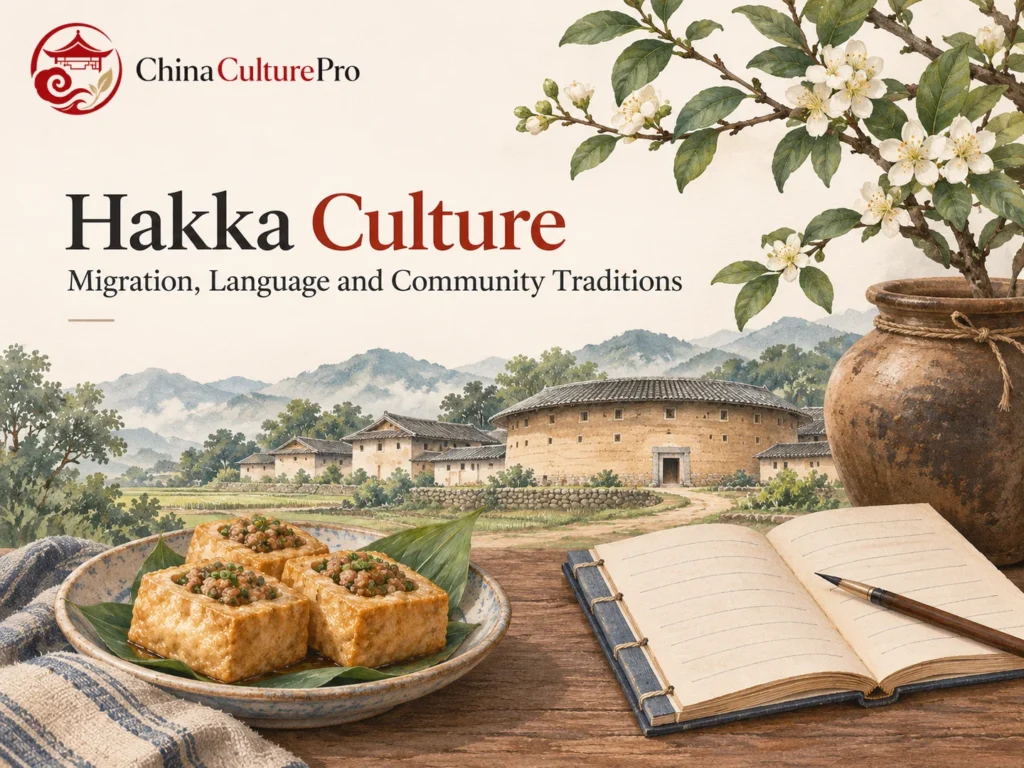

Quick Answer: What Is Hakka Culture?
Hakka (客家, Kèjiā) culture connects histories of migration with language, community institutions, building traditions, food and performance. It developed through settlement and interaction in southern China and through communities elsewhere, rather than as one unchanging way of life.[1][8]
- Regional communities: Local histories and surroundings shape different forms of Hakka life.
- Shared resources: Speech, family connections and cultural practices can link people across places.
- Living culture: New songs, language resources and community projects develop alongside inherited traditions.
No single house type, dish or level of language proficiency defines every Hakka person. Regional examples show how these connections take different local forms.
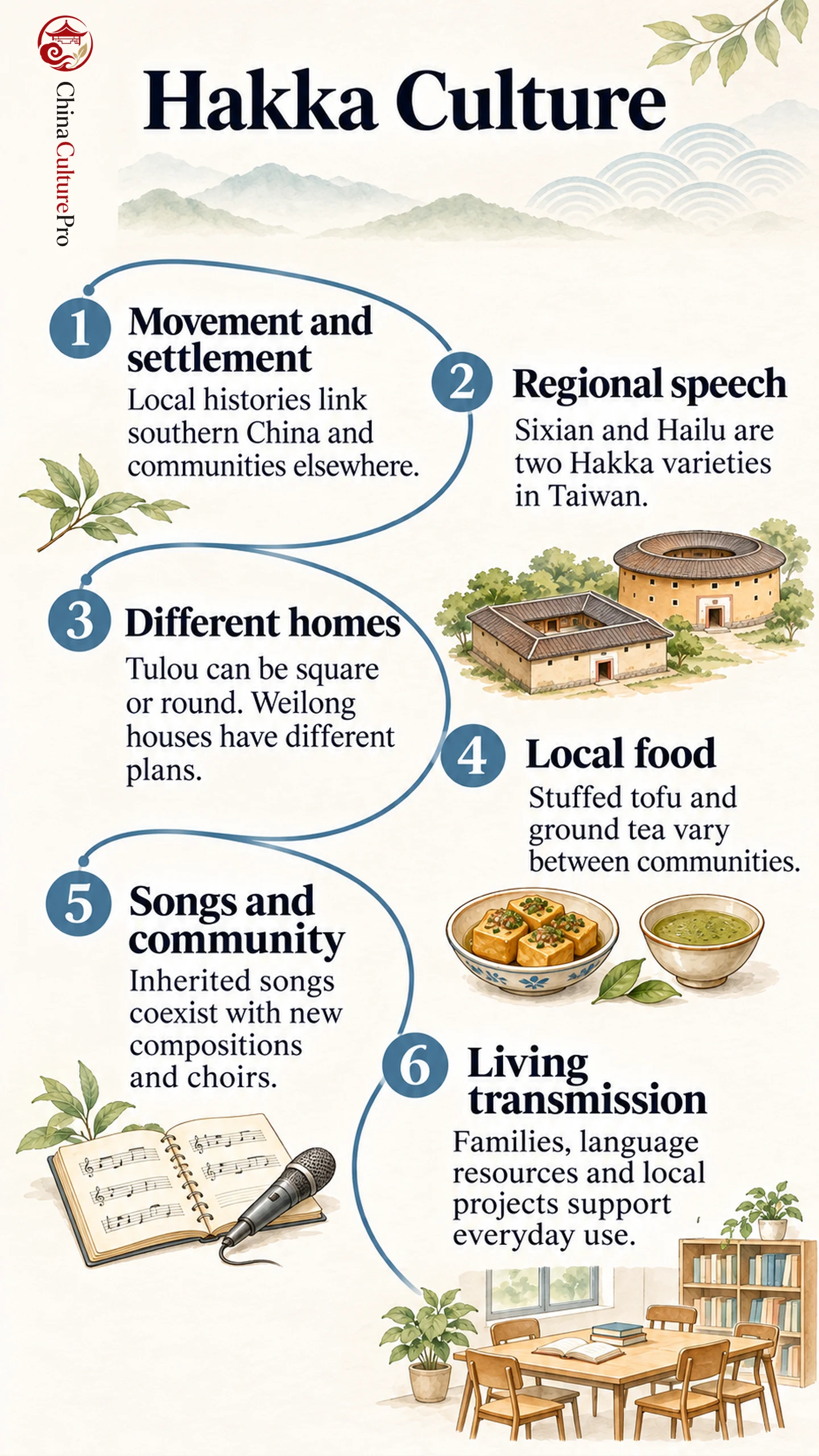
An earthen house in Fujian, a stuffed-tofu stall in Singapore and a language project in Taiwan reveal different aspects of Hakka culture. Following their local contexts explains how inherited practices connect people while also changing through settlement and exchange.
Migration, Settlement and Regional Communities
The name is often rendered “guest families,” reflecting histories of movement and settlement. It does not mean that Hakka people are temporary visitors wherever they live. Long-established communities have built local homes, institutions and social relationships.
A major historical settlement region lies where Guangdong, Fujian and Jiangxi meet. Research on migration routes emphasizes terrain, roads, political and economic conditions, and interaction with local cultures. These processes belong within Chinese migration history; they cannot be reduced to one identical ancestral journey for every family.[1]
Taiwan’s Hakka communities have connections with migrants from several parts of those provinces. Areas such as Taoyuan, Hsinchu, Miaoli and Meinong preserve different local histories. Their settlement histories connect Hakka heritage with particular places and surrounding communities.[9]
Hakka Language and Regional Speech Varieties
The Hakka language (客家话, Kèjiāhuà) has regional varieties. Taiwan’s official dictionary distinguishes forms including Sixian (四县腔, Sìxiàn qiāng) and Hailu (海陆腔, Hǎilù qiāng), alongside several others. It includes both older vocabulary and new coinages, showing that the language continues to describe changing life.[2]
The pinyin here gives Mandarin readings of Chinese names, not a guide to Hakka pronunciation. A language resource should identify which Hakka variety its recordings represent, rather than presenting one pronunciation as universal.
Language ability and identification are also different questions. In a June 2026 language-policy discussion in Taiwan, stronger public identification with Hakka heritage was considered alongside difficulties in passing on everyday speech. The relationship between identity, listening and speaking therefore needs more than a single “Hakka or not” label.[7]
Tulou, Weilong Houses and Different Ways of Living
Traditional houses reveal forms of shared living, but they are not a checklist for recognizing a Hakka person. Two important types are tulou (土楼, tǔlóu) and weilong houses (围龙屋, wéilóngwū). Their plans connect family residence with courtyards, ritual spaces and local building conditions.[4]
| Building type | Recognizable form | What the form helps explain |
|---|---|---|
| Tulou | Multistorey earthen buildings with inward-facing rooms and shared courtyards; circular and square plans occur. | Communal residence, family organization and defensive design.[3] |
| Weilong houses | Compound plans with a central ancestral hall and a different distribution of residential and ritual spaces. | Residential and ritual spaces arranged differently from the tulou examples.[4] |
The UNESCO-listed Fujian Tulou property contains 46 buildings dating from the fifteenth to twentieth centuries. That protected selection is not the total number of tulou, nor a model for all Hakka homes. Hoklo (福佬人, Fúlǎorén) communities also built tulou, so the exterior alone does not establish an exclusive ethnic identity.[3][4]
These buildings belong within wider Chinese domestic architecture. Ancestral halls can anchor shared ritual life, but their role and relationship with living rooms differ between compounds. Modern Hakka communities also live in many other housing settings.
Food Traditions Across Hakka Communities
Hakka cuisine includes local repertoires rather than one fixed menu. Ingredients and serving forms change as dishes travel, while food names retain links with particular communities.[5]
| Food | Distinguishing features |
|---|---|
| Stuffed tofu (酿豆腐, niàngdòufu), often called yong tau foo | Tofu filled with minced meat; Singapore versions also stuff vegetables and frequently use fish paste.[5] |
| Ground tea (擂茶, léichá), or lei cha | In Singapore, ground tea rice combines rice and chopped toppings with a separate green herbal soup; its familiarity differs among Hakka groups.[5] |
| Abacus seeds (算盘子, suànpánzǐ) | Taro-and-starch pieces with flattened centers, associated particularly with Dabu connections in the Singapore repertoire.[5] |
The same community label therefore need not predict a household’s meals. In Singapore, some dishes became widely available in hawker settings, while others remained more closely associated with a county or family background. County connections remain visible within this wider repertoire.[5]
Mountain Songs, Associations and Religious Life
Mountain songs (山歌, shāngē) connect voice, language and social expression. In Singapore, the documented musical repertoire extends from folk songs and opera to instrumental music and Christian hymns. Hakka music is not limited to one religious setting.[6]
Community associations have organized singing classes and choirs while encouraging new local compositions. Folk-song traditions can therefore be both inherited and newly written. Associations provide one setting for participation, alongside other community and religious groups.[6]
Contemporary Culture and Language Transmission
Language transmission now involves family use, education, public services and digital resources. Taiwan’s 2026 policy discussion included Hakka text corpora, speech recognition and opportunities to use the language in daily life. These are current efforts within Taiwan’s cultural setting, rather than proof that a digital tool by itself guarantees transmission.[7]
A different local picture appears in Singkawang, Indonesia. In 2026, a Taipei-based cultural program sent 15 young participants to examine Hakka language use and interaction with Dayak communities. Their reported fieldwork found Hakka still used in everyday communication and cultural life shaped through local exchange.[8]
That case belongs within Chinese Indonesian cultural life. It cannot establish language conditions across all Indonesia or all Hakka communities. Comparing places requires the distinction explored in diaspora language studies: cultural identification, actual use and speaking ability are related, but different, questions.
FAQs About Hakka Culture
Are Hakka a separate country or nationality?
No. Hakka names a cultural and linguistic community found in different places. It does not establish one modern citizenship or passport.
Is Hakka just an accent of Mandarin?
No. Hakka is a distinct Chinese speech tradition with its own regional varieties, rather than a local pronunciation of standard Mandarin.
Do all Hakka people live in round tulou?
No. Tulou can be square as well as circular, and Hakka people live in many other kinds of homes. Hoklo communities also built tulou.
Is every Hakka meal the same?
No. Local ingredients, ancestral counties and later settlement shape different food traditions. A dish familiar in one Hakka family may be uncommon in another.
Does Hakka identity require speaking the language fluently?
No. Identity and language ability can develop differently. Language transmission remains important, but a person’s heritage cannot be measured by one fluency test.
Sources
[1] Geographical Research. Simulation of the Migration Routes of Hakka Based on Spatial Accessibility
[2] Taiwan Ministry of Education. Dictionary of Taiwan Hakka: Introduction
[3] UNESCO World Heritage Centre. Fujian Tulou
[4] Li Hu and Tao Yang, Buildings. Landed and Rooted: Traditional Hakka Dwellings
[5] Singapore Chinese Cultural Centre, Culturepaedia. Hakka Food in Singapore
[6] Hsu Hsin-Wen, Singapore Chinese Cultural Centre, Culturepaedia. Hakka Music in Singapore
[7] Hakka Affairs Council. Language Revitalization at the 2026 National Languages Development Convention
[8] Taiwan Immigrants’ Global News Network. Hakka Remains a Daily Language in Singkawang: Youth Fieldwork
[9] Hakka Affairs Council. A Brief Historical Overview of the Hakka