


Quick Answer: What Is Chinese Agricultural Heritage?
Chinese agricultural heritage(农业文化遗产,nóngyè wénhuà yíchǎn)includes inherited farming systems in which production, local knowledge, biodiversity and community life remain connected. Fields, ponds, trees and buildings are part of the picture, alongside the skills and relationships that keep them useful.[1]
- Material: Crops, animals, waterworks and working landscapes
- Living: Cultivation skills, shared rules and cultural practices
- Continuing: Livelihoods and knowledge adapted across generations
Official recognition identifies particular systems or practices. It does not mean that every old farm has the same designation, or that agricultural heritage belongs only in a museum.
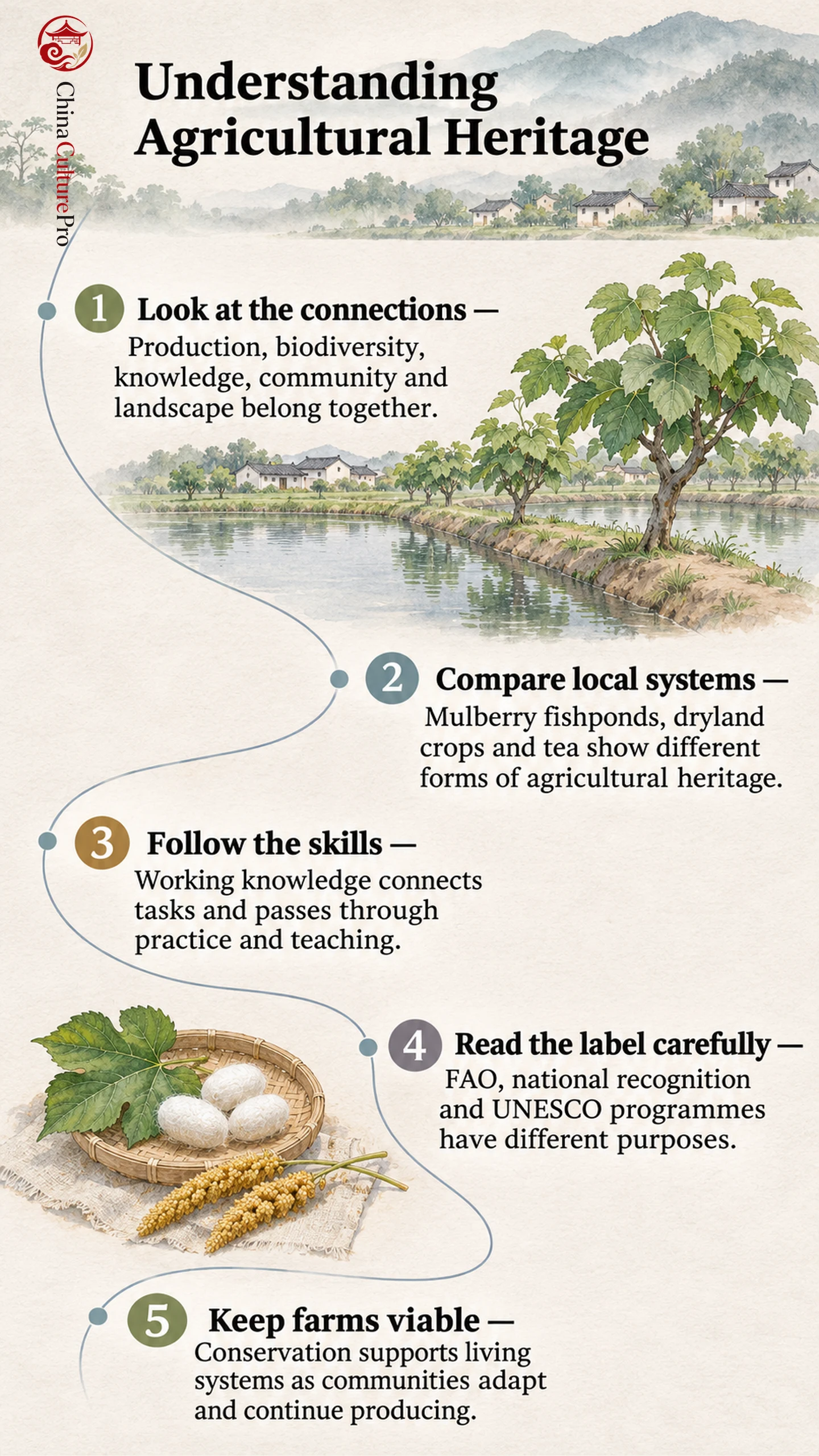
A fish pond and the trees on its banks may belong to one working system: leaves feed silkworms, their waste feeds fish, and pond mud nourishes trees.[2] Agricultural heritage asks how such relationships continue. This guide compares different Chinese examples and explains the labels used to recognize and support them.
What Makes a Farming System a Heritage System
Age alone does not explain a heritage system. A useful framework considers five connected dimensions: food and livelihoods, agricultural biodiversity, local knowledge, social and cultural organization, and landscape. These are the criteria used by the Food and Agriculture Organization of the United Nations, or FAO, in its Globally Important Agricultural Heritage Systems programme, known as GIAHS.[1]
The system is the relationship between those dimensions. A historic tool shows how one task was performed; a working agricultural system also involves land, useful plants and animals, decisions and people able to carry out the work. The broader history of Chinese agriculture explains how these relationships developed over time.
Three Systems in Different Landscapes
At Huzhou(湖州,Húzhōu)in Zhejiang(浙江,Zhèjiāng), the mulberry-dyke and fish-pond system(桑基鱼塘,sāngjī yútáng)links tree cultivation, silkworm rearing and aquaculture. Mulberry leaves feed silkworms; silkworm waste feeds fish; nutrient-rich pond mud is placed on the dykes to fertilize the trees. Water control and the use of different resources make this more than a collection of adjacent enterprises. It received GIAHS designation in 2017.[2]
Aohan(敖汉,Áohàn)in Inner Mongolia(内蒙古,Nèi Měnggǔ)offers a dryland contrast. Its system combines farming, forestry and livestock, with crops including foxtail millet, broomcorn millet, buckwheat and beans. Rotations and soil-moisture management are important forms of knowledge, accompanied by farming proverbs and seasonal customs. GIAHS designation came in 2012.[3]
At Anxi(安溪,Ānxī)in Fujian(福建,Fújiàn), agricultural heritage includes tea cultivation and local environmental management. Tieguanyin(铁观音,Tiěguānyīn)is closely associated with the area. The tea-producing system, designated in 2022, links farmers’ cultivation knowledge with the identity of local communities.[4]
These examples show why one picture of irrigated rice cannot represent all agricultural heritage. Rice-farming culture is one important branch within a wider range of systems.
Knowledge Carried through Work and Community
Working knowledge connects actions across a production cycle. In Huzhou, it includes propagating and managing mulberry trees, producing silkworm eggs, raising silkworms, reeling silk and textile-making. Learning only the fish-rearing part would miss other skills that connect the components. The system also belongs within the wider history of sericulture and silk.[2]
Cultural knowledge can also be communicated through proverbs, songs and seasonal customs. Aohan’s farming traditions include these expressions alongside practical techniques. Such knowledge is associated with work and local conditions; it is not a claim that one proverb can replace every decision about soil or weather.[3]
The distinction between documenting and continuing a skill is useful here. Recording a technique makes it available for study. Keeping it in use also requires people, suitable materials and a reason to carry out the work. A demonstration can reveal part of a process without showing the entire production system.
GIAHS, National Recognition and UNESCO: Different Programmes
Agricultural heritage has several routes to recognition. China-NIAHS(中国重要农业文化遗产,Zhōngguó Zhòngyào Nóngyè Wénhuà Yíchǎn)is China’s national agricultural-heritage programme. Its first list was published in May 2013. National recognition and the submission of candidates to FAO are different stages, as the ministry’s contemporary notice makes clear.[5]
| Framework | What the recognition concerns |
|---|---|
| China-NIAHS | Agricultural heritage systems recognized through China’s national programme |
| FAO GIAHS | Agricultural systems assessed through linked production, knowledge, biodiversity, culture and landscape criteria |
| UNESCO World Heritage | Listed properties, including some agricultural cultural landscapes |
| UNESCO intangible cultural heritage | Named living practices, knowledge and skills, rather than automatic recognition of an entire farming area |
One region may feature in more than one programme. The Hani(哈尼族,Hānízú)terraces at Honghe(红河,Hónghé)in Yunnan(云南,Yúnnán)include a World Heritage cultural landscape inscribed in 2013.[6] FAO’s Hani Rice Terraces record gives 2010 as its GIAHS designation date.[7] These are separate records; a shared regional setting does not mean identical boundaries or management requirements.
Intangible heritage concerns living expressions recognized and transmitted by communities. A farming-related skill may fit that understanding, but this does not establish that the skill has been separately inscribed on a UNESCO list.[8]
Keeping Production and Conservation Together
A heritage designation does not remove pressures on a working landscape. A 2023 land-use study of Nanxun(南浔,Nánxún), Huzhou, compared conditions from 1975 to 2019. It found expansion of fish ponds and built land alongside decline in mulberry and paddy fields, weakening the balance between parts of the traditional system. Attractive water scenery alone would not reveal that change.[9]
FAO’s approach is dynamic conservation: supporting adaptation and viable livelihoods while maintaining the relationships that give a system its heritage value. Its background statement identifies climate change, displacement and biodiversity loss among the pressures, and includes markets and agricultural tourism among possible opportunities.[10]
The useful questions are concrete: are farmers still producing, are locally important varieties and skills maintained, and do communities participate in decisions? New equipment and visitor income need to be assessed for their effects on that working system. Conservation depends on the continuing system, not simply the survival of an appealing view.
FAQs About Chinese Agricultural Heritage
Is agricultural heritage only about ancient tools?
No. Tools are one part of systems that also include biodiversity, knowledge, community practices and livelihoods.[1]
Are GIAHS sites the same as UNESCO World Heritage sites?
No. FAO and UNESCO operate different programmes. A region may receive both forms of recognition through separate records.[6][7]
Must heritage farms reject modern technology?
No. Dynamic conservation allows adaptation while protecting the relationships and knowledge that give a system its value.[10]
Does recognition guarantee that a system is thriving?
No. Land use, livelihoods and transmission still need attention after designation.[9][10]
Sources
[1] FAO. Become a GIAHS: criteria and assessment
[2] FAO. Zhejiang Huzhou Mulberry-dyke and Fish-pond System
[3] FAO. Aohan Dryland Farming System
[4] FAO. Three Chinese systems designated in May 2022, including Anxi tea
[5] Ministry of Agriculture. National agricultural heritage and selection of GIAHS candidates, July 2013
[6] UNESCO World Heritage Centre. Cultural Landscape of Honghe Hani Rice Terraces
[7] FAO. Hani Rice Terraces: designation record
[8] UNESCO. What is Intangible Cultural Heritage?
[9] Land. From Productive Landscape to Agritouristic Landscape? Evidence from Huzhou