

Quick Answer: How Does Rice Farming Shape Chinese Culture?
Rice farming connects a crop’s growing cycle with the work of managing fields and water.[1] In Chinese cultural settings, those tasks also provide contexts for shared knowledge, seasonal observances and food traditions.
- Cultivation: Preparing fields, establishing plants, tending and harvesting
- Water: Controlling supply and drainage across a working landscape
- Season: Matching tasks to crop development and local conditions
The cultural connections take different forms in different communities. A terraced mountain field, a rice–fish system and a mechanized plain are not interchangeable pictures of one national farming routine.

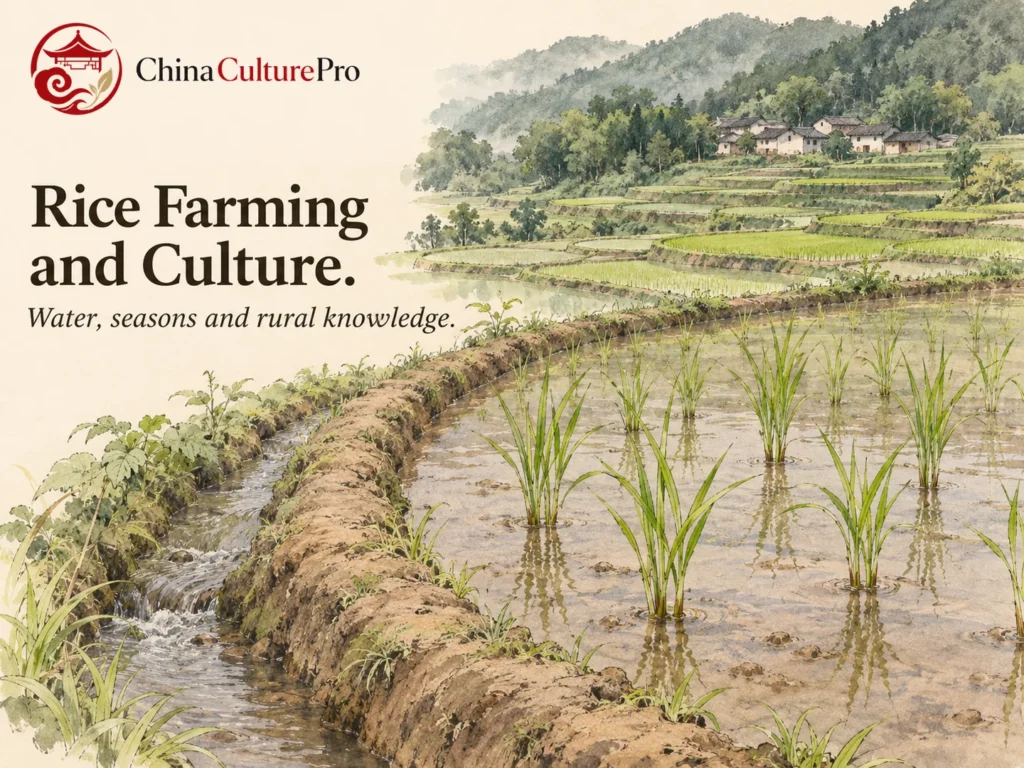
A flooded field is one moment in a longer farming year. Its mirror-like surface can hide the channels, prepared soil and decisions that keep a crop growing. Looking beyond that view reveals how rice cultivation brings technical work, household relationships and seasonal knowledge together, in both older traditions and contemporary rural life.
A Long History with Different Regional Settings
Rice harvesting has deep roots in the lower Yangtze(长江,Cháng Jiāng)region. A 2022 study examined wear and plant residues on stone tools from Shangshan(上山,Shàngshān)and Hehuashan(荷花山,Héhuāshān), dated to about 10,000–7,000 years before present. The evidence identifies early harvesting practices, not a single moment when a complete rice-farming culture was invented.[2]
Much later, during the Song dynasty(宋朝,Sòngcháo), new rice varieties, irrigation improvements and agricultural manuals supported changes in cultivation. Rice-growing and transport helped connect southern producing regions with growing markets. This history belongs to the broader development of Chinese agriculture, rather than to one unchanged ancient technique.[3]
Southern rice landscapes are important, but they are not the whole map. Photographs from the 2024 harvest record rice in Jilin(吉林,Jílín)in the northeast and Henan(河南,Hénán)in central China. Geography, crop varieties and growing conditions matter more than a simple north–south stereotype.[4]
From Seed to Harvest: Reading the Farming Cycle
Rice-growing involves a sequence of tasks, with some work continuing across several stages. A field’s colour or water surface tells only part of its story.[1][3]
| Stage | Work and changes to look for |
|---|---|
| Preparing the field | Soil preparation, levelling and attention to water movement |
| Establishing plants | Seeds sown into the field, or seedlings moved from a nursery |
| Growing and flowering | New shoots and grain-bearing heads develop while farmers manage weeds, nutrients and water |
| Ripening and harvest | Grains fill and mature before the crop is cut |
| After harvest | Grain is separated from the stalks and husked for food |
Transplanting moves seedlings raised elsewhere into the main field. Direct seeding puts the seed into that field without this move. The familiar image of people bending over young plants shows one establishment method, not an essential definition of rice cultivation.[5]
The table is a reading guide, not a crop schedule. It does not prescribe sowing dates, irrigation depths or a fixed number of harvests per year. Those decisions depend on the growing system and locality.
Water, Fields and Work between Households
Water management includes the landscape above and between the paddies. At Honghe(红河,Hónghé), Hani(哈尼族,Hānízú)communities in Yunnan(云南,Yúnnán)have developed channels bringing water from forested mountains to terraces. Forests, villages, fields and water form an interconnected system. The farming also integrates animals such as cattle, ducks and fish with red-rice cultivation.[6]
This is a productive landscape, supported by continuing work. The Hani cultural context helps explain why fields, settlement and community practices belong in the same account.
Qingtian(青田,Qīngtián)in Zhejiang(浙江,Zhèjiāng)offers a different example. In its rice–fish system, rice provides shade and food for fish, while fish activity contributes to nutrient cycling and management of some weeds and larvae. Ditches and refuges support fish when field conditions change. Farmers cooperate in maintaining canals, ditches and ponds.[7]
Water control also changes with technique. Alternate wetting and drying uses periods of drainage followed by irrigation. This is one example of a managed water regime. Field drainage depends on the growing system, crop stage and local conditions.[8]
Seasonal Knowledge, Celebrations and Food
The Twenty-Four Solar Terms(二十四节气,Èrshísì Jiéqì)divide the sun’s annual movement into seasonal markers. Developed in the Yellow River region and later used more widely, they became a framework for production and everyday routines. They are solar divisions, not names for phases of the moon.[9]
Farmers interpret seasonal markers alongside local temperature, rainfall, varieties and field conditions. The same marker can coincide with different tasks in different regions.
Rice can also connect production with shared performance and eating. In Qingtian, rice–fish dances and local dishes are cultural expressions associated with the farming system.[7] At the national level, the contemporary Chinese Farmers’ Harvest Festival celebrates many crops: the 2024 record includes rice alongside maize, grapes and other produce.[4]
These examples distinguish a locally developed tradition from a broad contemporary celebration. Neither supplies a universal ritual menu for every rice-growing household. The foods made from the harvested grain form another subject within Chinese rice dishes.
Living Knowledge in a Changing Countryside
Different parts of knowledge can persist at different rates. A 2014 survey in Mitian(咪田,Mītián), a Hani terrace village, found stronger retention of festival and water-management practices than of some beliefs and folk songs among younger respondents. That is a finding about a particular community at a particular time, not a verdict on every Hani village today.[10]
New equipment also belongs in the picture. An April 2026 account from Jinhua(金华,Jīnhuá), Zhejiang, describes trials combining mechanical transplanting with drone images used to identify missing or weak seedlings. Farmers still need to interpret conditions and organize the work, although the tools and services change.[11]
Chinese agricultural heritage concerns this living relationship between knowledge, land and livelihoods. A field can carry inherited practices while using contemporary equipment. Understanding its culture requires asking what people cultivate, how they manage it and which knowledge they continue to pass on.
FAQs About Rice Farming in Chinese Culture
Must all rice be transplanted by hand?
No. Direct seeding avoids transplanting, and transplanting itself can be mechanized.[5][11]
Does rice need to remain flooded throughout its growth?
No. Water regimes differ; alternate wetting and drying deliberately includes non-flooded periods.[8]
Is there one rice-farming calendar for all of China?
No. Seasonal markers provide shared reference points, while crop timing depends on local growing conditions.[9]
Are rice terraces only scenic heritage sites?
No. Landscapes such as Honghe’s terraces are also working agricultural systems sustained by communities.[6]
Sources
[1] FAO. Growing paddy rice and its growth stages
[2] Jiajing Wang and colleagues. New evidence for rice harvesting in the early Neolithic Lower Yangtze River, China
[3] Columbia University, Asia for Educators. Rice Cultivation during the Song
[4] Xinhua, via State Council. Chinese Farmers’ Harvest Festival across China, September 2024
[5] IRRI Direct Seeded Rice Consortium. What is direct-seeded rice?
[6] UNESCO World Heritage Centre. Cultural Landscape of Honghe Hani Rice Terraces
[7] FAO. Rice Fish Culture, China
[8] IRRI. Alternate Wetting and Drying
[9] UNESCO. The Twenty-Four Solar Terms
[10] Sustainability. Retention of Traditional Ecological Knowledge in a Hani Rice Terrace Village
[11] Jinhua, Zhejiang. Drones help mechanized rice transplanting, April 2026