


Quick Answer: How Are Chinese Calendar Months Named?
Chinese calendar months are mainly numbered in sequence within a lunisolar year. Their boundaries follow new moons, while the calendar also keeps the year aligned with the seasons.[1]
- Names: Zhengyue (正月, zhēngyuè) means month one; Dongyue (冬月, dōngyuè) and Layue (腊月, làyuè) are familiar names for months eleven and twelve.
- Length and count: Each month has 29 or 30 days. A year normally has twelve months, or thirteen when an additional month is inserted.[11]
- Seasonal context: Traditional seasonal groupings and literary names add meaning to the numbered sequence; they do not replace the calendar’s date labels.
A lunar month number does not identify the same-numbered Gregorian month. The eighth lunar month is not simply August.
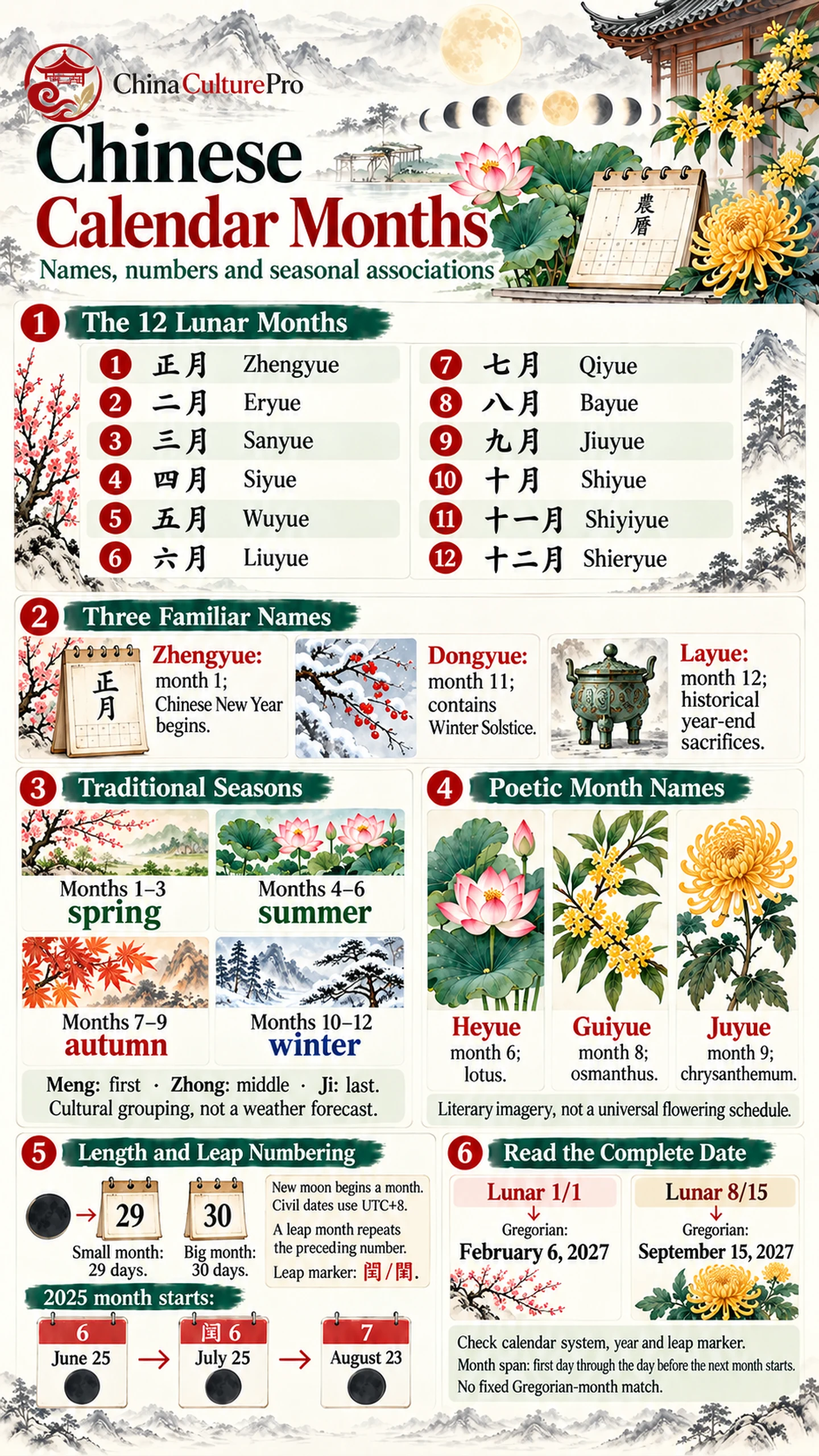
A calendar may give its eleventh lunar month a winter name, while an inscription uses a flower to name a month. Neither is a Gregorian month name. This guide explains the labels, numbering and seasonal associations used in the Chinese lunar calendar (农历, nónglì), so you can recognize what a date actually means.
The 12 Chinese Calendar Months: Names and Numbering
In ordinary modern Chinese, numbered month names usually refer to Gregorian dates unless the context says otherwise. For a traditional date, look for a lunar-calendar label or other clear context before interpreting the number. The names below all refer to lunar months.
| Number | Month name: Chinese and pronunciation | English reading |
|---|---|---|
| 1 | Zhengyue (正月, zhēngyuè) | First lunar month |
| 2 | Eryue (二月, èryuè) | Second lunar month |
| 3 | Sanyue (三月, sānyuè) | Third lunar month |
| 4 | Siyue (四月, sìyuè) | Fourth lunar month |
| 5 | Wuyue (五月, wǔyuè) | Fifth lunar month |
| 6 | Liuyue (六月, liùyuè) | Sixth lunar month |
| 7 | Qiyue (七月, qīyuè) | Seventh lunar month |
| 8 | Bayue (八月, bāyuè) | Eighth lunar month |
| 9 | Jiuyue (九月, jiǔyuè) | Ninth lunar month |
| 10 | Shiyue (十月, shíyuè) | Tenth lunar month |
| 11 | Shiyiyue (十一月, shíyīyuè), also Dongyue | Eleventh lunar month |
| 12 | Shieryue (十二月, shí’èryuè), also Layue | Twelfth lunar month |
The English labels identify position in the lunar year, not a translation into January through December. Eleven and twelve have ordinary numeric names as well as their familiar special names; winter and year-end labels do not create extra months.[3][4][11]
Why Zhengyue, Dongyue and Layue Have Special Names
These three conventional names are especially useful around the beginning and end of a lunar year. Each belongs to a particular month, but its cultural associations need a little context.
- Zhengyue: This is the first lunar month and the month in which Chinese New Year begins. In this word, 正 is pronounced zhēng, with a level first tone, rather than the more familiar zhèng. The name labels the whole month, not just New Year’s Day.[2]
- Dongyue: Literally “winter month,” this means the eleventh lunar month. Under modern calendar rules, the month containing the Winter Solstice (冬至, Dōngzhì) is numbered eleven. That rule explains an important seasonal connection without making Dongyue equivalent to Gregorian December.[3][11]
- Layue: This is the twelfth lunar month. Its name is associated with historical year-end la sacrifices, rather than being named after cured meat. The Laba Festival (腊八节, Làbā Jié), on its eighth day, is one familiar date within it.[4]
Seasonal Associations and Poetic Month Names
One traditional way to describe the ordinary twelve-month sequence groups months one to three as spring, four to six as summer, seven to nine as autumn, and ten to twelve as winter. The Book of Rites (礼记, Lǐjì), in its “Monthly Ordinances” (月令, Yuèlìng) chapter, organizes its seasonal material into first, middle and last months of each season.[5]
Within this naming pattern, Meng (孟, mèng) marks the first month, Zhong (仲, zhòng) the middle month, and Ji (季, jì) the last. The following table is a guide to traditional wording, not a modern weather calendar.
| Traditional season | Lunar months | First, middle and last month labels |
|---|---|---|
| Spring | 1–3 | Early spring (孟春, mèngchūn); mid-spring (仲春, zhòngchūn); late spring (季春, jìchūn) |
| Summer | 4–6 | Early summer (孟夏, mèngxià); midsummer (仲夏, zhòngxià); late summer (季夏, jìxià) |
| Autumn | 7–9 | Early autumn (孟秋, mèngqiū); mid-autumn (仲秋, zhòngqiū); late autumn (季秋, jìqiū) |
| Winter | 10–12 | Early winter (孟冬, mèngdōng); midwinter (仲冬, zhòngdōng); late winter (季冬, jìdōng) |
These month-based groupings do not have exactly the same boundaries as the solar terms (节气, jiéqì), which follow the Sun’s position. They also do not determine when a particular region becomes warm or cold. An inserted month repeats an existing number rather than creating a fourth label in this first–middle–last sequence.[1][11]
Literary and traditional aliases offer another way to evoke the time of year:
- Heyue (荷月, héyuè): The sixth lunar month, associated with lotus flowers.[6]
- Guiyue (桂月, guìyuè): The eighth lunar month, associated with osmanthus blossoms.[7]
- Juyue (菊月, júyuè): The ninth lunar month, associated with chrysanthemums.[8]
These are useful clues in poetry or a painting’s inscription, rather than a universal official list of twelve flower months. They evoke seasonal imagery without promising that the same flowers bloom everywhere at once. Context still matters: Guiyue can also refer to the Moon itself, so the surrounding words must support a month reading.[7]
Month Lengths and Leap-Month Numbering
A lunar month starts on the civil day containing shuo (朔, shuò), the astronomical new moon, when the Sun and Moon have the same apparent ecliptic longitude. Visibility of a thin crescent is not the test. Modern Chinese calendar dates use UTC+8 to determine the civil day.[1][11]
A big month (大月, dàyuè) has 30 days; a small month (小月, xiǎoyuè) has 29. Their lengths come from the calculated month boundaries, so you cannot assume that big and small months alternate in a fixed pattern.[11]
A leap month (闰月, rùnyuè) adds a whole month while repeating the preceding number. It is marked 闰 in simplified Chinese or 閏 in traditional Chinese. Later months keep their usual numbers. The 2025 sequence shows how this works:[9][11]
- Ordinary sixth month, day one: June 25, 2025.
- Leap sixth month, day one: July 25, 2025.
- Seventh month, day one: August 23, 2025.
The inserted month is neither Gregorian June repeated nor a newly named “month thirteen.” Keep the leap marker when copying a date: ordinary sixth month and leap sixth month identify different parts of the same lunar year.
How to Read a Lunar Month on a Gregorian Calendar
Use the full year and the calendar label when comparing dates. The same lunar month and day can fall on different Gregorian dates in different years. These two examples use the 2027 conversion table:[10]
- Lunar month one, day one: February 6, 2027, in the Gregorian calendar.
- Lunar month eight, day fifteen: September 15, 2027, in the Gregorian calendar—the date of the Mid-Autumn Festival that year.
For a date you encounter elsewhere, check these details before looking it up:
- Calendar system: Does the record identify the date as lunar or Gregorian? A bare month number may be ambiguous.
- Year: Which lunar year belongs to the date? Gregorian January or February can still contain the end of the preceding lunar year.
- Leap marker: If a number occurs twice, does the record specify the ordinary month or its leap counterpart?
Then find the complete date in that year’s conversion table. To identify a month’s full span, find its first day and the next month’s first day; the earlier month ends the day before the latter. Check the following Gregorian year’s table if the interval crosses December 31.
There is no reliable shortcut based on always subtracting eleven days or assuming a fixed one-month difference. Astronomical calendar calculations are possible, but a published annual table is a simpler way to resolve the date accurately.[1][10]
FAQs About Chinese Calendar Months
Is the first lunar month the same as January?
No. Zhengyue is the first month of the Chinese lunisolar year; January is the first Gregorian month. Their boundaries differ. Always include the year when finding the Gregorian dates of a lunar month.
Do all Chinese lunar months have 30 days?
No. Lunar months have either 29 or 30 days, never 31. On a traditional calendar, 大 means a 30-day month and 小 means a 29-day month. The length of a numbered month can change between years.[11]
Are poetic month names official calendar names?
They are literary or traditional aliases, rather than the numeric labels used to organize the calendar. They can appear in inscriptions and other cultural writing. Use the context to identify the month; for an unambiguous date, keep its year, number and any leap marker.
Are Chinese zodiac months the same as lunar months?
Not necessarily. The Earthly Branches (地支, dìzhī) can label months under different conventions. Some systems connect them to lunar months; some astrology charts use months bounded by solar terms. Check the convention before equating an animal-month label with a numbered lunar month.[12]
Sources
[1] Hong Kong Observatory. Calendar: The Chinese Agricultural Calendar
[2] Ministry of Education, Taiwan. Revised Mandarin Chinese Dictionary: Zhengyue
[3] Ministry of Education, Taiwan. Revised Mandarin Chinese Dictionary: Dongyue
[4] Ministry of Education, Taiwan. Revised Mandarin Chinese Dictionary: Layue
[5] Book of Rites. Monthly Ordinances
[6] Ministry of Education, Taiwan. Revised Mandarin Chinese Dictionary: Heyue
[7] Ministry of Education, Taiwan. Revised Mandarin Chinese Dictionary: Guiyue
[8] Ministry of Education, Taiwan. Revised Mandarin Chinese Dictionary: Juyue
[9] Hong Kong Observatory. Gregorian–Lunar Calendar Conversion Table of 2025
[10] Hong Kong Observatory. Gregorian–Lunar Calendar Conversion Table of 2027
[11] Standardization Administration of China. GB/T 33661-2017: Calculation and Promulgation of the Chinese Calendar
[12] East China Normal University. Astronomical Geography Teaching Research: Traditional Calendars and Gan-Zhi Timekeeping