

Quick Answer: What Is Lichun?
Lichun (立春, Lìchūn), or Start of Spring, is conventionally the first of the twenty-four solar terms (节气, jiéqì). It begins when the Sun’s apparent ecliptic longitude reaches 315°, a position calculated as Earth travels around the Sun.[1]
- Timing: Lichun falls in early February and follows the Sun’s position, rather than a fixed lunar month and day.
- Meaning: It expresses renewal, the start of the traditional spring season and preparation for agricultural work.
- Customs: Welcoming ceremonies, symbolic ox figures and seasonal foods give the occasion its cultural character; practices differ by place.[2]
Lichun is distinct from Chinese New Year (春节, Chūnjié) and from the arrival of warm weather across China.
A calendar can announce Lichun (立春, Lìchūn) while the air outside still feels wintry. The name marks a traditional seasonal turning point, rather than a promise of immediate warmth. Our Chinese lunar calendar (农历, nónglì) overview explains the wider framework; here, the focus is Lichun’s dates, cultural meaning and regional customs.
When Is Lichun?
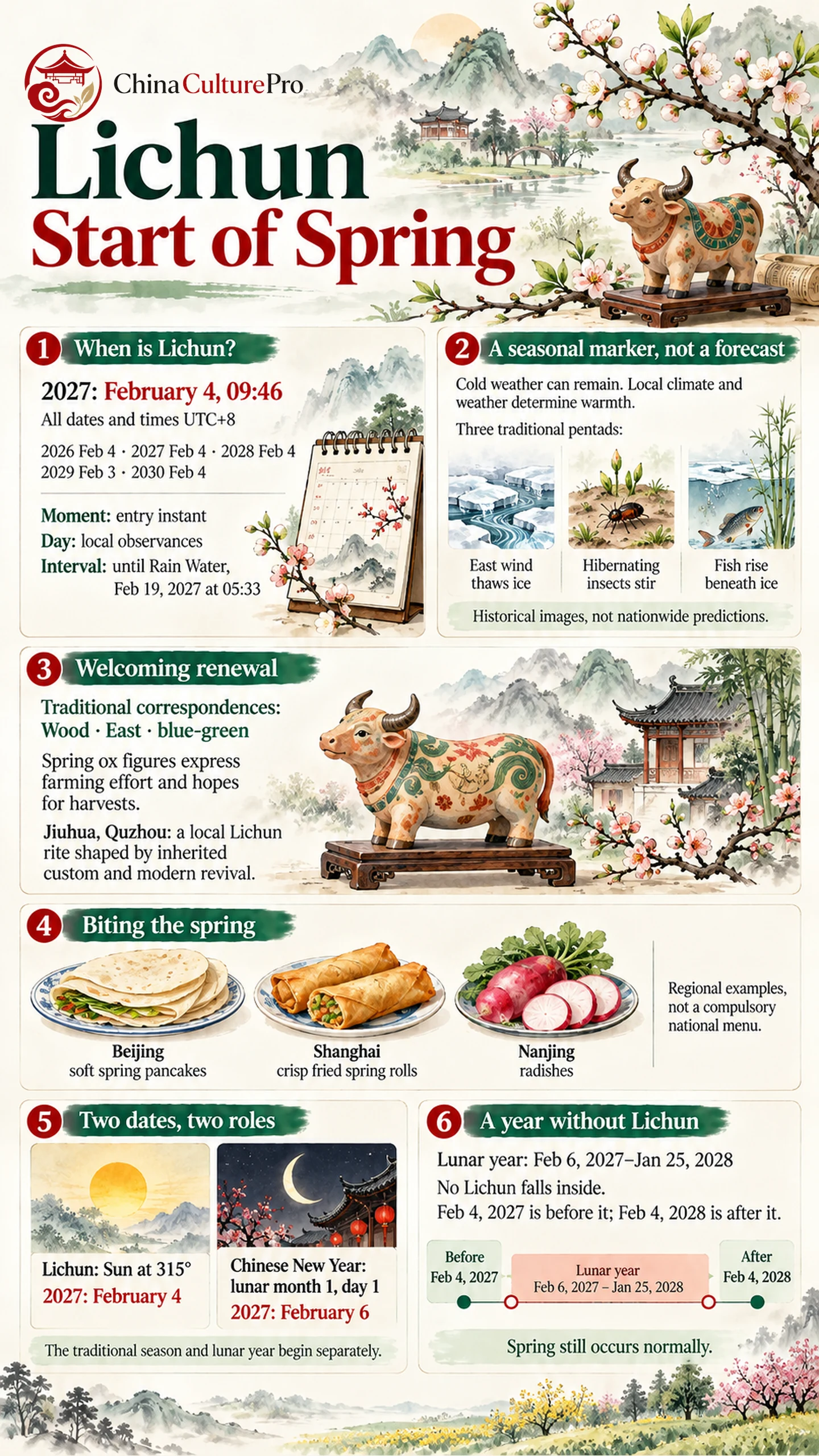
The next Lichun begins on February 4, 2027, at 09:46 in UTC+8, the time used in mainland China and Hong Kong. The date stays near early February because solar terms follow the Sun’s annual progress. It is not permanently February 4.[3]
| Year | Lichun date, UTC+8 |
|---|---|
| 2026 | February 4 |
| 2027 | February 4 |
| 2028 | February 4 |
| 2029 | February 3 |
| 2030 | February 4 |
The dates above follow the annual conversion tables.[4] For comparison, the 2026 entry instant was February 4 at 04:02, while the 2028 instant is February 4 at 15:31, all in UTC+8.[3]
Three uses of “Lichun” need separating: the astronomical instant of entry, the calendar day associated with observances, and the approximately fifteen-day seasonal interval. In 2027, that interval continues until Rain Water (雨水, Yǔshuǐ) begins on February 19 at 05:33, UTC+8.[3]
Overseas calendars may show a different civil date for the same instant. Convert the time zone rather than assuming the Chinese date applies everywhere. A festival program’s dates must be checked separately from the astronomical entry time.
Does Lichun Mean Spring Weather Has Arrived?
No. Lichun starts spring in the traditional solar-term framework, while local warmth depends on latitude, regional climate and current weather. Much of China can remain cold at this point; milder conditions arrive earlier in some southern areas.[5]
Seasonal temperature changes also lag behind changes in sunlight because warming and cooling depend on the accumulated heat balance.[6] Increasing daylight does not switch off cold-air outbreaks. Lichun therefore cannot tell every farmer to sow, or every visitor to expect blossoms, on the same day.
This is also different from the Spring Equinox (春分, Chūnfēn), the March solar marker used to begin spring in the equinox-based convention. Chinese descriptions instead divide Lichun into three pentads (三候, sānhòu), traditionally about five days each:[7]
- East wind thaws the ice: 东风解冻 (dōng fēng jiě dòng) describes frozen ground and ice beginning to soften.
- Hibernating insects stir: 蛰虫始振 (zhé chóng shǐ zhèn) pictures hidden insects beginning to move, without necessarily emerging fully.
- Fish rise beneath the ice: 鱼陟负冰 (yú zhì fù bīng) pictures fish approaching the surface below remaining ice, not literally carrying it.
These are historical observations and literary images. They are not a nationwide timetable predicting identical conditions in every region.[7]
Cultural Meaning: Renewal, Farming and Welcoming Spring
Lichun’s central cultural theme is renewed growth and readiness for work. In traditional Wuxing (五行, wǔxíng) correspondences, spring connects with the Wood phase (木, mù), the east and qing (青, qīng), a historical color category covering blue and green. These are cultural classifications, not instructions about which colors everyone must wear.[8]
Welcoming spring (迎春, yíngchūn) gave seasonal change a public form. Classical court ritual texts describe rulers receiving the season in the eastern outskirts. Those descriptions present a ceremonial ideal; they should not be treated as proof that every community performed one identical rite.[8]
The spring ox (春牛, chūnniú) made the agricultural message visible. Ceremonies used an ox figure, made from materials such as earth or a covered frame, and could include symbolically striking it. The action encouraged diligence and expressed hopes for a plentiful harvest. Materials and performance varied locally.[2]
A specific surviving example is the Lichun rite at Waichen Village in Jiuhua, Quzhou, Zhejiang. It centers on a local temple associated with Goumang (句芒, Gōumáng), a traditional spring and Wood deity. The Jiuhua Lichun rite entered the national intangible-cultural-heritage extension list in 2011.[9]
The festival documented there in 2012 was shaped by modern restoration and revival as well as inherited custom. It is a living local tradition shaped by both continuity and revival.[8]
Biting the Spring: Pancakes, Spring Rolls and Radishes
Biting the spring (咬春, yǎochūn) means welcoming the season through food. The name describes a cultural act, not a single compulsory dish. A spring plate (春盘, chūnpán) historically brought together vegetables and other foods to greet the season; its contents changed with place and period.[10]
Three examples show the range of foods associated with Lichun:[5]
| Food | Regional example | What distinguishes it |
|---|---|---|
| Spring pancakes (春饼, chūnbǐng) | Beijing and other northern areas | Thin, soft wheat pancakes wrapped around vegetables, sometimes with meat or egg |
| Spring rolls (春卷, chūnjuǎn) | Shanghai | Filled rolls with a crisp fried wrapper; fillings differ locally |
| Radishes | Nanjing | Eating radish is one local way to “bite” the new season |
The contrast is not simply “pancakes in the north, rolls in the south.” Northern places such as Boshan in Shandong also have their own spring-roll traditions. Nanjing’s radish custom likewise shows why foods should be attached to particular communities, rather than assigned exclusively to half the country.[5]
At a meal, the soft pancake and crisp fried roll are different foods, even when English menus use similar spring-related names. Neither requires one nationwide filling. The shared meaning is greeting fresh growth through eating together; the foods carry no guaranteed medicinal or protective effect.
Lichun and Chinese New Year: Different Dates, Different Roles
Lichun begins a traditional season; Chinese New Year begins a lunar calendar year. Their proximity can make them seem interchangeable, especially when seasonal foods and New Year preparations overlap. Their dates are determined differently.[11]
| Comparison | Lichun | Chinese New Year |
|---|---|---|
| Date rule | Sun reaches 315° ecliptic longitude | First day of lunar month 1 |
| Main calendar role | Opens traditional spring | Opens the lunar calendar year |
| Date in 2027, UTC+8 | February 4 | February 6 |
The 2027 dates are two days apart.[3][4] Neither event cancels the other, and Lichun does not reset the lunar month to day 1. The wider calendar is lunisolar: its lunar dates and solar seasonal markers coexist. The comparison here concerns their calendar roles, rather than the full New Year celebration.
Why Can a Lunar Year Have Two Lichuns—or None?
Double spring (双春, shuāngchūn) means that two Lichun entry dates fall inside one lunar year. A year without spring (无春年, wúchūnnián) contains none. These names count calendar markers between successive Chinese New Years, not actual seasons.
The lunar year beginning February 6, 2027, ends January 25, 2028. Lichun on February 4, 2027, falls before it; the next Lichun, on February 4, 2028, falls after it. Comparing those dates shows why that lunar year contains no Lichun.[4]
Spring still occurs normally. The label does not predict marriage outcomes, harvests or personal fortune.
FAQs About Lichun
Is Lichun always on February 4?
No. Its civil date varies with the year and time zone. The UTC+8 date is February 3 in 2029, for example. Check the year’s calendar rather than storing February 4 as a permanent rule.[4]
Does the Chinese zodiac year begin at Lichun or Chinese New Year?
Ordinary Chinese zodiac (生肖, shēngxiào) animal-year identification uses Chinese New Year. Some astrological conventions, including Four Pillars (八字, bāzì), use Lichun’s entry instant instead. Our Chinese zodiac overview follows the ordinary New Year boundary.[11]
Can eggs stand upright only on Lichun?
No. Eggs can balance on other dates when their center of gravity rests over a suitable base. The solar term creates no special gravitational window. The game’s association with early spring should not be confused with the March equinox.[12]
Is Lichun a public holiday in China?
Lichun is not a nationwide statutory public holiday in mainland China. Its cultural importance does not create an automatic day off. Any overlap with New Year leave or a local event is a separate matter.[13]
Sources
[1] Hong Kong Observatory. The 24 Solar Terms
[2] China Intangible Cultural Heritage Network. The Twenty-Four Solar Terms: Lichun
[3] Hong Kong Observatory. Date and Time of the 24 Solar Terms
[4] Hong Kong Observatory. Gregorian–Lunar Calendar Conversion Table, 1901–2100
[5] China Weather. Biting the Spring: A Map of Lichun Foods
[6] NOAA NESDIS. NOAA Satellites View 2023 Summer and Winter Solstices
[7] Wu Cheng. Yueling Qishierhou Jijie
[8] Wang Xiaobing. Heritagization, Authenticity and Transmission: A Study of the Jiuhua Lichun Rite
[9] China Intangible Cultural Heritage Network. Jiuhua Lichun Rite
[10] Shanghai Civil Affairs Bureau. Tracing Traditional New Year Foods
[11] Hong Kong Observatory. What Year Is It Today?
[12] Exploratorium. Egg-Quinox Challenge
[13] Ministry of Justice. National Measures on Holidays for Annual Festivals and Commemorative Days