


Quick Answer: How Did Traditional Chinese Timekeeping Work?
Traditional Chinese timekeeping used several overlapping divisions of the day. Three are especially useful when reading historical labels:
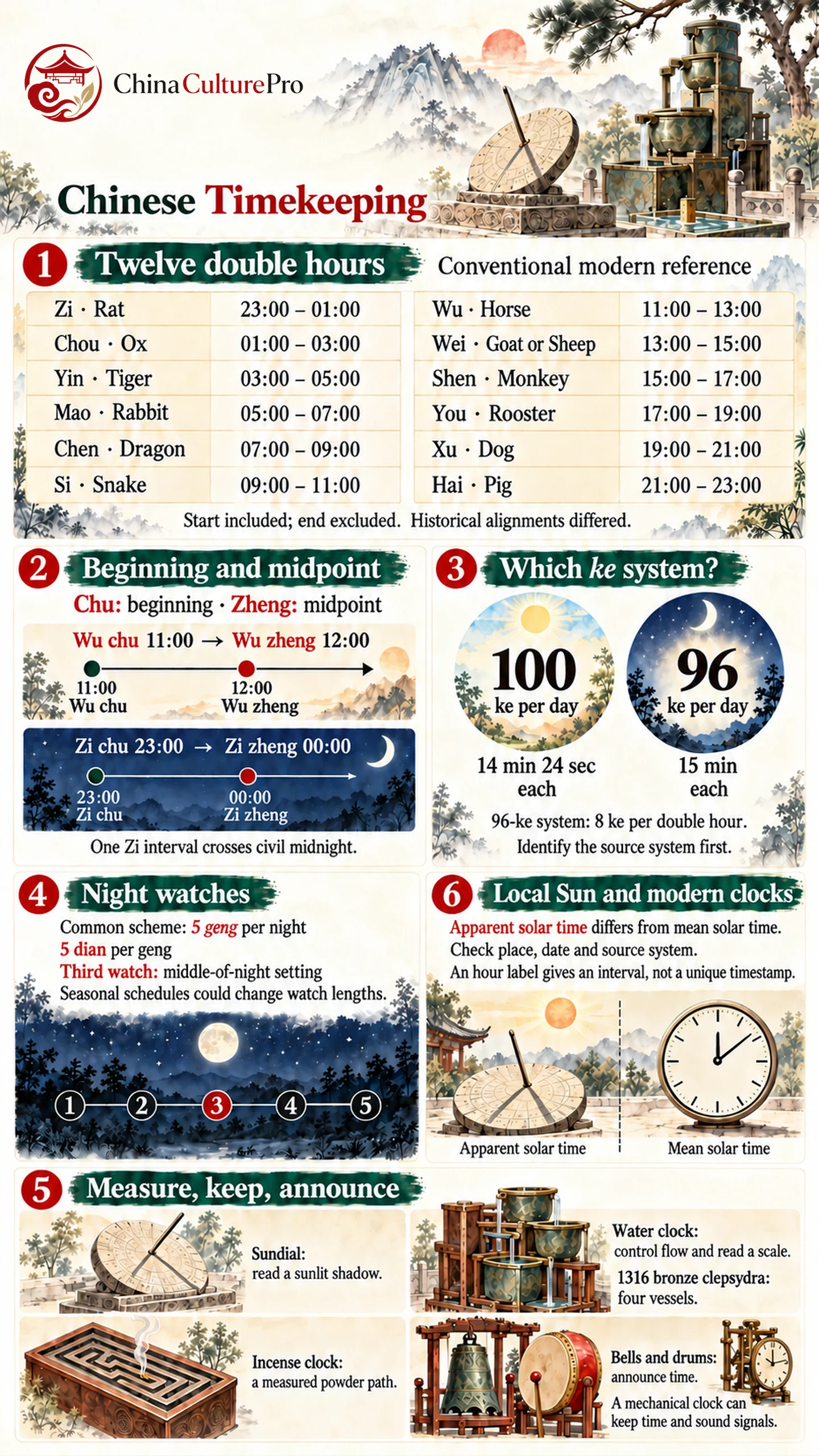
- Double hours: The twelve shichen (时辰, shíchén) divide a day and night into twelve periods, conventionally matched to two modern hours each.
- Finer divisions: A ke (刻, kè) marks a smaller interval. Its historical length depends on the system being used.
- Night watches: Geng (更, gēng) divide the night, with dian (点, diǎn) providing subdivisions within a watch.[1][4][5]
Modern clock equivalents help readers identify these terms. An exact historical conversion also depends on the period, place and time standard.
A historical drama may announce a midnight hour, a novel may mention the third night watch, and a museum label may describe a hundred-part day. These expressions belong to related but different systems. This guide explains traditional Chinese timekeeping; the broader Chinese lunar calendar guide covers the calendar in which many such labels appear.
The Twelve Double Hours: Names and Modern Clock Times
The double hours take their names from the twelve Earthly Branches (地支, dìzhī). The table gives the conventional modern reading, with the associated animals as recognition aids. Each range includes its starting time and excludes its ending time.[1]
| Double hour: name, Chinese and pinyin | Modern clock interval | Animal label |
|---|---|---|
| Zi hour (子, zǐ) | 23:00–01:00 | Rat |
| Chou hour (丑, chǒu) | 01:00–03:00 | Ox |
| Yin hour (寅, yín) | 03:00–05:00 | Tiger |
| Mao hour (卯, mǎo) | 05:00–07:00 | Rabbit |
| Chen hour (辰, chén) | 07:00–09:00 | Dragon |
| Si hour (巳, sì) | 09:00–11:00 | Snake |
| Wu hour (午, wǔ) | 11:00–13:00 | Horse |
| Wei hour (未, wèi) | 13:00–15:00 | Goat or Sheep |
| Shen hour (申, shēn) | 15:00–17:00 | Monkey |
| You hour (酉, yǒu) | 17:00–19:00 | Rooster |
| Xu hour (戌, xū) | 19:00–21:00 | Dog |
| Hai hour (亥, hài) | 21:00–23:00 | Pig |
Thus 01:00 belongs to Chou, and 23:00 begins Zi. Writing a range as 23:00–00:59 is another common display convention, but it should include all the seconds within the final minute. There is no gap before 01:00.
These are time-of-day labels. The same animals appear in the Chinese zodiac, but an hour’s branch and a birth year’s animal identify different parts of the calendar. Being born during Rat time does not by itself make someone a Rat-year person.[1]
The table also needs a historical boundary. A study of official chronicle data identified a Song-dynasty convention in which the first double hour began at midnight rather than 23:00. The familiar mapping is therefore a reading aid, not proof that every surviving text used the same alignment.[2]
Chu, Zheng and the Midnight Boundary
In the conventional reading used here, chu (初, chū) marks the beginning of a double hour, while zheng (正, zhèng) marks its midpoint. Each double hour consequently has two one-hour halves. These labels locate a reading within the double hour.[11]
Two examples make the distinction clear:
- Around noon: Wu chu marks 11:00; Wu zheng marks 12:00, halfway through the 11:00–13:00 interval.
- Around midnight: Zi chu marks 23:00; Zi zheng marks 00:00, halfway through the continuous 23:00–01:00 interval.[11]
The second example separates an hour label from a date boundary. At 23:30 and the following 00:30, the branch is still Zi, yet the modern civil date has changed at midnight. Moving into the next double hour and moving into the next date are different events.
For an actual historical record, retain the source’s calendar convention. An hour table alone cannot decide which date a writer intended, nor does the start of Zi establish a universal 23:00 date change. Historical calendrical practice and the rules adopted by a particular divination system should be identified separately.[2]
Ke and Geng: Smaller Units and Night Watches
A double hour identifies a broad part of the day. Finer graduations and night-watch counts answer different questions, so their numerical values need their own definitions.
Ke: Why a Quarter Hour Is Not Always Historical
A ke was a graduation of time, often used alongside the double hours. It need not be understood as a subdivision originally derived from a shichen. Two important systems illustrate the difference:[2][3]
- A hundred-ke day: Dividing a nominal twenty-four-hour day into 100 equal parts gives 14 minutes 24 seconds per ke. One double hour contains eight and one-third of these units.
- A ninety-six-ke day: Dividing the same day into 96 equal parts gives fifteen minutes per ke, with exactly eight ke in each double hour.[11]
The hundred-ke arrangement could coexist with twelve double hours; its fractions made conversion less convenient, rather than making the system impossible. The ninety-six-ke arrangement provides the clean quarter-hour relationship familiar today.
These examples are not an exhaustive history of every scheme. Before assigning minutes to an old record, establish which unit the document uses. The smaller historical unit fen (分, fēn) also varied in definition, so its name alone does not establish a modern sixty-second minute.[2]
Geng and Dian: Dividing the Night
In a common night-watch arrangement, the night was divided into five geng, each subdivided into five dian. Here dian belongs to the watch-counting system; it should not be read as the modern hour label in an expression such as “three o’clock.”[4][5]
The phrase sangeng banye (三更半夜, sāngēng bànyè), roughly “in the middle of the night,” reflects the third watch’s position in that sequence. It identifies a nighttime setting without automatically supplying an exact modern minute.[5]
Watch length was not universally fixed at two modern hours. In seasonally adjusted arrangements, the changing length of the night affected the watch schedule. A surviving Qing palace watch clock provides a concrete example: its mechanisms adjusted the beginning, end and intervals of nighttime striking to the seasonal night length.[6]
That clock also distinguishes keeping time from announcing it. Its separate systems handled ordinary time, hour and quarter-hour striking, and night-watch signals. Its separate daytime and nighttime signals show how one instrument could support different reporting schedules.[6]
Sundials, Water Clocks and Public Time Signals
Timekeeping involved observation, the maintenance of an interval, and communication. Different instruments could support different parts of that work. A city’s audible signal need not have been the device that originally measured the time.
| Instrument or system | How it worked | What the reader should distinguish |
|---|---|---|
| Sundial (日晷, rìguǐ) | Read a shadow against a prepared scale. | Solar observation required suitable sunlight and setup.[8] |
| Clepsydra (漏刻, lòukè), or water clock | Used controlled water flow and a graduated indicator. | Could maintain a time indication without sunlight; flow control and calibration mattered.[7][8] |
| Incense clock (香钟, xiāngzhōng) | Measured progress along a prepared burning path. | A designed duration belongs to a particular instrument, not to every stick of incense.[9] |
| Mechanical watch clock | Used a clock mechanism to maintain time and operate striking systems. | A single instrument could combine timekeeping and public signals.[6] |
A bronze water clock cast in Guangzhou in 1316 makes the water-flow principle tangible. Four vessels supplied water downward in stages. The receiving vessel’s rising water lifted a wooden float and indicator, whose position could be read against a graduated scale. The multi-vessel arrangement helped regulate the supply. The object is now in the National Museum of China collection.[7]
Sundials and water clocks could also work together. Solar observations could check or calibrate a water clock whose flow introduced errors. Their relationship was complementary: a shadow reading established an astronomical reference, while controlled flow sustained an indication between observations.[8]
The incense-clock example is different again. One surviving Chinese clock uses powdered incense laid along a stencil-defined path, rather than an ordinary incense stick. Different stencils represent different durations. Burning-path design explains the measured interval; the bare phrase “one stick of incense” supplies no universal number of minutes.[9]
Bells and drums belonged to the public-announcement side of this system. Their sounds made a time signal available beyond the person reading a scale. A drumbeat announced a time; a graduated scale or clock mechanism supplied the reading behind it.[6][8]
Local Solar Time vs Modern Clock Time
The table above translates conventional time labels, not every historical moment into present-day Beijing time. Solar observation is local: places at different longitudes reach their local solar noon at different moments. A modern zone clock instead supplies a shared time standard across its designated area.[10]
There is another distinction within solar time itself. Apparent solar time follows the observed Sun, whose motion does not provide a perfectly uniform timescale. Mean solar time corrects for those variations. A sundial reading and a uniform clock reading therefore need not agree exactly, even at the same place.[10]
For a historical timestamp, retain three pieces of context: the location, the date, and the time system used by the source. The date may itself need calendar conversion before astronomical comparisons become possible. If a record supplies only a double-hour name, it describes an interval rather than a unique instant. Even a finer-looking expression requires its unit and starting convention to be established.[2][10]
FAQs About Traditional Chinese Timekeeping
Was a ke always fifteen minutes?
No. A hundred equal ke in a twenty-four-hour day gives 14 minutes 24 seconds each. A ninety-six-ke division gives fifteen minutes. Identify the source’s system before converting the unit.
Does Zi hour mean the date has already changed?
No. In the familiar mapping, Zi spans 23:00–01:00, crossing the modern midnight date boundary. Its branch label alone does not say which date a historical or interpretive system assigns to the moment.
What does wushi sanke mean?
Wushi sanke (午时三刻, wǔshí sānkè) needs a stated counting convention. If three fifteen-minute ke have elapsed from Wu chu at 11:00, the result is 11:45. From Wu zheng at 12:00, it is 12:45. These are conditional examples, not one universal translation of an unspecified historical phrase.
Are double hours still used in China today?
Modern everyday clocks use hours and minutes. Double-hour language remains useful for traditional calendars, historical writing and cultural references. It helps explain an old label without replacing the modern civil clock.
Sources
[1] Hong Kong Observatory. Heavenly Stems and Earthly Branches
[2] Sôma, M., Kawabata, K. and Tanikawa, K.. Units of Time in Ancient China and Japan
[3] Taiwan Ministry of Education. Ke: historical and modern definitions
[4] Taiwan Ministry of Education. Dian: timekeeping meanings
[5] Taiwan Ministry of Education. Geng: night-watch meaning
[6] The Palace Museum. Tower-Style Clock with Hour, Quarter-Hour and Night-Watch Signals
[7] National Museum of China. Bronze Water Clock
[8] National Museum of China. Sundial
[9] Science Museum Group. Chinese Incense Clock
[10] Hong Kong Observatory. Universal Time and Greenwich Mean Time
[11] National Astronomical Observatory of Japan. Equal and Unequal Time Systems