
Quick Answer: What Are Heavenly Stems and Earthly Branches?
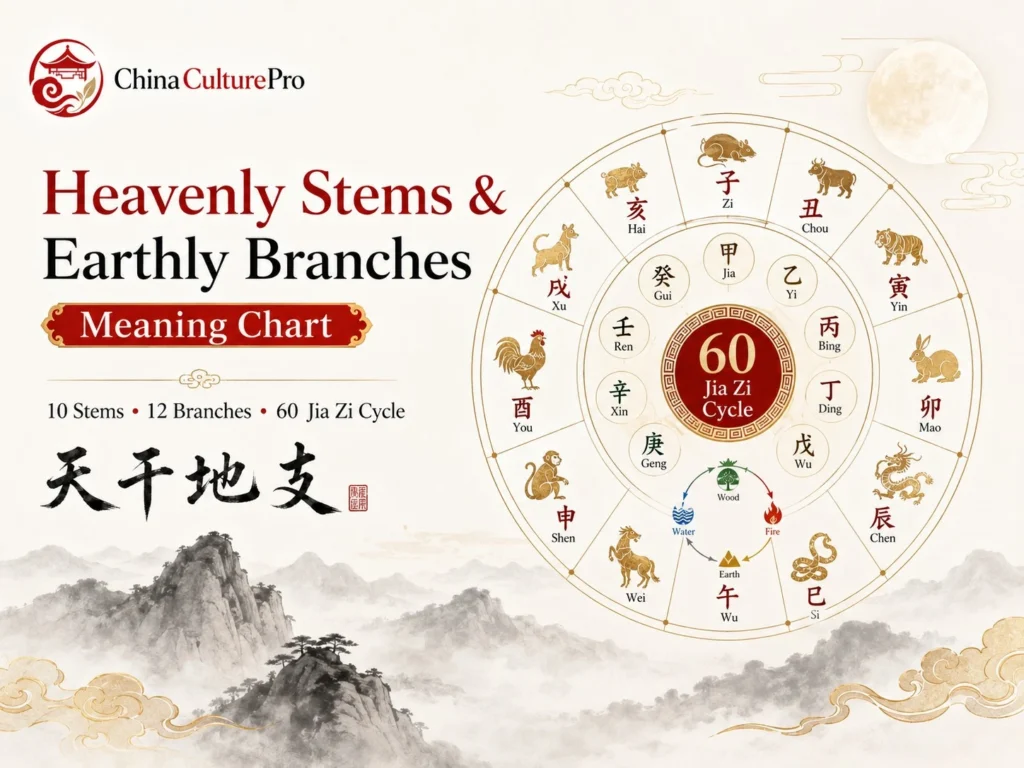
Heavenly Stems and Earthly Branches are the basic time language of the traditional Chinese calendar, Chinese zodiac, BaZi, and Chinese metaphysics. In Chinese, they are called Tian Gan Di Zhi (天干地支), often shortened to Gan Zhi (干支).
The system has 10 Heavenly Stems and 12 Earthly Branches.
The 10 Heavenly Stems are Jia, Yi, Bing, Ding, Wu, Ji, Geng, Xin, Ren, and Gui. They carry Five Elements and Yin-Yang qualities.
The 12 Earthly Branches are Zi, Chou, Yin, Mao, Chen, Si, Wu, Wei, Shen, You, Xu, and Hai. They connect with the 12 Chinese zodiac animals, months, double-hours, directions, hidden stems, and branch relationships.
One Heavenly Stem plus one Earthly Branch forms one stem-branch pair, such as Jia Zi (甲子), Yi Chou (乙丑), or Bing Wu (丙午). These pairs rotate in order and form the 60 Jia Zi cycle, also called the Sexagenary Cycle.
This system is the foundation behind Chinese Zodiac, Five Elements Chinese Zodiac, Na Yin, Ben Ming Nian, Tai Sui, Fan Tai Sui, and BaZi Four Pillars.
| Item | Detail |
|---|---|
| Main Topic | Heavenly Stems and Earthly Branches |
| Chinese Term | Gan Zhi / 干支 |
| Heavenly Stems | 10 stems |
| Earthly Branches | 12 branches |
| Core Logic | One stem + one branch |
| Full Cycle | 60 combinations |
| Used In | Calendar, zodiac, Five Elements zodiac, Na Yin, Tai Sui, BaZi |
| Important Limit | Not the same as the 12 zodiac animals alone |
Key Point: Heavenly Stems and Earthly Branches are not only ancient calendar symbols. They are the underlying structure that gives Chinese time its Five Elements, Yin-Yang, zodiac animals, hidden roots, and repeating 60-year cycle.
What Do the Heavenly Stems Mean?
Heavenly Stems are the “Heaven” layer of Gan Zhi. They describe visible qi, outer expression, Five Elements, and Yin-Yang movement.
There are 10 Heavenly Stems. Every two stems share one element: one Yang and one Yin.
| Stem | Chinese | Element | Yin/Yang | Reading Direction |
|---|---|---|---|---|
| Jia | 甲 | Wood | Yang | Big tree, upright growth |
| Yi | 乙 | Wood | Yin | Vine, grass, flexible growth |
| Bing | 丙 | Fire | Yang | Sun, bright fire |
| Ding | 丁 | Fire | Yin | Lamp, candle, refined fire |
| Wu | 戊 | Earth | Yang | Mountain earth |
| Ji | 己 | Earth | Yin | Field soil |
| Geng | 庚 | Metal | Yang | Axe, raw metal, hard edge |
| Xin | 辛 | Metal | Yin | Jewelry, refined metal |
| Ren | 壬 | Water | Yang | River, ocean, great water |
| Gui | 癸 | Water | Yin | Rain, dew, subtle water |
The Heavenly Stems are not abstract letters. They are ten kinds of visible qi.
Jia is like a tall tree rising upright. Yi is like vine, grass, or flexible plant growth. Bing is like the sun shining outward. Ding is like a lamp or candle burning with refined light. Wu is like a mountain. Ji is like cultivated field soil. Geng is like an axe or raw metal with a hard edge. Xin is like refined jewelry. Ren is like a great river or ocean. Gui is like rain, dew, or subtle water.
Yang stems tend to be more outward, active, broad, and direct. Yin stems tend to be more inward, refined, detailed, and subtle.
In BaZi, the Heavenly Stem of the Day Pillar is especially important. It is called the Day Stem or Day Master, and it represents the core self in a Four Pillars chart.
This page is not a full BaZi tutorial. The key point here is simple: the Heavenly Stem is the upper, visible qi of a stem-branch pair.
What Do the Earthly Branches Mean?
Earthly Branches are the “Earth” layer of Gan Zhi. They describe roots, space, seasonal anchors, time periods, zodiac animals, hidden stems, and branch relationships.
The 12 Chinese zodiac animals are the most familiar outer layer of the 12 Earthly Branches. Rat is Zi, Ox is Chou, Tiger is Yin, Rabbit is Mao, Dragon is Chen, Snake is Si, Horse is Wu, Goat is Wei, Monkey is Shen, Rooster is You, Dog is Xu, and Pig is Hai.
But an Earthly Branch is not only an animal sign. Each branch also connects with direction, season, double-hour, hidden stems, and relationships such as combinations, clashes, punishments, harms, and breaks.
| Branch | Chinese | Zodiac | Direction | Time | Basic Image |
|---|---|---|---|---|---|
| Zi | 子 | Rat | North | 11pm–1am | hidden water movement |
| Chou | 丑 | Ox | Northeast | 1am–3am | damp earth, storage |
| Yin | 寅 | Tiger | East-northeast | 3am–5am | wood rising |
| Mao | 卯 | Rabbit | East | 5am–7am | pure wood |
| Chen | 辰 | Dragon | Southeast | 7am–9am | wet earth, water storage |
| Si | 巳 | Snake | South-southeast | 9am–11am | fire rising |
| Wu | 午 | Horse | South | 11am–1pm | strong fire |
| Wei | 未 | Goat | Southwest | 1pm–3pm | dry earth, wood storage |
| Shen | 申 | Monkey | West-southwest | 3pm–5pm | metal movement |
| You | 酉 | Rooster | West | 5pm–7pm | pure metal |
| Xu | 戌 | Dog | Northwest | 7pm–9pm | dry earth, fire storage |
| Hai | 亥 | Pig | North-northwest | 9pm–11pm | deep water, wood birth |
Each Earthly Branch rules a two-hour period. Zi hour is 11pm to 1am, not midnight to 2am. This is why old Chinese time expressions such as Zi hour, Chou hour, and Wu hour are based on two-hour blocks.
The branch layer is also why Chinese zodiac reading becomes deeper than animal personality.
Xu is not only Dog; it is dry earth with fire storage. Hai is not only Pig; it carries deep water and hidden Wood. In traditional reading, these inner roots help explain why people born under the same animal can still feel very different.
Heavenly Stems vs Earthly Branches: What Is the Difference?
The difference between Heavenly Stems and Earthly Branches is not just “10 versus 12.” It is a difference in layer.
Heavenly Stems are more visible. Earthly Branches are more rooted.
Heavenly Stems carry Five Elements and Yin-Yang in a direct way. Earthly Branches carry zodiac animals, directions, time periods, hidden stems, and branch relationships.
| Layer | Heavenly Stems | Earthly Branches |
|---|---|---|
| Chinese | 天干 | 地支 |
| Symbolic Layer | Heaven qi | Earth root |
| Number | 10 | 12 |
| Main Associations | Five Elements, Yin-Yang | Zodiac, time, direction, hidden stems |
| Visibility | More visible | More hidden |
| In BaZi | Upper character of each pillar | Lower character of each pillar |
| Image | Branches and leaves above ground | Roots under the earth |
A Chinese cultural master might explain it this way: Heavenly Stems are like qi floating above; Earthly Branches are like roots planted below.
If you read only the stem, the qi has no root. If you read only the branch, the root does not show. A complete pillar needs both.
For example, Jia Zi (甲子) is not only Jia and not only Zi. Jia is Yang Wood, like a tall tree. Zi is the Rat branch and hidden water movement. Together, Jia Zi can be read as Yang Wood sitting on water. The stem shows what rises. The branch shows what supports it below.
This is why one pillar in BaZi, the calendar, or the 60 Jia Zi cycle must be read as an upper-lower structure. The stem and branch are not separate labels pasted together. They form one unit of time.
The 10 Heavenly Stems Chart
The chart below gives a simple lookup for the 10 Heavenly Stems.
| # | Stem | Pinyin | Chinese | Element | Yin/Yang | Image |
|---|---|---|---|---|---|---|
| 1 | Jia | jiǎ | 甲 | Wood | Yang | big tree |
| 2 | Yi | yǐ | 乙 | Wood | Yin | vine / grass |
| 3 | Bing | bǐng | 丙 | Fire | Yang | sun |
| 4 | Ding | dīng | 丁 | Fire | Yin | lamp / candle |
| 5 | Wu | wù | 戊 | Earth | Yang | mountain |
| 6 | Ji | jǐ | 己 | Earth | Yin | field soil |
| 7 | Geng | gēng | 庚 | Metal | Yang | axe / raw metal |
| 8 | Xin | xīn | 辛 | Metal | Yin | jewelry / refined metal |
| 9 | Ren | rén | 壬 | Water | Yang | river / ocean |
| 10 | Gui | guǐ | 癸 | Water | Yin | rain / dew |
Important note: the Heavenly Stem Wu (戊) is not the same as the Earthly Branch Wu (午). They are both written as “Wu” in English romanization, but they are different Chinese characters with different meanings.
- Wu (戊) = Yang Earth Heavenly Stem.
- Wu (午) = Horse Earthly Branch.
This distinction is important when reading 2026 Bing Wu, Five Elements Chinese Zodiac, BaZi, or Tai Sui.
The 12 Earthly Branches Chart
The chart below gives a simple lookup for the 12 Earthly Branches, their zodiac animals, directions, and traditional two-hour periods.
| # | Branch | Pinyin | Chinese | Zodiac Animal | Direction | Time |
|---|---|---|---|---|---|---|
| 1 | Zi | zǐ | 子 | Rat | North | 11pm–1am |
| 2 | Chou | chǒu | 丑 | Ox | Northeast | 1am–3am |
| 3 | Yin | yín | 寅 | Tiger | East-northeast | 3am–5am |
| 4 | Mao | mǎo | 卯 | Rabbit | East | 5am–7am |
| 5 | Chen | chén | 辰 | Dragon | Southeast | 7am–9am |
| 6 | Si | sì | 巳 | Snake | South-southeast | 9am–11am |
| 7 | Wu | wǔ | 午 | Horse | South | 11am–1pm |
| 8 | Wei | wèi | 未 | Goat | Southwest | 1pm–3pm |
| 9 | Shen | shēn | 申 | Monkey | West-southwest | 3pm–5pm |
| 10 | You | yǒu | 酉 | Rooster | West | 5pm–7pm |
| 11 | Xu | xū | 戌 | Dog | Northwest | 7pm–9pm |
| 12 | Hai | hài | 亥 | Pig | North-northwest | 9pm–11pm |
Earthly Branches are used for years, months, days, and hours. In popular Chinese zodiac reading, most people know them through the 12 animals. In traditional calendar and BaZi reading, however, each branch is also a time-space anchor with hidden qi inside it.
This is why “Horse year” is only the outer name. At a deeper Gan Zhi level, Horse year means a Wu branch year.
How the 60-Year Cycle Works
The 60-year cycle is formed by rotating the 10 Heavenly Stems and 12 Earthly Branches together.
The first pair is Jia Zi (甲子), or Yang Wood Rat. The second is Yi Chou (乙丑), or Yin Wood Ox. The third is Bing Yin (丙寅), or Yang Fire Tiger. The cycle continues until the 60th pair, Gui Hai (癸亥), or Yin Water Pig. After that, it returns to Jia Zi.
This is called the 60 Jia Zi cycle, or the Sexagenary Cycle.
| Order | Stem-Branch | Reading |
|---|---|---|
| 1 | Jia Zi | Yang Wood Rat |
| 2 | Yi Chou | Yin Wood Ox |
| 3 | Bing Yin | Yang Fire Tiger |
| 4 | Ding Mao | Yin Fire Rabbit |
| 5 | Wu Chen | Yang Earth Dragon |
| 6 | Ji Si | Yin Earth Snake |
| … | … | … |
| 60 | Gui Hai | Yin Water Pig |
A common question is: why 60, not 120?
There are 10 stems and 12 branches, so simple multiplication would give 120 possible pairs. But the traditional Gan Zhi system does not use every mathematical possibility.
Yang stems pair with Yang branches. Yin stems pair with Yin branches. This means half of the theoretical combinations do not appear in the standard cycle.
The 10 stems and 12 branches return to their starting point together after 60 steps because the least common multiple of 10 and 12 is 60.
This cycle is not only used for years. It can also be used for months, days, and hours in the traditional Chinese calendar. In BaZi, a complete birth chart contains four stem-branch pairs: year, month, day, and hour.
The 60 Jia Zi is not just a counting trick. It gives time Five Elements, Yin-Yang, zodiac animals, and later symbolic layers such as Na Yin and Tai Sui. When traditional Chinese culture says a certain year has a certain qi, that reading usually begins with this stem-branch foundation.
Heavenly Stems, Earthly Branches, and the Chinese Zodiac
The 12 Chinese zodiac animals come from the 12 Earthly Branches.
This means the zodiac animal is the popular animal layer of the branch system. It is useful, but it is not the whole system.
For example, “Year of the Horse” means a Wu branch year. But if we say “Fire Horse,” we are already adding the Heavenly Stem. In 2026, the stem-branch is Bing Wu. Bing is Yang Fire. Wu is the Horse branch. Together, they form Fire Horse in the Five Elements Chinese Zodiac system.
| Popular Term | Gan Zhi Reading | Connected Topic |
|---|---|---|
| Year of the Horse | Wu branch year | Chinese Zodiac |
| Fire Horse | Bing Wu | Five Elements Chinese Zodiac |
| Bing Wu / Ding Wei | Heavenly River Water | Na Yin |
| Horse in Horse year | Zhi Tai Sui / Ben Ming Nian | Tai Sui / Ben Ming Nian |
| Horse and Rat | Wu-Zi clash | Compatibility / Fan Tai Sui |
This one example shows why Gan Zhi is the foundation of the whole cluster.
The animal layer says Horse. The stem-branch layer says Bing Wu. The Five Elements zodiac layer says Fire Horse. The Na Yin layer says Heavenly River Water for the Bing Wu / Ding Wei pair. The Ben Ming Nian layer says Horse people meet their own branch again. The Tai Sui layer says the annual branch interacts with personal branches. The compatibility layer reads branch relationships such as Wu-Zi clash.
To understand the animal layer built from the Earthly Branches, start with our Chinese Zodiac guide.
To see how a stem element and branch animal form an Element-Animal sign, read our Five Elements Chinese Zodiac guide.
To understand symbolic Na Yin names attached to the 60 Jia Zi, read our Na Yin Five Elements guide.
How Heavenly Stems and Earthly Branches Are Used in BaZi
BaZi means “Eight Characters.” It is also called the Four Pillars of Destiny.
The reason is simple: a BaZi chart has four pillars, and each pillar has two characters. Each pillar contains one Heavenly Stem and one Earthly Branch. Four pillars times two characters equals eight characters.
| Pillar | Contains | Basic Meaning |
|---|---|---|
| Year Pillar | Stem + Branch | ancestry, early life, public environment |
| Month Pillar | Stem + Branch | parents, career base, seasonal qi |
| Day Pillar | Stem + Branch | self, spouse palace, core identity |
| Hour Pillar | Stem + Branch | children, later life, inner direction |
The Day Stem is called the Day Master. It is the core self-reference point in BaZi. For example, if a person’s Day Stem is Jia, the person is often called a Jia Wood Day Master. If the Day Stem is Bing, the person is a Bing Fire Day Master.
A full BaZi reading does not stop at the Day Stem. It reads all four pillars: year, month, day, and hour. It also studies Five Element balance, seasonal strength, Ten Gods, hidden stems, branch relationships, luck cycles, and annual influences.
This page does not go into all those systems. The key point is structural: BaZi is built from Heavenly Stems and Earthly Branches.
A Chinese practitioner might say: BaZi is not eight random characters. It is four layers of time. In each layer, the Heavenly Stem shows what is exposed, and the Earthly Branch shows what is rooted and hidden.
Hidden Stems: What Is Stored Inside the Earthly Branches?
Hidden Stems are one of the clearest reasons why Earthly Branches are not just zodiac animals.
In Chinese, they are called Cang Gan (藏干), meaning “hidden stems.” Each Earthly Branch contains one to three hidden Heavenly Stems. These hidden stems show the inner qi stored inside the branch.
In BaZi, hidden stems are important for reading Five Element strength, roots, Ten Gods, and internal structure. They explain why a branch has more depth than its animal name.
| Branch | Hidden Stems | Simple Reading |
|---|---|---|
| Zi | Gui | pure Yin Water |
| Chou | Ji, Gui, Xin | damp earth with water and metal |
| Yin | Jia, Bing, Wu | wood rising with fire and earth |
| Mao | Yi | pure Yin Wood |
| Chen | Wu, Yi, Gui | wet earth, water storage |
| Si | Bing, Geng, Wu | fire rising with metal and earth |
| Wu | Ding, Ji | strong fire with earth |
| Wei | Ji, Ding, Yi | dry earth, wood storage |
| Shen | Geng, Ren, Wu | metal movement with water and earth |
| You | Xin | pure Yin Metal |
| Xu | Wu, Xin, Ding | dry earth, fire storage |
| Hai | Ren, Jia | deep water with wood birth |
The Dog branch Xu stores Wu, Xin, and Ding. This is why Xu is not only “Dog.” It is dry earth with metal and fire storage.
The Pig branch Hai stores Ren and Jia. This is why Hai is not only “Pig.” It is deep water with hidden Wood.
This matters in real reading. Two people may both be born in Pig years, but a Xin Hai year, Yi Hai year, Gui Hai year, Ding Hai year, and Ji Hai year do not carry the same upper-lower structure. The branch is Hai in all of them, but the Heavenly Stem above it changes how the branch expresses itself.
This is also why only reading the zodiac animal is too shallow. The animal is the shell. The branch contains hidden stems. The stem above the branch changes how that hidden qi appears.
Hidden stems are the inner roots of the Earthly Branches.
How Gan Zhi Connects to Five Elements, Na Yin, Ben Ming Nian, and Tai Sui
This page is the foundation beneath several major Chinese zodiac and metaphysics topics.
| Topic | How Gan Zhi Connects |
|---|---|
| Chinese Zodiac | 12 animals come from 12 Earthly Branches |
| Five Elements Chinese Zodiac | Heavenly Stem element + Earthly Branch animal |
| Na Yin | 60 Jia Zi pairs carry 30 Na Yin names |
| Ben Ming Nian | Same Earthly Branch returns every 12 years |
| Tai Sui / Fan Tai Sui | Annual branch interacts with personal branch |
| Chinese Zodiac Compatibility | Branch combinations, clashes, harms, and breaks |
| BaZi | Four pillars are four stem-branch pairs |
This connection explains why the same year can be read through several layers.
Take 2026 as an example.
2026 is Bing Wu. Bing is Yang Fire. Wu is the Horse branch. In Five Elements Chinese Zodiac, this creates Fire Horse.
In Na Yin, Bing Wu belongs to the Bing Wu / Ding Wei pair, whose Na Yin is Heavenly River Water.
In Ben Ming Nian, Horse people meet their own Horse branch again in a Horse year.
In Tai Sui, the year’s Wu branch becomes the annual Tai Sui branch. Personal branches then interact with it through Zhi, Chong, Xing, Hai, or Po relationships.
In Chinese Zodiac Compatibility, the Wu branch can form relationships with other branches. For example, Rat and Horse form the Zi-Wu clash.
This is why Gan Zhi is the bottom layer of the system. If you understand the stems and branches, the upper topics become easier to connect.
To understand why your own zodiac branch returns every 12 years, read our Ben Ming Nian guide.
For branch clashes, harms, and breaks in relationships, see our Chinese Zodiac Compatibility guide.
To understand how yearly branches interact with Tai Sui, read our Tai Sui and Fan Tai Sui guide.
For the 2026 example, read our Year of the Horse guide.
Common Mistakes About Heavenly Stems and Earthly Branches
Heavenly Stems and Earthly Branches are easy to confuse because they connect to many systems at once. These are the most common mistakes.
| Mistake | Better Understanding |
|---|---|
| Heavenly Stems are zodiac animals | Stems are Five Elements plus Yin-Yang |
| Earthly Branches are only animals | Animals are only the popular layer |
| 10 × 12 = 120 combinations | Only 60 valid Yin-Yang matched pairs appear |
| Chinese zodiac starts on January 1 | Check Chinese New Year; BaZi may use solar terms |
| Stem element equals Na Yin element | Different systems |
| Year Gan Zhi equals full BaZi | Full BaZi needs year, month, day, and hour |
| Branch relations are only animal compatibility | Branches also contain hidden stems and qi roots |
| Wu is always the same Wu | Wu (戊) stem and Wu (午) branch are different |
The most important mistake is treating the zodiac animal as the whole system. The animal is only one readable layer of the branch.
Another major mistake is confusing Heavenly Stem element with Na Yin. For example, Bing Wu has Bing Fire as its Heavenly Stem, so it forms Fire Horse in the Five Elements Chinese Zodiac system. But Bing Wu / Ding Wei has Heavenly River Water as its Na Yin. Fire Horse and Heavenly River Water are both valid, but they belong to different layers.
A third mistake is treating one birth year as a full destiny reading. A year stem-branch is useful, but BaZi uses four pillars: year, month, day, and hour. The Day Master and full chart structure matter.
A fourth mistake is ignoring the calendar boundary. Common Chinese zodiac lookup usually follows Chinese New Year. Formal BaZi systems may use solar-term boundaries, especially Li Chun. People born in January or early February should always check the correct boundary for the system being used.
Because zodiac years do not begin on January 1, read our Chinese New Year guide before judging January or February births.
For quick year lookup, use our Chinese Zodiac & Lunar Birthday Calculator.
For a broader year-by-year zodiac framework, see our Chinese Zodiac guide.
Final Thoughts
Heavenly Stems and Earthly Branches are not just ancient calendar symbols. They are the underlying language of traditional Chinese time.
Heavenly Stems read the qi of Heaven: Five Elements, Yin-Yang, and visible expression.
Earthly Branches read the roots of Earth: zodiac animals, months, double-hours, directions, hidden stems, and branch relationships.
When one stem and one branch combine, they form the 60 Jia Zi cycle. From that cycle come the deeper layers behind Chinese Zodiac, Five Elements Zodiac, Na Yin, Ben Ming Nian, Tai Sui, and BaZi Four Pillars.
If Chinese zodiac animals are the surface, Gan Zhi is the structure underneath. Once you understand Heavenly Stems and Earthly Branches, the whole zodiac and metaphysics cluster becomes easier to read.
FAQs About Heavenly Stems and Earthly Branches
What are Heavenly Stems and Earthly Branches?
Heavenly Stems and Earthly Branches are the basic time system used in the traditional Chinese calendar, zodiac, BaZi, and metaphysics. There are 10 Heavenly Stems and 12 Earthly Branches. One stem and one branch combine to form a stem-branch pair, such as Jia Zi or Bing Wu.
How many Heavenly Stems and Earthly Branches are there?
There are 10 Heavenly Stems and 12 Earthly Branches. The 10 stems are Jia, Yi, Bing, Ding, Wu, Ji, Geng, Xin, Ren, and Gui. The 12 branches are Zi, Chou, Yin, Mao, Chen, Si, Wu, Wei, Shen, You, Xu, and Hai.
What is Gan Zhi?
Gan Zhi is the shortened Chinese term for Heavenly Stems and Earthly Branches. Gan refers to the Heavenly Stems, and Zhi refers to the Earthly Branches. In English, the full phrase “Heavenly Stems and Earthly Branches” is usually clearer for readers.
Why is the cycle 60 years, not 120?
The cycle has 60 valid combinations because the 10 stems and 12 branches rotate together with Yin-Yang matching. Yang stems pair with Yang branches, and Yin stems pair with Yin branches. The system returns to the starting point after 60 steps, forming the 60 Jia Zi cycle.
What is Jia Zi?
Jia Zi is the first stem-branch pair in the 60 Jia Zi cycle. Jia is Yang Wood, and Zi is the Rat branch. Together, Jia Zi can be read as Yang Wood Rat. After 60 combinations, the cycle returns to Jia Zi again.
Are Earthly Branches the same as Chinese zodiac animals?
No. The 12 zodiac animals are the popular animal layer of the 12 Earthly Branches. The branches also carry directions, months, double-hours, hidden stems, seasonal qi, and relationships such as combinations, clashes, harms, punishments, and breaks.
How are Heavenly Stems related to Five Elements?
The 10 Heavenly Stems are divided into Five Elements with Yin-Yang pairs. Jia and Yi are Wood. Bing and Ding are Fire. Wu and Ji are Earth. Geng and Xin are Metal. Ren and Gui are Water. Each pair has one Yang stem and one Yin stem.
How are Heavenly Stems and Earthly Branches used in BaZi?
BaZi uses four pillars: year, month, day, and hour. Each pillar contains one Heavenly Stem and one Earthly Branch. Four pillars create eight characters, which is why BaZi means “Eight Characters.” The Day Stem is called the Day Master and is central in BaZi reading.
What is the difference between Gan Zhi and Na Yin?
Gan Zhi is the stem-branch combination itself, such as Bing Wu. Na Yin is a symbolic Five Elements name attached to the 60 Jia Zi cycle. For example, Bing Wu is Fire Horse in the Heavenly Stem and zodiac system, but Bing Wu / Ding Wei has the Na Yin name Heavenly River Water.
Does the Chinese zodiac year start on January 1?
No. Common Chinese zodiac year lookup follows Chinese New Year, not January 1. Formal BaZi systems may use solar-term boundaries such as Li Chun. If you were born in January or early February, always check the correct year boundary before deciding your zodiac or Gan Zhi.