
Quick Answer: What Is BaZi?
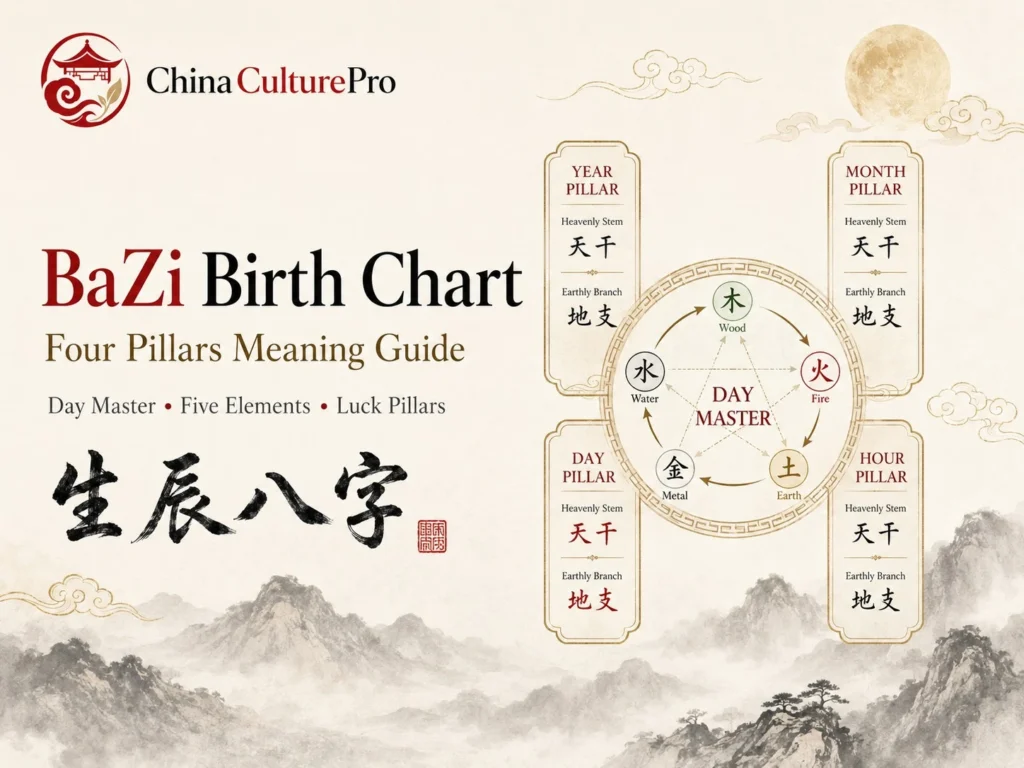
BaZi (生辰八字), often translated as the Four Pillars of Destiny or Chinese Birth Chart, is a traditional Chinese birth-chart system based on a person’s birth year, birth month, birth day, and birth hour.
BaZi literally means “Eight Characters.” These eight characters come from four pillars: the Year Pillar, Month Pillar, Day Pillar, and Hour Pillar. Each pillar contains one Heavenly Stem and one Earthly Branch. Four pillars create eight characters.
BaZi is not the same as Chinese zodiac. Chinese zodiac usually reads only the animal of the birth year. BaZi reads the full birth structure: year, month, day, and hour.
This is the main difference:
Chinese Zodiac reads the year branch animal.
Five Elements Chinese Zodiac reads the year stem element plus the year branch animal.
Na Yin reads the symbolic elemental texture of a Jia Zi pair.
Ben Ming Nian reads the return of your birth-year branch every 12 years.
Tai Sui reads how the annual branch interacts with personal branches.
BaZi reads the full Four Pillars: year, month, day, and hour.
A precise BaZi chart usually needs birth date, birth time, birthplace, and time zone. Some systems also adjust by true solar time. This matters because the Hour Pillar can change near time boundaries.
| Item | Detail |
|---|---|
| Main Topic | BaZi / 生辰八字 |
| Common English | Four Pillars of Destiny / Chinese Birth Chart |
| Literal Meaning | Eight Characters |
| Based On | Birth year, month, day, and hour |
| Core Structure | 4 pillars × stem + branch |
| Key Center | Day Master |
| Used For | Pattern, structure, timing, tendencies |
| Important Limit | Not a one-line fate sentence |
Key Point: BaZi does not simply ask, “What zodiac animal are you?” It asks how the qi of your birth year, month, day, and hour is structured. It reads patterns, timing, strengths, pressure points, and tendencies, not a fixed one-line verdict.
Why Is BaZi Called “Eight Characters”?
BaZi is called “Eight Characters” because the birth chart is built from four pillars, and each pillar has two characters.
Each pillar contains:
- one Heavenly Stem
- one Earthly Branch
The Heavenly Stem is the upper character. The Earthly Branch is the lower character.
| Pillar | Heavenly Stem | Earthly Branch | Forms |
|---|---|---|---|
| Year Pillar | Year Stem | Year Branch | 2 characters |
| Month Pillar | Month Stem | Month Branch | 2 characters |
| Day Pillar | Day Stem | Day Branch | 2 characters |
| Hour Pillar | Hour Stem | Hour Branch | 2 characters |
| Total | 4 stems | 4 branches | 8 characters |
These eight characters are not random symbols. They are four layers of time.
The Year Pillar is one layer. The Month Pillar is one layer. The Day Pillar is one layer. The Hour Pillar is one layer.
Each layer has a Heavenly Stem that shows the exposed qi and an Earthly Branch that stores hidden roots. This is why the previous system, Heavenly Stems and Earthly Branches, is the foundation of BaZi. BaZi is the personal birth-chart application of that stem-branch language.
BaZi is not the same as zodiac, not the same as the year pillar alone, and not the same as Na Yin. Zodiac reads only the animal layer of the year branch. Na Yin is a symbolic layer attached to Jia Zi pairs. BaZi reads the full Four Pillars.
To understand the stem-branch language behind BaZi, read our Heavenly Stems and Earthly Branches guide.
The Four Pillars: Year, Month, Day, and Hour
The Four Pillars are the basic structure of a BaZi chart. Each pillar represents a different layer of time and life.
They should not be read as four isolated boxes. A Chinese practitioner would read them as one connected structure: year as the outer root, month as the seasonal command, day as the self, and hour as the later result.
Year Pillar / 年柱
The Year Pillar is connected with ancestry, family background, early environment, and the outer social layer.
It is also the layer most people know through Chinese zodiac. If someone says, “I was born in the Year of the Horse,” they are usually referring to the year branch. If someone says they have a certain Na Yin life, such as Gold in the Sea or Heavenly River Water, that is often a year-pillar folk reading.
But the Year Pillar is not the whole chart.
This is a major mistake in popular zodiac reading. A person’s zodiac animal can describe one important layer, but it cannot replace the full BaZi chart.
The Year Pillar can show public environment, family roots, early-life background, and the generational layer. It is useful, but it is only one of four pillars.
Month Pillar / 月柱
The Month Pillar is one of the most important parts of a BaZi chart because the month branch is tied to seasonal qi.
In BaZi, the month branch is often called the Month Command. It shows the season in which the Day Master was born. This matters because the same Day Master can become strong, weak, supported, pressured, warm, cold, dry, or damp depending on the season.
For example, Jia Wood born in the Yin month has seasonal support because Wood is rising. Jia Wood born in the Shen month faces Metal pressure because autumn Metal is strong. The Day Master is still Jia Wood, but the season changes the reading.
The Month Pillar can also relate to parents, growth environment, career base, work structure, and social position.
It should not be treated as a simple “month sign.” In BaZi, the Month Pillar is not just a birth-month label. It is the seasonal anchor of the whole chart.
Day Pillar / 日柱
The Day Pillar is the center of BaZi.
The Day Stem is called the Day Master. It represents the self, the central qi of the person, and the main reference point of the chart.
The Day Branch is often called the spouse palace. It can be used to read relationship patterns, intimate dynamics, and the root under the self.
Real BaZi reading does not begin with the zodiac animal. It begins with the Day Master.
If the Day Master is Jia Wood, the entire chart is read in relation to Jia Wood. If the Day Master is Bing Fire, the entire chart is read in relation to Bing Fire. Ten Gods, Useful God, wealth star, officer star, resource star, and output star are all defined through their relationship with the Day Master.
This is why the Day Pillar is the core of BaZi.
Hour Pillar / 时柱
The Hour Pillar is connected with children, later life, long-term direction, inner wishes, and future results.
It can also show what develops later, what remains hidden earlier, or what becomes important in the second half of life.
Because the Hour Pillar depends on birth time, accurate birth time is important. A wrong birth hour can change the Hour Pillar. If the birth time is near a boundary, even a small difference can change the Earthly Branch of the hour.
Some systems also use birthplace and true solar time correction. In large countries or wide time zones, the same clock time may not reflect the same solar time. If someone is born close to an hour boundary, this can matter.
| Pillar | Main Meaning | Common Misunderstanding |
|---|---|---|
| Year | ancestry, early life, public layer | Not the whole chart |
| Month | parents, career base, season qi | More than a month sign |
| Day | Day Master, self, spouse palace | Core of BaZi |
| Hour | children, later life, inner direction | Depends on accurate birth time |
The Four Pillars are not a flat table. They are four layers of time: the year shows outer roots, the month shows seasonal command, the day shows the self, and the hour shows later results.
Day Master: The Center of a BaZi Chart
The Day Master is the Heavenly Stem of the Day Pillar. It is the center of the BaZi chart.
It represents the “self” in the chart: not the full personality, not the whole fate, but the central qi that all other characters are measured against.
| Item | Meaning |
|---|---|
| Day Master | Heavenly Stem of the Day Pillar |
| Represents | The self / core qi |
| Used For | Ten Gods, strength, useful element, chart structure |
| Common Mistake | Treating it as a simple personality label |
The Day Master is important because all Ten Gods are defined by their relationship to it.
For example, if the Day Master is Jia Wood:
| Relationship to Jia Wood | Element Direction | Ten Gods Direction |
|---|---|---|
| Controls me | Metal controls Wood | Officer / Seven Killings |
| I control | Wood controls Earth | Wealth |
| Produces me | Water produces Wood | Resource |
| I produce | Wood produces Fire | Output |
| Same as me | Wood with Wood | Friend / Rob Wealth |
This is why BaZi is a relationship system. The same element can be helpful or harmful depending on how it relates to the Day Master, where it appears, whether it has root, and whether the chart needs it.
The Day Master is not a simple personality slogan.
It is too shallow to say, “Jia Wood people are always upright” or “Bing Fire people are always bright.” A Jia Wood Day Master born in a strong spring month is not the same as Jia Wood born in a strong autumn month. Jia Wood sitting on Zi Water is not the same as Jia Wood sitting on Wu Fire.
The Day Master must be read with Month Command, root support, Five Element flow, hidden stems, Ten Gods, Useful God, Luck Pillars, and Annual Luck.
A useful way to understand it is this: the Day Master is not a personality label. It is the reference point of the chart. BaZi is a network of relationships, and the Day Master is the center point.
How BaZi Uses Heavenly Stems and Earthly Branches
BaZi uses Heavenly Stems and Earthly Branches in every pillar.
Each pillar has an upper character and a lower character.
The Heavenly Stem is the upper character. It shows visible qi, outward expression, and what is more exposed.
The Earthly Branch is the lower character. It shows root, hidden qi, environment, support, and what is stored underneath.
Inside the Earthly Branch are Hidden Stems. These hidden stems become important in reading root strength, Ten Gods, and internal resources.
| Layer | In BaZi | Reading Direction |
|---|---|---|
| Heavenly Stem | Upper character | visible qi, outward expression |
| Earthly Branch | Lower character | root, hidden qi, environment |
| Hidden Stems | Inside branch | inner resources, roots, Ten Gods |
| Pillar | Stem + branch together | complete time layer |
Take Bing Wu (丙午) as an example.
Bing is Yang Fire. It is bright, visible, and outward. Wu is the Horse branch. Inside Wu are Ding Fire and Ji Earth. So a Bing Wu pillar has strong Fire expression, with hidden Fire and Earth inside the branch.
But this does not mean Bing Wu always reads the same way.
If Bing Wu appears in the Year Pillar, it may show public or early-life Fire energy. If it appears in the Day Pillar, it affects the self and spouse palace. If it appears in the Hour Pillar, it may show later-life direction or future results.
The same pillar changes meaning by position.
This is one of the most important BaZi principles: a pillar is not only a name. It is position + qi + relationship. The same Bing Wu can be useful, excessive, beautiful, unstable, supportive, or harmful depending on the full chart.
Five Elements Balance in BaZi
BaZi uses the Five Elements: Wood, Fire, Earth, Metal, and Water.
These elements interact through generating and controlling cycles.
| Relationship | Cycle |
|---|---|
| Generating | Wood → Fire → Earth → Metal → Water → Wood |
| Controlling | Wood controls Earth, Earth controls Water, Water controls Fire, Fire controls Metal, Metal controls Wood |
This basic cycle is important, but BaZi is not a simple inventory check.
A common beginner mistake is to count the elements and say: “There is no Metal, so I must add Metal.” That is not real BaZi reading.
A chart is not judged by whether all five elements appear equally. A missing element is not always useful. A strong element is not always bad. A weak element is not always harmful.
The real questions are:
- Is the Day Master strong or weak?
- What season was the person born in?
- Does the Day Master have roots in the Earthly Branches?
- Which elements are excessive?
- Which elements are blocked?
- Is the chart cold, hot, dry, or damp?
- Does the qi flow, or is it stuck?
- Which element helps the chart function better?
For example, a winter chart may need Fire for warmth even if Fire is not completely missing. A summer chart may need Water for cooling even if Water is weak. A strong Day Master may need output, wealth, or control. A weak Day Master may need resource or peer support.
BaZi is not “two Wood, one Fire, no Metal, so add Metal.”
It is more accurate to say: BaZi reads whether the chart has structure, flow, support, balance of temperature, and a useful element that can solve the chart’s main problem.
Missing does not always mean needed. More does not always mean worse. Useful matters more than quantity.
Ten Gods in BaZi: Why Relationships Matter
Ten Gods, or Shi Shen (十神), are one of the most important systems in BaZi.
They are not literal gods. They are relationship roles formed between the Day Master and the other elements in the chart.
The logic is based on Five Element relationships:
- same as me
- I produce
- I control
- controls me
- produces me
These relationships are then divided by Yin and Yang, creating ten roles.
| Relationship to Day Master | Ten Gods Direction |
|---|---|
| Same element | Friend / Rob Wealth |
| I produce | Eating God / Hurting Officer |
| I control | Direct Wealth / Indirect Wealth |
| Controls me | Direct Officer / Seven Killings |
| Produces me | Direct Resource / Indirect Resource |
The Ten Gods are commonly translated as:
| Ten God | Chinese | Basic Direction |
|---|---|---|
| Friend | 比肩 | peers, self-support, independence |
| Rob Wealth | 劫财 | competition, friends, shared resources |
| Eating God | 食神 | talent, output, comfort, creativity |
| Hurting Officer | 伤官 | expression, rebellion, sharp talent |
| Direct Wealth | 正财 | stable wealth, management, practical resources |
| Indirect Wealth | 偏财 | flexible wealth, opportunity, external resources |
| Direct Officer | 正官 | rules, responsibility, status, order |
| Seven Killings | 七杀 | pressure, power, danger, discipline |
| Direct Resource | 正印 | support, learning, protection, motherly energy |
| Indirect Resource | 偏印 | unusual knowledge, protection, isolation, strategy |
Ten Gods are used to read career style, wealth pattern, relationship tendency, pressure type, learning ability, expression, authority, competition, and resources.
But Ten Gods cannot be judged alone.
Seven Killings is not always disaster. When controlled or transformed well, it can become authority, discipline, and power. When uncontrolled, it can become pressure, risk, or violence.
Hurting Officer is not always bad. When paired well with Resource, it can show talent and refined expression. When it directly attacks Officer without balance, it can create conflict with rules or authority.
Direct Wealth does not guarantee wealth. If Wealth has no root, is robbed, or becomes unfavorable, it may not produce real financial stability.
Direct Resource is not always good. Too much unfavorable Resource can lead to dependence, laziness, overthinking, or lack of action.
Ten Gods are relationship roles. Their meaning depends on position, strength, combination, and whether they support the structure of the chart.
Useful God, Favorable Elements, and Common Misunderstandings
Useful God, or Yong Shen (用神), is one of the most misunderstood ideas in BaZi.
It does not mean “the element missing from the chart.” It means the element or structural point that helps the chart function better.
Favorable Elements are supportive directions. They may help the Day Master, regulate the chart, improve flow, balance temperature, or support a useful structure.
| Mistake | Better Reading |
|---|---|
| Missing element must be added | Missing does not always mean useful |
| Equal Five Elements are best | BaZi is about structure and flow |
| Useful God is easy to find | It depends on strength, season, roots, and pattern |
| A color or crystal fixes the chart | Symbolic aids cannot replace behavior and timing |
| Calculator output gives final Useful God | Useful God needs chart interpretation |
Judging Useful God may involve Day Master strength, Month Command, root support, excessive or weak elements, chart pattern, qi flow, temperature, dryness, and dampness.
Sometimes the missing element is not useful. Adding it may damage the structure.
Sometimes a strong element is not bad. It may be the element that makes the chart work.
Sometimes the first need is not support or control, but temperature regulation. A cold winter chart may need Fire. A hot summer chart may need Water. A dry chart may need moisture. A damp chart may need warmth or movement.
This is why automatic “favorable element” results should be treated carefully.
Useful God is not “what is missing.” It is what the chart needs to unblock, regulate, support, restrain, or complete a structure. Without reading the whole chart, the conclusion is easy to oversimplify.
Luck Pillars and Annual Luck
BaZi does not stop at the birth chart.
The birth chart shows the original structure. Luck Pillars and Annual Luck show how time moves through that structure.
| Layer | Meaning | Image |
|---|---|---|
| Original Chart | Birth structure | The car |
| Luck Pillars | 10-year life phases | Road condition |
| Annual Luck | Energy of a specific year | Weather |
| Monthly / Daily Timing | Shorter triggers | Road surface |
The Original Chart is the structure you are born with. It shows the Day Master, Four Pillars, hidden stems, Ten Gods, Five Element flow, and chart pattern.
Luck Pillars, also called Da Yun (大运), are 10-year phases. They show the larger background of each life period.
Annual Luck, or Liu Nian (流年), is the energy of a specific year entering the chart. A year can activate, clash, combine, support, or pressure parts of the original chart and current Luck Pillar.
Monthly and daily timing are more detailed trigger layers.
A Chinese practitioner might explain it like this: the original chart is the car, the Luck Pillars are the road conditions, and Annual Luck is the weather. To understand one period, you need all three.
This also explains how BaZi connects to Tai Sui.
Tai Sui is part of the Annual Luck layer. The year’s Earthly Branch becomes the annual Tai Sui branch. But BaZi reads more than whether your zodiac animal Fan Tai Sui. It also reads how the annual stem and branch interact with your original chart, Luck Pillar, Day Master, Ten Gods, and branch relationships.
This page does not explain the full method for starting Luck Pillars. That involves gender, Yin-Yang year, solar terms, and timing calculation. The key idea here is enough: BaZi reads the original chart together with time movement.
What Can BaZi Be Used For?
BaZi is best understood as pattern reading, timing awareness, and decision support.
It can help show tendencies, strengths, pressure points, and timing windows. It should not be used as fear-based fortune telling or as a replacement for real-world judgment.
| Use Case | What BaZi Can Show | What It Should Not Replace |
|---|---|---|
| Career | work style, pressure type, timing | skills and effort |
| Wealth | wealth pattern, risk style | financial advice |
| Relationships | spouse palace, relationship patterns | communication and choice |
| Health | tendencies and stress points | medical diagnosis |
| Timing | luck cycles and annual triggers | real-world planning |
| Naming | element direction reference | full naming strategy alone |
In career reading, BaZi may show whether a person fits structured authority, independent work, creative output, business risk, technical skill, management, or advisory roles. But it cannot replace actual ability, training, and effort.
In wealth reading, BaZi may show how a person relates to resources, risk, stability, flexible income, or financial pressure. But it is not financial advice.
In relationship reading, BaZi may show spouse palace patterns, emotional habits, branch clashes, or Ten Gods related to partner dynamics. But it cannot replace communication, choice, and responsibility.
In health tendency reading, BaZi may show stress points, imbalance patterns, or seasonal weakness. But it is not medical diagnosis.
The best use of BaZi is not passive fate. It helps a person understand structure, rhythm, risks, and timing. Knowing the road does not remove the need to drive well.
BaZi Calculator vs BaZi Reading
A BaZi calculator and a BaZi reading are not the same thing.
A calculator can generate the chart. A reading interprets the chart.
| Tool | What It Does | Limit |
|---|---|---|
| BaZi Calculator | Generates Four Pillars chart | Does not fully interpret structure |
| BaZi Reading | Interprets Day Master, Ten Gods, luck | Depends on skill and method |
| AI Reading | Gives quick explanation | Needs human judgment for nuance |
| Master Reading | Uses experience and context | Methods may vary by school |
A BaZi calculator may output Four Pillars, Heavenly Stems, Earthly Branches, Hidden Stems, Ten Gods, Day Master, Luck Pillars, Annual Luck, and element counts.
These outputs are useful, but they are not the same as interpretation.
Chart generation arranges the characters. BaZi reading reads the qi.
Software can usually calculate the mechanical layer: stems, branches, hidden stems, Ten Gods, and Luck Pillars. But Useful God, chart structure, illness-medicine logic, timing, and real-life application need interpretation.
Input accuracy also matters.
A good BaZi chart needs:
- birth date
- birth time
- birthplace
- time zone
- boundary system
- true solar time correction, if that method is used
People born in January or early February should be especially careful. Common Chinese zodiac lookup often follows Chinese New Year. Formal BaZi systems commonly use solar terms, especially Li Chun, and the Month Pillar follows solar-term boundaries.
This means BaZi boundaries can be stricter than popular zodiac boundaries.
If you do not know your birth time, the Year, Month, and Day Pillars may still be read, but the Hour Pillar will be missing or uncertain.
Common Mistakes About BaZi
BaZi is easy to oversimplify. These are the most common mistakes.
| Mistake | Better Understanding |
|---|---|
| BaZi = Chinese zodiac | Zodiac is only the year branch |
| Year pillar = full destiny | Year pillar is only one of four pillars |
| Missing element must be added | Useful God depends on structure |
| Day Master = personality label | Day Master is the chart reference point |
| Ten Gods are always good or bad | They depend on position, strength, and usefulness |
| Birth time is not important | Hour Pillar depends on accurate time |
| Calculator output is final | Calculator gives chart; reading interprets structure |
| Na Yin = BaZi core | Na Yin is auxiliary, not the core structure |
| BaZi means fate cannot change | BaZi shows patterns and timing, not passive fatalism |
The biggest mistake is treating BaZi as a more complicated zodiac animal reading. Zodiac is only the year branch. BaZi reads four pillars.
Another common mistake is treating a missing element as something that must be added. This is the source of many shallow Five Elements remedies. A missing element may be useless or harmful. A present element may be the key to the chart.
A third mistake is treating the Day Master as a personality label. The Day Master is the reference point, not the whole conclusion.
A fourth mistake is trusting calculator output as final judgment. A calculator can produce the chart, but it does not fully read structure, flow, Useful God, timing, or real-life meaning.
BaZi does not mean fate cannot change. It shows patterns, timing, strengths, and risks. The point is not to surrender to fate. The point is to understand the structure and make better choices.
How This Guide Connects to Chinese Zodiac Content
BaZi is the point where the Chinese zodiac system moves from year-based reading into personal birth-chart reading.
The previous layers are mostly based on the year. BaZi expands the reading to year, month, day, and hour.
| Related Topic | How BaZi Connects |
|---|---|
| Chinese Zodiac | Year branch animal only |
| Heavenly Stems and Earthly Branches | Four Pillars use stems and branches |
| Five Elements Chinese Zodiac | Year stem + year branch |
| Na Yin | Symbolic layer of Jia Zi pairs |
| Ben Ming Nian | Year branch returns every 12 years |
| Tai Sui / Fan Tai Sui | Annual branch interacts with personal chart |
| Compatibility | Day pillar, spouse palace, branches, Ten Gods |
To understand the year-animal layer first, start with our Chinese Zodiac guide.
To check the correct year boundary for January or February births, read our Chinese New Year guide.
For quick year and zodiac lookup, use our Chinese Zodiac & Lunar Birthday Calculator.
To see how the year stem and year branch form an Element-Animal sign, read our Five Elements Chinese Zodiac guide.
To understand the symbolic Na Yin layer attached to Jia Zi pairs, read our Na Yin Five Elements guide.
To understand why your own year branch returns every 12 years, read our Ben Ming Nian guide.
For branch clashes, harms, and compatibility patterns, see our Chinese Zodiac Compatibility guide.
To understand how annual Tai Sui interacts with personal branches, read our Tai Sui and Fan Tai Sui guide.
For the 2026 year example, read our Year of the Horse guide.
For someone born in 2026, the year pillar is Bing Wu. But that does not complete the BaZi chart. Month, day, and hour still need to be calculated.
For everyone else, 2026 is an Annual Luck layer entering the chart. It should be read with the original chart and current Luck Pillar, not only by zodiac sign.
This is why BaZi is the natural next step after Chinese zodiac. It takes the year system and turns it into a full personal chart.
Final Thoughts
BaZi is not an upgraded version of “what zodiac animal are you.”
It breaks a person’s birth year, month, day, and hour into four layers of time. Each layer has a Heavenly Stem that shows exposed qi and an Earthly Branch that stores hidden roots.
The eight characters are not eight isolated symbols. They are a structure of qi.
Real BaZi reading starts with the Day Master. Then it reads Month Command, Five Element relationships, Ten Gods, Hidden Stems, Useful God, Luck Pillars, and Annual Luck.
Reading only the zodiac animal is too shallow. Reading only the year pillar is too shallow. Reading only missing elements is too shallow.
A BaZi chart is not meant to make people fear fate. It is meant to help people understand structure, timing, strengths, pressure points, and choices. Once the structure is clear, the next step is not passive acceptance. The next step is better action.
FAQs About BaZi / Four Pillars of Destiny
What is BaZi?
BaZi is a traditional Chinese birth-chart system based on a person’s birth year, month, day, and hour. Each of the four pillars contains one Heavenly Stem and one Earthly Branch, creating eight characters. It is also called the Four Pillars of Destiny.
What does BaZi mean in Chinese?
BaZi means “Eight Characters.” Ba means eight, and Zi means characters. Sheng Chen Ba Zi means the eight characters of a person’s birth time. These eight characters come from the Year, Month, Day, and Hour Pillars.
Why is it called Four Pillars of Destiny?
It is called Four Pillars because the chart has four time pillars: year, month, day, and hour. Each pillar has one Heavenly Stem and one Earthly Branch. These four pillars form the basic structure used in BaZi reading.
What information do I need for a BaZi chart?
You usually need birth date, birth time, birthplace, and time zone. Some systems also use true solar time. For people born near year, month, or hour boundaries, accuracy matters more. Formal BaZi also commonly uses solar-term boundaries such as Li Chun.
What is the Day Master in BaZi?
The Day Master is the Heavenly Stem of the Day Pillar. It represents the self and becomes the reference point for the whole chart. Ten Gods, Useful God, strength, wealth star, officer star, and resource star are all judged in relation to the Day Master.
Is BaZi the same as Chinese zodiac?
No. Chinese zodiac usually reads the year branch animal, such as Rat, Ox, Tiger, or Horse. BaZi reads the full Four Pillars: year, month, day, and hour. Zodiac is only one layer inside a much larger chart.
Is BaZi the same as Na Yin?
No. Na Yin is a symbolic Five Elements name attached to Jia Zi pairs. It can add cultural and symbolic meaning, but it is not the core of BaZi. BaZi focuses on Four Pillars, Day Master, Ten Gods, hidden stems, structure, Luck Pillars, and Annual Luck.
What are Ten Gods in BaZi?
Ten Gods are the relationship roles between the Day Master and the other elements in the chart. They include Friend, Rob Wealth, Eating God, Hurting Officer, Direct Wealth, Indirect Wealth, Direct Officer, Seven Killings, Direct Resource, and Indirect Resource. They are not literal gods.
What are Luck Pillars?
Luck Pillars, or Da Yun, are 10-year cycles in BaZi. They show the larger energy background of each life phase. A full timing reading compares the original chart, the current Luck Pillar, and the Annual Luck of a specific year.
Can BaZi predict the future?
BaZi can read timing patterns, tendencies, pressure points, and likely themes. It should not be treated as exact fixed-event prediction. A strong reading gives decision support and timing awareness, not a rigid sentence that removes personal choice.
Is a BaZi calculator enough?
A BaZi calculator is useful for generating the chart, but it is not enough for full interpretation. It can show Four Pillars, stems, branches, hidden stems, Ten Gods, and Luck Pillars. Reading the structure, Useful God, timing, and real-life meaning requires interpretation.
What if I do not know my birth time?
You can still read the Year, Month, and Day Pillars, but the Hour Pillar will be missing or uncertain. This affects readings related to children, later life, inner direction, and some timing details. A partial chart can be useful, but it is not as complete as a full BaZi chart.