

Quick Answer: Where Did the Chinese Zodiac Come From?
The Chinese zodiac, or Shengxiao, developed when twelve animals were gradually paired with the older Twelve Earthly Branches: Zi, Chou, Yin, Mao, Chen, Si, Wu, Wei, Shen, You, Xu, and Hai. The branch sequence already existed as a system for recording time; animal identities were added later, making the abstract signs easier to remember and use.
The essential answers are:
Why are there 12 animals? The number comes from the Twelve Earthly Branches.
Why this order? Each animal follows the fixed position of its paired branch.
Why these animals? The list evolved over time, and no surviving early text records one selection process.
When did the modern list appear? Qin manuscripts contain differing pairings, while Eastern Han texts show a sequence close to today’s.
Is the Great Race historical? No. It is a folktale explaining an already established order.
The zodiac did not begin when twelve animals won a competition and created a twelve-year cycle. The twelve positions came first; the animals were gradually fitted into them.
To explore the meanings and traditions of all twelve signs, visit our complete guide to the Chinese Zodiac.
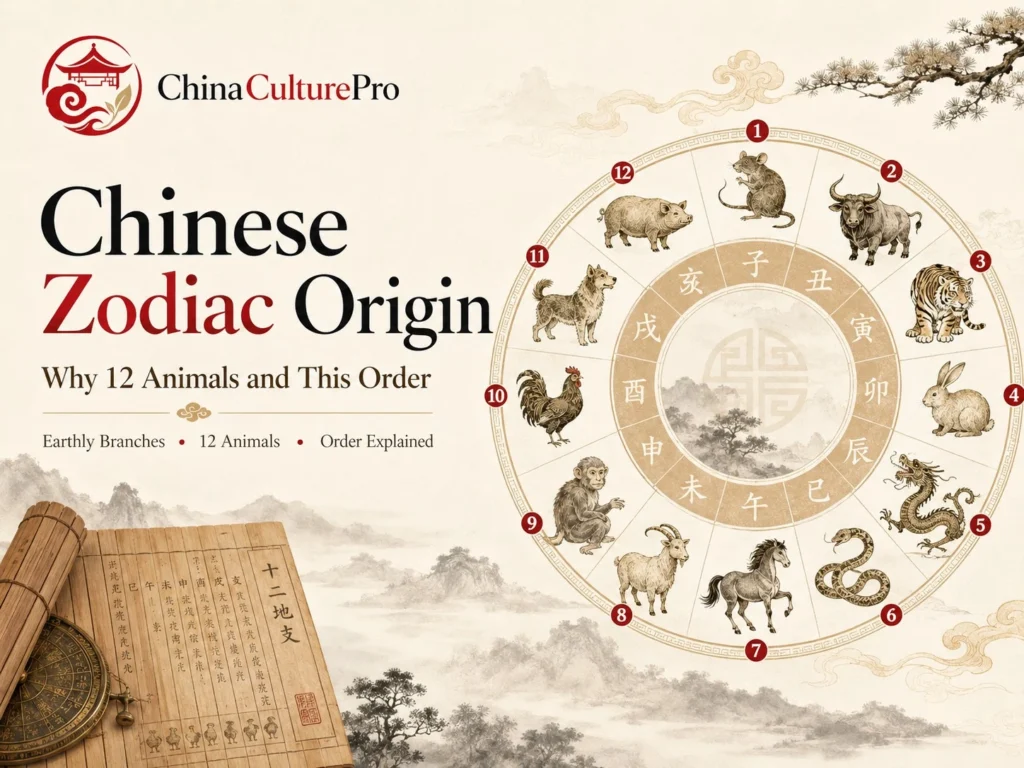
The 12 Chinese Zodiac Animals in Order
Shengxiao is the conventional term for the twelve-animal cycle, while Shuxiang refers to the animal associated with a person’s birth year. Unlike the Western zodiac, which is based on the Sun’s apparent movement through twelve zodiacal sectors, the Chinese system centers on recurring years and the Earthly Branch sequence.
| Order | Animal | Chinese | Earthly Branch | Pinyin | Yin or Yang |
|---|---|---|---|---|---|
| 1 | Rat | 鼠 | 子 | Zǐ | Yang |
| 2 | Ox | 牛 | 丑 | Chǒu | Yin |
| 3 | Tiger | 虎 | 寅 | Yín | Yang |
| 4 | Rabbit | 兔 | 卯 | Mǎo | Yin |
| 5 | Dragon | 龙 | 辰 | Chén | Yang |
| 6 | Snake | 蛇 | 巳 | Sì | Yin |
| 7 | Horse | 马 | 午 | Wǔ | Yang |
| 8 | Goat | 羊 | 未 | Wèi | Yin |
| 9 | Monkey | 猴 | 申 | Shēn | Yang |
| 10 | Rooster | 鸡 | 酉 | Yǒu | Yin |
| 11 | Dog | 狗 | 戌 | Xū | Yang |
| 12 | Pig | 猪 | 亥 | Hài | Yin |
The sequence repeats every twelve years because each animal is fixed to one branch: Rat to Zi, Ox to Chou, and so on.
The English names are cultural translations rather than exact zoological labels. Shu may be Rat or Mouse, Niu Ox, Cattle, or Buffalo, Tu Rabbit or Hare, Yang Goat, Sheep, or Ram, and Ji Chicken or Rooster.
The animals follow the older sequence explained in Heavenly Stems and Earthly Branches.
Historical Origin: The Earthly Branches Came First
The history of the Chinese zodiac must be separated into three kinds of evidence: the older stem-branch timekeeping system, archaeological manuscripts containing animal–branch pairings, and later folk stories created to explain the completed order.
| Period | Evidence or Development | What It Shows |
|---|---|---|
| Shang period | Stem-branch day notation in oracle-bone inscriptions | The calendrical signs existed before a mature twelve-animal zodiac |
| Late Warring States–Qin period | Shuihudi and Fangmatan daybooks | Animals were paired with branches, but the lists were not fully standardized |
| Eastern Han period | Wang Chong’s Lunheng and related texts | The animal sequence had become highly consistent with the modern version |
| Later imperial China | Use in timekeeping, art, ritual, astrology, and folklore | The zodiac became a widely shared cultural system |
The Older Earthly Branch System
The Twelve Earthly Branches were first used to organize days and later extended to years, months, double hours, and directions. Paired sequentially with the Ten Heavenly Stems, they form the sixty-unit Gan-Zhi cycle.
Animals appear to have been attached after the branch sequence was established, probably making abstract signs such as Zi, Chou, Yin, and Mao easier to remember and transmit. Chinese children still learn compact pairings such as “Zi Rat, Chou Ox, Yin Tiger, Mao Rabbit,” reflecting this older branch-based structure.
Early Lists Were Not Identical to Today’s
The Shuihudi Qin bamboo manuscripts from Hubei provide some of the earliest archaeological evidence of branch–animal pairings, but their list differs from the modern sequence. One version associates Wu with deer and Wei with horse. The Fangmatan Qin manuscripts contain other combinations, including Wu with horse.
These differences show that animal–branch systems already existed by the late Warring States and Qin periods, but regional traditions had not yet been fully standardized.
By the Eastern Han period, passages in Wang Chong’s Lunheng record a sequence substantially matching the modern cycle from Rat through Pig. The zodiac therefore has no single documented invention date; it emerged as changing animal associations were gradually standardized within an older calendrical framework.
Why Are There 12 Chinese Zodiac Animals?
The direct answer is that the zodiac contains twelve animals because it was built onto the existing Twelve Earthly Branches.
Several calendrical and astronomical systems help explain why groups of twelve became important in ancient Chinese timekeeping, but they do not represent separate proven origins of the animal cycle.
| Possible Factor | What It Helps Explain | What It Does Not Prove |
|---|---|---|
| Twelve Earthly Branches | The zodiac’s exact number and fixed positions | Why each particular animal was selected |
| Twelve months | How branches could organize the annual cycle | That lunar months directly created the animal list |
| Twelve double hours | How one day was divided into twelve periods | That animal behavior originally determined the signs |
| Jupiter’s approximate 12-year orbit | A possible astronomical background for twelve-year reckoning | That Jupiter alone created the branch system |
| Other cultural groups of twelve | Why twelve became a familiar organizing number | A single historical source for the zodiac |
Jupiter, known in ancient China as the Age Star, completes an orbit in approximately 11.86 years and was associated with twelve celestial sectors and the Earthly Branches. This provides useful astronomical context but does not prove that Jupiter alone created the system.
Historically, the twelve-position structure came first and the animals were assigned to it later. The Great Race reverses that relationship for storytelling by presenting the animals as twelve contest winners.
Why These Animals and Why This Order?
No surviving early document records a meeting at which someone deliberately selected Rat, Ox, Tiger, Rabbit, Dragon, Snake, Horse, Goat, Monkey, Rooster, Dog, and Pig.
The completed list probably reflects several cultural forces:
Agricultural life: Oxen, horses, goats, pigs, chickens, and dogs were central to farming, transport, food, and household protection.
Wild animals: Tigers, snakes, rabbits, monkeys, and rodents were familiar through hunting, agriculture, danger, and crop damage.
Sacred imagination: Dragon, the only clearly mythical animal in the standard list, brought religious, auspicious, and natural symbolism into the cycle.
Animal worship and regional symbolism: Tigers, dragons, cattle, snakes, and other animals already held ritual or protective meanings.
Mnemonic value: Familiar animals made the abstract Earthly Branches easier to remember.
Regional variation: Qin manuscripts suggest that different animal lists or pairings circulated before the modern system stabilized.
Later explanatory traditions: Double-hour behavior, yin–yang alternation, and toe-number theories gave the completed system additional meaning.
No single theory proves why all twelve animals were chosen. Practical life, sacred symbolism, memory, regional traditions, and gradual standardization probably worked together.
Why Did the Order Become Fixed?
| Explanation | Historical Status | What It Explains |
|---|---|---|
| Fixed Earthly Branch sequence | Structural foundation | Why the completed animal order became stable |
| Historical standardization | Supported by manuscripts and texts | Why early animal pairings could differ |
| Great Race | Folklore | Why the animals appear to arrive in this sequence |
| Double-hour behavior | Later cultural correspondence | Why each animal seems suited to a particular time |
| Yin–yang and toe-number theories | Traditional interpretation | How later thinkers explained alternating properties |
| Moral symbolism | Folklore and popular culture | Why animals acquired personality lessons |
Once Rat was paired with Zi, Ox with Chou, and the remaining animals with their respective branches, the fixed branch sequence also fixed the zodiac order.
Historical evidence does not fully explain why every animal acquired its particular position. Qin manuscripts preserve alternative pairings, while the Great Race and other folk theories later supplied memorable cultural explanations.
The Great Race and Why the Rat Comes First
The Great Race is the best-known story used to explain the zodiac order. Versions differ: the organizer may be the Jade Emperor, Buddha, or another divine ruler, and the contest may involve a race, river crossing, or test of arrival.
A common version follows this sequence:
Rat rides on Ox’s back across the river and jumps ahead at the finish.
Ox arrives second after carrying Rat most of the way.
Tiger fights the current and takes third place.
Rabbit crosses by jumping between rocks or floating on a log.
Dragon arrives fifth after stopping to help people or animals.
Snake surprises Horse and takes sixth place.
Horse follows in seventh.
Goat, Monkey, and Rooster cooperate and finish eighth, ninth, and tenth.
Dog delays to play in the water despite being a strong swimmer.
Pig stops to eat or sleep and arrives last.
In many modern versions, Rat fails to wake Cat or pushes it into the river, causing Cat to miss the zodiac and become Rat’s enemy. The tale turns a fixed sequence into lessons about intelligence, strength, generosity, cooperation, distraction, and appetite, but it remains folklore rather than a historical account of the zodiac’s creation.
Why Is the Rat First?
Three explanations are commonly given:
Structural explanation: Rat is paired with Zi, the first Earthly Branch.
Great Race explanation: Rat uses Ox’s strength and wins through strategy.
Yin–yang explanation: Zi hour crosses midnight, marking the transition between old and new. A later folk theory connects this transition with the rat’s four front toes and five rear toes, symbolically combining even and odd numbers.
The primary explanation is structural: Rat comes first because it is paired with Zi, the first branch. The race and toe-number theories are later cultural interpretations that make this position memorable.
How the Zodiac Fits the Chinese Time System
The zodiac animals are best known as year signs, but the Earthly Branches also organize double hours and form part of the sixty-year Gan-Zhi cycle.
The Animals and the 12 Double Hours
Traditional Chinese timekeeping divides the day into twelve shichen, each roughly equal to two modern hours.
| Earthly Branch | Animal | Traditional Time | Folk Explanation |
|---|---|---|---|
| Zi | Rat | 23:00–01:00 | Rats become active and search for food at night |
| Chou | Ox | 01:00–03:00 | Oxen rest, chew cud, or prepare for early farm work |
| Yin | Tiger | 03:00–05:00 | Tigers were believed to hunt before dawn |
| Mao | Rabbit | 05:00–07:00 | Rabbits emerge to feed around daybreak |
| Chen | Dragon | 07:00–09:00 | Dragons are associated with clouds, mist, and rain |
| Si | Snake | 09:00–11:00 | Snakes become more active as the day warms |
| Wu | Horse | 11:00–13:00 | Horses are associated with the strength of midday yang |
| Wei | Goat | 13:00–15:00 | Goats graze and rest during the afternoon |
| Shen | Monkey | 15:00–17:00 | Monkeys are active and vocal later in the day |
| You | Rooster | 17:00–19:00 | Chickens return to their roosts at dusk |
| Xu | Dog | 19:00–21:00 | Dogs begin guarding the household at night |
| Hai | Pig | 21:00–23:00 | Pigs settle into deep rest |
These explanations are useful cultural memory aids, but they do not prove that animal behavior originally determined the twelve pairings.
The Zodiac and the 60-Year Cycle
The Ten Heavenly Stems and Twelve Earthly Branches advance together and return to their starting combination after sixty steps, forming the sexagenary cycle from Jia-Zi to Gui-Hai.
Because each stem carries yin–yang and Five-Element attributes, the same animal appears in five elemental forms. Dragon years, for example, cycle through:
The same animal-and-element combination returns every sixty years rather than every twelve. The animal identifies the Earthly Branch, while the Heavenly Stem supplies the rotating element.
Each zodiac animal combines with a rotating phase in the Five Elements Zodiac.
Regional Variants and Common Misunderstandings
As the zodiac spread across East and Southeast Asia, local traditions adapted some animals and translations to their own languages, environments, and symbolism.
| Tradition | Common Difference | Important Note |
|---|---|---|
| China | Rabbit, Ox, Goat, Pig | Standard Chinese list |
| Vietnam | Cat replaces Rabbit; Water Buffalo commonly represents Ox | The reasons may involve language, agriculture, and local preference |
| Japan | Wild Boar commonly represents the final sign | The Chinese Pig became associated with the locally familiar boar |
| Korea | The eighth animal is often translated as Sheep or Ram | The underlying term does not map neatly onto one English species |
| English translations | Rat/Mouse, Rabbit/Hare, Goat/Sheep/Ram, Rooster/Chicken | Several Chinese animal terms are broader than one English label |
Vietnam’s substitution of Cat for Rabbit is well established, but its cause is uncertain. Common theories point to linguistic resemblance, the usefulness of cats in rice-growing communities, and local cultural preference.
| Common Misunderstanding | More Accurate Explanation |
|---|---|
| The Great Race is the proven origin | It is folklore; the historical foundation lies in the Earthly Branches and early manuscript evidence |
| Twelve animals were chosen at one meeting | No such event is recorded; the list developed gradually |
| The race created the order | The stable order follows the older branch sequence |
| Animals were chosen for personality traits | Most personality associations were added after the signs were established |
| Chinese and Western zodiacs are the same | The Chinese system centers on cyclical years and branches; the Western zodiac centers on solar positions |
| Every zodiac year begins on January 1 | The Chinese zodiac does not follow the Gregorian New Year |
| Goat, Sheep, and Ram are different signs | They are English translations of the broader Chinese term Yang |
| Cat is absent only because Rat cheated | That is a folktale; no historical source records one definitive reason |
| Dragon proves the system began as mythology | Dragon symbolism entered a calendrical structure not created by the race story |
One plausible explanation for Cat’s absence is chronology. Ancient-DNA research suggests that modern domestic cats reached China through Silk Road connections around the seventh century CE, centuries after the zodiac sequence had largely stabilized. Earlier communities interacted with leopard cats, but they were not the same domesticated species. This timing is significant but does not prove a single cause.
In popular lunar-calendar use, a new zodiac year begins at Chinese New Year rather than January 1. Some calendrical, fortune-telling, and Four Pillars traditions instead use Lichun, the Start of Spring. Readers born near either boundary should check which convention a calculator or practitioner follows.
Use the Chinese Zodiac Calculator to identify the correct animal from an exact birth date, and review the calendar boundary explained in Chinese New Year.
What Was the Chinese Zodiac Used For?
By turning an abstract branch sequence into memorable animals, the zodiac became useful in both timekeeping and everyday culture.
Its major uses include:
Identifying years and generations: Asking someone’s zodiac animal can indirectly indicate their approximate age.
Remembering the Earthly Branches: The animals make the twelve-sign sequence easier to learn.
Marking time: Branches are used for years, months, days, and double hours.
Forming the sixty-year cycle: Each animal year combines with a Heavenly Stem and elemental identity.
Supporting folk traditions: Zodiac signs became connected with compatibility, Ben Ming Nian, and annual fortune.
Representing the New Year: Annual animals appear in greetings, decorations, stamps, coins, and crafts.
Shaping art and identity: Zodiac animals appear in tomb figures, sculpture, ceramics, paper cutting, textiles, jewelry, fashion, and personal profiles.
For many Chinese people, asking “What is your zodiac animal?” is not an abstract question about mythology. It can connect age, family generations, New Year memories, and a shared way of speaking about time.
Traditional animal relationships are explained in Chinese Zodiac Compatibility. For the wider system of months, leap months, and festival dates, read Lunar Calendar.
Final Thoughts
The Twelve Earthly Branches explain both the zodiac’s twelve positions and its fixed order. The branches came first, animal identities were attached gradually, and Qin manuscripts show that early pairings differed from the modern list.
The Great Race, double-hour stories, yin–yang theories, and animal symbolism do not replace this evidence, but they explain how the system was remembered and transmitted. The Chinese zodiac is best understood as an ancient timekeeping structure gradually given animal identities and later enriched by stories, symbolism, and everyday custom.
This animal cycle is one part of the wider traditions covered in Chinese Culture.
FAQs About the Chinese Zodiac Origin and Order
What is the origin of the Chinese zodiac?
The Chinese zodiac developed when animals were paired with the older Twelve Earthly Branches. Qin-period manuscripts preserve early versions with some different animals, while Eastern Han texts show a sequence close to the one used today.
What are the 12 Chinese zodiac animals in order?
The order is Rat, Ox, Tiger, Rabbit, Dragon, Snake, Horse, Goat, Monkey, Rooster, Dog, and Pig. They correspond to Zi, Chou, Yin, Mao, Chen, Si, Wu, Wei, Shen, You, Xu, and Hai.
Why are there 12 Chinese zodiac animals?
There are twelve because the animal cycle was built onto the Twelve Earthly Branches. Twelve months, twelve double hours, and Jupiter’s approximate twelve-year orbit provide related context, but the branches directly determine the number of positions.
Why were these particular animals chosen?
No surviving document records one selection rule. The list probably reflects agricultural life, wild animals, sacred symbolism, regional traditions, and the practical value of using familiar creatures to remember abstract calendrical signs.
Why is the Rat first in the Chinese zodiac?
Rat is first because it is paired with Zi, the first Earthly Branch. The Great Race explains its position through cleverness, while later yin–yang theories connect Rat with the transition across midnight.
Is the Great Race the true origin of the Chinese zodiac?
No. The Great Race is a popular folktale that gives the completed sequence a memorable explanation. Archaeological manuscripts and historical texts show that the zodiac developed gradually through animal pairings with the Earthly Branches.
When did the Chinese zodiac begin?
There is no documented founding date. Animal–branch pairings appear in manuscripts from the late Warring States and Qin periods, around the third century BCE. A sequence close to the current zodiac was established by the Eastern Han period.
Why is there no Cat in the Chinese zodiac?
There is no single proven reason. Domestic cats may not have become widespread in China until centuries after the zodiac had stabilized. The story that Rat deceived Cat is a later folkloric explanation.
Is the eighth zodiac animal a Goat, Sheep, or Ram?
All three translations are used. The Chinese word Yang does not make the same species distinctions required in English. Goat is common in English lists, but Sheep and Ram can also be appropriate.
Does the zodiac year begin at Chinese New Year or Lichun?
In popular lunar-calendar use, the zodiac changes at Chinese New Year. Some traditional calendrical and Four Pillars systems use Lichun, the Start of Spring. People born near either boundary should confirm which convention is being applied.