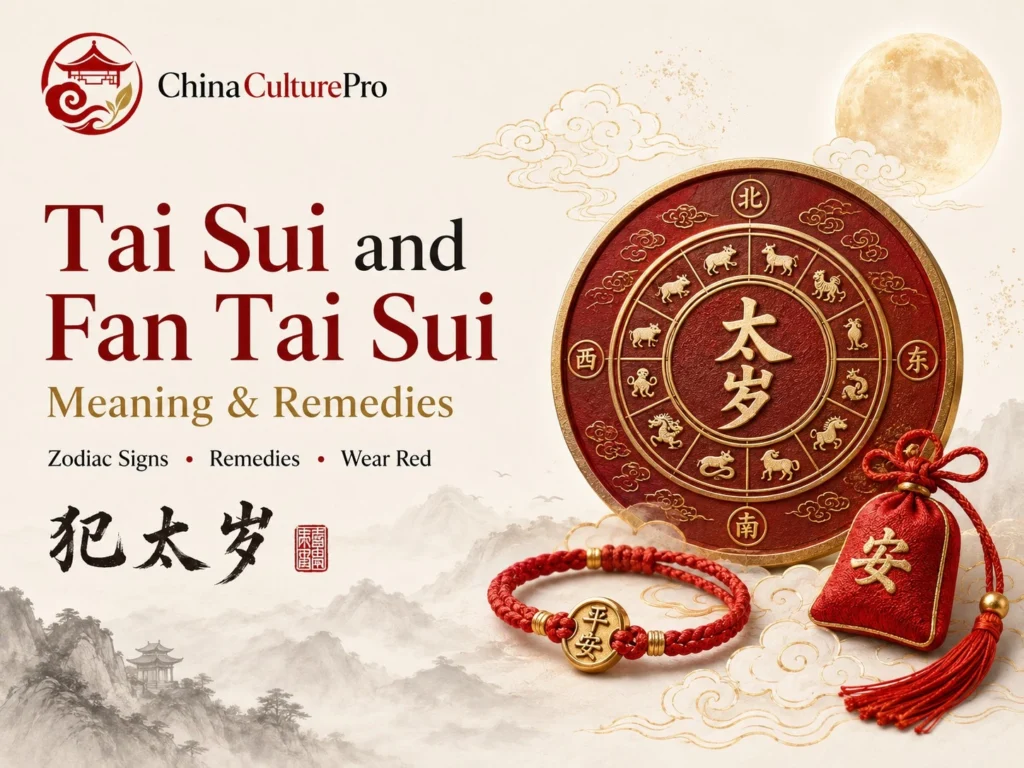

Quick Answer: What Is Tai Sui and Fan Tai Sui?
Tai Sui (太岁) is the yearly ruling energy in Chinese tradition. It is often translated as Grand Duke Jupiter, but it is more than an astronomical idea. In folk belief, Taoist practice, Feng Shui, and Chinese zodiac reading, Tai Sui is the annual force that governs the year’s qi, direction, rules, and pressure points.
Fan Tai Sui (犯太岁), often translated as “offending Tai Sui,” means a person’s zodiac sign, BaZi chart, or spatial direction has a strong interaction with the Tai Sui of the year. This interaction may appear as Zhi Tai Sui, Chong Tai Sui, Xing Tai Sui, Hai Tai Sui, or Po Tai Sui.
Fan Tai Sui does not mean guaranteed bad luck. A better reading is: the year is more unstable, more active, or more demanding for you. It may bring change, pressure, conflict, delays, emotional tension, or the need to act more cautiously.
Common remedies include Bai Tai Sui, An Tai Sui, wearing red, carrying Tai Sui amulets, doing good deeds, avoiding reckless decisions, and respecting the Tai Sui direction in Feng Shui.
| Item | Detail |
|---|---|
| Main Topic | Tai Sui and Fan Tai Sui |
| Chinese Terms | Tai Sui (太岁) / Fan Tai Sui (犯太岁) |
| Common English | Grand Duke Jupiter / Offending Tai Sui |
| Based On | 60-year cycle, Tai Sui Generals, Earthly Branch relations |
| Common Types | Zhi, Chong, Xing, Hai, Po Tai Sui |
| Common Effects | Change, pressure, instability, conflict, caution |
| Common Remedies | Bai Tai Sui, An Tai Sui, red items, amulets, good deeds |
| Important Limit | Not a guaranteed bad-luck sentence |
Key Point: Tai Sui is not a deity created to bring disaster, and Fan Tai Sui is not a fixed bad-luck sentence. It is a strong yearly interaction. The right response is not fear, but caution, respect, restraint, and preparation.
What Does Tai Sui Really Mean?
Tai Sui is often linked with Sui Xing, or Jupiter, because Jupiter takes about 12 years to move through the zodiac cycle. In Chinese tradition, this astronomical rhythm became connected with timekeeping, zodiac years, annual qi, and direction.
Over time, Tai Sui was also personified as the Tai Sui General. In the 60 Jia Zi cycle, each year is associated with a different Tai Sui General. This gives Tai Sui both a time-based meaning and a deity-based meaning in folk and Taoist practice.
But Tai Sui should not be reduced to “one angry god.” It is better understood as the strongest ruling qi of a year.
Tai Sui can be understood through two main layers:
- Time and zodiac layer: Your zodiac animal or BaZi chart interacts with the year’s Earthly Branch.
- Space and Feng Shui layer: Each year has a Tai Sui direction, and traditional Feng Shui avoids disturbing that direction.
In zodiac reading, Tai Sui explains why some animal signs feel more pressure in a certain year. In Feng Shui, Tai Sui explains why certain directions should not be disturbed by major renovation, drilling, digging, or loud construction.
The English term Grand Duke Jupiter is useful, but incomplete. It points to the Jupiter connection, but it does not fully express the Chinese cultural meaning. Tai Sui is a yearly force, a time marker, a directional presence, and a symbolic ruling energy.
A Chinese cultural master might explain it this way: Tai Sui is not a god looking for people to punish. It is the heaviest qi of the year. When people move with the year’s qi, life feels more orderly. When they push directly against it, act recklessly, or disturb the wrong direction, friction becomes easier.
This is why respect for Tai Sui is not only religious. It is also a cultural way of saying: know the force of the year, do not act blindly, and do not rush when the year is already unstable.
What Does Fan Tai Sui Mean?
Fan Tai Sui means “offending Tai Sui,” but this phrase can sound more frightening in English than it should.
It does not mean you angered a deity and must be punished. It means your zodiac sign, BaZi structure, or direction has a strong relationship with the year’s ruling qi. That relationship may be direct, conflicting, pressuring, hidden, or disruptive.
| Traditional Phrase | Better Reading |
|---|---|
| Offending Tai Sui | Strong interaction with the year’s ruling energy |
| Zhi / Same Year | Standing directly before the year’s energy |
| Chong / Clash | Opposing direction, visible movement |
| Xing / Punishment | Rules, pressure, inner conflict |
| Hai / Harm | Hidden friction and slow drain |
| Po / Break | Broken rhythm, plan disruption |
Fan Tai Sui is often described in folk language as an unlucky year. A more accurate interpretation is that the year becomes tighter. The person may feel more pressure, more change, more conflict, more delays, or more need for caution.
This can appear in work, money, relationships, health, home, travel, or emotional state. But it is not automatic disaster. It is a warning that the year should not be handled casually.
The best way to understand Fan Tai Sui is this: the year has called your name. Not because you did something wrong, but because your zodiac or life pattern has a tight relationship with the year’s qi. Tight does not mean disaster. Tight means you should move with more awareness.
The Five Main Types of Fan Tai Sui
The five main types of Fan Tai Sui are Zhi, Chong, Xing, Hai, and Po. They are not five levels of disaster. They are five different ways a person may interact with the year’s Tai Sui.
| Type | Chinese | Basic Meaning | Common Theme |
|---|---|---|---|
| Zhi Tai Sui | 值太岁 | Same zodiac as the year | Pressure, responsibility, self-focus |
| Chong Tai Sui | 冲太岁 | Direct clash | Movement, change, conflict |
| Xing Tai Sui | 刑太岁 | Punishment / pressure | Rules, tension, inner conflict |
| Hai Tai Sui | 害太岁 | Harm | Hidden trouble, trust issues |
| Po Tai Sui | 破太岁 | Breakage | Disruption, loss, broken plans |
Zhi Tai Sui / 值太岁
Zhi Tai Sui happens when your zodiac animal is the same as the zodiac animal of the year. This is often connected with Ben Ming Nian, your own zodiac birth year.
Zhi Tai Sui is not a direct clash. It means you stand directly before the year’s Tai Sui. The year’s energy matches your own zodiac branch, so the pressure feels closer and more personal.
Common themes include self-focus, responsibility, emotional sensitivity, being noticed, and feeling pushed to prove yourself.
For example, in a Horse year, Horse people are Zhi Tai Sui. In 2026, the Fire Horse year, Horse people face both Ben Ming Nian and Zhi Tai Sui.
Zhi Tai Sui is one of the most self-focused forms of Fan Tai Sui. The danger is not only outside trouble. It is also overreacting, overproving, or making big decisions from ego pressure.
Chong Tai Sui / 冲太岁
Chong Tai Sui is a direct clash with the year’s Tai Sui. It is usually the most visible and active form of Fan Tai Sui.
Chong means opposition. The person’s zodiac branch faces the year’s branch directly. This can bring movement, conflict, relocation, job change, relationship turning points, travel, or sudden changes in direction.
In a Horse year, Rat people are Chong Tai Sui because Rat and Horse form the Zi-Wu clash.
Chong Tai Sui is not always bad. Sometimes it forces a person to move out of a stuck place. But because the movement is strong, it should be managed carefully.
The best response is to plan change instead of being dragged by it.
Xing Tai Sui / 刑太岁
Xing Tai Sui means punishment or pressure. It is usually less obvious than a clash, but it can feel heavy.
This type often relates to rules, systems, legal matters, repeated emotional knots, inner tension, or conflict that is hard to explain. It can show up as being blocked by procedure, pressured by responsibility, or trapped in a repeated pattern.
Some systems also discuss self-punishment. In a Horse year, Horse people may be considered to face self-punishment in addition to Zhi Tai Sui.
Xing Tai Sui is the most inwardly heavy type. It may not explode like Chong Tai Sui, but it can make a person feel stuck, irritated, or mentally burdened.
The best response is to follow rules carefully, avoid legal or contractual carelessness, and manage emotions before they become self-sabotage.
Hai Tai Sui / 害太岁
Hai Tai Sui means harm. This type is quieter than a clash, but it can be draining.
Hai often appears as hidden friction, misunderstanding, trust issues, gossip, small people problems, relationship discomfort, or slow obstacles. It may not feel dramatic at first, but over time it can create exhaustion.
In a Horse year, Ox people are Hai Tai Sui because Ox and Horse form the Chou-Wu harm.
Hai Tai Sui is the most hidden type. The problem is often not one large conflict, but small things that slowly wear down trust, energy, or cooperation.
The best response is to communicate clearly, avoid vague promises, protect boundaries, and do not ignore small signs of trouble.
Po Tai Sui / 破太岁
Po Tai Sui means breakage. It often points to broken rhythm, broken plans, broken cooperation, broken promises, or unexpected disruption.
Po does not always mean a total collapse. More often, something that seemed stable develops a crack. A plan changes, a deal weakens, a relationship loses trust, or a project loses its original shape.
In a Horse year, Rabbit people are Po Tai Sui because Rabbit and Horse form the Mao-Wu break.
Po Tai Sui is the most fragmented type. It is not always one large problem, but a pattern of small breakages.
The best response is to double-check agreements, avoid overpromising, leave backup plans, and protect cooperation.
A simple way to remember the five types: Chong hits directly, Hai wears things down quietly, Po breaks a corner, Xing gets stuck in rules or emotions, and Zhi stands directly before Tai Sui.
Which Zodiac Signs Fan Tai Sui in 2026?
This guide is evergreen, but 2026 is an important example because it is the Fire Horse year. Chinese New Year in 2026 begins on February 17, 2026. Before that date, the common Chinese zodiac-year boundary has not yet entered the Horse year.
In 2026, the main zodiac signs that Fan Tai Sui are Horse, Rat, Ox, and Rabbit.
| 2026 Sign | Tai Sui Type | Earthly Branch Relation | What to Watch |
|---|---|---|---|
| Horse | Zhi Tai Sui / Ben Ming Nian | Same Horse branch | Pressure, self-focus, big decisions |
| Rat | Chong Tai Sui | Zi-Wu clash | Change, movement, conflict |
| Ox | Hai Tai Sui | Chou-Wu harm | Hidden friction, slow obstacles |
| Rabbit | Po Tai Sui | Mao-Wu break | Broken plans, relationship or work disruption |
Horse people face Zhi Tai Sui and Ben Ming Nian in 2026. In some systems, Horse also carries a self-punishment theme. This makes 2026 a year when Horse people should avoid ego-driven decisions, reckless expansion, and emotional overreaction.
Rat people face Chong Tai Sui. This is the most active form, often linked with change, relocation, job shifts, conflict, or pressure to move. The key is to manage change instead of resisting everything or rushing blindly.
Ox people face Hai Tai Sui. The main issue is hidden friction: misunderstanding, slow delays, small people problems, relationship fatigue, or plans that get stuck quietly.
Rabbit people face Po Tai Sui. This may show as broken plans, unstable cooperation, damaged rhythm, or a need to repair agreements before they fall apart.
Some yearly guides may include additional signs based on school-specific rules, but this evergreen guide focuses on the four clearest Horse-year relationships: same, clash, harm, and break.
These signs are not doomed in 2026. They should simply be more cautious, disciplined, flexible, and prepared.
For the 2026 zodiac context, read our Year of the Horse guide.
What Happens When You Fan Tai Sui?
When you Fan Tai Sui, the year may feel less stable. This does not mean something terrible must happen. It means you should pay more attention to risk, timing, communication, and decision-making.
| Area | Possible Pattern | Practical Advice |
|---|---|---|
| Career | Change, pressure, delays | Avoid impulsive job moves |
| Money | Loss, risky decisions | Reduce speculation, avoid guarantees |
| Relationships | Misunderstanding, arguments | Speak slower, avoid hard confrontation |
| Health | Fatigue, small injuries | Check health, drive carefully |
| Home / Travel | Movement, repair, relocation | Plan before acting |
| Mindset | Restlessness, self-pressure | Slow down before decisions |
Different types of Fan Tai Sui feel different:
- Zhi Tai Sui: personal pressure, self-focus, overreaction, ego decisions.
- Chong Tai Sui: obvious movement, outside pressure, sudden change.
- Xing Tai Sui: rules, procedures, inner tension, repeated emotional knots.
- Hai Tai Sui: hidden drain, mistrust, gossip, small relationship damage.
- Po Tai Sui: broken rhythm, damaged plans, weakened cooperation.
What Fan Tai Sui fears most is not disaster falling from the sky. It is a person rushing harder when the year is already unstable. When the year is moving and the person also becomes reckless, problems grow faster.
Handled wisely, Fan Tai Sui can also become a year of correction, restructuring, and growth.
Tai Sui Remedies: What Can You Do?
Tai Sui remedies should be understood on two levels: cultural remedies and practical remedies.
Traditional remedies help people show respect, begin the year with caution, and create a symbolic boundary. Practical remedies turn that respect into daily behavior.
Traditional Tai Sui Remedies
| Remedy | Cultural Meaning | Practical Reading |
|---|---|---|
| Bai Tai Sui | Pray to the year’s Tai Sui | Begin the year with respect and caution |
| An Tai Sui | Settle / enshrine Tai Sui | Create a protective reminder |
| Hua Tai Sui | Reduce Tai Sui conflict | Follow local temple or Taoist guidance |
| Wear Red | Protection and blessing | Stay alert and grounded |
| Tai Sui Amulet | Symbolic protection | Reminder, not a guarantee |
| Good Deeds | Build merit and reduce conflict | Improve relationships and mindset |
| Xie Tai Sui | Thank Tai Sui at year-end | Complete the ritual cycle |
Bai Tai Sui means praying to the year’s Tai Sui for peace and protection. Many people do this early in the lunar year.
An Tai Sui means settling or enshrining Tai Sui, often through a temple or Taoist practice. The purpose is to ask for stability and protection through the year.
Hua Tai Sui means reducing or transforming the unstable interaction with Tai Sui. Practices differ by region, temple, Taoist lineage, and family custom.
Wearing red is common, especially during Ben Ming Nian or Zhi Tai Sui. Red symbolizes protection, blessing, and active yang energy. It can include red clothing, red socks, a red bracelet, or a red belt.
Tai Sui amulets or talismans are also common. But they should not be treated as a magic switch. Their practical value is also psychological: they remind you that this is a year to stay alert.
Doing good deeds is one of the most important traditional remedies. Help elders, support weaker people, reduce conflict, and avoid creating resentment. In Chinese thinking, lowering conflict is also a way of lowering risk.
Practical Tai Sui Remedies
Use the year to reduce risk and avoid unnecessary friction:
- Set lower-risk plans early in the year.
- Avoid impulsive resignation, investment, lending, or guarantees.
- Review contracts carefully.
- Do not make marriage, breakup, resignation, or business decisions at emotional peaks.
- Drive, travel, and exercise more cautiously.
- Avoid hard confrontation with bosses, clients, partners, and family.
- If marriage, moving, renovation, or job change is necessary, plan timing and backup options.
- Keep a stable routine, sleep enough, and reduce avoidable stress.
- Do good deeds and repair relationships where possible.
The best remedy is not buying one object and forgetting the year. The real meaning of respecting Tai Sui is turning caution into daily discipline: less impulse, less gambling, less hard confrontation, more patience, more kindness, and more good deeds.
Bai Tai Sui, An Tai Sui, Hua Tai Sui, and Xie Tai Sui
Several ritual terms often appear in Tai Sui articles. They are related but not identical.
| Practice | Meaning | When It Is Usually Done |
|---|---|---|
| Bai Tai Sui | Pray to Tai Sui | Early in the lunar year |
| An Tai Sui | Settle / enshrine Tai Sui | Early in the year |
| Hua Tai Sui | Reduce Tai Sui conflict | During a Fan Tai Sui year |
| Xie Tai Sui | Give thanks to Tai Sui | End of the lunar year |
Bai Tai Sui is the general act of praying to Tai Sui. Many people do it after Chinese New Year or early in the lunar year.
An Tai Sui is more about settling or enshrining Tai Sui through a ritual arrangement, temple process, or talisman.
Hua Tai Sui focuses on reducing the conflict or instability of a Fan Tai Sui year.
Xie Tai Sui means thanking Tai Sui near the end of the lunar year. In traditional practice, if you pray at the beginning, you should give thanks at the end.
Exact practices differ by region, temple, Taoist tradition, and family custom. There is no single rule used everywhere. Follow local temple or Taoist guidance instead of assuming one universal ritual method.
Tai Sui Direction and Feng Shui
Tai Sui is not only related to zodiac signs. It is also related to direction in Feng Shui.
Each year has a Tai Sui direction. The opposite direction is often called Sui Po. Traditional Feng Shui advises people not to disturb the Tai Sui direction with major construction, drilling, digging, knocking walls, or loud renovation.
| Feng Shui Term | Meaning |
|---|---|
| Tai Sui Direction | Direction of the year’s Tai Sui |
| Sui Po | Opposite direction from Tai Sui |
| Avoid | Major renovation, digging, drilling, noisy disturbance |
| Practical Tip | Check yearly Feng Shui guidance before major work |
In a Horse year, Tai Sui is associated with the Horse branch and the South / Wu sector. For 2026, many Feng Shui readings connect Tai Sui with the southern direction.
Ordinary daily life does not need panic. You do not need to fear normal walking, sitting, working, or sleeping. The traditional warning is mainly about major disturbance in that direction.
If you plan large renovation, demolition, drilling, digging, or major construction, check the year’s Tai Sui direction first. This guide does not expand detailed degree ranges or annual flying star methods; those belong to a separate yearly Feng Shui guide.
Common Myths About Tai Sui
Tai Sui is often misunderstood. These myths make the topic either too frightening or too shallow.
| Myth | Better Understanding |
|---|---|
| Fan Tai Sui means disaster | It means caution, instability, and stronger yearly friction |
| Fan Tai Sui means you angered a god | It means your energy is tightly related to the year’s qi |
| Zodiac sign alone decides everything | BaZi, age, choices, and environment matter |
| Wearing an amulet solves everything | It is a symbolic reminder, not a magic switch |
| Red fixes all problems | Red is blessing and reminder, not a guarantee |
| You cannot marry, move, or change jobs | You can, but plan more carefully |
| Same zodiac, same fate | Different ages and charts change the experience |
| Remedies are only superstition | They can also work as cultural psychology and risk management |
Fan Tai Sui does not mean guaranteed bad luck. Many people marry, move, change jobs, start businesses, or make major progress in a Fan Tai Sui year. The issue is not whether action is forbidden. The issue is whether the action is planned or reckless.
A person’s zodiac sign is only one layer. A 12-year-old, 24-year-old, 36-year-old, 48-year-old, and 60-year-old of the same zodiac sign will experience the year differently. Their BaZi, family, career stage, health, money situation, and choices are not the same.
Red items, amulets, and rituals can be meaningful, but they do not replace good decisions. The object is not the entire remedy. The mindset behind it matters.
Traditional remedies can also be understood as cultural psychology and risk management. Bai Tai Sui creates respect. Wearing red creates awareness. Doing good deeds reduces resentment. Careful planning reduces real-world risk.
How to Spend a Fan Tai Sui Year Wisely
A Fan Tai Sui year is not a year to disappear. It is a year to stabilize.
Use the year to reduce unnecessary risk, repair weak points, and avoid turning small problems into large ones.
- Set lower-risk plans early in the year.
- Review important decisions twice.
- Leave a cooling period before major commitments.
- Do not fight only for face.
- Avoid speculation, guarantees, and high leverage.
- Be careful with driving, sports, tools, and travel.
- Do not decide marriage, breakup, resignation, or investment during emotional peaks.
- Choose timing carefully if you must move, renovate, marry, or change jobs.
- Keep backup plans for work and money.
- Repair relationships before small resentment becomes open conflict.
- Listen to elders, professionals, or people with more experience.
- Do good deeds and reduce unnecessary conflict.
- If you follow the ritual tradition, remember to thank Tai Sui at year-end.
Fan Tai Sui does not tell you to hide for a year. It tells you not to be hard when the year is already hard.
Slow half a step, and you make one fewer mistake. Soften one sentence, and you create one fewer knot. A stable year is already a strong remedy.
How This Guide Connects to Chinese Zodiac Content
Tai Sui and Fan Tai Sui are important parts of the Chinese Zodiac, Five Elements, BaZi, and Feng Shui content system.
To confirm your animal sign first, start with our Chinese Zodiac guide.
For quick birth-year and zodiac lookup, use our Chinese Zodiac & Lunar Birthday Calculator.
Because Tai Sui years follow the Chinese year boundary, read our Chinese New Year guide before judging January or February births.
Ben Ming Nian is closely connected with Zhi Tai Sui because your own zodiac year is usually the year when you directly face Tai Sui. To understand why your own zodiac year feels stronger, read our Ben Ming Nian guide.
For Earthly Branch clashes, harms, and breaks in relationships, see our Chinese Zodiac Compatibility guide.
To understand why 2026 is a Fire Horse year, read our Five Elements Chinese Zodiac guide.
To see why 2026 Bing Wu also has the Na Yin name Heavenly River Water, read our Na Yin Five Elements guide.
Tai Sui is the bridge between zodiac years, year energy, Feng Shui direction, and yearly caution. This page is the evergreen hub. Year-specific pages can explain which signs Fan Tai Sui in each year.
Final Thoughts
Tai Sui is not a deity created to bring disaster, and Fan Tai Sui is not guaranteed bad luck.
Tai Sui is more like the heaviest qi of the year. Zhi, Chong, Xing, Hai, and Po Tai Sui describe different friction patterns between a person and that yearly energy.
Real remedies are not only praying, wearing red, or carrying an amulet. They are also about knowing where the year is unstable, slowing your steps, softening your words, lowering risk, and doing more good.
When the year is tense, do not become harder than the year itself. Slow half a step, and you make one fewer mistake. Soften one sentence, and you create one fewer knot.
FAQs About Tai Sui and Fan Tai Sui
What is Tai Sui?
Tai Sui is the yearly ruling energy in Chinese tradition. It is often translated as Grand Duke Jupiter and is also personified as the Tai Sui General of the year. Tai Sui relates to annual qi, zodiac year energy, and Feng Shui direction.
What is Fan Tai Sui?
Fan Tai Sui means a person’s zodiac sign, BaZi chart, or direction has a strong interaction with the year’s Tai Sui. This may appear as Zhi, Chong, Xing, Hai, or Po Tai Sui. It does not mean guaranteed disaster. It means a year that needs more caution.
Is Tai Sui the same as Grand Duke Jupiter?
Grand Duke Jupiter is the common English translation of Tai Sui, but the meaning is broader in Chinese tradition. Tai Sui is connected with Jupiter, but it also refers to the annual Tai Sui deity, the ruling yearly qi, and the Feng Shui direction of the year.
Which zodiac signs Fan Tai Sui in 2026?
In 2026, the Fire Horse year, the main Fan Tai Sui signs are Horse, Rat, Ox, and Rabbit. Horse is Zhi Tai Sui and Ben Ming Nian. Rat is Chong Tai Sui. Ox is Hai Tai Sui. Rabbit is Po Tai Sui. The Horse year begins at Chinese New Year on February 17, 2026.
What are the types of Fan Tai Sui?
The five main types are Zhi Tai Sui, Chong Tai Sui, Xing Tai Sui, Hai Tai Sui, and Po Tai Sui. Zhi means same zodiac as the year. Chong means direct clash. Xing means punishment or pressure. Hai means harm. Po means breakage or disruption.
Is Ben Ming Nian the same as Fan Tai Sui?
Ben Ming Nian is usually a form of Fan Tai Sui because it is commonly Zhi Tai Sui: your zodiac animal is the same as the year’s zodiac animal. However, Fan Tai Sui is broader. Chong, Xing, Hai, and Po Tai Sui can affect signs that are not in their own zodiac year.
What should I do if I Fan Tai Sui?
Traditional remedies include Bai Tai Sui, An Tai Sui, wearing red, carrying a Tai Sui amulet, doing good deeds, and thanking Tai Sui at year-end. Practical remedies include avoiding reckless decisions, reducing financial risk, driving carefully, reviewing contracts, and communicating more calmly.
Does wearing red help Fan Tai Sui?
Wearing red is a common Chinese tradition, especially during Ben Ming Nian or Zhi Tai Sui. Red symbolizes protection, blessing, and active yang energy. It is not magic. Its real value is also as a reminder to stay grounded, cautious, and respectful of the year.
Can I get married or move house during Fan Tai Sui?
Fan Tai Sui does not automatically forbid marriage, moving, job change, renovation, or business decisions. It means these actions should be planned more carefully. Choose timing, check documents, reduce impulsive choices, prepare backup plans, and avoid acting only from pressure or emotion.
Is Fan Tai Sui always bad luck?
No. Fan Tai Sui is not guaranteed bad luck. It means the year’s qi interacts strongly with your sign or chart. Some people experience pressure, while others experience breakthrough, relocation, growth, or correction. The key is to turn instability into planned adjustment instead of reckless reaction.