
Quick Answer: What Is Feng Shui?
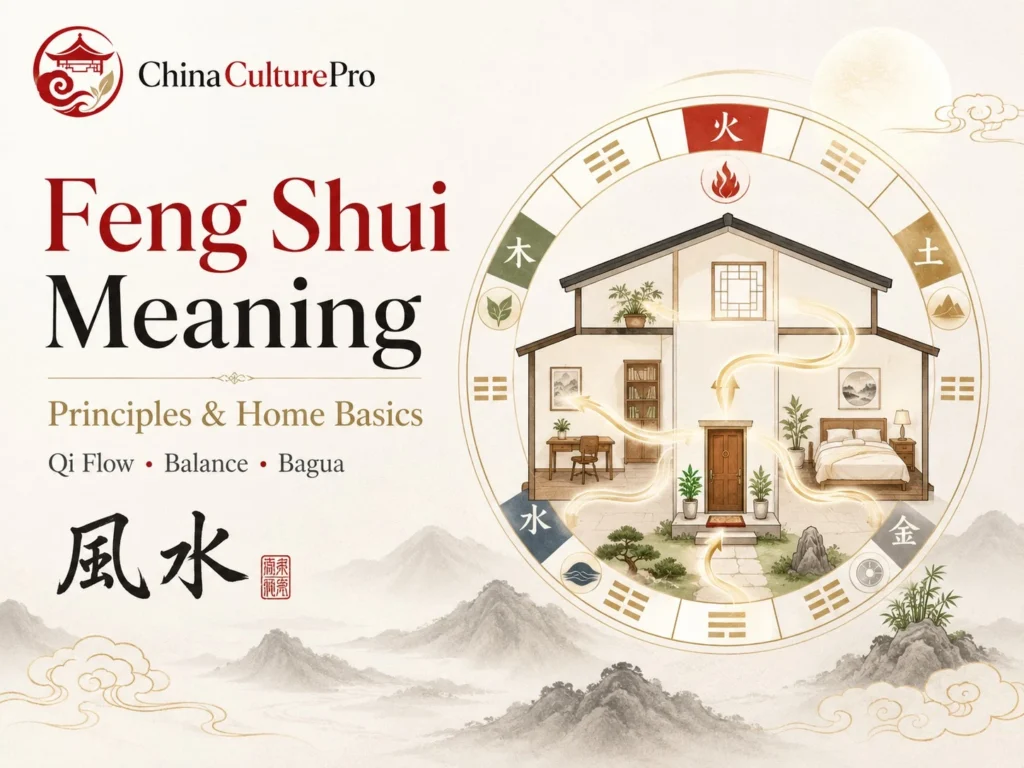
Feng Shui (风水) is a traditional Chinese way of reading the relationship between people and space. The words literally mean “wind and water,” but Feng Shui is not only about wind, water, decorating, colors, plants, mirrors, or lucky objects.
At its core, Feng Shui studies qi (气): how qi enters a space, how it moves, where it settles, where it rushes, and where it becomes blocked.
A home, bedroom, office, shop, or building is not treated as an empty box. It has a qi mouth, movement paths, resting points, support, pressure, light, darkness, direction, and timing. Feng Shui reads these layers to see whether a space feels stable, smooth, nourishing, pressured, blocked, or too restless.
The basic ideas include qi flow, yin-yang balance, Five Elements, Bagua, Form School, Compass School, directions, and annual timing. In practical home Feng Shui, the most important areas are often the front door, bed, stove, desk, entryway, light, airflow, clutter, back support, and open space.
| Item | Detail |
|---|---|
| Main Topic | Feng Shui / 风水 |
| Literal Meaning | Wind and Water |
| Core Idea | Managing qi flow between people and space |
| Main Layers | Form, direction, time, Five Elements, Bagua |
| Used For | Home, bedroom, office, site, renovation timing |
| Important Limit | Not just decor, not guaranteed magic |
Key Point: Feng Shui is not a decorating trick or an interior design style. It reads the qi between people and space. The goal is not to fear a house, but to understand where the space is smooth, where it is blocked, where qi rushes too fast, and where stability is needed.
The previous Chinese zodiac and BaZi topics focus mainly on time: years, months, hours, annual luck, and personal timing. Feng Shui moves into space: house, direction, qi mouth, form, compass, annual sectors, and the environment people live in.
What Does “Feng Shui” Really Mean?
The words “Feng Shui” literally mean “wind and water,” but the deeper meaning is about qi.
Wind shows how qi moves. Water shows how qi gathers.
Wind is moving, invisible, and hard to hold. If the wind is too strong, qi scatters. If air cannot move at all, qi becomes stale. Water is visible and gathering. In traditional thinking, water can collect qi, guide qi, and nourish a place.
This is why one of the most important Feng Shui ideas is cang feng ju qi (藏风聚气), often translated as “hide wind and gather qi.”
Good Feng Shui is not about making qi as strong as possible. It is about letting qi arrive, slow down, settle, and become usable.
| Feng Shui Image | Deeper Meaning |
|---|---|
| Wind | movement, flow, invisible qi |
| Water | gathering, settling, nourishment |
| Too much wind | qi scatters too quickly |
| Blocked air | qi becomes stale |
| Gentle gathering | qi can settle and support people |
Traditional Feng Shui began with site selection. Ancient people looked at mountains, rivers, roads, slopes, wind, water sources, sunlight, and protection. A good site often needed support behind it, open space in front, balanced forms on both sides, and a gentle way for qi and water to gather.
In a modern city, the same logic can be translated into practical language:
- A “back mountain” may become a solid wall or stable building support.
- A “bright hall” may become an open entryway, courtyard, or living-room space.
- Water flow may be read through roads, walkways, traffic, entrances, or actual water.
- Sharp forms may appear as building corners, road rushes, high-pressure structures, or narrow gaps between towers.
A Chinese Feng Shui master might say: Feng Shui is not about asking where there is wind and where there is water. It asks where qi comes from, where it stops, where it rushes, and where it cannot settle.
The Core Principles of Feng Shui
Feng Shui has many schools and methods, but beginners should first understand a few core principles. These principles are more important than memorizing lucky objects.
| Principle | What It Means | Simple Reading |
|---|---|---|
| Qi Flow | Qi should enter, move, and settle smoothly | A door should be open, paths should not rush or block |
| Yin-Yang | Active and quiet, bright and dark, open and closed need balance | Bedroom should be calmer; living room can be brighter |
| Five Elements | Wood, Fire, Earth, Metal, and Water describe states of qi | Use elements according to room function |
| Form First | Shape and environment matter before objects | Roads, buildings, doors, and layout matter more than ornaments |
| Position Matters | Door, bed, stove, and desk are key positions | These are places where people receive qi daily |
| Timing Matters | Feng Shui changes by year and direction | Check Tai Sui and annual sectors before major renovation |
Qi should be able to enter, move, and settle. It should not rush straight through a home, become trapped in clutter, or scatter without gathering.
Yin and Yang describe balance. A bedroom should not feel like a busy office. A living room should not feel like a dark storage room. A good home does not make every room feel the same.
Five Elements describe different states of qi. Wood, Fire, Earth, Metal, and Water can appear through color, shape, material, lighting, movement, and room function.
Form comes before small objects. A road rushing toward the door matters more than a lucky charm. A bed with no support matters more than the color of a pillow.
Position matters because people interact with certain places every day. The front door, bed, stove, and desk shape entry, rest, nourishment, work, and attention.
Timing matters because Feng Shui is not completely static. Annual Feng Shui considers Tai Sui direction, Sui Po, San Sha, Flying Stars, and other yearly shifts. Major renovation, drilling, wall breaking, or ground disturbance should not ignore annual directions.
Feng Shui Is Not Just Home Decor
Many English Feng Shui articles focus on plants, mirrors, crystals, colors, candles, and lucky objects. These can be part of Feng Shui culture, but they are not the foundation.
Feng Shui should not begin with buying objects. It should begin with reading the space.
| Mistake | Better Understanding |
|---|---|
| Feng Shui is just decor | Decor is only the surface layer |
| A lucky object fixes everything | Objects cannot replace layout and qi flow |
| Good design equals good Feng Shui | Beauty and qi flow are related but not identical |
| Expensive objects work better | Price does not decide Feng Shui value |
| More symbols mean more luck | Too much clutter can block qi |
| Feng Shui is only superstition | It can also be read as spatial order and cultural practice |
A plant may add life. A mirror may expand light. A red object may lift yang qi. A water feature may symbolize flow. But if the front door is blocked, the bed is unsupported, the stove is dirty, and the desk faces a wall with the back exposed, the main structure is still weak.
Objects can have symbolic value and psychological effect. They can remind people of growth, clarity, warmth, wealth, calm, or protection. But they cannot replace the basic reading of door, bed, stove, desk, light, movement, clutter, support, and annual directions.
A better order is:
- Read the outer environment.
- Check the door and main qi flow.
- Stabilize the bed, stove, desk, and seating.
- Clear clutter and repair broken areas.
- Adjust light, air, movement, and function.
- Use symbolic objects only after the main structure is clean and stable.
Feng Shui is not against beauty. A beautiful space can support qi. But beauty alone is not enough. A room can look expensive and still feel unstable, rushed, dark, cold, sharp, or unsupported.
Form School Feng Shui: Shape, Land, and Surroundings
Form School Feng Shui reads shape, land, road, water, building form, support, pressure, openness, and balance. In traditional Feng Shui, form is often read before compass methods because the visible environment sets the large pattern.
The old language speaks of mountains, water, dragons, tigers, bright halls, and protective forms. In modern homes, the same ideas can be understood through walls, roads, buildings, paths, views, entry spaces, and pressure from nearby structures.
| Form Concept | Traditional Idea | Home Reading |
|---|---|---|
| Back Support | Mountain support behind | Stable wall or protected back |
| Bright Hall | Open space in front | Entry or living area where qi can gather |
| Left-Right Balance | Green Dragon and White Tiger support | No severe imbalance or pressure from one side |
| Road / Water Flow | Qi follows movement and water | Roads, corridors, and paths should not rush harshly |
| Sharp Forms | Corners, cuts, pressure | Avoid direct pressure from sharp corners or buildings |
| Front-Back Stability | Open front, supported back | Not exposed everywhere, not trapped everywhere |
Back Support
A bed, sofa, or desk usually feels better with solid support behind it. In traditional language, this is called having support or a “back mountain.”
In modern language, it gives the body and mind a sense of stability. A bed floating in open space, a desk with the back to the door, or a sofa with a walkway directly behind it can feel exposed.
Bright Hall
A bright hall is an open area where qi can gather before entering or settling. It does not need to be a grand courtyard. In a home, it may be a clean entryway, open living area, or uncluttered space in front of important furniture.
If the front area is cramped, dark, blocked, or pressured, qi has no place to settle.
Road and Water Flow
In traditional Feng Shui, water carries and gathers qi. In cities, roads, walkways, corridors, and traffic can act like movement channels.
A road or corridor rushing directly toward a door can create harsh qi. A gentle curved approach is usually more comfortable than a sharp direct rush.
Sharp Forms and Pressure
Sharp corners, building edges, high-pressure roads, large signs, nearby towers, overhead structures, or narrow gaps between buildings can create pressure. In Feng Shui language, these may be called sha forms. In modern language, they create visual, physical, and psychological stress.
A Chinese master might say: Form decides the large pattern. If the door is rushed by a road, the back has no support, and the house is pressured by sharp forms, small objects are only small repairs at the end.
Compass Feng Shui: Directions, Bagua, and Luo Pan
Compass Feng Shui reads direction, sitting and facing, Bagua, Luo Pan, time, annual qi, and directional relationships. It is often called the Li Qi, or “principle and qi,” side of Feng Shui.
Form School and Compass School are not enemies. They answer different questions.
| Method | Focus | Beginner Understanding |
|---|---|---|
| Form School | Shape, land, roads, support | What the space looks and feels like |
| Compass School | Direction, Bagua, Luo Pan, time | Where the space faces and how qi changes |
| Modern Bagua | Life-area mapping | Useful as an entry tool, but simplified |
Form reads whether the space has shape and support. Compass methods read direction and timing.
Bagua (八卦) means Eight Trigrams. It is not only a modern home life-area map. The Eight Trigrams are built from yin and yang lines and are used to describe natural forces, directions, family roles, elements, and patterns of change.
Many English Feng Shui pages use a modern Bagua Map that divides a home or room into life areas such as wealth, career, relationship, family, and fame. This can be useful for beginners, but it should not be confused with the full traditional compass system.
Traditional Feng Shui also uses the Luo Pan (罗盘), a specialized Chinese compass with many rings. It can measure sitting and facing direction, mountains, sectors, and other layers. Beginners do not need to learn the Luo Pan immediately, but they should understand one thing: direction is not random.
If a method depends on direction, the direction should be measured. It should not be guessed from memory.
The simplest way to understand the relationship is this: Form reads whether the space has shape and support. Compass reads whether the direction and timing carry usable qi. If you only read form, you may miss time and direction. If you only read compass theory but ignore the actual building, the reading becomes empty.
Bagua Map and the Eight Life Areas
The Bagua Map is one of the most searched Feng Shui tools in English. It is often used to connect parts of a home or room with life themes.
A common modern Bagua layout uses nine areas: eight surrounding areas plus the center.
| Bagua Area | Common Life Theme | Element Direction |
|---|---|---|
| North | Career | Water |
| East | Family / growth | Wood |
| Southeast | Wealth | Wood |
| South | Fame / visibility | Fire |
| Southwest | Relationship | Earth |
| West | Children / creativity | Metal |
| Northwest | Helpful people | Metal |
| Northeast | Knowledge | Earth |
| Center | Health / balance | Earth |
This table is useful as an entry point. It helps beginners observe which areas of a home are bright, blocked, broken, cluttered, used, or ignored.
But it should be used carefully.
Different Feng Shui schools use Bagua differently. Traditional compass systems use directions and trigrams. Modern Western or BTB-style Bagua may align the map with the entrance or front door. These are not the same method.
For beginners, the Bagua Map can be used as an observation tool. It can help you ask:
- Which area of the home is cluttered?
- Which area feels dark or unused?
- Which area receives good light?
- Which area is broken, leaking, blocked, or unstable?
- Which life theme does this area symbolically connect with?
Bagua Map alone does not replace form, compass direction, floor plan, actual movement, room function, or the people living in the home.
The Five Elements in Feng Shui
The Five Elements in Feng Shui are Wood, Fire, Earth, Metal, and Water. They are not only physical materials. They are five states of qi expressed through shape, color, texture, movement, function, and atmosphere.
| Element | Spatial Feeling | Common Expressions | Use With Care |
|---|---|---|---|
| Wood | growth, life, upward movement | plants, green, vertical lines, wood furniture | too much can feel crowded |
| Fire | warmth, visibility, activity | light, red, orange, candles, triangles | too much can feel restless |
| Earth | stability, support, heaviness | stone, ceramic, square shapes, yellow, brown | too much can feel heavy |
| Metal | order, clarity, boundary | metal objects, white, gray, round shapes | too much can feel cold |
| Water | flow, wisdom, movement | water, blue, black, curves, mirrors | too much can feel unstable |
The goal is not to force all five elements into every room. A bedroom does not need the same qi as an office. A kitchen does not need the same qi as a meditation room.
Room function matters.
| Room | Better Element Direction | Avoid Overdoing |
|---|---|---|
| Bedroom | stability, calm, gentle support | too much Fire, moving Water, or visual noise |
| Office | clarity, order, focus, flow | cluttered Wood, excessive Fire, harsh cold Metal |
| Living Room | brightness, life, gathering | blocked seating or restless movement |
| Kitchen | clean Fire and Water coordination | dirty stove, leaks, poor ventilation |
Five Elements in Feng Shui are not decoration categories. They are spatial qi patterns.
Key Areas in Home Feng Shui: Door, Bed, Stove, and Desk
In home Feng Shui, some areas matter more than others because people interact with them every day.
Traditional residential Feng Shui often emphasizes the door, main resting area, and stove. In modern life, the desk is also important because many people spend long hours working or studying there.
| Area | Feng Shui Role | Basic Rule |
|---|---|---|
| Door | Qi mouth | clean, bright, open |
| Bed | rest and recovery | solid support, calm position |
| Stove | fire and nourishment | clean, stable, not conflicted |
| Desk | work and focus | command position, back support |
Front Door / 门: The Qi Mouth
The front door is the qi mouth of the home. It is where qi first enters.
A good front door area should be bright, clean, open, and easy to use. It should not be blocked by shoes, boxes, trash, broken objects, or dark narrow clutter.
The door itself should work well. A broken handle, blocked opening, peeling surface, or long-term damage creates a weak first impression for qi.
The space outside the door also matters. A door facing a harsh road rush, sharp corner, elevator door, or direct opposite door may feel pressured. The answer is not always fear, but it should be read carefully.
A door is not simply “bigger is better.” A small home with an oversized door may feel scattered. A large home with a tiny, hidden, blocked entrance may feel restricted. The door should match the home.
Bed / 床: Rest and Recovery
The bed affects sleep, stability, health, and relationship atmosphere. It is one of the most important positions because people receive qi there for many hours every night.
A bed usually works best with solid support behind the headboard. A solid wall gives a sense of backing. The bed should ideally allow the person to see the door without being directly in line with it. This is often called the command position.
Common problems include a bed with no solid back support, a bed directly facing the door, a beam pressing above the bed, a mirror directly reflecting the bed, a bed head against a window, too many electronics, strong light, or moving water in the bedroom.
A bedroom should be calm. It should not feel like an office, storage room, gym, or busy hallway.
Stove / 灶: Fire and Nourishment
The stove represents Fire, cooking, nourishment, and the root of food in the home. It should be clean, stable, and usable.
A stove that is broken, dirty, rarely used, or buried in clutter weakens the nourishment layer of the home. This does not mean the stove automatically creates wealth, but it does mean the kitchen should be respected.
Fire and Water conflict is also a common kitchen issue. A stove directly pressed by water features, sink, or refrigerator arrangement may need attention, depending on layout.
The practical rule is simple: keep the stove clean, stable, ventilated, and active.
Desk / 书桌 or Office Desk: Focus and Direction
The desk affects focus, work, study, and career attention.
A good desk position allows the person to see the door without being directly hit by the door line. The back should have support, preferably a solid wall or stable background. The front should have some open space, like a small bright hall.
Common problems include sitting with the back to the door, sitting under a beam, facing a blank wall too closely, working in darkness, working in clutter, having no back support, or being directly rushed by a door or hallway.
The desk does not need to be dramatic. It needs to feel stable, clear, and usable.
A Feng Shui master would usually check the door, bed, stove, and desk before recommending small decorative cures. These four places shape daily qi more than most objects.
Feng Shui Room-by-Room Basics
Different rooms have different functions, so they need different qi. A bedroom, kitchen, living room, and office should not all follow the same rule.
| Room | Main Goal | Common Focus |
|---|---|---|
| Entryway | receive qi | light, clean, open |
| Bedroom | rest and stability | bed position, calm energy |
| Living Room | gathering | seating, light, flow |
| Kitchen | nourishment | stove, cleanliness |
| Office / Study | focus | desk command position |
| Bathroom | drainage | ventilation, cleanliness |
The entryway receives the first qi of the home. It should be clean, bright, and easy to pass through. A dark or blocked entry weakens the first impression of the space.
The bedroom should support sleep and recovery. Use a stable bed position, reduce clutter, avoid too many mirrors, avoid strong moving water, and keep light soft.
The living room gathers people. It should feel bright, open, and welcoming. Seating should have support, and the main walking path should not be blocked.
The kitchen supports nourishment. Cleanliness, ventilation, and stove stability matter more than decorative cures.
The office should support focus. Desk position, back support, good light, and reduced clutter are more important than adding random lucky objects.
The bathroom is related to drainage and moisture. It should be ventilated, clean, and well maintained. Leaks, bad smells, and long-term dampness should be fixed.
Common Feng Shui Mistakes
Feng Shui is easy to misunderstand because many online tips focus on quick cures. These are the most common mistakes.
| Mistake | Better Understanding |
|---|---|
| Buying cures first | Read the space first |
| More symbols mean more luck | Clutter blocks qi |
| Bagua map solves everything | Form, direction, and use matter |
| Ignoring bed / door / stove | Key positions shape daily qi |
| Only looking at colors | Function and position matter more |
| Putting too many mirrors or plants in the bedroom | Bedrooms need calm qi |
| Leaving the entryway cluttered | The door is the qi mouth |
| Sitting or sleeping with no back support | Long-term positions need stability |
| Moving annual bad sectors | Check yearly directions before major work |
| Mixing all schools together | Different schools use different methods |
Buying objects before reading the space is the first mistake. A crystal, plant, mirror, red object, or water feature may have symbolic use, but it cannot replace a clear door, stable bed, working stove, or supported desk.
Another mistake is treating the Bagua Map as the whole of Feng Shui. Bagua can help beginners observe a home, but it does not replace form, compass direction, floor plan, room function, or annual timing.
A third mistake is creating clutter in the name of luck. More symbols do not mean more qi. Too many objects can make a space visually noisy and energetically blocked.
A fourth mistake is mixing every rule from every school. Traditional compass methods, Form School, Eight Mansions, Flying Stars, and Western / BTB Bagua do not always use the same logic. Mixing them without understanding can create confusion.
The safest beginner rule is this: read the space first. Fix the obvious problems before adding symbolic cures.
Annual Feng Shui, Tai Sui Direction, and Flying Stars
Feng Shui includes both stable house structure and annual movement.
A house has its own layout, direction, form, and long-term qi. But each year also brings annual directions and qi shifts. This is why yearly Feng Shui looks at Tai Sui direction, Sui Po, San Sha, Flying Stars, and other timing layers.
| Annual Layer | What It Means | Beginner Rule |
|---|---|---|
| Tai Sui | Yearly ruling direction | avoid major disturbance |
| Sui Po | Opposite Tai Sui direction | avoid reckless renovation |
| San Sha | Annual three killings sector | keep quiet if possible |
| Flying Stars | Annual qi shifts by palace | use yearly guide |
Tai Sui direction is the direction associated with the year’s Tai Sui. Traditional Feng Shui advises people not to disturb this direction with major renovation, drilling, digging, wall breaking, or loud construction.
Sui Po is the direction opposite Tai Sui. It is also treated with caution.
San Sha is another annual sector often kept quiet when possible.
Flying Stars refer to the annual movement of nine stars into different palaces or sectors. Each year, the pattern changes, creating different themes for different areas.
For example, in a Fire Horse year such as 2026, the Horse branch relates to the South / Wu sector. This makes the southern direction important in annual Tai Sui direction discussions. A full 2026 Flying Stars chart belongs in a dedicated yearly Feng Shui guide.
To understand annual Tai Sui energy and Fan Tai Sui, read our Tai Sui and Fan Tai Sui guide.
The basic rule is simple: Feng Shui is not something arranged once and forgotten forever. A home has its base structure, but the year also has its qi. Major disturbance should respect annual directions.
Feng Shui and BaZi: Space and Person Together
BaZi and Feng Shui are connected, but they do not read the same thing.
BaZi reads the person’s birth-time structure. Feng Shui reads the qi of the space.
| System | Reads | Main Question |
|---|---|---|
| BaZi | person and time | What is the person’s structure and timing? |
| Feng Shui | space and direction | What qi does the environment provide? |
| Together | person-space fit | Does this space support this person now? |
BaZi looks at a person’s Four Pillars, Day Master, Five Elements, Ten Gods, Luck Pillars, and Annual Luck. Feng Shui looks at the home, site, direction, qi mouth, form, Bagua, Five Elements, annual sectors, and movement of qi.
A simple way to understand the difference: BaZi reads the person. Feng Shui reads the environment.
The same house can feel different to different people. One person may feel supported by a quiet, Earth-heavy space. Another may feel stuck in it. One person may need more Wood and light. Another may need more Metal and order. One person in one luck period may need stability; the same person in another period may need movement and openness.
A Chinese master might say: BaZi is like the structure of the person. Feng Shui is like the road and environment the person walks through every day. A good personal structure can still suffer in a bad environment. A weaker structure can sometimes feel more stable in a supportive space.
This page does not expand detailed Eight Mansions, personal gua numbers, or East / West group methods. Those belong in deeper Feng Shui and BaZi-Feng Shui guides.
To understand how personal timing differs from space Feng Shui, read our BaZi Birth Chart guide.
What Feng Shui Can and Cannot Do
Feng Shui should be useful, not frightening.
It can help people read and improve spatial order, comfort, stability, timing awareness, and environmental support. But it should not be used as a promise of wealth, health, or total destiny control.
| Feng Shui Can Help With | Feng Shui Cannot Replace |
|---|---|
| spatial order | medical advice |
| comfort and stability | financial planning |
| timing awareness | personal effort |
| renovation caution | legal judgment |
| environmental support | full destiny control |
| better rest and focus | communication and action |
Feng Shui can help make a bedroom calmer, an office clearer, an entryway more open, and a kitchen cleaner and more stable. It can help people notice pressure, clutter, poor support, harsh movement, dark corners, and poor timing for renovation.
It can also help people treat space with more awareness. This has cultural, psychological, and practical value.
But Feng Shui cannot guarantee wealth. A wealth area, water feature, plant, or lucky object cannot replace industry, skill, money management, timing, and choices.
Feng Shui cannot replace medical care, legal judgment, financial planning, or personal effort. It also cannot fix every life problem through one object.
The best role of Feng Shui is environmental support. It helps the space become more stable, smoother, clearer, and more nourishing. It does not remove the need for human action.
How This Guide Connects to Chinese Zodiac Content
Feng Shui is the point where this Chinese zodiac and metaphysics cluster moves from time into space.
The earlier topics focus mostly on time: zodiac years, year branches, Five Elements years, Na Yin names, Ben Ming Nian, Tai Sui, Heavenly Stems and Earthly Branches, and BaZi birth timing.
Feng Shui adds the spatial side: house, direction, qi mouth, form, Bagua, annual sectors, and environment.
| Related Topic | How Feng Shui Connects |
|---|---|
| Chinese Zodiac | yearly branch and animal layer |
| Heavenly Stems and Earthly Branches | annual directions and timing |
| Five Elements | shared element language |
| Na Yin | symbolic Five Elements layer of Jia Zi |
| Ben Ming Nian | stronger yearly awareness for own branch |
| Chinese Zodiac Compatibility | branch relationships and clashes |
| Tai Sui | annual direction and disturbance rules |
| BaZi | person-time structure |
| Bagua | space mapping and directions |
To understand the year-animal layer behind many yearly Feng Shui references, start with our Chinese Zodiac guide.
To understand how annual branches and directions are named, read our Heavenly Stems and Earthly Branches guide.
To see how Five Elements work in zodiac years, read our Five Elements Chinese Zodiac guide.
To understand the symbolic Five Elements layer of the 60 Jia Zi cycle, read our Na Yin Five Elements guide.
To understand why some years feel stronger for your own zodiac branch, read our Ben Ming Nian guide.
For branch clashes, harms, and relationship patterns, see our Chinese Zodiac Compatibility guide.
For the 2026 Fire Horse context, read our Year of the Horse guide.
This page completes the bridge between time and space. Chinese zodiac and BaZi explain time patterns. Feng Shui explains the spatial environment. Together, they create a fuller view of people, timing, direction, and place.
Final Thoughts
Feng Shui is not a decorating trick, and it is not only a style of interior design.
It reads the qi between people and space.
Wind shows how qi moves. Water shows how qi gathers. Form reads the surrounding shape and spatial structure. Compass methods read direction, time, Bagua, and Five Elements.
The door is the qi mouth. The bed and desk are long-term receiving positions. The stove is the home’s fire and nourishment root.
Real Feng Shui first asks where qi comes from, where it settles, where it rushes, and where it gets blocked. Then it adjusts the space so it becomes more stable, smoother, and more supportive.
The purpose is not to make people afraid of their homes. The purpose is to understand the space clearly: where it is smooth, where it is blocked, where it moves too fast, and where it needs to become calm.
FAQs About Feng Shui
What is Feng Shui in simple words?
Feng Shui is a traditional Chinese way of reading the relationship between people and space. It studies qi: how it enters, moves, settles, rushes, or becomes blocked. In simple words, Feng Shui asks whether a space supports the people living or working there.
What does Feng Shui literally mean?
Feng Shui literally means “wind and water.” Wind shows how qi moves. Water shows how qi gathers. The deeper meaning is not about weather, but about the movement and settling of qi in a place.
Is Feng Shui Chinese or Japanese?
Feng Shui originated in China and later spread to other parts of East Asia and Southeast Asia, including Japan, Korea, Vietnam, Singapore, Malaysia, and other regions. Japanese fusui has connections with Chinese Feng Shui, but it also developed local forms.
What are the main principles of Feng Shui?
The main principles include qi flow, yin-yang balance, Five Elements, Form School, Compass School, position, and timing. In practical homes, the most important ideas are smooth movement, stable support, clean entry, good light, balanced elements, and careful use of annual directions.
What is qi in Feng Shui?
Qi is the vital force or field quality that Feng Shui reads. It is not just air, but air movement, light, space, activity, pressure, comfort, and how a place feels. Good qi can enter, move, settle, and support people.
What is the Bagua Map?
The Bagua Map is a Feng Shui tool that connects areas of a space with life themes such as career, wealth, family, fame, relationships, creativity, helpful people, knowledge, and health. It is useful for beginners, but it is not the only Feng Shui system.
What are the Five Elements in Feng Shui?
The Five Elements are Wood, Fire, Earth, Metal, and Water. In Feng Shui, they can appear through colors, shapes, materials, lighting, plants, water, furniture, and room function. They should be used according to the space, not forced equally into every room.
What is the command position?
The command position means a bed or desk can see the door without being directly in line with the door. The back should have support, such as a solid wall. This gives a feeling of stability, awareness, and control.
What is the most important part of home Feng Shui?
The most important areas are usually the front door, bed, stove, and desk. The door is the qi mouth, the bed supports rest, the stove relates to nourishment, and the desk affects focus. These daily-use positions matter more than most decorative objects.
Is Feng Shui the same as interior design?
No. Interior design focuses on appearance, function, comfort, and style. Feng Shui focuses on qi flow, direction, support, position, timing, and the relationship between people and space. The two can work together, but they are not the same.
Does Feng Shui really work?
Feng Shui can be understood as a traditional cultural system for reading and adjusting space. Its value may be seen through qi, comfort, order, psychology, light, movement, support, and risk awareness. It should not be treated as magic or guaranteed destiny control.
Can Feng Shui make you rich?
Feng Shui cannot guarantee wealth. Wealth areas, water features, plants, or lucky objects are symbolic and environmental supports. Real wealth also depends on timing, industry, skill, choices, effort, and financial judgment.
What is bad Feng Shui?
Bad Feng Shui often includes rushing qi, clutter, darkness, broken areas, blocked doors, poor airflow, no back support, bed or desk directly rushed by a door, sharp forms, long-term leaks, and disturbing annual sectors such as Tai Sui direction during major renovation.
How is Feng Shui related to Tai Sui?
Tai Sui is connected to annual direction in Feng Shui. Each year has a Tai Sui direction, and traditional Feng Shui avoids major disturbance in that sector. This includes heavy renovation, drilling, digging, wall breaking, or loud construction.
How is Feng Shui related to BaZi?
BaZi reads a person’s birth-time structure. Feng Shui reads the qi of the space. BaZi asks what structure and timing a person has. Feng Shui asks what kind of environment the person lives or works in. Together, they consider person, time, and place.