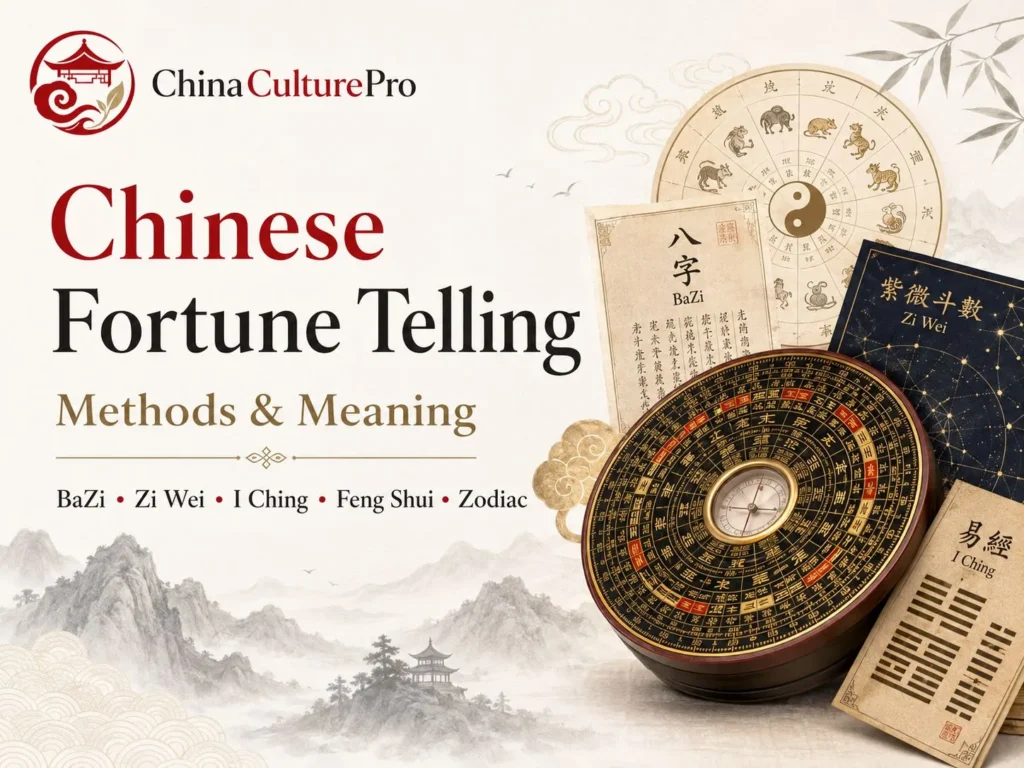

Quick Answer: What Is Chinese Fortune Telling?
Chinese fortune telling, also called Chinese divination or Chinese astrology in English, is not one single method. It is a broad group of traditional systems used to understand fate, personality, timing, relationships, choices, and life trends.
In Chinese, the common word suan ming (算命) is often translated as “fortune telling,” but the actual methods can be very different. Some methods read a person’s birth time. Some answer a specific question. Some observe the face or palm. Some study the effect of the living environment.
The main types include:
BaZi / Four Pillars of Destiny: uses birth year, month, day, and hour to analyze personality, Five Elements balance, and life cycles.
Zi Wei Dou Shu / Purple Star Astrology: uses a birth chart with stars and twelve palaces to analyze different life areas.
I Ching Divination: uses hexagrams to interpret a specific question, timing, or situation.
Kau Cim / Fortune Sticks: uses temple lots or fortune sticks to receive symbolic guidance.
Face Reading: studies facial features, complexion, and overall appearance.
Palm Reading: studies palm lines, hand shape, fingers, and mounts.
Feng Shui: studies how home, workplace, direction, layout, and environment may influence people.
Chinese Zodiac, Five Elements, and Tai Sui: the most familiar folk entry points for yearly fortune, compatibility, and caution years.
Chinese fortune telling is often used for personality, relationships, career direction, marriage, naming, moving, business openings, and timing decisions. It belongs to traditional culture and folk belief, not professional medical, legal, or financial advice.
Key point: Chinese fortune telling is not simply “future prediction.” It is a symbolic framework that uses birth time, Heavenly Stems and Earthly Branches, Yin Yang, Five Elements, hexagrams, stars, appearance, and environment to interpret tendencies, choices, timing, and life patterns.
Chinese Fortune Telling, Chinese Divination, and Chinese Astrology: Are They the Same?
These English terms are often mixed together, but they do not mean exactly the same thing. The differences matter because Chinese fortune telling includes several systems, not just one.
| Term | Chinese Meaning | What It Usually Means | Scope |
|---|---|---|---|
| Chinese Fortune Telling | 中国算命 | the broadest everyday term for traditional fate reading and prediction methods | widest |
| Chinese Divination | 中国占卜 / 占测 | methods used to answer a specific question or read a current situation | more focused on questions |
| Chinese Astrology | 中国星象学 / 命理占星 | methods connected with birth time, calendar cycles, stars, zodiac, or destiny charts | often used for BaZi, Zi Wei Dou Shu, zodiac |
| Chinese Metaphysics | 中国玄学 | a broader modern English category for destiny, Feng Shui, date selection, and related systems | more academic or professional |
| Suan Ming | 算命 | the common Chinese term for “calculating fate” | broad in daily speech |
In Chinese, suan ming is used broadly. A person may say they are “getting their fortune told,” but the method could be BaZi, Zi Wei Dou Shu, I Ching, face reading, palm reading, Feng Shui, or temple fortune sticks.
A common mistake is treating the Chinese Zodiac as a complete system. Zodiac readings use the birth year only; BaZi uses year, month, day, and hour, so it is much more detailed.
Why Fortune Telling Has Been Important in Chinese Culture
Chinese fortune telling has lasted because it connects with how traditional Chinese culture understands timing, environment, relationships, and change.
A common Chinese idea is tian shi, di li, ren he (天时地利人和): the right timing, the right environment, and the right human relationships. Fortune telling developed as one way to read these forces when making decisions.
Its cultural importance comes from several layers:
- Timing Matters: traditional Chinese life has long paid attention to auspicious dates, seasonal cycles, and yearly changes.
- Yin Yang And Five Elements: these ideas appear in medicine, martial arts, architecture, agriculture, calendar systems, and fortune-telling methods.
- Heavenly Stems And Earthly Branches: many readings use the same calendar structure behind Chinese years, months, days, and hours.
- Life Decisions: fortune telling has been used for marriage matching, naming children, choosing business opening dates, moving homes, building houses, and planning major events.
- Cultural Habit: even people who do not strongly believe in fortune telling may still check zodiac luck, wear red during their Ben Ming Nian, or avoid certain days for weddings.
- Self-Understanding: a good reading is not just “good luck” or “bad luck.” It explains strengths, weaknesses, timing, and possible trade-offs.
For many Chinese families, fortune telling is not always a strict command. It can reduce uncertainty, support family discussion, respect elders, and give symbolic meaning to life events.
To understand traditional Chinese culture more broadly, read our Chinese Culture guide.
The Main Types of Chinese Fortune Telling
The clearest way to understand Chinese fortune telling is to divide it into major categories. These methods do not all work the same way.
| Category | Chinese | Main Methods | What It Focuses On | Typical Questions |
|---|---|---|---|---|
| Fate Calculation | 命理 | BaZi, Zi Wei Dou Shu | birth time, destiny chart, life cycles | What is my life pattern? What are my strengths? |
| Divination | 卜筮 | I Ching, Kau Cim, Qimen Dunjia | a specific question, timing, situation | Should I do this? Is this the right time? |
| Physiognomy | 相术 | Face Reading, Palm Reading | visible features, complexion, palm lines | What does my appearance suggest about personality or tendency? |
| Environmental Methods | 风水 | Feng Shui | house, workplace, direction, layout, energy flow | Does this environment support or weaken me? |
| Calendar-Based Methods | 历法类 | Chinese Zodiac, Five Elements, Tai Sui, Auspicious Dates | year cycles, elements, seasonal timing | Which year should I be careful? Is this date suitable? |
These categories answer different questions. In traditional practice, BaZi may be used for a life chart, I Ching for one decision, Feng Shui for a house, and date selection for a wedding or business opening. A Chinese master would not treat them as the same method.
BaZi / Four Pillars of Destiny
BaZi (八字), also called the Four Pillars of Destiny, is one of the most important Chinese fate calculation systems.
BaZi uses a person’s birth year, month, day, and hour. Each part becomes one “pillar.” Each pillar contains one Heavenly Stem and one Earthly Branch, giving eight characters in total. That is why it is called BaZi, meaning “eight characters.”
| BaZi Element | What It Means |
|---|---|
| Birth Year | family background, early environment, broader social pattern |
| Birth Month | season, career tendency, life structure, strength of elements |
| Birth Day | self, core identity, marriage palace |
| Birth Hour | later life, children, ambitions, hidden tendencies |
| Heavenly Stems | visible element energy |
| Earthly Branches | deeper element roots and hidden relationships |
| Five Elements | Wood, Fire, Earth, Metal, Water balance |
| Ten Gods | relationship between the self element and other elements |
| Luck Cycles | ten-year luck periods and annual changes |
BaZi is used to analyze personality tendencies, Five Elements balance, career direction, marriage patterns, wealth potential, health tendencies, and life timing. It also appears in naming, compatibility, and date selection.
A key point: BaZi is not “Chinese zodiac plus element.” Two people with the same zodiac animal can have very different charts if their month, day, or hour is different.
To explore birth-time destiny analysis, read our BaZi guide. To understand the calendar system behind many readings, read our Heavenly Stems And Earthly Branches guide.
Zi Wei Dou Shu / Purple Star Astrology
Zi Wei Dou Shu (紫微斗数), often translated as Purple Star Astrology, is another detailed Chinese destiny analysis system. Like BaZi, it uses birth information, but its structure is different.
Zi Wei Dou Shu creates a chart with twelve palaces. Each palace represents one life area, such as self, siblings, spouse, children, wealth, health, travel, friends, career, property, fortune, and parents.
| Zi Wei Dou Shu Element | What It Represents |
|---|---|
| Life Palace | core personality and life direction |
| Spouse Palace | marriage and relationship patterns |
| Wealth Palace | money, income, and financial tendency |
| Career Palace | work, status, and professional development |
| Health Palace | physical tendency and caution areas |
| Property Palace | home, assets, and family base |
| Stars | symbolic forces placed in different palaces |
| Four Transformations | Lu, Quan, Ke, Ji; changes in fortune, power, reputation, and obstacles |
| Luck Periods | life stages and timing shifts |
Compared with BaZi, Zi Wei Dou Shu is more visual. BaZi focuses on stems, branches, Five Elements, and structural relationships; Zi Wei Dou Shu uses palaces, stars, and transformations.
Traditionally, Zi Wei Dou Shu has a refined reputation and is sometimes described as an elite or palace-style system. Today it is used for career, marriage, wealth, family, relationships, and major life stages. It is a birth-chart method, not a quick zodiac reading.
I Ching Divination and Kau Cim
I Ching divination and Kau Cim are different from BaZi and Zi Wei Dou Shu. They usually answer a present question rather than analyze an entire life chart.
| Method | I Ching Divination | Kau Cim |
|---|---|---|
| Chinese Name | 易经占卜 | 求签 |
| Common Setting | personal divination, study, consultation | temples and folk religious settings |
| Tool | coins, yarrow stalks, or other methods to form a hexagram | fortune sticks and written lots |
| Output | hexagram, changing lines, text interpretation | numbered lot, poem, and explanation |
| Main Focus | change, timing, trend, decision logic | symbolic guidance for a current concern |
| Typical Questions | career decision, relationship doubt, timing, travel, business choice | marriage, health, exams, job search, lawsuits, travel |
| Birth Time Needed? | usually no | no |
I Ching divination uses hexagrams to read how a situation is changing. It is not a fortune-cookie answer; it is a symbolic system built around change, timing, and conditions.
Kau Cim is more common in temples. A person asks a question, shakes a bamboo container, receives a fortune stick, and reads the corresponding poem or explanation. Both methods usually guide a specific question rather than replace a full life-chart reading.
Face Reading and Palm Reading
Face reading and palm reading belong to physiognomy (相术), a group of traditional methods that interpret visible features.
| Method | Face Reading | Palm Reading |
|---|---|---|
| Chinese Name | 面相 | 手相 |
| What It Observes | forehead, eyebrows, eyes, nose, mouth, ears, chin, face shape, complexion, moles, wrinkles | palm lines, palm shape, fingers, mounts, skin texture |
| Traditional Focus | personality, social style, life stages, family tendency, health signals | vitality, thinking style, emotion, career tendency, talent, relationship pattern |
| Common Use | judging character, marriage tendency, career style, interpersonal behavior | personal development, marriage, career, emotional patterns |
| Important Limit | not a medical diagnosis | not a medical diagnosis |
In traditional Chinese culture, face reading is not only about whether someone looks “good” or “bad.” A skilled reader may look at feature balance, complexion, expression, spirit, voice, posture, and changes over time.
Palm reading is also not always treated as fixed. Some lines may become clearer, weaker, or more complex as life changes.
Texts such as Ma Yi Shen Xiang (麻衣神相) and Liu Zhuang Xiang Fa (柳庄相法) are often mentioned in Chinese physiognomy traditions. They show a long history of observing appearance, but face or palm reading should not replace medical diagnosis.
Feng Shui and Environment-Based Fortune Reading
Feng Shui (风水) has a special position in Chinese fortune telling. It is not exactly “telling a person’s fate.” It studies how space, direction, layout, and environment may influence people.
Traditional Feng Shui may look at:
- Home Layout: entrance, bedroom, kitchen, living room, light, airflow, and internal movement.
- Office Space: desk direction, support behind the seat, door position, window position, and work stability.
- Building Site: mountain, water, road, open space, and surrounding forms.
- Grave Feng Shui: ancestral burial sites and their symbolic influence on descendants.
- Annual Directions: yearly changes in auspicious and inauspicious directions.
- Personal Element Needs: some practitioners combine Feng Shui with BaZi to adjust color, direction, or layout.
A common mistake is reducing Feng Shui to objects. Feng Shui is not simply “put a lucky cat here and become rich.” It is a broader environmental assessment, and good advice often overlaps with common sense: clean space, good light, airflow, quiet rest, stable seating, safe movement, and a feeling of support.
To understand environment-based practice, read our Feng Shui guide.
Chinese Zodiac, Five Elements, and Tai Sui
Chinese Zodiac, Five Elements, and Tai Sui are the most familiar public entry points into Chinese fortune telling. They are easy to understand, but they are not as detailed as full BaZi or Zi Wei Dou Shu.
| System | Chinese | What It Covers | How It Is Used | Limitation |
|---|---|---|---|---|
| Chinese Zodiac | 生肖 | twelve animals based mainly on birth year | personality, compatibility, yearly luck | too broad if used alone |
| Five Elements | 五行 | Wood, Fire, Earth, Metal, Water | element balance, personality, colors, directions, years | needs BaZi for precision |
| Tai Sui | 太岁 | annual deity and yearly conflict system | caution years, Ben Ming Nian, zodiac clashes | not a full destiny chart |
| Auspicious Dates | 择日 | choosing suitable dates and times | weddings, moving, opening, travel | depends on method and context |
The Chinese Zodiac is easy to remember, but it only uses the birth year. Two people may share the same animal sign while having very different BaZi charts.
Five Elements appear in BaZi, Feng Shui, naming, color choices, seasonal interpretation, and many folk practices. But simple labels like “you are Wood” or “you lack Fire” are usually too broad without the full chart.
Tai Sui is often discussed during the New Year as part of yearly-fortune culture. It can signal caution years, but it should not be treated as a complete fate reading.
To understand the most popular entry point, read our Chinese Zodiac guide. To understand elemental balance in zodiac-based readings, read our Five Elements Chinese Zodiac guide. To understand yearly conflict and caution years, read our Tai Sui guide.
How Chinese Fortune Telling Is Usually Done
A Chinese fortune telling reading usually starts with the question. The method depends on what the person wants to know.
- Confirm The Question The reader first asks what the person wants to understand: life direction, career, marriage, yearly luck, a business decision, a move, a health concern, or a specific event.
- Collect Information For BaZi or Zi Wei Dou Shu, the reader needs birth year, month, day, hour, gender, and sometimes birthplace. For Feng Shui, the reader may need a floor plan or site visit. For I Ching, the reader needs a clear question.
- Choose The Method BaZi is used for life structure. Zi Wei Dou Shu is used for chart-based life areas. I Ching or Kau Cim can be used for a specific question. Feng Shui is used for space. Face reading and palm reading require direct observation.
- Create The Chart Or Sign A BaZi reader calculates the Four Pillars. A Zi Wei Dou Shu reader creates the chart. An I Ching reader forms a hexagram. A Feng Shui practitioner observes layout and direction.
- Read The Structure The reader interprets Five Elements, Ten Gods, luck cycles, palaces, stars, hexagrams, facial features, palm lines, or environmental patterns.
- Give Trends And Suggestions A serious reader should not only say “good” or “bad.” The better reading explains the reason, timing, trade-offs, and practical direction.
In traditional Chinese thinking, a good fortune teller is not simply a prophet. The better role is closer to an analyst who reads patterns, explains timing, and helps the person think before making a decision.
What Chinese Fortune Telling Can and Cannot Tell You
Chinese fortune telling is best treated as a traditional and symbolic way to think about life patterns. It can be useful for reflection, but it has clear limits.
| Chinese Fortune Telling Can Suggest | Chinese Fortune Telling Cannot Guarantee |
|---|---|
| personality tendencies | a 100% accurate future |
| possible strengths and weaknesses | the exact date of death or disaster |
| broad luck cycles or difficult periods | medical diagnosis |
| relationship compatibility patterns | legal or financial advice |
| career direction and suitable fields | guaranteed wealth, marriage, children, or promotion |
| family and marriage tendencies | decisions made for you |
| symbolic meaning behind choices | scientific proof that fate is fixed |
| timing considerations | freedom from responsibility |
The best use of Chinese fortune telling is self-reflection. It gives an outside framework for thinking about patterns, timing, and choices. The worst use is treating every sentence as an absolute command.
Important life choices still require reason, evidence, professional advice, and personal responsibility.
Chinese Fortune Telling vs Western Astrology vs Tarot
Chinese fortune telling, Western astrology, and Tarot can all be used for self-reflection and symbolic interpretation, but their foundations are different.
| Point | Chinese Fortune Telling | Western Astrology | Tarot |
|---|---|---|---|
| Main Basis | birth time, Heavenly Stems, Earthly Branches, Five Elements, stars, hexagrams, appearance, space | planets, zodiac signs, houses, aspects | 78 cards, spreads, images, symbols |
| Common Input | birth year, month, day, hour; or a specific question | birth date, time, and location | one clear question |
| Typical Focus | fate structure, timing cycles, relationships, career, environment | psychology, personality, relationships, transits | present question, emotional pattern, choice |
| Reading Style | structural, calendar-based, element-based | planet-based and psychological | visual, intuitive, symbolic |
| Cultural Background | Chinese Yin Yang, Five Elements, calendar, divination, Feng Shui | Greco-Babylonian and Western esoteric traditions | European esoteric and symbolic traditions |
| Common Strength | long-term structure and timing | personality and psychological language | direct reflection on a current issue |
This comparison is not about which system is “more accurate.” Chinese fortune telling gives more weight to time structure, elements, and life cycles. Western astrology emphasizes planets and psychological traits. Tarot focuses more on symbolic images and present questions.
Common Misunderstandings About Chinese Fortune Telling
Many misunderstandings come from treating all Chinese methods as one thing.
| Mistake | Better Understanding |
|---|---|
| Thinking all Chinese fortune telling is BaZi | Chinese fortune telling includes fate calculation, divination, physiognomy, Feng Shui, and calendar-based methods |
| Thinking the Chinese Zodiac is a complete reading | zodiac only uses the birth year and is much broader than BaZi |
| Thinking Feng Shui is just lucky objects | Feng Shui is a traditional environmental assessment system |
| Thinking fortune telling gives 100% future prediction | it is usually better understood as trend and pattern interpretation |
| Asking the same question repeatedly until the answer feels good | repeated questioning can confuse judgment; a serious reader may tell you to stop |
| Letting one master’s sentence decide your whole life | the final decision remains yours |
| Treating AI fortune telling as equal to an experienced master | AI can explain basic concepts, but it lacks lived experience, lineage training, correction, and ethical judgment |
| Calling it only superstition with no structure | it has a symbolic and cultural structure, even if it is not scientific proof of fate |
| Using fortune telling instead of professional advice | medical, legal, and financial issues need qualified professionals |
| Paying high fees because of fear | fear-based “disaster removal” is a warning sign |
A balanced view is more useful than blind belief or blind dismissal. Chinese fortune telling has cultural structure, symbolic logic, and practical history, but not every fortune teller is trustworthy and not every claim should be accepted.
Online and AI Chinese Fortune Telling Today
Today, many people use websites, apps, and AI tools for Chinese fortune telling. They may enter their birth date to generate a BaZi chart, check Five Elements, read zodiac compatibility, ask about yearly luck, or compare relationship signs.
| Aspect | What It Can Do | Main Limit |
|---|---|---|
| Online BaZi Calculators | quickly generate Four Pillars and basic element information | may not explain context well |
| Zodiac Compatibility Tools | simple matching for zodiac animals | too broad for serious relationship judgment |
| AI Fortune Telling | explains concepts, summarizes charts, answers basic questions | may overgeneralize or sound confident without real expertise |
| Feng Shui Apps | suggest directions, layouts, or yearly positions | cannot replace site observation |
| Digital Kau Cim Or I Ching Tools | gives symbolic text quickly | may lack ritual context and careful interpretation |
AI can help beginners learn basic concepts such as Heavenly Stems, Earthly Branches, Five Elements, zodiac compatibility, and common BaZi terms. But it should not be treated as an authority. It may miss context, mix schools, overstate conclusions, or handle sensitive issues poorly.
A practical warning: if an online reader, app, or AI-style service says you will suffer disaster unless you pay for an expensive cure, stop immediately. Fear-based fortune telling is not responsible practice.
How to Approach Chinese Fortune Telling Responsibly
Chinese fortune telling is safest when used for cultural understanding and self-reflection, not as a command system.
Use it responsibly this way:
- Treat It As A Reference: use the reading as one perspective, not the final answer.
- Keep Your Judgment: a reading should help you think, not remove your responsibility.
- Avoid Fear-Based Services: be careful with anyone who says you must pay to avoid disaster.
- Do Not Replace Professional Advice: health problems need doctors; legal problems need lawyers; financial problems need qualified advisors.
- Be Careful With Marriage And Investment Decisions: these should depend on facts, communication, risk, and expert guidance, not one reading.
- Ask Clear Questions: vague questions usually lead to vague answers.
- Respect The Cultural System: even if you do not believe it literally, you can still understand its role in Chinese culture.
- Look For Practical Guidance: a good interpretation should reduce confusion, not create anxiety.
Use Chinese fortune telling to understand patterns, timing, and choices. Do not use it to frighten people, control relationships, or sell expensive “cures.”
Final Thoughts
Chinese fortune telling is not one single system. It includes fate calculation, divination, physiognomy, Feng Shui, and calendar-based methods.
BaZi and Zi Wei Dou Shu focus on birth charts. I Ching and Kau Cim focus on present questions. Face reading and palm reading observe visible features. Feng Shui reads the influence of space. Chinese Zodiac, Five Elements, and Tai Sui are familiar public entry points.
The key is not to treat Chinese fortune telling simply as future prediction. It is a traditional Chinese way of reading time, personality, environment, relationships, choices, and life trends through symbolic systems.
Whether you believe in it or not, learning this topic helps explain why some Chinese families check wedding dates, compare BaZi before marriage, wear red during Ben Ming Nian, or choose an auspicious day before moving.
FAQs About Chinese Fortune Telling
What is Chinese fortune telling?
Chinese fortune telling is a broad group of traditional Chinese systems used to interpret fate, personality, timing, relationships, choices, and life trends. It includes BaZi, Zi Wei Dou Shu, I Ching divination, Kau Cim, face reading, palm reading, Feng Shui, Chinese Zodiac, Five Elements, and Tai Sui.
Is Chinese fortune telling the same as Chinese astrology?
Not exactly. Chinese astrology usually refers to systems connected with birth time, calendar cycles, stars, or zodiac signs, such as BaZi, Zi Wei Dou Shu, and Chinese Zodiac. Chinese fortune telling is broader and also includes I Ching, Kau Cim, face reading, palm reading, and Feng Shui.
What is BaZi?
BaZi, or Four Pillars of Destiny, is a Chinese fate calculation system based on birth year, month, day, and hour. These create four pillars and eight characters, which are used to analyze Five Elements balance, personality, career, marriage, wealth, and life cycles.
What is Zi Wei Dou Shu?
Zi Wei Dou Shu, or Purple Star Astrology, is a Chinese destiny chart system. It uses birth information to create a chart with twelve palaces, stars, transformations, and luck periods, then analyzes areas such as career, marriage, wealth, family, and relationships.
What is the difference between BaZi and Chinese Zodiac?
Chinese Zodiac mainly uses the birth year, so it is broad and easy to understand. BaZi uses birth year, month, day, and hour, making it much more detailed. Two people with the same zodiac animal may have very different BaZi charts.
Is Feng Shui a type of fortune telling?
Feng Shui is related to Chinese fortune telling, but it is not direct fate calculation. It studies how environment, layout, direction, and space may affect people. Some practitioners combine Feng Shui with BaZi or Five Elements.
What is I Ching divination?
I Ching divination uses hexagrams to interpret a specific question, timing, or changing situation. It does not usually require birth time. It is used more for present decisions than for a full life reading.
What is Kau Cim?
Kau Cim is a temple fortune-stick practice. A person asks a question, shakes a container of sticks, receives one numbered stick, and reads the corresponding poem or explanation. It is often used for marriage, exams, work, travel, health concerns, or legal worries.
Is Chinese fortune telling accurate?
There is no single standard answer. Chinese fortune telling is best understood as trend interpretation and symbolic analysis, not guaranteed prediction. Its value is in offering an outside framework for reflection, not replacing judgment or evidence.
What information do you need for a Chinese fortune telling reading?
For BaZi and Zi Wei Dou Shu, you usually need birth year, month, day, hour, gender, and sometimes birthplace. For I Ching or Kau Cim, you need a clear question. For Feng Shui, a floor plan or site observation may be needed. For face or palm reading, direct observation is usually required.