
Quick Answer: What Is Na Yin Five Elements?
Na Yin Five Elements (纳音五行) is a symbolic Five Elements naming system based on the 60 Jia Zi, also called the Sexagenary Cycle.
It is not the same as the ordinary Chinese zodiac element system. In Five Elements Chinese Zodiac, a year is read through the Heavenly Stem element plus the zodiac animal, such as Fire Horse, Wood Rat, or Earth Dog. Na Yin reads another layer: the symbolic elemental texture of each stem-branch pair in the 60 Jia Zi cycle.
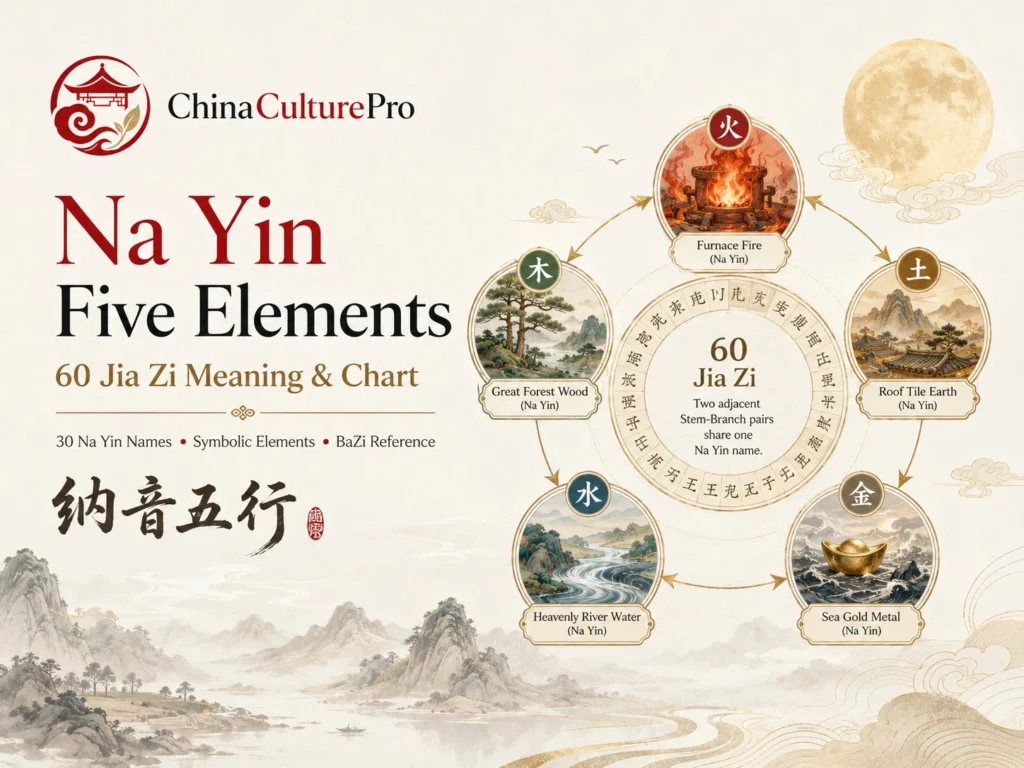
There are 60 stem-branch combinations, but only 30 Na Yin names. Every two adjacent combinations share one Na Yin name. For example, Jia Zi and Yi Chou share Gold in the Sea (海中金). Bing Yin and Ding Mao share Fire in the Furnace (炉中火).
Na Yin names are not plain elements such as Metal, Fire, Wood, Water, or Earth. They are image-based Five Elements names, such as Sword-Edge Metal, Buddhist Lamp Fire, Heavenly River Water, Flatland Wood, and Roof Tile Earth.
In folk usage, people may say someone is a “Gold in the Sea life” or “Heavenly River Water life.” This usually refers to birth-year Na Yin. In stricter BaZi (八字) reading, however, Na Yin is only one symbolic layer, not the whole chart.
| Item | Detail |
|---|---|
| Main Topic | Na Yin Five Elements |
| Chinese Term | 纳音五行 |
| Based On | 60 Jia Zi / Sexagenary Cycle |
| Core Rule | Two adjacent stem-branch combinations share one Na Yin name |
| Total Names | 30 Na Yin types |
| Example | Jia Zi / Yi Chou = Gold in the Sea |
| Main Use | Symbolic life texture, BaZi reference, year-pillar reading |
| Important Limit | Not the same as Heavenly Stem element or zodiac element |
Key Point: If you ask “What is my Chinese zodiac element?”, most guides mean the Heavenly Stem element, such as Fire Horse. If you ask “What is my Na Yin?”, you are asking for the symbolic 60 Jia Zi name, such as Heavenly River Water. Both can apply to the same year, but they are different layers.
What Does “Na Yin” Really Mean?
The term Na Yin is easier to understand if the two characters are separated.
Na means to receive, contain, collect, classify, or bring into a system.
Yin means sound, tone, or musical vibration. In traditional Chinese thought, sound was not only physical sound. It could also connect with rhythm, timing, qi, Five Elements, and cosmic order.
So Na Yin is not just an element label. It is a way of bringing the 60 stem-branch combinations into a symbolic system connected with sound, number, image, and Five Elements.
Na Yin has three layers:
- Stem-branch layer: Which Jia Zi combination is being read?
- Sound and order layer: How that combination is received into the tonal and symbolic system.
- Image layer: What state or texture of the Five Elements this combination carries.
This is why Na Yin names are so specific. They do not simply say Metal, Fire, Wood, Water, or Earth. They say Gold in the Sea, Fire in the Furnace, Great Forest Wood, Roadside Earth, Sword-Edge Metal, Buddhist Lamp Fire, Heavenly River Water, and Great Sea Water.
The image matters.
Gold in the Sea is not the same as Sword-Edge Metal. One is hidden, deep, and not easily seen. The other has been shaped into a blade and has edge, decision, and force.
Fire in the Furnace is not the same as Fire on the Mountain. One is contained, trained, and useful for forging. The other is visible, exposed, and easy to notice from far away.
A Chinese cultural master might say: Na Yin does not only ask, “Which element is this?” It asks, “What state is this element in?” Is the metal hidden, sharpened, thin, refined, or mixed with sand? Is the fire controlled, visible, sudden, quiet, or heavenly?
In this sense, Na Yin is the morphology of the Five Elements. It reads state, position, form, and texture.
How Is Na Yin Calculated?
To find your Na Yin, you first need the correct stem-branch of your birth year. This means you need both the Heavenly Stem and the Earthly Branch of the Chinese year.
For public Chinese zodiac lookup, this site follows the Chinese New Year boundary. If you were born in January or early February, you must check the Chinese New Year date for your birth year. If you were born before Chinese New Year, your stem-branch year and Na Yin usually belong to the previous Chinese year in this common zodiac system.
For formal BaZi work, some practitioners use solar-term boundaries such as Li Chun. If you are doing a professional chart, follow the system used by your practitioner.
| Step | What to Check |
|---|---|
| 1 | Confirm your birth year |
| 2 | Check Chinese New Year boundary if born in January or February |
| 3 | Find the year’s Heavenly Stem and Earthly Branch |
| 4 | Locate that stem-branch pair in the Na Yin chart |
| 5 | Read the corresponding Na Yin name |
| 6 | Use full BaZi if reading more than birth-year Na Yin |
For example, 2026 is Bing Wu. In the Na Yin chart, Bing Wu belongs to the same Na Yin pair as Ding Wei. Their Na Yin is Heavenly River Water (天河水).
But someone born before Chinese New Year in 2026 may still belong to the previous Chinese year, Yi Si. Yi Si belongs to Buddhist Lamp Fire, not Heavenly River Water. This is why the year boundary matters.
For ordinary readers, the safest method is to use a Na Yin chart or a reliable calculator. Traditional calculation methods exist, but they are not necessary for basic lookup.
Na Yin Five Elements Chart: 60 Jia Zi and 30 Names
The chart below lists the 30 Na Yin names. Each name is shared by two adjacent stem-branch combinations in the 60 Jia Zi cycle.
This table is the main lookup tool for Na Yin Five Elements.
| # | Stem-Branch Pair | Na Yin Name | Element |
|---|---|---|---|
| 1 | Jia Zi / Yi Chou | Gold in the Sea (海中金) | Metal |
| 2 | Bing Yin / Ding Mao | Fire in the Furnace (炉中火) | Fire |
| 3 | Wu Chen / Ji Si | Great Forest Wood (大林木) | Wood |
| 4 | Geng Wu / Xin Wei | Roadside Earth (路旁土) | Earth |
| 5 | Ren Shen / Gui You | Sword-Edge Metal (剑锋金) | Metal |
| 6 | Jia Xu / Yi Hai | Fire on the Mountain (山头火) | Fire |
| 7 | Bing Zi / Ding Chou | Stream Below the Valley (涧下水) | Water |
| 8 | Wu Yin / Ji Mao | City-Wall Earth (城头土) | Earth |
| 9 | Geng Chen / Xin Si | White Wax Gold (白蜡金) | Metal |
| 10 | Ren Wu / Gui Wei | Willow Wood (杨柳木) | Wood |
| 11 | Jia Shen / Yi You | Spring Water (泉中水) | Water |
| 12 | Bing Xu / Ding Hai | Roof Tile Earth (屋上土) | Earth |
| 13 | Wu Zi / Ji Chou | Thunderbolt Fire (霹雳火) | Fire |
| 14 | Geng Yin / Xin Mao | Pine and Cypress Wood (松柏木) | Wood |
| 15 | Ren Chen / Gui Si | Long-Flowing Water (长流水) | Water |
| 16 | Jia Wu / Yi Wei | Gold in the Sand (沙中金) | Metal |
| 17 | Bing Shen / Ding You | Fire at the Foot of the Mountain (山下火) | Fire |
| 18 | Wu Xu / Ji Hai | Flatland Wood (平地木) | Wood |
| 19 | Geng Zi / Xin Chou | Wall Earth (壁上土) | Earth |
| 20 | Ren Yin / Gui Mao | Gold Leaf (金箔金) | Metal |
| 21 | Jia Chen / Yi Si | Buddhist Lamp Fire (佛灯火) | Fire |
| 22 | Bing Wu / Ding Wei | Heavenly River Water (天河水) | Water |
| 23 | Wu Shen / Ji You | Great Post-Road Earth (大驿土) | Earth |
| 24 | Geng Xu / Xin Hai | Hairpin and Bracelet Gold (钗钏金) | Metal |
| 25 | Ren Zi / Gui Chou | Mulberry Wood (桑柘木) | Wood |
| 26 | Jia Yin / Yi Mao | Great Stream Water (大溪水) | Water |
| 27 | Bing Chen / Ding Si | Earth in the Sand (沙中土) | Earth |
| 28 | Wu Wu / Ji Wei | Heavenly Fire (天上火) | Fire |
| 29 | Geng Shen / Xin You | Pomegranate Wood (石榴木) | Wood |
| 30 | Ren Xu / Gui Hai | Great Sea Water (大海水) | Water |
The key point is that the Na Yin name belongs to the pair, not only to a single year. Jia Zi and Yi Chou both share Gold in the Sea. Bing Wu and Ding Wei both share Heavenly River Water.
This is why Na Yin is different from the simple Heavenly Stem element. A single year can have a Heavenly Stem element and a separate Na Yin name at the same time.
How to Read Na Yin Names
A Na Yin name has two layers.
The first layer is the Five Element category: Metal, Fire, Wood, Water, or Earth.
The second layer is the image: Sea, Furnace, Forest, Roadside, Sword Edge, Mountain, Valley, Wall, Lamp, River, Sand, or Sea.
You must read both layers. If you only read the element, you miss the real meaning.
| Same Element | Different Na Yin Images | Reading Direction |
|---|---|---|
| Metal | Gold in the Sea vs Sword-Edge Metal | Hidden value vs formed sharpness |
| Metal | Gold Leaf vs Hairpin and Bracelet Gold | Thin surface beauty vs refined wearable value |
| Fire | Fire in the Furnace vs Fire on the Mountain | Trained heat vs visible influence |
| Fire | Buddhist Lamp Fire vs Heavenly Fire | Quiet lasting light vs vast external radiance |
| Water | Spring Water vs Great Sea Water | Clean source vs vast depth |
| Wood | Great Forest Wood vs Willow Wood | Large rooted growth vs flexible softness |
| Earth | Roadside Earth vs City-Wall Earth | Service foundation vs protective structure |
Gold in the Sea is hidden value. Sword-Edge Metal is formed sharpness. Both are Metal, but their states are different.
Fire in the Furnace is controlled heat. Fire on the Mountain is visible influence. Buddhist Lamp Fire is quiet and lasting. Heavenly Fire is vast and external.
Great Forest Wood has roots, scale, and collective growth. Willow Wood is soft, flexible, and responsive to wind and water.
Spring Water is a clean source. Great Sea Water is deep, vast, and inclusive.
Roadside Earth supports movement. City-Wall Earth protects and separates.
A simple method is this: first identify the element, then read the image. The element tells you the category. The image tells you the state.
Na Yin is not only Five Elements. It is Five Elements in form.
The 30 Na Yin Meanings by Element
The 30 Na Yin names can be grouped into five elements. Each element has six forms.
These are symbolic reading directions, not complete destiny judgments. A complete reading still needs the full stem-branch context and BaZi chart.
Metal Na Yin Types
Metal Na Yin is not always hard, cold, or strict. Metal can be hidden, sharpened, thin, refined, mixed, or ornamental.
| Na Yin | Core Image | Reading Direction |
|---|---|---|
| Gold in the Sea | Metal hidden under the sea | Hidden value, inner wealth, unrealized potential |
| Sword-Edge Metal | A sharpened blade | Decisiveness, edge, formed power |
| White Wax Gold | Metal covered or protected | Value not fully revealed, protected potential |
| Gold in the Sand | Gold mixed with sand | Value that needs sorting and refining |
| Gold Leaf | Thin decorative gold | Surface beauty, light value, ornament |
| Hairpin and Bracelet Gold | Refined wearable gold | Finished value, elegance, refinement |
Gold in the Sea is valuable but not easily seen. Sword-Edge Metal has already been formed and can cut through confusion. White Wax Gold suggests protected value. Gold in the Sand must be sifted. Gold Leaf shines on the surface. Hairpin and Bracelet Gold is refined, shaped, and visible.
Fire Na Yin Types
Fire Na Yin is not only passion or action. Fire can be trained, visible, sudden, quiet, supported, or vast.
| Na Yin | Core Image | Reading Direction |
|---|---|---|
| Fire in the Furnace | Fire trained by a furnace | Controlled heat, forging, formation |
| Fire on the Mountain | Fire visible on a mountain | Reputation, visibility, influence |
| Thunderbolt Fire | Sudden thunder-fire | Shock, breakthrough, sudden force |
| Fire at the Foot of the Mountain | Fire below the mountain | Supported but less exposed fire |
| Buddhist Lamp Fire | A lamp before Buddha | Quiet light, faith, persistence |
| Heavenly Fire | Fire in the heavens | Vast light, external radiance |
Fire in the Furnace is useful because it is contained. Fire on the Mountain is visible from far away. Thunderbolt Fire breaks silence. Fire at the Foot of the Mountain has support but less exposure. Buddhist Lamp Fire is small but lasting. Heavenly Fire is high, vast, and radiant.
Wood Na Yin Types
Wood Na Yin is not only growth. Wood can be forest, willow, pine, flatland growth, practical mulberry, or fruit-bearing pomegranate.
| Na Yin | Core Image | Reading Direction |
|---|---|---|
| Great Forest Wood | A large forest | Rooted growth, collective strength |
| Willow Wood | Willow branches | Flexibility, softness, adaptation |
| Pine and Cypress Wood | Evergreen pine and cypress | Endurance, integrity, cold resistance |
| Flatland Wood | Wood on open land | Slow growth, foundation, family ground |
| Mulberry Wood | Practical mulberry tree | Usefulness, nourishment, livelihood |
| Pomegranate Wood | Fruit-bearing pomegranate | Inner substance, fruit, late value |
Great Forest Wood has scale and roots. Willow Wood bends with wind. Pine and Cypress Wood endures cold seasons. Flatland Wood grows steadily in ordinary ground. Mulberry Wood is useful and nourishing. Pomegranate Wood carries fruit, inner substance, and later value.
Water Na Yin Types
Water Na Yin is not only flexibility or wisdom. Water can be hidden, pure, continuous, heavenly, fast, or vast.
| Na Yin | Core Image | Reading Direction |
|---|---|---|
| Stream Below the Valley | Hidden valley stream | Low-profile flow, quiet movement |
| Spring Water | Clear spring source | Purity, origin, clean beginning |
| Long-Flowing Water | Long continuous water | Continuity, persistence, distance |
| Heavenly River Water | River in the heavens | Vast, high, distant water |
| Great Stream Water | Large stream | Fast flow, width, momentum |
| Great Sea Water | Vast sea | Depth, inclusion, final gathering |
Stream Below the Valley moves quietly in a low place. Spring Water is clean at the source. Long-Flowing Water continues over distance. Heavenly River Water is high and distant. Great Stream Water has width and force. Great Sea Water is deep, broad, and difficult to measure.
Earth Na Yin Types
Earth Na Yin is not only stability. Earth can serve, protect, cover, scatter, divide, or connect.
| Na Yin | Core Image | Reading Direction |
|---|---|---|
| Roadside Earth | Earth beside the road | Service, support, practical foundation |
| City-Wall Earth | Earth forming a city wall | Protection, boundary, defense |
| Roof Tile Earth | Earth made into roof tiles | Shelter, cover, domestic protection |
| Earth in the Sand | Earth mixed with sand | Loose foundation, scattered support |
| Wall Earth | Earth forming a wall | Separation, structure, inner-outer boundary |
| Great Post-Road Earth | Earth of a major road station | Movement, connection, public passage |
Roadside Earth supports travelers. City-Wall Earth protects and defines a boundary. Roof Tile Earth shelters from above. Earth in the Sand is loose and needs consolidation. Wall Earth separates inner and outer space. Great Post-Road Earth supports movement, connection, and public passage.
Across all five groups, the same principle applies: Na Yin reads the form of the element, not only the element itself.
Na Yin vs Five Elements Chinese Zodiac
Na Yin Five Elements and Five Elements Chinese Zodiac are often confused. They both use the language of Five Elements, but they read different layers.
The clearest example is 2026.
In the Five Elements Chinese Zodiac system, 2026 is Bing Wu. Bing is Yang Fire, and Wu is the Horse branch. So 2026 is Fire Horse.
In the Na Yin system, Bing Wu belongs to the pair Bing Wu / Ding Wei. That pair’s Na Yin is Heavenly River Water.
So 2026 can be both Fire Horse and Heavenly River Water. This is not a contradiction. It is two different systems reading two different layers.
| System | What It Uses | 2026 Example | Main Reading |
|---|---|---|---|
| Five Elements Chinese Zodiac | Heavenly Stem + Zodiac Animal | Fire Horse | Year element and animal |
| Na Yin Five Elements | 60 Jia Zi symbolic name | Heavenly River Water | Symbolic texture of the stem-branch pair |
| Zodiac Animal | Earthly Branch only | Horse | Basic animal layer |
Do not use the Fire of Fire Horse to reject the Water of Heavenly River Water. They are not competing labels.
If you ask, “What is my Chinese zodiac element?” most pages are asking for the Heavenly Stem element. If you ask, “What is my Na Yin?” you are asking for the symbolic 60 Jia Zi name.
The same year can have three valid layers:
- Zodiac animal: Horse
- Five Elements Chinese Zodiac: Fire Horse
- Na Yin: Heavenly River Water
They are all correct, but they should not be mixed.
To understand the Heavenly Stem element plus zodiac animal system, read our Five Elements Chinese Zodiac guide.
How Na Yin Is Used in BaZi Reading
Na Yin can be used in BaZi / Four Pillars reading, but it should not be treated as the whole chart.
A person’s year, month, day, and hour pillars can each have a Na Yin. In folk usage, when people say someone is “Gold in the Sea life” or “Great Sea Water life,” they usually mean the person’s birth-year Na Yin.
This is useful culturally, but it is broad. Many people share the same birth-year Na Yin.
Strict BaZi reading does not rely only on birth-year Na Yin. It also reads the Day Master, month command, Ten Gods, Five Element balance, structure, useful element, luck cycles, and annual influences.
| Use Case | How Na Yin Helps | Limit |
|---|---|---|
| Year Pillar | Gives symbolic life texture | Too broad if used alone |
| Four Pillars | Adds symbolic layer to each pillar | Not the main BaZi structure |
| Compatibility | Compares symbolic element qualities | Cannot replace full chart |
| Naming / cultural reading | Gives poetic element image | Needs context |
Some schools use Na Yin more heavily, especially in cultural life readings, year-pillar identity, naming, or simplified compatibility. Other schools treat it as a symbolic supplement.
A balanced view is best: Na Yin gives image and texture. It can enrich interpretation, but it should not replace the core BaZi structure.
A Chinese practitioner might say: Na Yin can tell you the taste or texture of a pillar, but it is not the whole meal. The Day Master and the full chart still decide the main structure.
How to Find Your Na Yin by Birth Year
To find your birth-year Na Yin, first identify your Chinese year’s stem-branch. Then match that stem-branch to the Na Yin chart.
Remember the Chinese New Year boundary. If you were born in January or early February, do not use the Gregorian year automatically. Check whether Chinese New Year had already started.
| Birth Year Example | Stem-Branch | Na Yin |
|---|---|---|
| 1971 | Xin Hai | Hairpin and Bracelet Gold |
| 1983 | Gui Hai | Great Sea Water |
| 1995 | Yi Hai | Fire on the Mountain |
| 2007 | Ding Hai | Roof Tile Earth |
| 2019 | Ji Hai | Flatland Wood |
| 2026 | Bing Wu | Heavenly River Water |
For example, 2026 is Bing Wu, so its Na Yin is Heavenly River Water. But someone born before Chinese New Year in 2026 may still belong to the previous Chinese year, so their Na Yin should be checked from the previous stem-branch.
This boundary matters more than many readers expect. A person born a few weeks before Chinese New Year may have a different zodiac animal, Heavenly Stem element, and Na Yin from someone born a few weeks after Chinese New Year.
For fast year lookup, use our Chinese Zodiac & Lunar Birthday Calculator.
For a complete reading, the birth-year Na Yin is only the beginning. A full BaZi chart can also read the Na Yin of the month, day, and hour pillars.
Na Yin Compatibility and Element Relationships
Na Yin can be used as a compatibility reference, but it should not replace full relationship analysis.
At the basic level, Na Yin compatibility can use the Five Elements generating and controlling cycles.
The generating cycle is:
Wood → Fire → Earth → Metal → Water → Wood
The controlling cycle is:
Wood controls Earth, Earth controls Water, Water controls Fire, Fire controls Metal, Metal controls Wood.
But Na Yin compatibility is not only about the element. The image matters. Fire in the Furnace and Heavenly Fire are both Fire, but their textures are different. Gold in the Sea and Sword-Edge Metal are both Metal, but they do not behave like the same Metal.
| Na Yin Relation | Simple Meaning | Reading Caution |
|---|---|---|
| Generates | Support, nourishment | Too much support may create dependence |
| Controls | Regulation, pressure, shaping | Too much control becomes suppression |
| Same Na Yin element | Shared texture | Can support or repeat |
| Different texture | Friction or complement | Needs full BaZi context |
Generating is not always good. Too much support can become dependence or depletion. Fire needs Wood as fuel, but if all Wood is consumed, support becomes exhaustion.
Controlling is not always bad. Good control can create form. Metal may need Fire to refine it. Fire may need Water to regulate it. Earth may need Wood to loosen it. Too much control becomes suppression or damage.
This is why Na Yin compatibility should be read carefully. It can add symbolic texture, but it cannot replace full BaZi compatibility. A serious compatibility reading should also consider Day Pillars, Earthly Branch combinations and clashes, Ten Gods, Five Element balance, and real-life behavior.
For relationship matching, see our Chinese Zodiac Compatibility guide.
How Accurate Is Na Yin Five Elements?
Na Yin has cultural and symbolic value, but it should not be exaggerated.
It is more detailed than plain Five Elements because each element appears in six forms. Metal is not only Metal; it can be Gold in the Sea, Sword-Edge Metal, White Wax Gold, Gold in the Sand, Gold Leaf, or Hairpin and Bracelet Gold. Fire, Wood, Water, and Earth also appear in six different states.
That makes Na Yin more textured than a simple element label.
But birth-year Na Yin alone is still broad. Many people share the same year Na Yin. It cannot decide a person’s whole personality, marriage, career, or fate.
| Reading Level | What It Shows | Limit |
|---|---|---|
| Birth-Year Na Yin | Basic symbolic life texture | Very broad |
| Four-Pillar Na Yin | Symbolic layer across all pillars | Still not full BaZi core |
| Full BaZi | Day Master, balance, Ten Gods, luck cycles | Needs full birth data |
| Real Life | Choices, family, education, environment | Cannot be replaced by Na Yin |
Na Yin is best used as a symbolic layer. It can explain the texture of a stem-branch pair, support cultural interpretation, help with year-pillar identity, and add poetic depth to BaZi reading.
It should not be used as a one-sentence life verdict.
A useful way to read Na Yin is: it gives texture, not total fate.
How This Guide Connects to Chinese Zodiac Content
Na Yin Five Elements is an advanced guide within the Chinese Zodiac, Five Elements, and BaZi content cluster.
To understand the animal layer first, start with our Chinese Zodiac guide.
To check the stem-branch year for your birth year, use our Chinese Zodiac guide.
Because Na Yin follows the Chinese year boundary, read our Chinese New Year guide before judging January or February births.
Na Yin also connects with Ben Ming Nian. The same zodiac animal returns every 12 years, but the same stem-branch and Na Yin return every 60 years. To understand why the same zodiac animal returns every 12 years, read our Ben Ming Nian guide.
For the 2026 example, read our Year of the Horse guide.
This page focuses on Na Yin. It connects upward to Five Elements Chinese Zodiac and downward to individual Na Yin types such as Gold in the Sea, Fire in the Furnace, Heavenly River Water, Flatland Wood, Roof Tile Earth, and Great Sea Water.
Final Thoughts
Na Yin Five Elements is not the same as ordinary Chinese zodiac elements.
It does not simply ask whether something is Metal, Wood, Water, Fire, or Earth. It asks what state that element is in.
Metal may be hidden in the sea, sharpened on a sword edge, spread thin as gold leaf, or refined into hairpins and bracelets.
Fire may be trained in a furnace, visible on a mountain, sudden like thunderbolt, quiet like a Buddhist lamp, or radiant in the heavens.
Water may begin as a spring, run as a long river, descend from the heavens, rush as a great stream, or gather as the great sea.
Na Yin reads the state, position, form, and texture of the Five Elements. Its 30 names are not decorative labels. They are 30 ways that qi takes shape inside the 60 Jia Zi cycle.
FAQs About Na Yin Five Elements
What is Na Yin Five Elements?
Na Yin Five Elements is a symbolic Five Elements naming system based on the 60 Jia Zi cycle. Every two adjacent stem-branch combinations share one Na Yin name. For example, Jia Zi and Yi Chou share Gold in the Sea. Na Yin describes the symbolic texture of a stem-branch pair.
How many Na Yin types are there?
There are 30 Na Yin types. The 60 Jia Zi combinations are divided into 30 pairs, and each pair has one Na Yin name. For example, Bing Yin and Ding Mao share Fire in the Furnace, while Bing Wu and Ding Wei share Heavenly River Water.
How do I find my Na Yin?
First find your birth year’s Heavenly Stem and Earthly Branch. If you were born in January or February, check the Chinese New Year date first. Then locate that stem-branch in the Na Yin chart. The Na Yin name of that pair is your birth-year Na Yin.
Is Na Yin the same as my Chinese zodiac element?
No. Your Chinese zodiac element usually means the Heavenly Stem element plus zodiac animal, such as Fire Horse. Na Yin is the symbolic 60 Jia Zi name, such as Heavenly River Water. The same year can have both labels, but they belong to different systems.
Why do two Jia Zi share one Na Yin name?
Na Yin groups the 60 stem-branch combinations into 30 symbolic pairs. Each two adjacent combinations share one Na Yin name. This pairing comes from the traditional Na Yin system, which connects stem-branch order, sound, number, and Five Elements symbolism.
What does Gold in the Sea mean?
Gold in the Sea means Metal hidden under the sea. It suggests value that is real but not easily visible. The image points to hidden potential, inner wealth, or something precious that needs time, support, or discovery before it can be used.
What does Heavenly River Water mean?
Heavenly River Water is the Na Yin of Bing Wu and Ding Wei. It means water in the heavens, not ordinary ground water. Its image suggests something high, vast, distant, clear, and not directly mixed with ordinary earth. 2026 Bing Wu belongs to this Na Yin.
Is Na Yin used in BaZi?
Yes, Na Yin can be used in BaZi as a symbolic layer. A person’s year, month, day, and hour pillars can each have a Na Yin. However, strict BaZi reading still centers on the Day Master, month command, Ten Gods, Five Element balance, and luck cycles.
Can Na Yin be used for compatibility?
Yes, but only as an auxiliary layer. Na Yin can compare symbolic elemental textures and use generating or controlling relationships. However, full compatibility reading also needs BaZi, Day Pillars, Earthly Branch relationships, Ten Gods, Five Element balance, and real-life interaction.
Is Na Yin accurate?
Na Yin has cultural and symbolic value. It is more detailed than plain Five Elements because each element has six different forms. But birth-year Na Yin alone is too broad to decide a person’s fate. It is best used as symbolic texture, not a complete life verdict.