

Quick Answer: What Is a Chinese Almanac?
A Chinese almanac, or Tong Shu (通书, tōngshū), is a traditional household publication built around a calendar. It combines date information with customary annotations and other reference material.[1]
- Calendar information: Gregorian and lunar dates, festivals and solar terms (节气, jiéqì).
- Daily annotations: Yi (宜, yí) lists activities traditionally considered suitable; Ji (忌, jì) lists those traditionally avoided in that edition.
- Additional material: Depending on the book, readers may find hour tables, direction charts, ritual explanations and household miscellany.
Read these layers separately. A date can be checked against a calendar, while an activity label describes a traditional classification, not a guaranteed outcome or a personal forecast.
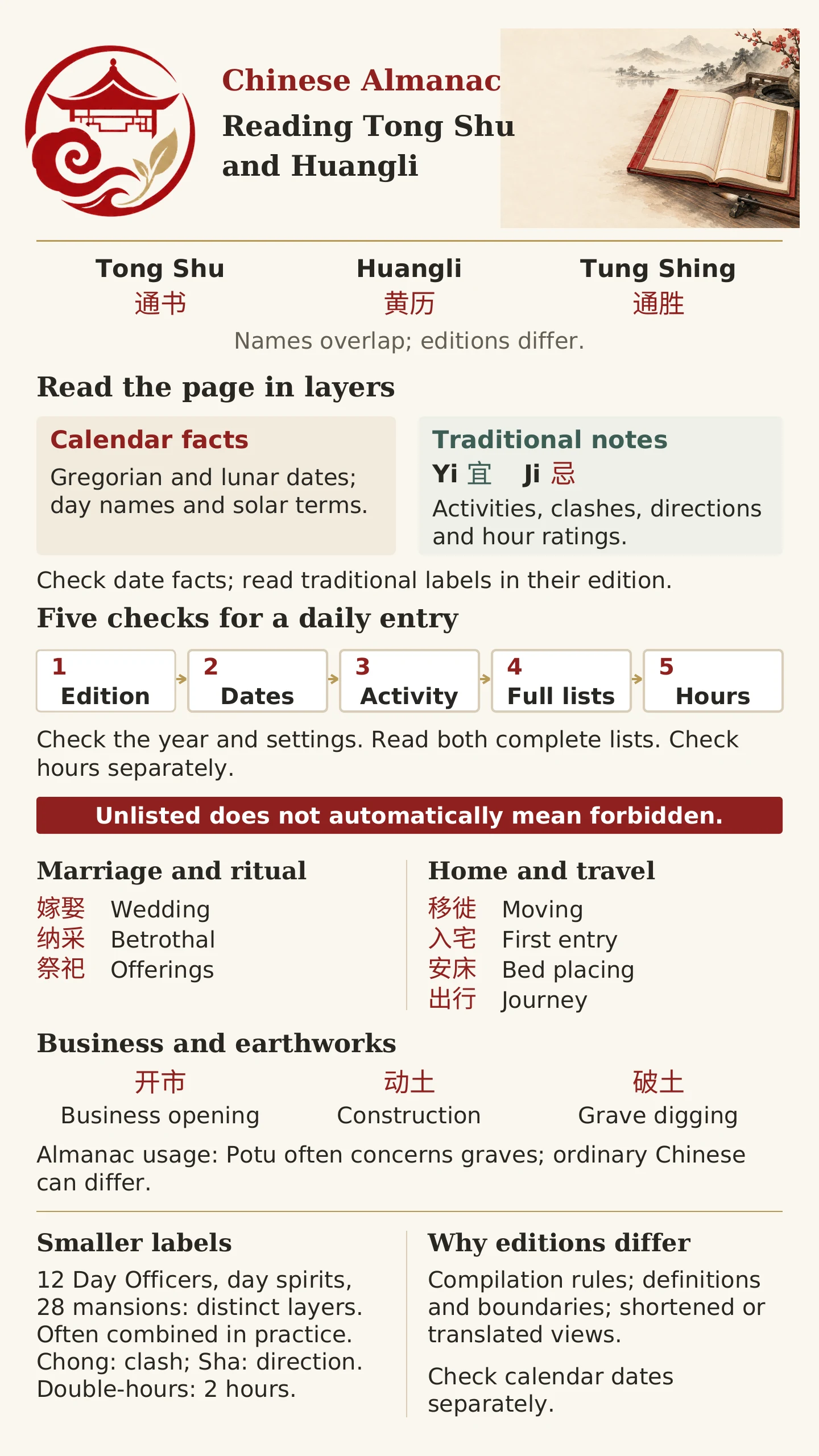
A single page can show two dates, unfamiliar characters, lists of activities and small notes about directions or hours. This guide explains a practical reading order, with room for the different layouts used by publishers and online calendars.
Tong Shu, Huangli and Tung Shing: Names and Background
Huangli (黄历, huánglì) is a common mainland Chinese name for this kind of almanac. Tong Shu emphasizes the broader reference book. In Hong Kong and other Cantonese-speaking communities, Tung Shing (通胜, Mandarin: tōngshèng) is a familiar name. In Taiwan, Nongminli (农民历, nóngmínlì), often translated as “farmers’ almanac,” is widely used.
The Cantonese naming story involves the similar sounds of “book” and “lose”: the character for book, 书, sounds like 输, meaning to lose. Replacing “book” with 胜, meaning victory, gives the name a more favorable association.[2]
These names overlap, but they do not identify one standardized publication. Editions can include different annotations, reference chapters and layouts. Treat the publisher, year and explanatory notes as part of what you are reading.
The Chinese lunar calendar explains the underlying date system. This guide concentrates on how an almanac presents and interprets information on top of it.
What the Main Fields on an Almanac Page Mean
Start with the heading for the date, then identify the labels around it. Their position and color may change between books, so read the characters rather than assuming every red or black mark has the same function.
| Printed field | What it records | How to read it |
|---|---|---|
| Gregorian date | The civil year, month and day | Confirm the intended date first. |
| Nongli (农历, nónglì) | The corresponding traditional lunar month and day | Check the month number and any leap-month designation. |
| Gan-Zhi (干支, gānzhī) | A Heavenly Stem (天干, tiāngān) paired with an Earthly Branch (地支, dìzhī) | Identify whether it labels the year, month, day or hour. |
| Solar terms | Seasonal markers based on the Sun’s position | A seasonal date is not a local weather forecast. |
| Yi | The edition’s traditionally suitable activities | Match the activity precisely. |
| Ji | The edition’s traditionally avoided activities | Read the full list, including qualifications. |
| Chong (冲, chōng) | A traditional clash annotation, often naming an animal | This is a symbolic relationship, not the reader’s identity. |
| Sha (煞, shà) | A traditional adverse-direction annotation | Keep it distinct from the clash line. |
| Shichen (时辰, shíchen) | Twelve traditional double-hours, sometimes marked favorable or unfavorable | Separate a particular time window from a whole-day entry. |
The day label belongs to the date; it does not automatically describe the person looking at the page. Our Heavenly Stems and Earthly Branches guide explains the naming system.[3]
How to Read a Daily Almanac Entry
Use the same sequence with a printed page or an app. First establish what record you are seeing, then interpret the relevant activity and any narrower time conditions.
- Confirm the edition and year. Note the publisher or app, and read its time-zone or date-boundary settings when supplied.
- Match the dates. Check both the Gregorian date and lunar month/day, including whether a repeated month is marked leap.
- Identify the activity. A wedding ceremony, betrothal, move and first entry into a new home can occupy different categories.
- Read both complete lists. An omitted activity is not automatically forbidden. Expand shortened cards or consult the original entry before deciding that a term is absent.
- Check the hour column separately. A favorable double-hour is a narrower annotation; it does not turn every activity on that day into a suitable one.
For a calendar check, October 24, 2026 corresponds to lunar month nine, day fifteen, with the day name Xin-Wei (辛未, Xīn-Wèi). Those are verifiable date labels. They do not establish the day’s Yi, Ji, clash or direction entries.[4]
Here is a separate, undated reading exercise: imagine an entry placing Jisi (祭祀, jìsì), ritual offerings, under Yi and Dongtu (动土, dòngtǔ), construction groundbreaking, under Ji. It classifies the first activity as favored and the second as avoided. If travel is absent from both complete lists, the exercise supplies no explicit entry for travel. Other notes may still qualify the record.
The undated exercise demonstrates vocabulary only; it assigns no activity judgments to October 24, 2026.
Common Yi and Ji Activities Explained
Short Chinese activity labels carry more specific meanings than broad English words such as “wedding,” “moving” or “building.” The following are useful starting translations in an almanac context; the edition’s own glossary takes priority when it makes a finer distinction.[5]
| Activity | Useful English meaning | Distinction to retain |
|---|---|---|
| Jiaqu (嫁娶, jiàqǔ) | Holding the wedding ceremony | Different from the betrothal stage. |
| Nacai (纳采, nàcǎi) | Betrothal or presenting marriage gifts | Not automatically the wedding itself. |
| Jisi (祭祀, jìsì) | Making ritual offerings | Often concerns ancestors or deities. |
| Chuxing (出行, chūxíng) | Setting out on a journey | Do not invent a universal distance threshold. |
| Yixi (移徙, yíxǐ) | Moving residence | A broad relocation category. |
| Ruzhai (入宅, rùzhái) | Moving into a new home | May emphasize the formal first entry. |
| Anchuang (安床, ānchuáng) | Placing or installing a bed | Not ordinary nightly sleep. |
| Kaishi (开市, kāishì) | Opening or resuming business | Can refer to a new opening or a seasonal reopening. |
| Dongtu (动土, dòngtǔ) | Beginning construction-related earthworks | Often contrasted with grave-related digging. |
| Potu (破土, pòtǔ) | Grave-related groundbreaking in many almanacs | Check context before translating it as general construction. |
Ruzhai means moving into a new residence, rather than simply walking into a room.[6] Potu needs particular care: almanac usage often distinguishes it from Dongtu, but ordinary Chinese also uses Potu for construction groundbreaking. The surrounding category matters more than a single rigid English equivalent.[7]
Activity scope can also vary by region. A book may distinguish the physical move, first entry, bed placement and business opening even when a family plans several of them on the same day. Match the printed term before applying the annotation.
Day Officers, Clashes and Other Smaller Labels
The smaller labels belong to several traditional systems. They may be interpreted together, but they are not interchangeable and should not be added up as a simple “good versus bad” score.
- Day classification: The Twelve Day Officers (建除十二值日, jiànchú shí’èr zhírì) use the sequence Establish (建, jiàn), Remove (除, chú), Full (满, mǎn), Balance (平, píng), Stable (定, dìng), Hold (执, zhí), Break (破, pò), Danger (危, wēi), Success (成, chéng), Receive (收, shōu), Open (开, kāi) and Close (闭, bì). These are category names, not a universal ranking for every activity.[8]
- Other daily markers: The day spirits (值神, zhíshén) include Yellow Path (黄道, huángdào) and Black Path (黑道, hēidào) classifications. Almanacs may also assign lunar mansions (二十八宿, èrshíbā xiù). These are different layers; a mansion label is not a report of which stars you can see that evening.
- Clashes and directions: A Chong line naming an animal expresses a traditional clash. A Sha line naming a direction expresses a customary directional avoidance. Neither is a physical hazard report or a prediction that harm will occur.
- Hour labels: Each traditional double-hour spans two modern hours; for example, the Zi (子, Zǐ) period runs from 23:00 to 01:00. Check the edition’s handling of midnight, time zones and any conversion before interpreting a time slot.[3]
Our traditional Chinese timekeeping guide explains the hour framework. The practical reading skill is to recognize which system a label belongs to before considering how that edition combines its annotations.
Why Different Almanacs Can Disagree
Two editions can share the same calendar date but print different activity lists. Three distinctions help explain what changed:
- Compilation traditions: Editors may draw on different classifications and give different weights to the day officers, stars and other rules.[8]
- Definitions and boundaries: Compare the exact activity term, date boundary and stated settings. Two translations may look equivalent while referring to different actions.
- Presentation: An app may show a short selection, abbreviate a phrase or omit a qualification present in the full record.
A genuine date-conversion error is a separate issue. Check the date component against an authoritative calendar, then examine the source of the traditional annotations. Agreement on the lunar date does not establish the effectiveness of an auspiciousness claim.
The Chinese auspicious dates guide covers the broader selection traditions and their limits beyond reading a single entry.
FAQs About the Chinese Almanac
Is a Chinese almanac the same as the lunar calendar?
No. A calendar supplies the system for organizing dates. An almanac is a publication that uses those dates as a framework for customary annotations and other reference material. Its date conversion and its activity judgments therefore need different kinds of checking.
What does “everything is unsuitable” mean in an almanac?
Zhu Shi Bu Yi (诸事不宜, zhū shì bù yí) is a broad unfavorable label within traditional date selection. Read it with the surrounding entry and edition notes. It is not an instruction to suspend ordinary life, stop routine work or treat necessary everyday tasks as forbidden.
Are auspicious days the same for everyone?
The printed Yi and Ji lists are general annotations. Some date-selection traditions add a person’s birth information and the nature of the event. That is a separate interpretive process, and neither a general label nor an individualized reading guarantees an outcome.
Can I use an old Tong Shu for a new year?
Do not reuse an old year’s daily pages as the new year’s schedule. Dates, day names and corresponding annotations must match the intended year. Older chapters about vocabulary, customs or historical practice may still be useful, provided you recognize their period and regional context.
Sources
[1] Richard J. Smith. The Educational Role of Chinese Almanacs: Past, Present, and Future, in Chinese Education for the 21st Century Conference Proceedings
[2] Peter So. 2021 Chinese Almanac: Publisher’s Sample
[3] Hong Kong Observatory. Heavenly Stems and Earthly Branches
[4] Hong Kong Observatory. 2026 October Calendar
[5] Xu Dafang. Glossary of Traditional Date-Selection Terms
[6] Ministry of Education, Taiwan. Revised Mandarin Chinese Dictionary: 入宅
[7] Ministry of Education, Taiwan. Revised Mandarin Chinese Dictionary: 破土
[8] Joey Yap. What Is the Tong Shu? Chinese Date Selection Explained