


Quick Answer: Why Does Chinese New Year Change Every Year?
Chinese New Year (春节, chūnjié) always begins on the first day of the first month of the traditional Chinese calendar, Nongli (农历, nónglì). Its Gregorian date changes because this calendar is lunisolar: months follow the Moon, while the year is kept aligned with the Sun’s seasonal cycle.[1][2]
Twelve lunar months are shorter than a solar year, so the festival usually moves earlier in the Gregorian calendar. An extra leap month (闰月, rùnyuè) periodically makes the following New Year later. In modern calendars, Chinese New Year falls between January 21 and February 20.[3]
A February celebration one year can become a January celebration the next. That shift can look unpredictable on a phone calendar, yet it follows a clear astronomical system. The key is to distinguish a fixed traditional date from its changing Gregorian equivalent.
How Lunar Months Make the Date Move
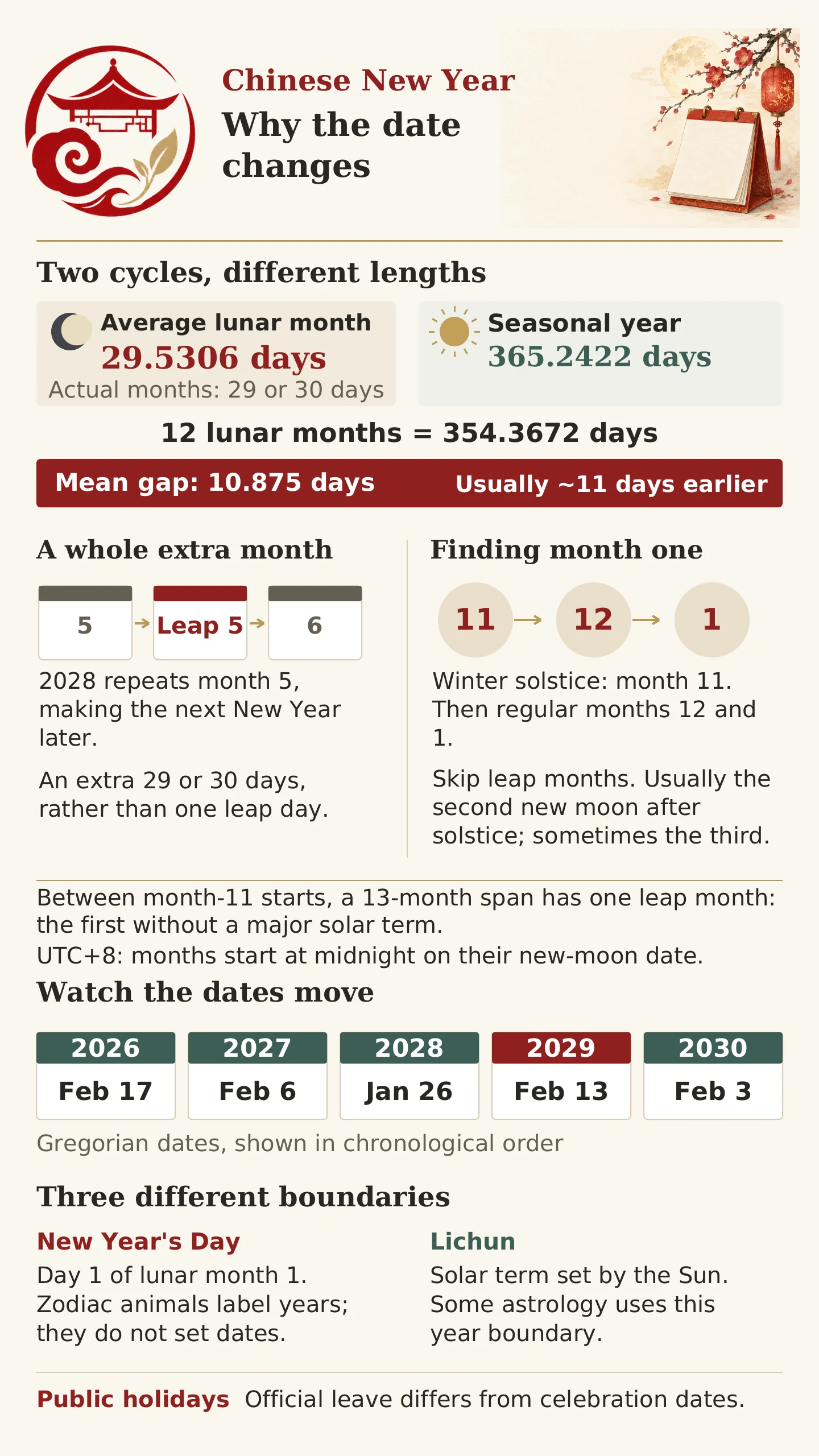
A month in the Chinese lunar calendar follows the cycle from one new moon to the next, called a synodic month. Its average length is 29.5306 days. Calendar months must contain whole days, so an actual Chinese lunar month has either 29 or 30 days.[1]
Twelve average synodic months total 354.3672 days. A tropical year, which measures the return of the seasonal cycle, is about 365.2422 days. The difference is 10.875 days, explaining why a twelve-month lunar year is roughly eleven days shorter.[1]
The Gregorian calendar follows the solar year through years of 365 or 366 days. Without an extra lunar month between two New Years, the next celebration therefore tends to land about eleven Gregorian dates earlier. The exact shift varies with actual month lengths and the Gregorian leap day; subtracting eleven from last year’s date is not a reliable calculation method.
How Leap Months Keep Chinese New Year in Season
If every Chinese year contained only twelve lunar months, the shortfall would accumulate. New Year would drift through the seasons instead of remaining near the seasonal transition from winter toward spring. A leap month corrects that drift by adding a whole lunar month, producing a year with thirteen months.[1]
This extra month repeats the preceding month’s number with a leap designation. It is not called month thirteen, and it has 29 or 30 days. It also differs from February 29, which adds one day to a Gregorian year rather than one month to a Chinese year.[4]
The timing matters: a leap month between one Chinese New Year and the next makes that interval longer. Consequently, the following celebration generally appears about three weeks later in the Gregorian calendar, rather than continuing its earlier movement.
For example, the 2028 calendar contains a leap fifth month beginning on June 23. That additional month falls between Chinese New Year on January 26, 2028, and the next occurrence on February 13, 2029. The latter date sits eighteen days later in the Gregorian month-and-day sequence.[5]
How the First Lunar Month Is Determined
New moons identify month beginnings, but the Sun helps determine which month is the first. The calendar uses the following relationships:[4][2]
- Locate the northern winter solstice, Dongzhi (冬至, dōngzhì). The lunar month containing that date is month eleven. Its wider cultural significance is explained in our Dongzhi Festival guide.
- Apply the leap-month rules. When thirteen lunar months fall between successive month-eleven beginnings, the first following month without a major solar term, Zhongqi (中气, zhōngqì), is designated leap. These twelve markers track the Sun’s seasonal progress independently of lunar month boundaries.
- Number the regular months forward: month twelve, then month one, Zhengyue (正月, zhēngyuè). A leap month repeats a number rather than advancing this count. The first day of month one is New Year’s Day.
This explains the familiar shortcut, “the second new moon after the winter solstice.” It works in most years, but a leap month eleven or twelve can make New Year fall on the third new moon instead.[4]
Modern Chinese calendar dates use UTC+8. A month begins at midnight on the civil day containing the calculated new moon, not at the exact instant of conjunction and not when someone first sees a crescent. For more on the numbering, read about Chinese calendar months.[4]
Chinese New Year Dates from 2026 to 2030
Chinese New Year in 2027 falls on Saturday, February 6. This short sequence shows how dates move earlier, then later when an extra lunar month intervenes. The dates below follow the published UTC+8 calendar tables.[5]
| Year | Chinese New Year date | Movement from the previous year’s date |
|---|---|---|
| 2026 | February 17 | Starting point |
| 2027 | February 6 | 11 days earlier |
| 2028 | January 26 | 11 days earlier |
| 2029 | February 13 | 18 days later |
| 2030 | February 3 | 10 days earlier |
The movement column compares Gregorian month-and-day positions, not the elapsed number of days between celebrations. For the festival’s broader meaning and annual details, visit our Chinese New Year guide.
Chinese New Year, Lichun and Public Holidays
Several dates can appear together on a Chinese calendar without serving the same purpose. Keep these distinctions separate when checking a festival, birth year or period of leave.
- Chinese New Year and Lichun: New Year begins month one. Lichun (立春, lìchūn), or Start of Spring, is a solar term determined by the Sun’s position. It may fall before or after New Year’s Day; the two are not interchangeable. The Lichun guide explains its seasonal meaning.[2]
- Zodiac year boundaries: In common public usage, the Chinese zodiac (生肖, shēngxiào) changes at Chinese New Year. Some traditional astrology systems use Lichun instead. These conventions label years; the animal does not set the festival date. For January or February births, check the exact date with our zodiac and lunar birthday calculator.[2]
- Celebrations and public holidays: New Year’s Day, the traditional celebration period and officially announced days off have different boundaries. The first fifteen days of Chinese New Year describe the cultural sequence. Check the relevant year’s official holiday notice separately for leave dates and any adjusted working days.
FAQs About Chinese New Year Dates
Why is Chinese New Year sometimes in January and sometimes in February?
Lunar months and solar seasons do not fit together in whole numbers. Twelve lunar months tend to bring the next New Year earlier, while an intervening leap month moves it later. This adjustment keeps the festival within its familiar late-January-to-February window instead of letting it drift through the year.
Is Chinese New Year always on the second new moon after the winter solstice?
No. That is a useful rule of thumb, but a leap month near the end of the previous lunar year can make it the third new moon. The dependable definition is the first day of the first regular lunar month, determined through the calendar’s month-numbering rules.[4]
Can the Chinese New Year date be calculated years in advance?
Yes. Astronomical calculations allow calendars to be published decades ahead. However, a new moon or solar term close to midnight can create a one-day date uncertainty in some future calculations. This can arise within decades, not only in an extremely distant future; use updated official conversion tables.[5]
Sources
[1] Hong Kong Observatory. The Chinese Agricultural Calendar (Nongli)
[2] Hong Kong Observatory. What year is it today?
[3] National Geographic Education. Lunar New Year
[4] Y. T. Liu. Rules for the Chinese Calendar
[5] Hong Kong Observatory. Gregorian-Lunar Calendar Conversion Table