

Quick Answer: What Are the Six Autumn Solar Terms?
The six autumn solar terms (节气, jiéqì) mark the traditional autumn season, beginning in early August and continuing until Start of Winter, or Lidong (立冬, Lìdōng), in early November. Their order stays the same; their Gregorian starting dates can shift slightly between years.[1]
The table gives the 2026 starting dates in UTC+8. These are year-specific dates, not permanent anniversaries.[2]
| Solar term | English name | 2026 date, UTC+8 |
|---|---|---|
| Liqiu (立秋, Lìqiū) | Start of Autumn | August 7 |
| Chushu (处暑, Chǔshǔ) | End of Heat | August 23 |
| Bailu (白露, Báilù) | White Dew | September 7 |
| Qiufen (秋分, Qiūfēn) | Autumn Equinox | September 23 |
| Hanlu (寒露, Hánlù) | Cold Dew | October 8 |
| Shuangjiang (霜降, Shuāngjiàng) | Frost’s Descent | October 23 |
Shuangjiang begins autumn’s final segment. Autumn continues afterward until Lidong, which falls on November 7 in 2026.[2]
A calendar may announce autumn while Beijing still feels like midsummer. Weeks later, longan, persimmons and newly harvested grain give the season a different texture. China’s autumn calendar connects these changes with local foods and customs, although neither the weather nor the menu follows one national timetable.
Why Autumn Can Begin Before the Weather Cools
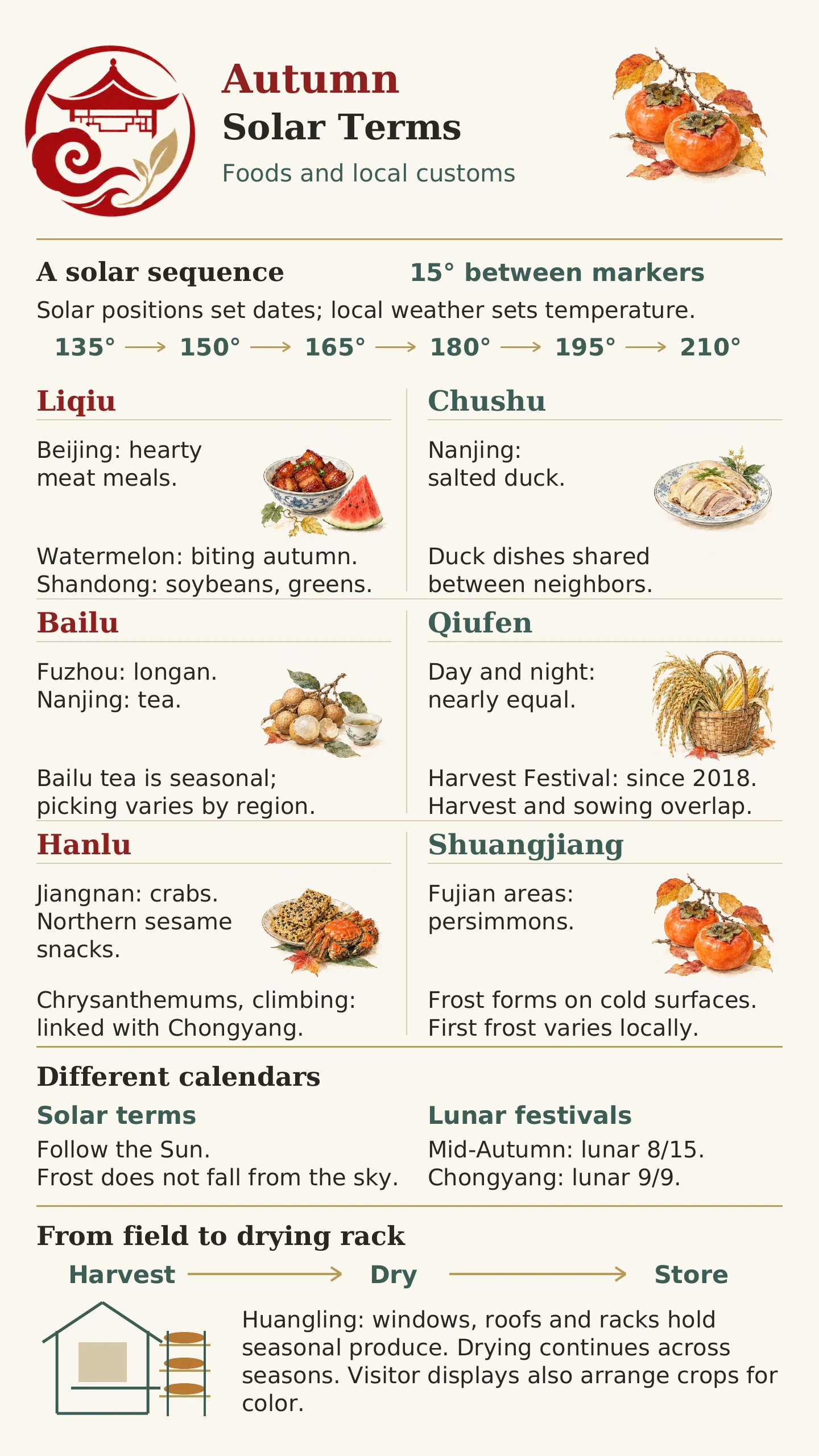
Each solar term begins when the Sun reaches a specified position along the ecliptic, with successive terms separated by 15 degrees of solar longitude. Liqiu starts at 135 degrees; Shuangjiang starts at 210 degrees. A thermometer reading does not determine either date.[1]
These solar markers appear within the Chinese lunisolar calendar, Nongli (农历, nónglì), but do not follow fixed lunar month-and-day dates. Our Chinese lunar calendar guide explains that relationship.
Local cooling depends on latitude, elevation and weather patterns. The popular name “autumn tiger,” Qiulaohu (秋老虎, qiūlǎohǔ), describes spells of lingering or returning heat after Liqiu. It has no fixed calendar window. This explains the apparent contradiction: traditional autumn can begin while summer heat remains.[3]
Foods and Customs Across the Six Autumn Solar Terms
The examples below show how particular communities mark the season. They provide a cultural guide rather than a shared six-date menu.
Liqiu: Biting Autumn and Hearty Meals
In Beijing, “putting on autumn flesh,” Tieqiubiao (贴秋膘, tiē qiūbiāo), is associated with hearty meat dishes after summer. Braised pork and pork knuckle mark the change with a substantial family meal. The name recalls older ideas about recovering weight lost during summer.[3]
Another practice is “biting autumn,” Yaoqiu (咬秋, yǎoqiū), also called “gnawing autumn,” Kenqiu (啃秋, kěnqiū). Eating watermelon gives the phrase a literal form: a bite of summer fruit marks autumn’s arrival.[3]
The food need not be meat or melon. Records from Zhucheng and Laixi in Shandong describe eating Zha (渣, zhā), a preparation of ground soybeans and greens sometimes described as “little tofu.” Here the seasonal meal centers on soybeans and greens, alongside the meat and melon traditions described above.[4]
Chushu: Duck Dishes as Summer Heat Eases
Chushu’s name suggests the ending of heat, although hot days may continue. In Nanjing, duck is a particularly recognizable seasonal food. Salted duck and duck prepared at home connect this period with the city’s established duck-eating culture.[5]
Households also share duck dishes with neighbors. The custom has a social dimension: preparing food and giving some away marks the season through neighborhood relationships. The neighborhood gift matters as much as the particular recipe.[5]
Nor does Chushu announce a uniform rice harvest. Early and late rice follow different crop cycles, and the timing of harvesting, transplanting and field care depends on the locality. Autumn farming involves overlapping tasks rather than one operation assigned to each term.[6]
Bailu: Longan, Tea and Cooler Nights
Bailu evokes dew on vegetation as nights cool. In Fuzhou, Fujian, eating longan is a well-documented seasonal custom. The fruit’s brown shell and translucent flesh make it a distinctive part of the local autumn table. Eating it marks the season through a familiar regional fruit.[7]
Tea offers a different regional example. In Nanjing, Bailu tea (白露茶, báilù chá) refers to tea associated with picking around this part of the season. It is an autumn harvest label, rather than a separate botanical type of tea.[7]
Neither label gives every tea-growing area the same picking schedule. Climate, elevation and the kind of tea being produced affect the harvest. For a broader comparison, see our guide to Chinese tea harvest seasons.
Qiufen: The Equinox and Harvest Celebrations
At the September equinox, the Sun crosses the celestial equator. Day and night are approximately equal, rather than exactly twelve hours everywhere: atmospheric refraction and the way sunrise and sunset are defined affect the measured daylight.[8]
On farms, autumn harvesting can overlap with sowing winter crops. Northern maize harvesting and winter-wheat sowing, and rapeseed sowing in suitable regions, belong to this broader agricultural transition. Actual dates follow local crops and conditions.[6]
A modern observance makes that connection explicit. China established the Chinese Farmers’ Harvest Festival (中国农民丰收节, Zhōngguó Nóngmín Fēngshōu Jié) in 2018, assigning it to Qiufen each year. It is a contemporary festival honoring agriculture, rather than an unchanged ancient holiday.[9]
Older rituals have their own histories. Beijing’s Moon Altar was used for imperial moon worship at the autumn equinox during the Ming and Qing periods. This is distinct from the Mid-Autumn Festival (中秋节, Zhōngqiū Jié), dated to the fifteenth day of the eighth lunar month.[10]
A folk custom recorded for Qiufen placed plain rice balls beside fields, symbolically hoping to “stick” birds’ beaks and protect grain. Its meaning lies in farmers’ wishes for the harvest, not in practical pest control.[11]
Hanlu: Sesame Foods, Crabs and Chrysanthemums
Around Hanlu, Jiangnan’s autumn table often features hairy crabs, Dazhaxie (大闸蟹, dàzháxiè). The connection belongs especially to the lower Yangtze’s seasonal food culture; the solar term does not set a universal date on which every crab becomes ready to eat.[12]
Sesame provides another example. Sesame balls, brittle and pastries are associated with Hanlu in northern food traditions. Their familiar ingredients make the seasonal occasion part of everyday food culture.[12]
The farming term “cold-dew wind,” Hanlufeng (寒露风, hánlùfēng), also needs care. It describes damaging cool conditions affecting southern late rice, particularly around heading and flowering. Such conditions can occur before the calendar reaches Hanlu; the name is not a weather appointment.[13]
Chrysanthemum viewing and “climbing heights,” Denggao (登高, dēnggāo), also belong to the broader autumn season. They are closely associated with the Chongyang Festival (重阳节, Chóngyáng Jié), whose date is the ninth day of the ninth lunar month. Chongyang falls on October 18 in 2026, ten days after Hanlu, illustrating why their seasonal overlap should not be treated as a shared fixed date.[2][12][14]
Shuangjiang: Persimmons and the Approach of Winter
In parts of Fujian, eating persimmons is associated with Shuangjiang. The ripe orange fruit makes an appealing seasonal marker, but its harvest depends on variety and location. The custom does not mean that every persimmon ripens on the same calendar day.[15]
“Frost’s Descent” can be misleading if read literally. Hoarfrost forms when water vapor deposits directly as ice on a sufficiently cold surface. Dew, by contrast, consists of liquid droplets. Frost does not fall from the sky like rain or snow.[16]
The term begins at a defined solar position, whether or not a particular town experiences frost. Northern and high-elevation places may have seen it earlier; warmer southern locations may remain frost-free. Autumn’s final term therefore points toward winter without supplying a nationwide first-frost forecast.[1][16]
From the Harvest to Drying and Storage
Harvesting explains many autumn food traditions, but the work continues after crops leave the field. Drying and storing produce help households make use of seasonal abundance. Meanwhile, autumn sowing prepares some fields for the following year’s crops.[6]
Huangling, a mountain village in Wuyuan, Jiangxi, is known for “drying autumn,” Shaiqiu (晒秋, shàiqiū). Limited flat ground encouraged the use of windows, roofs and wooden racks for drying produce such as peppers and maize. The racks turn the village’s built environment into working space.[17]
Today’s visitor-facing displays also arrange crops for color and visual effect. Drying continues through different seasons, using whichever produce is available. A carefully composed tourism display and everyday household drying can share materials while serving different purposes.[17]
This agricultural background helps explain the prominence of grain, fruit and preserved produce. It sits alongside other influences already seen here: family meals, neighborhood gifts, court ritual and a modern national harvest celebration.
FAQs About Autumn Solar Terms
When does autumn begin in the Chinese solar terms?
Traditional autumn begins at Liqiu in early August and continues until Lidong in early November. Qiufen lies in the middle of that season. This differs from the Northern Hemisphere’s astronomical convention of beginning autumn at the September equinox.[1][8]
Is the Mid-Autumn Festival a solar term?
No. Qiufen follows the Sun’s position; Mid-Autumn follows the lunar calendar, falling on its eighth month’s fifteenth day. Their Gregorian dates can coincide: both fell on September 23 in 1980. Different calendar rules do not mean the dates can never overlap.[10][18]
Do all parts of China eat the same autumn foods?
No national six-term menu exists. Beijing’s hearty Liqiu meals, Nanjing’s Chushu duck and Fuzhou’s Bailu longan illustrate distinct regional traditions. A documented local association does not mean every household follows it, or that the food is absent elsewhere.[3][5][7]
Does Shuangjiang mean frost starts everywhere?
No. Shuangjiang begins at a fixed solar longitude, not at a temperature threshold. Actual frost depends on local surface conditions and weather, so it can arrive before or after the term, or be absent in warm regions.[1][16]
Sources
[1] Hong Kong Observatory. The 24 Solar Terms
[2] Hong Kong Observatory. 2026 Gregorian–Lunar Calendar
[3] China News Service. Liqiu Foods and Folk Customs
[4] Shandong Local Chronicles. Seasonal Customs
[5] China Weather. Chushu Customs and Nanjing Duck
[6] Ministry of Agriculture and Rural Affairs. 2026 Autumn Harvest and Sowing Guidance
[7] China Weather. Bailu Longan and Tea Traditions
[8] NASA Night Sky Network. Embracing the Equinox
[9] State Council. Decision Establishing the Chinese Farmers’ Harvest Festival
[10] Beijing Municipal Cultural Heritage Bureau. Moon Altar
[11] China Weather. Qiufen Foods and Folk Customs
[12] People’s Daily Overseas Edition. Hanlu Foods and Seasonal Customs
[13] China Weather. Hanlufeng and Late Rice
[14] Palace Museum. Chongyang Festival
[15] China Weather Fujian. Shuangjiang Persimmon Customs
[16] Hong Kong Observatory. The Looks of Water in Winter
[17] Wuyuan Huangling. Seasonal Drying and Contemporary Displays
[18] Hong Kong Observatory. 1980 Gregorian–Lunar Calendar