

Quick Answer: What Are the Nine Nines of Winter?
Shu Jiu (数九, shǔjiǔ), often called the Nine Nines of Winter, is a Chinese folk practice for marking the cold season. It combines a day count with familiar songs and visual records.[1]
- Count: Nine groups of nine days make 81 days altogether.
- Starting point: The common convention used here counts the winter solstice, Dongzhi (冬至, Dōngzhì), as day one.
- Customs: People recite seasonal rhymes, color daily marks or trace characters while waiting for spring.[1]
These nine-day units are not solar terms (节气, jiéqì). Their dates can be calculated; their seasonal imagery does not forecast a particular day’s weather.
A winter expression that sounds like three days can actually name a nine-day period. A painted plum branch can also serve as a calendar. These traditions turn the passage through cold weather into something people can count, recite and mark on paper, one day at a time.
How to Count Shu Jiu: 2026–2027 Dates
Use the same starting convention throughout a count:
- Find the starting date: Identify the winter solstice’s Gregorian date in the time zone being used.
- Include day one: Count that calendar date as day one, then include the next eight dates to complete the first group.
- Advance in nine-day blocks: Begin a new group every nine days until the ninth group ends on day 81.
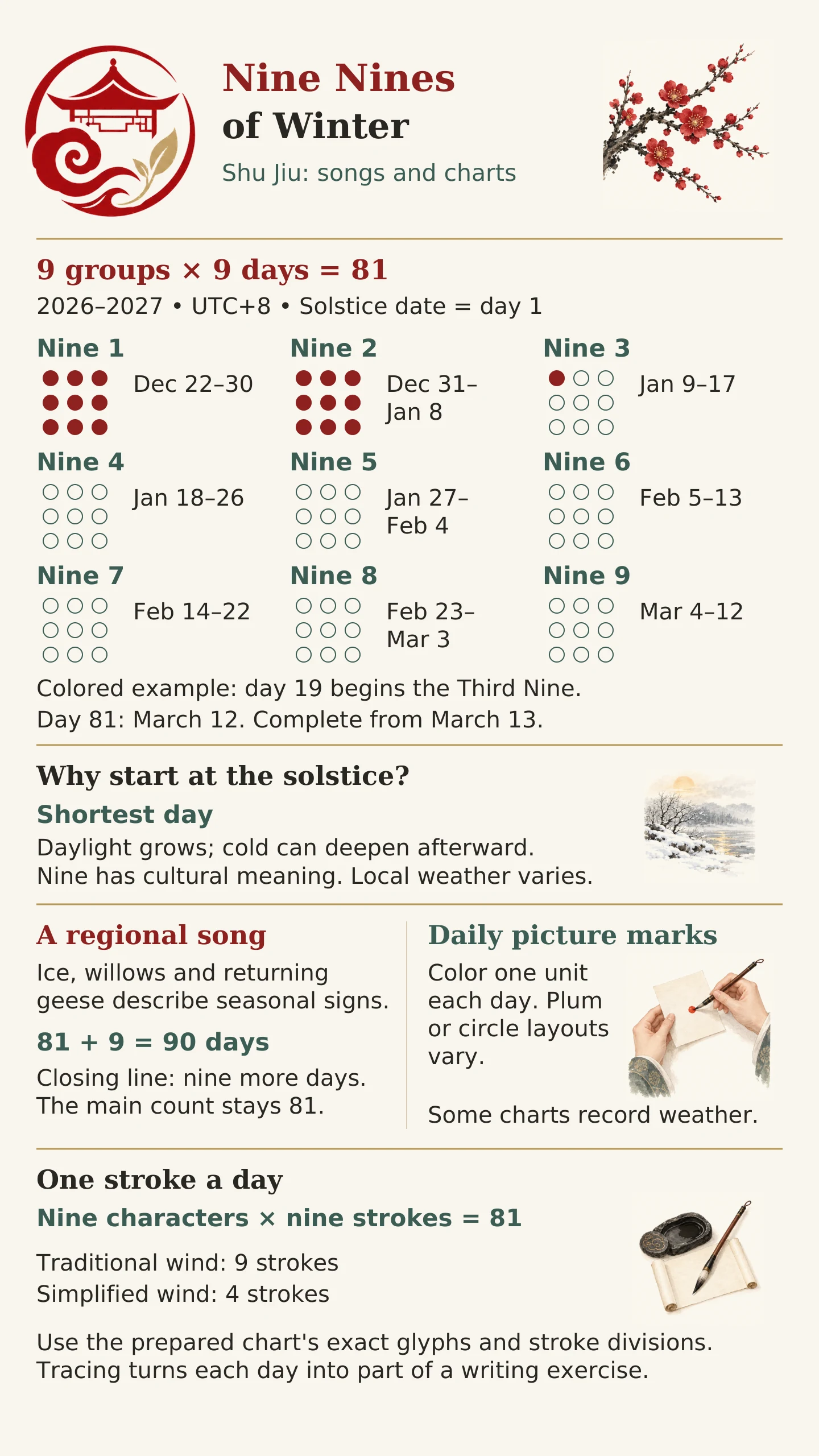
For 2026–2027, the starting date is December 22, 2026, in UTC+8. The solstice date follows astronomical calculation; the nine-day ranges below are calculated from it using the stated folk-counting convention.[2]
| Period | Days of the count | Gregorian dates, UTC+8 |
|---|---|---|
| First Nine (一九, yījiǔ) | 1–9 | December 22–30, 2026 |
| Second Nine (二九, èrjiǔ) | 10–18 | December 31, 2026–January 8, 2027 |
| Third Nine (三九, sānjiǔ) | 19–27 | January 9–17, 2027 |
| Fourth Nine (四九, sìjiǔ) | 28–36 | January 18–26, 2027 |
| Fifth Nine (五九, wǔjiǔ) | 37–45 | January 27–February 4, 2027 |
| Sixth Nine (六九, liùjiǔ) | 46–54 | February 5–13, 2027 |
| Seventh Nine (七九, qījiǔ) | 55–63 | February 14–22, 2027 |
| Eighth Nine (八九, bājiǔ) | 64–72 | February 23–March 3, 2027 |
| Ninth Nine (九九, jiǔjiǔ) | 73–81 | March 4–12, 2027 |
January 9 is therefore day 19, the first day of the Third Nine. March 12 is day 81; from March 13, this cycle is complete. Some accounts begin on the day after the solstice instead, shifting every range one day later. Check the convention before comparing tables.[3]
Why the Count Begins at the Winter Solstice
The Dongzhi Festival shares its date with the Northern Hemisphere’s shortest day. After the solstice, daylight increases, yet the land can continue losing more heat than it receives. This lag helps explain why deeper cold often comes afterward.[4]
The saying that cold peaks in the Third Nine reflects seasonal experience, rather than a fixed forecast. Long-term observations place the coldest period in different nines across China: many northern places peak earlier than some southern coastal areas. Individual winters can depart from those averages.[5]
There is also a cultural reason for grouping the days in nines. Traditional number symbolism associates nine with extremity and with yang (阳, yáng). Repeating it gives the wait for returning warmth a symbolic structure. Our guide to the meaning of nine explains the wider associations.[3]
The winter solar terms follow solar positions; Shu Jiu counts consecutive days. Their boundaries need not match. Start of Spring, Lichun (立春, Lìchūn), falls on February 4 in 2027, well before the count ends.[6][7]
Songs and Charts for Waiting Out the Cold
Songs make the stages memorable, while daily pictures and writing give the passing days a visible form.
The Nine Nines Song and Its Regional Versions
The Nine Nines Song (九九歌, Jiǔjiǔ Gē) survives in different regional versions. The following familiar northern wording moves from tightly guarded hands and ice toward willow growth, returning geese and farm work. These English meanings explain its imagery rather than reproduce its rhyme.[5][8]
| Stage or closing line | Chinese wording | English sense |
|---|---|---|
| First and Second Nines | 一九二九不出手 | People keep their hands tucked away from the cold. |
| Third and Fourth Nines | 三九四九冰上走 | Deep cold is pictured through ice-covered waterways. |
| Fifth and Sixth Nines | 五九六九沿河看柳 | People look for changing willows along the river. |
| Seventh Nine | 七九河开 | River ice opens as water begins to thaw. |
| Eighth Nine | 八九雁来 | Wild geese return from the south. |
| Closing line after the nine nines | 九九加一九,耕牛遍地走 | Add another nine days after the 81; oxen work across the fields. |
That closing line extends the imagery to 90 days: 81 plus nine. It does not turn the main Shu Jiu count into a ten-period calendar. Nor should it be translated as though the oxen line describes the Ninth Nine alone.[9]
Other local versions use different dialect words and seasonal observations. The inherited images are not a nationwide schedule for thawing, migration or farm work. In particular, the line about walking on ice is not evidence that a present-day river is safe to cross.[5]
Plum Blossoms and Circle Charts
A cold-dispelling chart (九九消寒图, jiǔjiǔ xiāohán tú) makes the count visible. In Hua Jiu (画九, huàjiǔ), or “painting the nines,” people color a prepared picture day by day. Plum designs provide 81 paintable units, arranged as buds, petals or other marks. The 81 marks are an artistic counting design, rather than a claim about the natural number of petals on a blossom.[10]
The plum blossom motif gives the winter record its recognizable subject. Layouts vary, so the essential feature is the total number of daily marks, rather than one required arrangement of flowers.
Tian Jiu (填九, tiánjiǔ), or “filling the nines,” uses circles instead. A nine-by-nine arrangement supplies 81 units. Some versions also record weather: marking the upper part for overcast skies and the lower part for sunshine, for example. These marks record what happened; they do not establish what the weather will do next.[3][10]
The activity remains useful in cultural education. In January 2026, the Natural History Museum of China combined the song with chart-making in a children’s winter program. A simple daily action can connect counting, observation and inherited imagery without requiring the original household setting.[8]
Writing Nine Characters, One Stroke a Day
Xie Jiu (写九, xiějiǔ), or “writing the nines,” uses outlined characters instead of pictorial marks. A well-known phrase is 亭前垂柳珍重待春風, evoking willows before a pavilion and an expectant wait for the spring breeze. The traditional tracing template is organized around nine characters counted as nine strokes each, making 81 daily strokes.[11]
Each day, the participant fills one outlined stroke in the prepared sentence. Once nine strokes complete a character, another nine-day group has passed. The practice combines a writing exercise with a visible record of waiting for spring.[11]
The exact written forms matter. Traditional 風 has nine strokes, while 风 has four; replacing one with the other breaks that version’s count. Follow the chosen chart’s glyphs and stroke divisions rather than assuming any modern font or rewritten phrase will provide 81 units.[12][13]
This use of Chinese calligraphy makes the paper itself a seasonal record. Surviving forms belong to both court and popular culture, rather than a single inventor’s design.[10][11]
FAQs About Shu Jiu
Does Shu Jiu start on the winter solstice day?
Under the common convention used here, yes: the solstice date is day one. Other accounts start the following day. Both readers and chart makers should state which convention they use, because the resulting date ranges differ by one day.[1][3]
Is Shu Jiu one of the solar terms?
No. Solar terms are determined by the Sun’s position, whereas Shu Jiu divides consecutive days into nine-day groups. The count begins at a solar term, Dongzhi, but its nine periods are not nine additional solar terms.[5][6]
Is the third nine always the coldest period?
No. The saying describes a climatic tendency, especially familiar in northern China. The timing of deepest cold varies with region and year, so neither the rhyme nor a nine-day date table can replace an actual weather forecast.[5]
Does the end of the nine nines mean winter is over?
Not by every definition. The traditional season turns to spring at Lichun, February 4 in 2027; this count ends on March 12. Local temperatures follow their own course, so completing the chart does not guarantee warm weather.[7]
Sources
[1] Inner Mongolia Meteorological Bureau. Counting Winter’s Nine-Day Periods
[2] Hong Kong Observatory. 2026 Gregorian–Lunar Calendar
[3] Dai Fengchun. Shu Jiu and Cold-Dispelling Charts
[4] Hong Kong Observatory. Why Cold Weather Lags Behind the Solstice
[5] CCTV. Counting the Nines, Climate and Regional Songs
[6] Hong Kong Observatory. The 24 Solar Terms
[7] Hong Kong Observatory. 2027 Gregorian–Lunar Calendar
[8] Natural History Museum of China. Winter Counting and Chart-Making Activity
[9] China Science Daily. Counting Winter’s Nines
[10] People’s Daily. Three Ways to Make a Cold-Dispelling Chart
[11] Palace Museum. Cold-Dispelling Charts
[12] Taiwan Ministry of Education. Dictionary Entry for 風
[13] Taiwan Ministry of Education. Dictionary Entry for 风