

Quick Answer: What Is the Shangsi Festival?
The Shangsi Festival (上巳节, Shàngsì Jié) is a traditional Chinese spring festival, historically associated with Han communities and riverside purification. Today it is generally observed on the third day of the third lunar month.
- Purification: Fuxi (祓禊, fúxì) involved cleansing by water and wishes to remove misfortune.
- Spring gatherings: Outings and waterside banquets included Qushui liushang (曲水流觞, qūshuǐ liúshāng), the custom of floating wine cups along winding water.
- Modern revival: Hanfu (汉服, hànfú), traditional Han Chinese clothing, features in some cultural gatherings alongside poetry and ritual demonstrations.
Customs differ across periods and communities; sharing the lunar date does not make every local celebration identical.
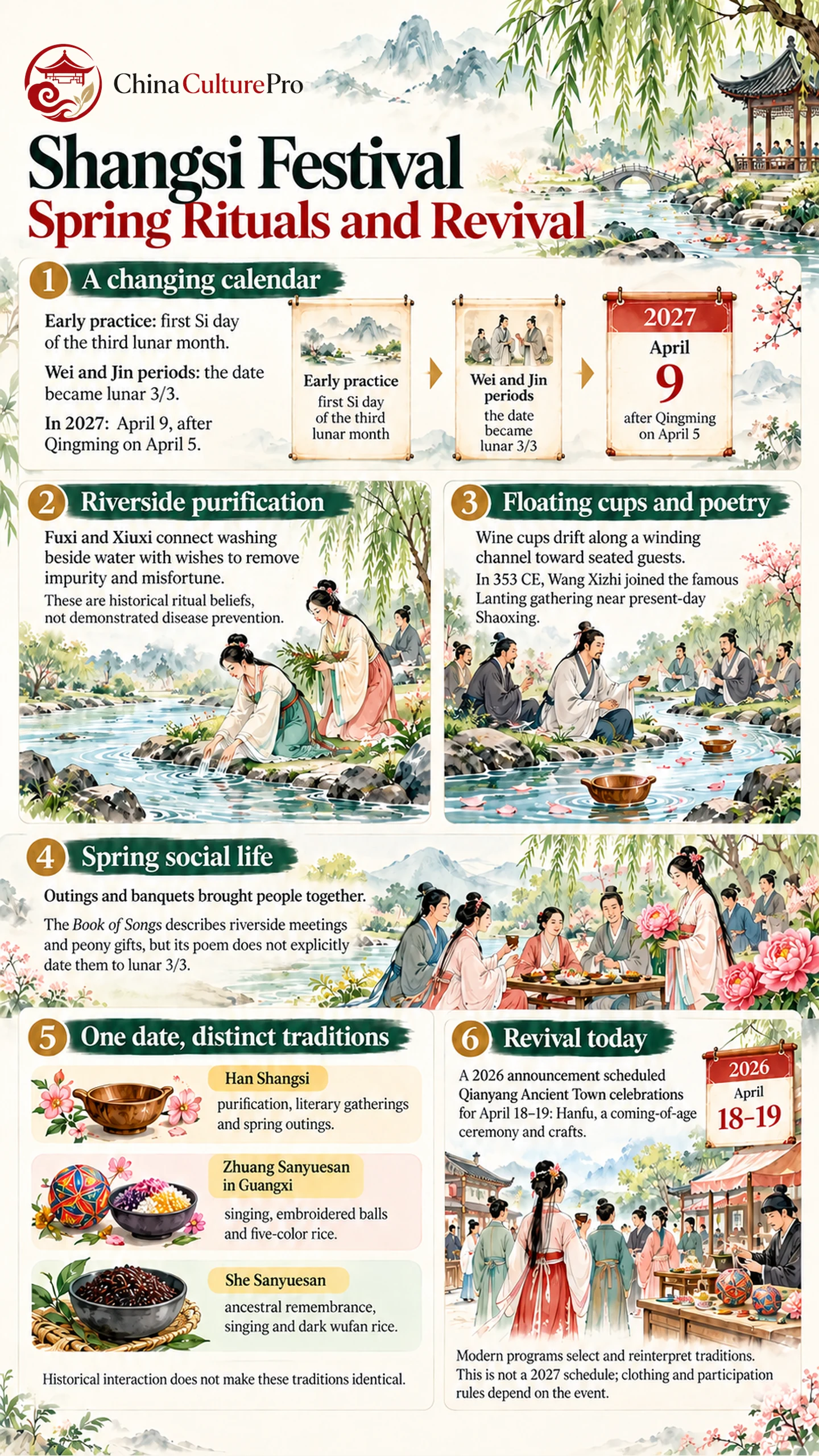
A cup drifting along a stream, friends gathering by the water, and a modern costume procession can all carry the Shangsi Festival (上巳节, Shàngsì Jié) label. Their connection runs through spring purification, poetry and social life. Among Chinese festivals and holidays, Shangsi offers a particularly vivid meeting of ritual and recreation.
When Is the Shangsi Festival?
Shangsi now generally falls on the third day of the third lunar month, hence the English name Double Third Festival. Its date is also called Sanyuesan (三月三, Sānyuèsān), literally “third month, third day.” In 2027, that lunar date falls on April 9, not March 3.[1]
The earlier observance followed the first Si (巳, Sì) day of the third lunar month. Si is one of twelve repeating day designations in traditional Chinese date reckoning. Here it identifies a day; the festival does not occur only in Snake years. During the Wei and Jin periods, observance became associated with the fixed lunar date of three-three rather than waiting for a Si day.[2]
Its order relative to Qingming (清明, Qīngmíng) changes. In 2027, Qingming Festival falls on April 5, four days before Shangsi. Qingming follows a solar term, while Shangsi follows a lunar date. Neither date alone establishes a local event schedule.[1]
Origins and Riverside Purification: Fuxi and Xiuxi
Riverside purification is central to Shangsi’s early history. Fuxi referred to ritual cleansing intended to remove impurity and misfortune; Xiuxi (修禊, xiūxì) referred to carrying out the purification observance. Washing and wishes for renewal belonged to the same seasonal occasion.[2]
The Book of the Later Han records officials and ordinary people cleansing themselves beside east-flowing water at Shangsi. Its explanation connects washing away accumulated dirt with removing old afflictions. The account combines bodily cleansing with a ritual wish to leave old afflictions behind.[2]
Spring water, aromatic plants and the renewal of the season helped give the observance its imagery. Historical descriptions and later interpretations connect bodily washing with leaving misfortune behind. These were ritual ideas, not instructions for modern hygiene or evidence of a therapeutic effect.[3]
Different explanations of the festival’s beginnings survive, so assigning one founder or a precise founding year would overstate the evidence. Over time, purification became associated with a wider occasion for gathering, feasting and enjoying spring. Cleansing rites and recreational practices could coexist.[7]
Floating Cups and the Lanting Gathering
Qushui liushang turns moving water into a shared social activity. Participants sit beside a winding stream or channel, and a wine cup is released upstream. When it stops near someone, that person takes a drink. Literary gatherings could combine this with composing poetry. The channel might be natural or constructed, making the arrangement suitable for a garden as well as a riverside setting.[4][7]
The best-known example is the Lanting gathering of 353 CE. Wang Xizhi and companions met at the Orchid Pavilion in Shanyin, in the area of present-day Shaoxing, Zhejiang, for a spring purification gathering. Their meeting became inseparable from his Preface to the Poems Composed at the Orchid Pavilion, commonly called the Lanting Preface.[3][4]
The preface turns a spring gathering into reflections on life and passing time, helping explain Shangsi’s literary associations. Lanting is a famous instance of the festival, rather than the origin of all its customs.[3]
Floating cups are therefore more than decorative objects in a modern display: they refer to the social arrangement of the historical gathering. Understanding that scene does not require participating in a drinking game.
Spring Outings, Banquets and Social Life
Shangsi’s social history extends beyond scholars composing beside a stream. Spring outings and banquets brought people into gardens and waterside landscapes. In Tang Chang’an, the Qujiang area became associated with festival feasting and excursions, including occasions involving the court. This gives the festival a broader recreational setting than the Lanting example alone.[7]
A much earlier literary scene appears in Zhen Wei, a poem in the Book of Songs. It depicts men and women meeting near the Zhen and Wei rivers, joking together and exchanging peonies. Later interpretations connect this riverside social world with Shangsi customs. The poem itself, however, does not explicitly identify the third day of the third lunar month.[3][6]
Such scenes explain the festival’s romantic associations. They do not establish a single national matchmaking ritual, or make “Chinese Valentine’s Day” an adequate description of the whole occasion. Purification, leisure, literary friendship and courtship belong to different parts of its history.
Shangsi and Other Sanyuesan Traditions
Several communities celebrate Sanyuesan on lunar three-three, with distinct local stories, foods and practices shaped by historical interaction. The following comparison separates three cultural settings.[5]
| Tradition | Cultural or regional context | Characteristic practices |
|---|---|---|
| Han Shangsi traditions and related revivals | Historical Han settings and present-day cultural groups | Riverside purification, floating cups, literary gatherings and spring outings; some modern programs add costume processions or ceremonial performances. |
| Zhuang Sanyuesan | Zhuang communities in Guangxi | Antiphonal singing at song gatherings, embroidered balls and decorated eggs; five-color glutinous rice is a familiar festival food. |
| She Sanyuesan | She communities in southeastern China | Remembrance of ancestors or ancestral heroes, singing gatherings and wufan, dark glutinous rice traditionally colored with plant leaves. |
Zhuang and She celebrations are living community traditions with their own identities. Their rice dishes are regional festival foods, not a national Shangsi menu or proven protection against illness.[5]
At Xinzheng in Henan, the same date is used to honor the Yellow Emperor on his traditional birthday. That commemorative association is not a historically verified birth date or the origin of every Sanyuesan celebration.[5]
How Shangsi Is Being Revived Today
Contemporary Shangsi revival often brings selected historical elements into cultural programs: traditional clothing, poetry, performances and craft activities. These events can make an unfamiliar festival visible again without reproducing a complete ancient rite. A staged ceremony and a community tradition maintained locally have different histories, even when both take place around lunar three-three.
One dated example comes from Qianyang Ancient Town in Hongjiang, Hunan. An announcement published on April 13, 2026 scheduled Shangsi celebrations for April 18–19. The program included a Hanfu parade, a coming-of-age ceremony, intangible cultural heritage crafts, performances and local food. Food offerings included eggs cooked with shepherd’s purse, alongside other regional dishes.[8]
That announcement documents a particular planned program. It does not establish what every Shangsi event offers, confirm every advertised activity took place, or announce a 2027 edition. Modern coming-of-age ceremonies are one programming choice, not a requirement for recognizing the festival.
Participation can be as simple as watching a performance or enjoying a spring gathering. Hanfu, drinking and poetry composition are not universal obligations. An individual event may set its own dress or participation conditions, so its current announcement remains the appropriate guide.
FAQs About the Shangsi Festival
Is Shangsi the same as Qingming?
No. Shangsi uses a lunar date and is associated with purification, gatherings and spring outings. Qingming follows a solar term and is strongly associated with ancestor remembrance. Their spring customs overlap, but the two names are not interchangeable.
Is Shangsi a Chinese Valentine’s Day?
It has romantic associations because historical spring gatherings included meetings between men and women. “Chinese Valentine’s Day” is a selective modern description, not the festival’s sole purpose or a label that explains every community’s observance.
Do people have to bathe in a river?
No. Riverside washing belongs to the festival’s historical purification traditions. It is not a general requirement for celebrating today. A modern event may demonstrate symbolic rites, and visitors can understand or enjoy the festival without entering a river.
Do you need to wear Hanfu to celebrate?
No. Hanfu is an option at many revival events, not a universal festival rule. Ordinary clothing does not prevent someone from appreciating Shangsi. Check the organizer’s current conditions if joining a particular procession or performance.
Sources
[1] Hong Kong Observatory. 2027 Gregorian–Lunar Calendar Conversion Table
[2] Zhang Xin, Peking University. 张辛:三月三上巳节
[3] He Dajiang, republished by Sichuan University Museum. 上巳节:水畔山间的千年风雅
[4] Palace Museum. 曲水流觞
[5] China Intangible Cultural Heritage website. 节庆丨“三月三”是什么节日?这些习俗你知道吗?
[6] Book of Songs, Wikisource transcription. 詩經/溱洧
[7] Zhang Bo, Guangming Daily, republished by China Writers. 唐代人怎么过上巳节?
[8] Hunan Government Website International. Shangsi Festival Celebrations