

Quick Answer: What Is the Dragon Head Raising Festival?
The Dragon Head Raising Festival, Longtaitou (龙抬头, Lóngtáitóu), falls on the second day of the second lunar month. It is also called Er Yue Er (二月二, èr yuè èr) or the Spring Dragon Festival (春龙节, Chūnlóng Jié).
- Seasonal meaning: It connects the return of spring with traditional wishes for rain and good harvests.
- Haircut custom: Some families mark the occasion with a haircut and wishes for a fresh start.
- Food custom: Everyday dishes receive festive names associated with dragons.
It happens every year, not only in a Dragon year. Participation varies; these customs express cultural wishes rather than producing good fortune.[2][3][4]
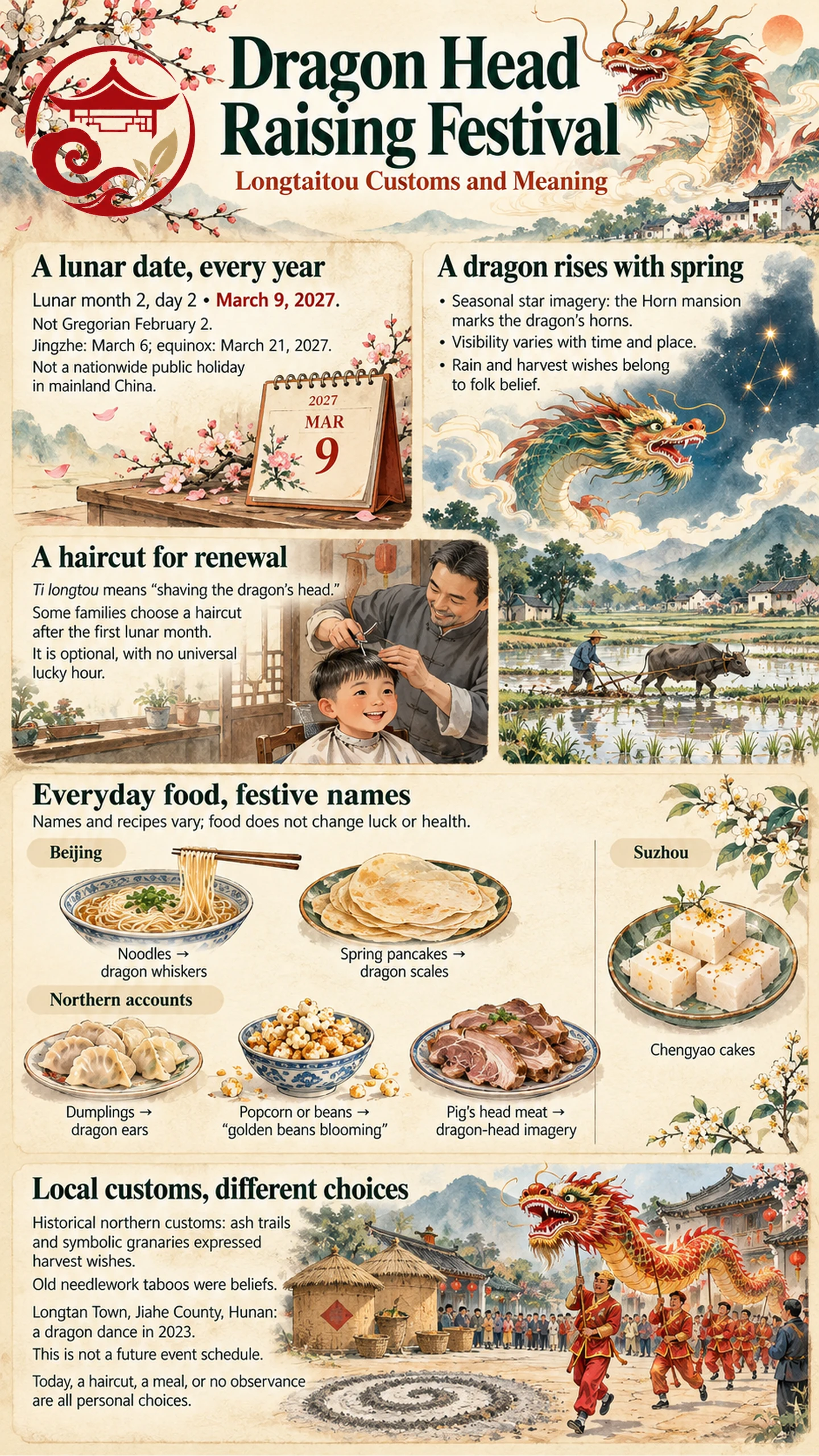
Why do haircuts and foods with dragon names share a date? Longtaitou (龙抬头, Lóngtáitóu) brings those customs together on the second day of the second lunar month. This guide explains their meanings and local differences within the wider calendar of Chinese festivals and holidays.
When Is the Dragon Head Raising Festival?
Longtaitou follows the Chinese lunisolar calendar, so its Gregorian date changes annually. Lunar February 2 is not the same as February 2 on an ordinary Gregorian calendar. In 2027, the festival falls on March 9.[1]
It also differs from the 24 solar terms, which follow the Sun’s position. In 2027, Jingzhe (惊蛰, Jīngzhé), often translated as “Awakening of Insects,” falls on March 6, while the Spring Equinox (春分, Chūnfēn) falls on March 21. Neither date is that year’s Longtaitou. Their seasonal associations overlap, but their date rules differ.[1]
Longtaitou is not a nationwide statutory public holiday in mainland China. A community performance may have its own schedule, and a family can arrange a meal when convenient. Distinguish the observance’s lunar date from a public event’s advertised date and from an employer’s leave arrangements.[9]
What Does Longtaitou Mean?
Longtaitou literally means “the dragon raises its head.” The image connects a changing night sky with the return of spring. In traditional Chinese astronomy, seven groups of stars form the Azure Dragon’s seven mansions (苍龙七宿, Cānglóng Qīxiù), part of a larger system of 28 lunar mansions. They stretch across several modern constellations rather than forming one modern constellation.[2]
The Horn mansion (角宿, Jiǎoxiù) represents the dragon’s horns. As those stars become visible rising in the eastern evening sky during this season, people can picture a dragon lifting its head while the rest of its body follows. This is a seasonal explanation, not a promise that the stars rise at sunset on every lunar February 2. Visibility depends on the year, location, observing time and conditions.[2]
The agricultural connection comes from a different layer of meaning: dragons were associated with clouds and rain, and communities expressed hopes for rainfall and productive fields. Such beliefs helped give a seasonal observance its cultural significance. They do not mean a ceremony controls rain or that everyone should begin planting on the same day.[4][5]
These layers explain why the festival brings together apparently unrelated activities: watching seasonal change, wishing for rain, and marking personal renewal. They do not establish one inventor or a single starting year for the observance.
Why Do People Get Haircuts on Longtaitou?
A festival haircut is commonly called “shaving the dragon’s head,” or ti longtou (剃龙头, tì lóngtóu). The expression gives an ordinary grooming appointment a festive meaning. For children, it can carry wishes for healthy growth; for adults, it can suggest renewal. Those wishes do not mean a haircut changes health, luck or future success.[3]
The date also comes just after the first lunar month. Some families avoid haircuts during that month and return to the barber in the second. The custom is documented in discussions of northern Chinese practice, but it is not a rule followed by every northern household, still less by all Chinese communities.[3]
A related saying claims that a first-month haircut harms a maternal uncle. It is a superstition, not a causal connection. Another often-repeated explanation links the saying to a supposed confusion between words meaning “remembering the past” and “a dead uncle.” That proposed origin is disputed and should not be presented as established history.[3]
If you plan a haircut, ask the barber about availability rather than assuming every shop observes the festival. Children and adults can choose another appointment date. No nationwide tradition fixes a lucky hour, requires a particular hairstyle, or makes a haircut a condition of celebrating. Follow the household’s preferences without treating its choice as a standard for everyone else.
What Do People Eat at Longtaitou?
Longtaitou food names often turn familiar dishes into parts of an imagined dragon. The ingredients remain ordinary grains, vegetables or meat. The following examples identify local associations, not a compulsory festival menu.[4][7]
| Actual food | Festive name or association | Local context | What to keep separate |
|---|---|---|---|
| Noodles | Dragon whiskers (龙须, lóng xū) | Recorded in Beijing festival food customs | A festive name, not one mandatory noodle recipe or thickness. |
| Spring pancakes (春饼, chūnbǐng) | Dragon scales (龙鳞, lóng lín) | Beijing and other local northern traditions | Thin pancakes differ from deep-fried spring rolls; they are also eaten on other occasions. |
| Dumplings | Dragon ears (龙耳, lóng ěr) | Appears in northern folk accounts | A local nickname, not a nationwide rule about what dumplings to serve. |
| Popcorn or fried beans | “Golden beans blooming” | A folk story associated with northern festival accounts | The rain-bringing story is a legend, not evidence that food changes weather. |
| Pig’s head meat | A symbolic association with a dragon’s head | Some northern festival food traditions | It is prepared pork, not a separate ingredient called dragon meat. |
| Chengyao cakes (撑腰糕, chēngyāogāo) | A name associated with supporting the waist | A documented Suzhou seasonal food | Forms vary; the traditional wish does not establish protection against back pain. |
The dragon-part names are documented together in festival accounts, while Suzhou has its own rice-cake tradition. Chengyao cakes should not all be described as fried leftovers from the previous year: contemporary local examples include other forms. Nor does a food’s presence in Suzhou prove it is exclusive to that city.[4][6][7]
Ask what a dish actually contains rather than inferring ingredients from its festive nickname. A family may choose one seasonal food, share an ordinary meal, or make no special food arrangements.
Other Customs and Regional Differences
Historical northern customs include “inviting the dragon back” (引龙回, yǐn lóng huí). Accounts describe an ash trail connecting the outside of a home with the kitchen or water vessel. Ash granaries (灰囤, huī dùn) were symbolic grain-store shapes associated with hopes for a full harvest. These are records of past household and farming practices, not present-day requirements or instructions for controlling pests.[4][5]
Some older accounts also mention avoiding needlework for fear of injuring the dragon’s eyes. That explanation belongs to folk belief. It does not establish a real danger from sewing, and households today need not observe the prohibition. Historical descriptions show what particular communities practiced or believed; they do not prove nationwide conformity.[4]
Public celebrations offer another kind of evidence. On February 21, 2023, a dragon-dance celebration took place in Longtan Town, Jiahe County, Hunan. It is a specific, dated example of a local community marking the festival. It does not establish that the same performance happens annually, or supply a schedule for a future year.[8]
Contemporary participation can be much quieter. One person might get a haircut; another household might share a seasonal dish. Others may not observe Longtaitou at all. Ask about the particular family or community rather than building a single itinerary from unrelated local customs. A haircut, household belief and public dragon dance can all be associated with the date without becoming a checklist everyone must complete.
FAQs About the Dragon Head Raising Festival
Is Longtaitou the Same as the Dragon Boat Festival?
No. Longtaitou falls on lunar February 2. The Dragon Boat Festival (端午节, Duānwǔ Jié) falls on lunar May 5 and has different festival traditions. A shared dragon image does not make them the same observance.
Do You Have to Get a Haircut on Longtaitou?
No. It is an optional custom. Keep your usual appointment or choose another date; there is no universal lucky hour, required hairstyle or obligation for children to participate.
Is Longtaitou One of the 24 Solar Terms?
No. Its date follows the lunar month and day, whereas solar terms follow the Sun’s position. A coincidence in a particular year does not merge the two systems.
Is the Dragon Head Raising Festival a Public Holiday?
It is not a nationwide statutory public holiday in mainland China. A local celebration or workplace arrangement is separate from the national holiday calendar.[9]
Sources
[1] Hong Kong Observatory. 2027 Gregorian–Lunar Calendar Conversion Table
[2] Beijing Municipal Government, from Beijing Daily. 二月初二可赏“龙抬头”天象
[3] East China Normal University. 澎湃|戴望云:二月二,为何会成为一年之中最有名的剃头日
[4] China Intangible Cultural Heritage Network. 二月二“龙抬头”且看习俗有说法
[5] China Intangible Cultural Heritage Network. 二月二 龙抬头
[6] Gusu District Government, Suzhou. 颜值口味技艺三重升级 非遗手艺人推出创新龙形撑腰糕
[7] Beijing Municipal Government. 春分至 龙抬头 咬春品鲜莫忘“安全”
[8] Hunan Provincial Government English Portal. Dragon-Head-Raising Festival Celebrated in Hunan
[9] Ministry of Justice, National Database of Laws and Regulations. 全国年节及纪念日放假办法