

Quick Answer: Which Day Is Chinese Valentine’s Day?
In modern English usage, Chinese Valentine’s Day commonly means Qixi (七夕, Qīxī). The same comparison is also applied to other occasions with different backgrounds:
- Qixi: A traditional festival associated with a lovers’ reunion legend and older customs celebrating skill.
- Lantern Festival: 元宵节 (Yuánxiāo Jié), a broader family and community festival with romantic associations in literature and historical night outings.
- May 20: The modern 520 observance, linked to a numerical expression of affection used online.
These are three useful comparisons, not an official fixed total. They do not share one origin, and couples need not celebrate all of them.
An invitation, a festival article and a May message can all mention “Chinese Valentine’s Day” while referring to different occasions. The label makes more sense once you separate traditional festivals, literary romance and modern number slang. Here is how to recognize the occasion behind the name.
Qixi, Lantern Festival and May 20 at a Glance
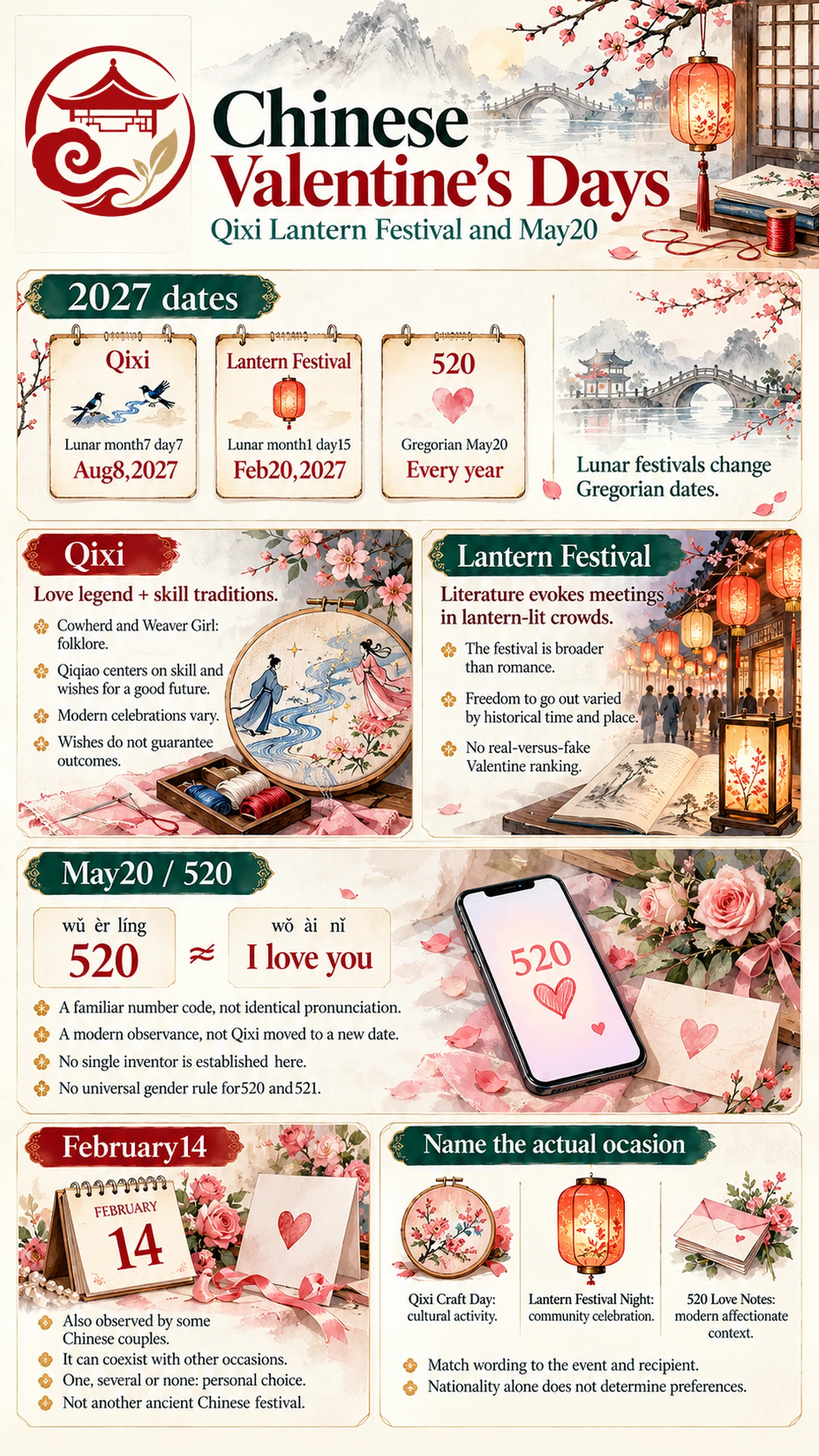
The calendar distinction is straightforward: Qixi and Lantern Festival follow dates in the traditional Chinese lunisolar calendar, while May 20 is a fixed Gregorian date. The 2027 conversions below are examples, not permanent Gregorian dates for the traditional festivals. [1]
| Occasion | Date rule and 2027 example | Romantic connection | What the label leaves out |
|---|---|---|---|
| Qixi | Seventh day of the seventh lunar month; August 8, 2027 | A legendary annual reunion, with a strong modern association with couples | Its historical skill traditions extend beyond dating or exchanging gifts. [2][3] |
| Lantern Festival | Fifteenth day of the first lunar month; February 20, 2027 | Lantern outings and encounters depicted in poetry and storytelling | It remains a family and community celebration; a lantern gathering is not automatically a matchmaking event. [4] |
| May 20 / 520 | May 20 every Gregorian year, including 2027 | A modern number code associated with “I love you” (我爱你, wǒ ài nǐ) | It is an informal modern observance, rather than an ancient festival or a converted Qixi date. [5][6] |
An event advertisement may emphasize romance, crafts or community activities according to its purpose. Read the actual event description as well as its headline. A cultural date also does not tell you when a particular gathering starts or whether time off work is provided.
Qixi: A Love Legend and a Festival of Skill
Qixi’s romantic association draws on the story of Niulang (牛郎, Niúláng), the Cowherd, and Zhinü (织女, Zhīnǚ), the Weaver Girl. In a familiar telling, the lovers are separated by the Milky Way and meet once a year across a bridge formed by magpies. This is a folk legend, not a historical account of two people or an astronomical event that observers can watch unfold. [2]
Another important strand is qiqiao (乞巧, qǐqiǎo), often translated as “begging for skill.” Historical practices included wishes for dexterity and displays of needlework or other abilities. Local forms differed: traditions documented in Xihe, Gansu, connect the occasion with women’s expressions of wishes and skill. Such practices help explain why describing Qixi only as a couples’ holiday narrows its cultural background. [3]
The older wishes and the love legend can coexist. They do not establish a single invention date, nor do they mean that every woman followed the same ceremony. Wishes for skill or a happy marriage belong to a cultural and religious context; performing them cannot guarantee either outcome.
Today, a couple might mark Qixi with a message, a date or a gift, while a cultural group might organize a craft activity. Neither choice requires reproducing a full historical ritual. The Qixi Festival guide explains the wider traditions; here, the key distinction is between that varied heritage and the modern romantic emphasis.
Lantern Festival: Romantic Encounters in Literature and History
Lantern Festival’s romantic reputation comes partly from the social setting of nighttime celebrations. In particular historical urban settings, relaxed night restrictions and crowded lantern streets created opportunities to meet. That context should not become the claim that women throughout Chinese history could leave home only on this one night. Customs and restrictions varied by period, place and social position. [4]
A concrete literary example is Xin Qiji’s (辛弃疾, Xīn Qìjí) Southern Song lyric Qingyu An: Yuanxi (青玉案·元夕, Qīngyù Àn: Yuánxī). It moves through the spectacle of a lantern night toward the discovery of a sought-for figure standing where the lights are sparse. The scene has romantic resonance, although the poem also supports readings beyond a literal love encounter. [7]
Literature explains a cultural association; it does not document how every person celebrated or prove an official “real Valentine’s Day.” A contemporary lantern outing can be romantic, familial or simply social. The festival’s broader setting remains important, as the Lantern Festival overview explains. Calling it a Chinese Valentine’s Day is therefore an interpretive comparison, rather than a reason to replace its own name.
May 20: How 520 Became a Modern Love Day
520 is read digit by digit in Mandarin as wǔ èr líng. The phrase wǒ ài nǐ has a different pronunciation. Their connection is an established piece of number slang: it relies on a loose sound association and shared recognition, not an exact match between every syllable. A reader who knows the convention understands the affectionate meaning even though the literal digits still mean five, two and zero. [6]
Written as a date, 5/20 gives that code an annual occasion. Contemporary usage connects May 20 with expressing affection, while social media and commercial promotion make the date more visible. These observations explain its present role without identifying one person, song, platform or exact moment as its inventor. The evidence used here does not establish that sort of single origin. [5]
The distinction from Qixi is practical as well as historical. May 20 does not move with the lunar calendar, and it is not the result of translating Qixi into a Gregorian date. Its identity comes from the number code. Messages, photos or dates are possible ways to mark it, rather than required customs or tests of commitment.
521 also appears as an affectionate number expression. Its existence does not create a universal rule assigning one code to men and the other to women. [5] For a personal message, what matters is whether the recipient understands the code and welcomes the intended meaning, rather than whether a calendar labels the day romantic.
Where Does February 14 Fit In?
February 14 is the Gregorian Valentine’s Day associated with Western traditions. Some Chinese couples also mark it, alongside Qixi or modern dates such as May 20. The modern popularity of Valentine’s Day has also helped shape how Qixi is presented as a romantic occasion. [3]
These uses can coexist. A person may prefer one celebration, several, a private anniversary or none of them. Adding February 14 to a discussion changes the scope of the list; it does not create a fourth ancient Chinese festival. Likewise, seeing several campaigns during the year is not evidence that every couple follows a shared calendar of obligations. Discussing personal preferences is more useful than inferring them from someone’s nationality.
Which Name Should You Use in a Greeting or Event Title?
Use the occasion’s own name when clarity matters, and match the wording to what is actually happening:
- Qixi culture or crafts: “Qixi Craft Day” identifies a cultural activity without promising a dating event. A greeting such as 七夕快乐 (Qīxī kuàilè) means “Happy Qixi.”
- Lantern gatherings: “Lantern Festival Night” suits a general community celebration. If an event includes matchmaking, state that separately rather than making it part of the festival’s definition.
- May 20 messages: “520 Love Notes” signals the modern number-code context. Choose personal wording for a recipient who understands it; a romantic declaration is not a neutral workplace greeting.
The event or relationship provides the context. Nationality alone does not determine a person’s preferences.
FAQs About Chinese Valentine’s Days
How Many Valentine’s Days Are There in China?
There is no single fixed count for this informal category. Lists vary according to whether they include traditional festivals, modern internet observances and February 14. This article compares three named occasions without treating them as an official set.
Is Qixi Always on July 7?
No. Qixi falls on the seventh day of the seventh lunar month, which is different from Gregorian July 7. Its Gregorian date changes; in 2027, it falls on August 8.
Is the Lantern Festival the Real Chinese Valentine’s Day?
It has romantic literary and historical associations, but that does not make Qixi an incorrect comparison. The two festivals have different cultural backgrounds, and neither needs to win an authenticity contest to be understood.
Is May 20 the Same as Qixi?
No. May 20 is a modern observance connected with 520 number slang. Qixi follows the traditional calendar and has older festival practices and legends. Sharing a romantic association does not make them the same occasion.
Sources
[1] Hong Kong Observatory. Gregorian–Lunar Calendar Conversion Table for 2027
[2] China Intangible Cultural Heritage Network. 话说“七夕”
[3] Xiao Fang; China Intangible Cultural Heritage Network. “巧”与“爱”,七夕节俗的两大主题
[4] China News Service; hosted by the Overseas Chinese Affairs Office. 妙趣中国年:为什么说元宵节才是中国“情人节”?
[5] Beijing Daily; hosted by Beijing Civilization Office. 520、521……每一天,都爱你
[6] Taiwan Ministry of Education. 網路新詞語例表
[7] Hong Kong Education Bureau. 青玉案·元夕:辛棄疾