

Quick Answer: What Shapes Taiwanese Culture?
Taiwanese culture encompasses Indigenous histories, migration, colonial experiences and locally developed ways of life. Language, religious practice, food and the arts reveal connections across communities while also preserving important differences.[1]
- Historical influences: Different periods changed settlement, education, institutions and cultural expression.
- Community diversity: Languages and traditions vary across families, regions and Indigenous peoples.
- Contemporary life: Writers, performers and community groups continue to create new work.
No single language, temple or food stands for everyone in Taiwan. Understanding a named community and its setting provides a clearer picture than collecting a list of supposedly universal habits.

A temple procession, a family conversation and a new literary translation reveal different parts of Taiwanese culture. Their meanings emerge through local histories and the people who use them, connecting inherited practices with the changing circumstances of everyday life.
Historical Layers and Local Change
Indigenous societies long predate later European colonial establishments and large-scale Han settlement. Dutch and Spanish presence, migration from the Chinese coast and Japanese colonial rule contributed different institutions and material traces. These experiences involved unequal power as well as exchange; culture developed through local responses to changing conditions.[1]
Japanese colonial rule lasted from 1895 to 1945. Its cultural history includes colonial education, modern arts, resistance and wartime mobilization. A Japanese-era building or literary form therefore belongs within a history of colonial government and local action, rather than a simple story of borrowed style.[2]
Migration is one part of this history. Connections with coastal China help explain some family, language and religious traditions, but do not account for all of Taiwan’s cultural life. People adapted inherited resources in the places where they lived, and later generations encountered different schools, media and social environments.
Postwar institutions also changed. The museum founded in Taipei in 1908 under Japanese colonial rule became the Taiwan Provincial Museum after the Nationalist government relocated to Taiwan in 1949. Renamed the National Taiwan Museum in 1999, it offers one concrete way to follow institutional change beyond the colonial period.[10]
Languages Beyond One Spoken Standard
Mandarin (华语, Huáyǔ), Taiwanese Hokkien (台语, Táiyǔ), also called Tâi-gí, and Hakka (客语, Kèyǔ) belong to different speech traditions. Indigenous languages and Taiwan Sign Language add further dimensions to the linguistic landscape. The 2022–2026 language-development plan includes work on several of these languages and their recorded materials.[4]
Taiwanese Hokkien has connections with the wider Southern Min world; Hakka speech varieties have their own histories. The pinyin here gives Mandarin readings of Chinese names. These relationships do not make the languages interchangeable. A family’s heritage, its usual language and each person’s reading or speaking ability can differ.
The 2019 Development of National Languages Act recognizes natural languages and sign languages used by Taiwan’s different ethnic groups and establishes their equal status. This is a framework for language rights and transmission, rather than evidence that everyone can speak every recognized language. Likewise, a shared Chinese-character text does not specify the language in which someone will read it aloud.[3]
Indigenous Cultures as Living Communities
Taiwan’s Indigenous peoples belong to the Austronesian-speaking world and have distinct community histories. The Tsou’s ceremonial life, the Bunun’s hunting-related observances and the Tao’s relationship with flying fish on Orchid Island illustrate different relationships among season, place and social life. These examples connect named peoples with distinct places and practices.[5]
Ceremonial participation depends on the particular community and occasion. Contemporary Indigenous life extends beyond ceremonial dress and heritage displays; language, family and changing forms of expression remain part of living society. Hakka cultural life is another distinct strand within Taiwan’s wider diversity, rather than a substitute category for Indigenous peoples.
Temples, Pilgrimages and Different Beliefs
Mazu (妈祖, Māzǔ) is an important deity in popular religious life. Pilgrimages associated with Dajia and Baishatun show how temples, processions and networks of participants organize major shared occasions. They are separate traditions with their own temples and patterns of participation.[6]
The movement of a sacred image, accompanying performance and the reception of pilgrims give the event a community dimension alongside devotion. Mazu worship also connects with traditions elsewhere, while taking particular local forms in Taiwan. This example belongs within popular religious practice; it does not establish that every resident shares one religion or participates in temple activities.
Religious life also includes Buddhism (佛教, Fójiào), Daoism (道教, Dàojiào), Christianity, Islam and other traditions. Their institutions and practices should be understood individually, alongside the ways people combine or distinguish different forms of devotion.[11]
Food, Markets and Everyday Social Life
Night markets (夜市, yèshì) make local food repertoires visible. Oyster omelets, noodle dishes, rice foods and other snacks appear in different combinations, and individual markets have their own specialties. Taiwanese food culture includes these local differences alongside home cooking and other dining settings.[7]
A market is also a setting for choosing, preparing and sharing food. Local sellers and specialties give night-market life its particular character. A famous snack may travel widely without becoming everyone’s everyday meal.
Puppetry, Literature and Contemporary Expression
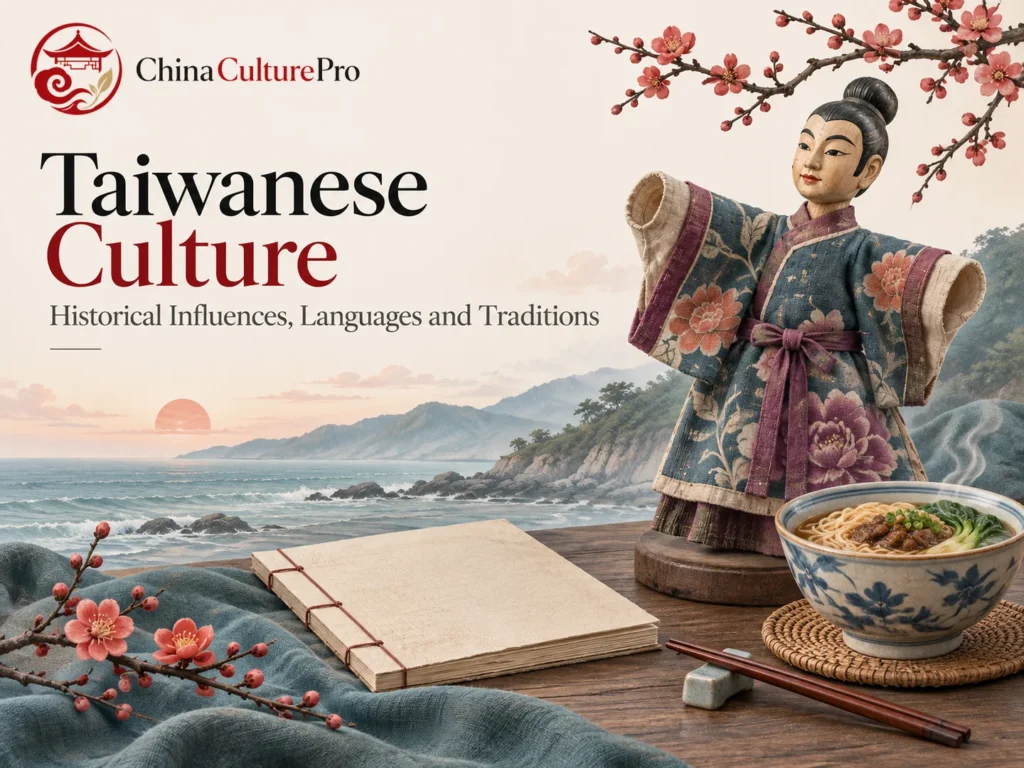
Glove puppetry (布袋戏, bùdàixì) combines carved wooden puppet parts and cloth bodies with manipulation, narration and musical accompaniment. Performers create movement and character through the puppet, while music supports the dramatic action. This differs from the mechanisms of other puppetry traditions.[8]
In Taiwan, the art developed through changing performance spaces and media, including theaters, radio, television and film. Changes in puppet scale, scenery, music and storytelling helped address different audiences. A screen production and a small traditional stage therefore represent different developments within the art, rather than one unchanged performance setting.[8]
Literature offers another example of ongoing exchange. The National Museum of Taiwan Literature’s April 2026 Tâigael workshop program brought together translation questions involving Tâi-gí, Mandarin, English and Gaelic. The planned sessions on writing and publishing show how inherited languages can support new creative work and international conversations.[9]
FAQs About Taiwanese Culture
Does Taiwanese always mean a language?
No. Taiwanese can refer broadly to people or culture. In a language discussion it often means Taiwanese Hokkien or Tâi-gí; the context should be made explicit.
Are Indigenous Taiwanese languages varieties of Chinese?
No. They belong to the Austronesian language family, rather than being regional forms of Mandarin or other Chinese languages.
Does everyone in Taiwan follow the same religion?
No. A prominent temple procession illustrates one religious tradition, not the beliefs or participation of every person.
Is Taiwanese culture only traditional culture?
No. New writing, translation, screen productions and language projects are also part of Taiwanese culture, alongside inherited practices.
Sources
[1] Taiwan Tourism Administration. Culture and Heritage
[2] Chou Wan-Yao, National Taiwan University repository. Taiwan under Japanese Rule (1895–1945)
[3] Ministry of Justice Laws and Regulations Database. Development of National Languages Act
[4] Executive Yuan / Ministry of Culture. National Languages Development Plan
[5] Taiwan Tourism Administration. Indigenous Ceremonies
[6] Taiwan Tourism Administration. Religious Activities
[7] Taiwan Tourism Administration. Night Markets
[8] Taiwan Bureau of Cultural Heritage. Glove Puppetry
[9] National Museum of Taiwan Literature. Taigael: Heritage Languages and Cross-Cultural Translation Workshop
[10] National Taiwan Museum. ICOM-NATHIST 2015 Conference: About the National Taiwan Museum
[11] Taiwan Tourism Administration. Religion