


Quick Answer: What Is Chinese Landscape Painting?
Chinese landscape painting (山水画, shānshuǐhuà) depicts mountains, water and the spaces that connect them. Shanshui paintings can lead the eye upward, across a broad expanse or deeper into overlapping forms. Paths, washes and areas left open can all guide the view.[1][2][3]
- Composition: Look for changes in scale, distance and direction.
- Format: A tall scroll and a long horizontal scroll reveal space differently.
- Meaning: Subject, inscriptions and historical setting support different readings.
Start with a landmark such as a path or shoreline, then see which way the painting leads.
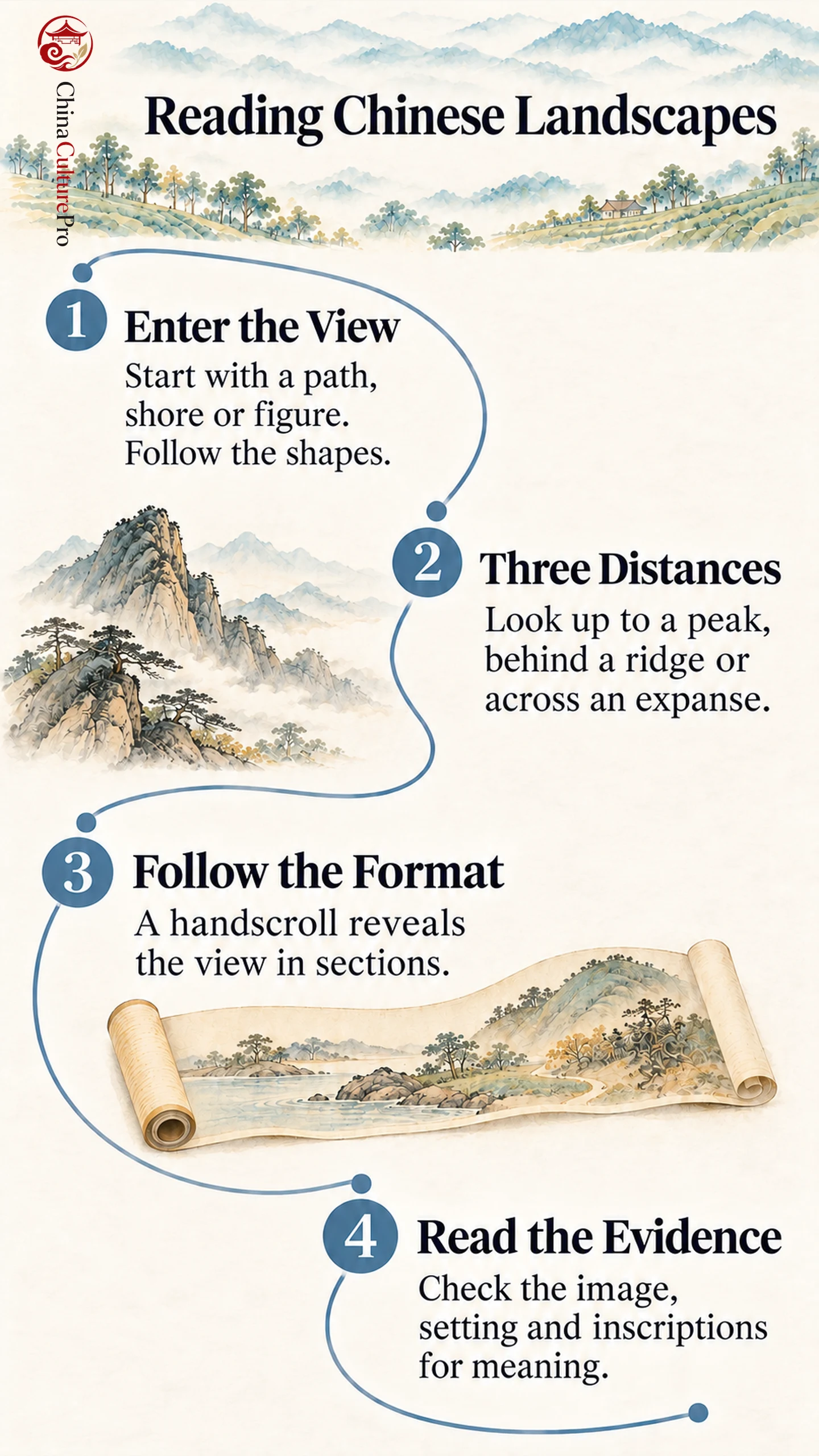
Start with a path, a shoreline or a tiny figure. Each gives your eye a place to stand. As you move through a Chinese landscape painting, the next ridge or interval of open water can shift your sense of distance.
How Mountains, Water and Space Organize the View
Look first for a large shape and the smaller forms beside it. A tree or traveler can give the eye a scale for a mountain. Layers of ridges can suggest depth through overlap. Pale tones can let a distant form recede, while darker marks can give another shape more weight. The guide to Chinese ink painting explains how a painter can make those shifts with ink and water.[1][2]
An open interval can suggest water or mist, give a path room to turn or separate two masses of rock. Follow what the edges do around it. A shoreline can give an empty area the shape of a river. A gap between ridges can separate nearer and farther mountains. The guide to Chinese painting techniques describes some ways painters give rock, foliage and water different textures.[1][2]
Guo Xi and the Three Distances
Guo Xi’s three distances (三远, sānyuǎn) describe ways to organize a view of mountains. Each starts with a different direction for the eye. They can help you describe a passage within a painting, even when other parts of the same work lead the eye elsewhere.[2][3]
| Distance | Direction of view | Visual clue |
|---|---|---|
| High distance | Look from the foot of a mountain toward its peak. | A route that draws the eye upward. |
| Deep distance | Look from the front of a mountain into the space behind it. | Overlapping slopes that let the eye enter farther back. |
| Level distance | Look out from a nearby position across a flatter expanse. | Successive landforms separated by water or open space. |
In Guo Xi’s Early Spring of 1072, rocky forms, pines and the main mountain draw the eye along a rising, winding route. Lighter passages around the slopes open gaps between them. The National Palace Museum also identifies small human activities in the scene. The overall mountain and the small routes through it invite views at different scales.[2][3]
What Changes Across a Scroll or Fan
Huang Gongwang’s Dwelling in the Fuchun Mountains invites a different pace. The Master Wuyong Scroll in the National Palace Museum has a painted area more than six meters long. A viewer can unroll the handscroll in sections, moving through stretches of shore, rising hills and more open spaces. The 1350 inscription describes working on the scroll over several years. The guide to Chinese scroll painting formats explains this sequential kind of viewing.[1][4]
Shitao’s Landscape of 1699 brings ink and color into the compact arc of a folding fan, now mounted as an album leaf. Its curved edges shape the space available for the image. The inscription shares the available surface with the scene. Compare how quickly the whole fan can come into view with how slowly a long handscroll can unfold.[1][6]
How to Read Meaning From a Specific Work
Some landscapes suggest retreat or a place for contemplation. Others were made for courts or in conversation with earlier painters. Those possibilities belong to different situations in literati painting and the broader history of Chinese painting. Look for evidence from the work’s commission, date, format or text before giving a mountain or river a fixed meaning.[7]
The Palace Museum’s A Thousand Li of Rivers and Mountains by Wang Ximeng is a Northern Song silk handscroll with prominent blue and green color. Its paths, settlements and streams offer ways to follow the landscape between peaks. In Shitao’s fan, the inscription discusses a principle he calls the single stroke. The guide to painting inscriptions and seals explains why words on a particular object can be stronger evidence for interpretation than a motif alone.[5][6]
FAQs About Chinese Landscape Painting
What does shanshui mean?
Shanshui means “mountains and water.” In painting, the term can refer to landscapes that also include trees, paths, architecture and people.
Is Chinese landscape painting always monochrome?
Ink-only landscapes are common. Some landscape paintings use prominent color, including the blue and green on Wang Ximeng’s silk handscroll.
Why do some landscapes use several viewpoints?
Different parts of a composition can direct the eye upward, across or deeper into the scene. A handscroll can reveal these changes as it opens.
Does empty space always represent mist?
An open area can suggest mist or water. It can also separate shapes or give the eye a pause. Its role depends on the surrounding marks.
Sources
[1] Princeton University Art Museum. Chinese Landscape Painting during the Song Dynasty
[2] National Palace Museum. Guo Xi: Early Spring
[3] National Palace Museum via Google Arts & Culture. A New Vision of National Treasures: Early Spring
[4] National Palace Museum. Huang Gongwang: Dwelling in the Fuchun Mountains, Master Wuyong Scroll
[5] The Palace Museum. Wang Ximeng: A Thousand Li of Rivers and Mountains
[6] The Metropolitan Museum of Art. Shitao: Landscape, 1699
[7] The Metropolitan Museum of Art. Landscape Painting in Chinese Art