
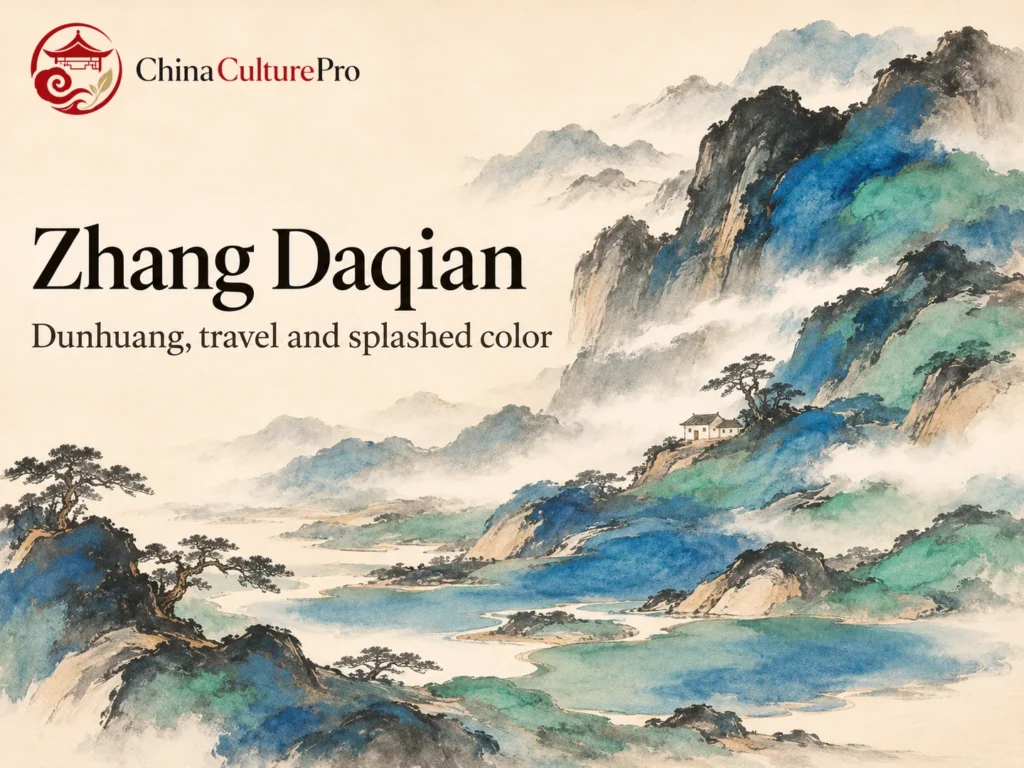

Quick Answer: Who Was Zhang Daqian?
Zhang Daqian (张大千, Zhāng Dàqiān, 1899–1983), also written Chang Dai-chien, was a Chinese painter and collector. He studied earlier paintings, made copies of Buddhist murals at Dunhuang and developed late landscapes using broad washes of ink and color. [1][2][3][5]
- Training: He learned to work in historical brush styles and studied painting and calligraphy in Shanghai. [1]
- Dunhuang: His portable studies recorded features of much older paintings on cave surfaces. [3][4]
- Later landscapes: In his overseas years he used layered washes, then worked small details into them to suggest a place. [2][5]
When reading a label, distinguish Zhang’s copy of an earlier work from a landscape he made under his own name. The labels describe different relationships to the past. [1][3][5]

A painted cave ceiling and a mountain emerging from layered blue and green washes may seem like separate subjects. Both help explain how Zhang Daqian worked. He could study a historical model closely and then use ink, color and scale to make an independent image. [3][5]
Early Training and the Study of Older Paintings
Zhang came from an artistic family in Neijiang, Sichuan. He studied weaving and dyeing in Kyoto after joining his brother there in 1917. He later trained in painting and calligraphy in Shanghai with Zeng Xi and Li Ruiqing. Copying earlier works gave him practice with particular kinds of line, brush contact and composition. [1]
Collecting gave him access to paintings he could study in detail. His career illustrates one way Chinese painters learned from earlier work. A copy could record a design, serve as practice or adapt the manner of another artist. The purpose of the copy matters when you interpret it. [1][3]
What Zhang Daqian Studied at Dunhuang
Zhang spent an extended period copying Dunhuang murals between 1941 and 1943. The painted surfaces belonged to Buddhist cave settings and came from different historical periods. Working through a copy let him study how colors, figures and patterns were arranged in a space. [3][4]
One surviving work is his copy of a High Tang painted ceiling from the Mogao Caves. It is mounted as a hanging scroll on paper. The hanging mount brings a design made for a ceiling down to eye level and lets a viewer examine it away from the cave. When you look at such a work, the Tang date describes the model. Zhang’s copy belongs to the twentieth century. [3]
Overseas Studios and Artistic Encounters
After leaving China in 1949, Zhang lived in several places, including periods in Argentina, Brazil and California. He also traveled in Europe and met Pablo Picasso in France in 1956. The gardens he made at residences in Brazil and the United States were part of how he made places to live and work abroad. He spent his final years in Taipei. [1][2][7]
In his overseas years he encountered modern approaches to abstraction and painters such as Zao Wou-Ki. Similarities in layered color and small motifs suggest a possible influence. His earlier brush training and later encounters both help explain the resulting work. [2][5]
How Splashed Ink and Color Become Landscape
Splashed ink (泼墨, pōmò) uses broad or loosely distributed ink to establish masses and shifts of tone. Splashed color (泼彩, pōcǎi) uses color washes for related effects. A painter can work back into the resulting areas to give them more definite forms. In Zhang’s work this is one of several painting techniques brought together in a landscape. [4][5]
In Mountains Clearing after Rain (峰晴隔雨图, Fēng Qíng Gé Yǔ Tú), made about 1965–70, Zhang built up layers of ink and color. Details of houses and trees give the viewer a scale and position within the washes. The pale gaps and smaller marks give an otherwise spreading field of color the distances of a landscape. [5]
In his final years he worked on Mount Lu (庐山图, Lúshān Tú), a silk painting about 1.8 meters high and nearly 10 meters wide. He made it between 1981 and 1983. The work evokes a named mountain and was not painted from direct observation at the site. Its size gives the changing ink and color room to unfold over a much larger surface. [4][6]
Copies, Attributions and Three Works to Read
Zhang’s skill at imitating older artists has also created problems of attribution. Some of his works were made to pass as older paintings. A museum label calling a work a study after an older design describes a different case. Material, inscriptions and seals, style and ownership history can all help determine which relationship the evidence supports. [1][2][3]
| Work | Material or format | What to look for |
|---|---|---|
| Copy of a High Tang Painted Vaulted Ceiling at Dunhuang | Paper hanging scroll | A ceiling design translated into a portable study. [3] |
| Mountains Clearing after Rain | Ink and color on paper | Small trees and houses give scale to the layered washes. [5] |
| Mount Lu | Large silk painting | Broad color and ink passages carry the landscape across nearly ten meters. [4][6] |
FAQs About Zhang Daqian
Is Chang Dai-chien the Same Artist as Zhang Daqian?
Yes. Chang Dai-chien is another romanization of Zhang Daqian’s name. Museum catalogues use both forms for the painter born in 1899. [1][2]
Did Zhang Daqian Paint the Dunhuang Murals?
The Buddhist murals predate him by centuries. Zhang made twentieth-century copies and studies of selected paintings, including ceiling designs. [3][4]
What Is Zhang Daqian’s Splashed-Color Technique?
He could establish areas with layered washes of ink and color and then add recognizable details such as trees and buildings. These smaller forms help the viewer read the washes as a landscape. [5]
Sources
[1] National Museum of Asian Art. Collectors and Dealers of Asian Art: Zhang Daqian
[2] The Metropolitan Museum of Art. Chang Dai-chien Acquisition Announcement
[3] National Palace Museum. Copy of a High Tang Painted Vaulted Ceiling at a Mogao Cave at Dunhuang
[4] National Palace Museum. Mount Lu Special Exhibition
[5] The Metropolitan Museum of Art. Mountains Clearing after Rain
[6] National Palace Museum. Zhang Daqian: Mount Lu
[7] National Palace Museum. Chang Dai-ch’ien Residence