

Quick Answer: Which Chinese Painters Should You Know?
Start with painters whose works ask you to look in different ways. This selection covers narrative figures, expansive landscapes, urban life, close observation of animals and experiments with ink and color. [1][2][3][5][8]
- Early figure painting: Begin with an old narrative scroll to see how artists used pose and spacing to organize a story. [1]
- Landscapes and city scenes: Compare a mountain hanging scroll with a riverside handscroll. Their formats guide the eye in different directions. [2][3]
- Modern painting: Look at how twentieth-century artists used repeated marks, tonal washes and broad fields of color. [6][7][8]
The artist’s name on a label may identify the maker, a traditional attribution or the model for a later copy. Check the wording alongside the date. [1][2][3]
A painting of a mountain and a painting of a city can come from the same era and offer very different ways of seeing. This guide to Chinese art starts with eight painters and one work for each, then uses details in the works to explain what changed across periods. [2][3]
Eight Painters and Works to Start With
| Painter | Historical setting | Work to look up |
|---|---|---|
| Gu Kaizhi (顾恺之, Gù Kǎizhī) | Early figure painting tradition | Admonitions Scroll (女史箴图, Nǚshǐ Zhēn Tú), an early copy after a fourth-century composition traditionally attributed to Gu. [1] |
| Fan Kuan (范宽, Fàn Kuān) | Northern Song landscape | Travelers Among Mountains and Streams (溪山行旅图, Xīshān Xínglǚ Tú), a mountain hanging scroll. [2] |
| Zhang Zeduan (张择端, Zhāng Zéduān) | Northern Song urban life | Along the River During Qingming (清明上河图, Qīngmíng Shànghé Tú), the Beijing handscroll attributed to Zhang. [3] |
| Zhao Mengfu (赵孟頫, Zhào Mèngfǔ) | Yuan landscape and calligraphy | Autumn Colors on the Qiao and Hua Mountains (鹊华秋色图, Què Huá Qiūsè Tú), dated 1295. [4] |
| Chen Shu (陈书, Chén Shū) | Qing scholar landscapes and bird painting | Cockatoo (白鹦鹉图, Bái Yīngwǔ Tú), an ink and color hanging scroll dated 1721. [5] |
| Qi Baishi (齐白石, Qí Báishí) | Twentieth-century expressive ink | Shrimp (虾柳图, Xiāliǔ Tú), dated 1927. [6] |
| Xu Beihong (徐悲鸿, Xú Bēihóng) | Twentieth-century academic drawing and ink | Grazing Horse (马图, Mǎ Tú), dated 1932. [7] |
| Zhang Daqian (张大千, Zhāng Dàqiān) | Twentieth-century studies of older art and new color methods | Mountains Clearing after Rain (峰晴隔雨图, Fēng Qíng Gé Yǔ Tú), about 1965–70. [8][9] |
Early Figures and Song Views of the World
The Admonitions Scroll tells a story through groups of court figures. Their positions and gestures carry the narrative. The surviving British Museum scroll is an early copy of a composition associated with Gu Kaizhi, so its value lies in what it preserves about early figure painting and how the subject was transmitted. [1]
The vertical scale of Fan Kuan’s hanging scroll makes the travelers look small against an immense mountain. The path and figures give the eye a point of entry before it takes in the rising forms. In the Qingming Scroll, the movement is horizontal. Fields, the river crossing and the streets emerge gradually as the handscroll opens. A comparison of Fan Kuan and Guo Xi offers another way to read the scale and paths of Northern Song landscape. [2][3]
How Yuan and Qing Painters Reworked Older Models
In the 1295 handscroll, Zhao Mengfu depicts two mountains from the region around Jinan. His inscription explains that he made the work for a friend with family ties to the area. Read the different shapes of the hills with the dedication in mind. A painting of a real region could also carry a personal connection to a place. [4]
Chen Shu painted landscapes in a scholar tradition as well as detailed bird subjects. In her 1721 Cockatoo, close description of the bird belongs to an approach practiced by earlier court painters. Compare the precise outlines in the bird scroll with the looser brushwork expected in her scholar landscapes. [5]
Three Directions in Twentieth-Century Painting
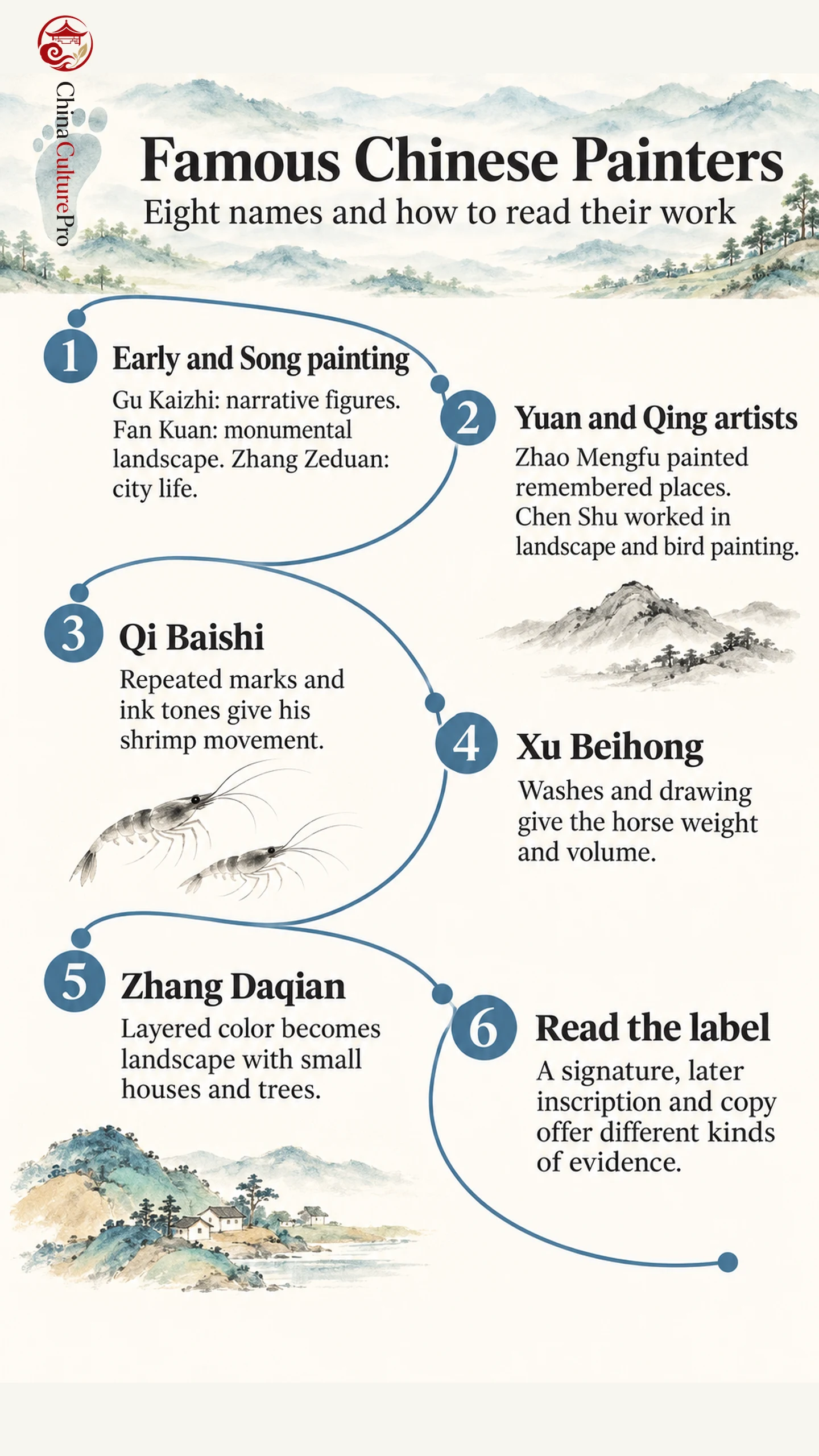
Qi Baishi built each shrimp from a related sequence of brush marks. Differences in ink tone and placement separate them without turning each animal into an isolated study. The same kind of gesture can give the whole group movement. [6]
In Grazing Horse, Xu Beihong uses washes and blank paper to suggest light across the horse’s body. The neck turns and the body recedes in space, showing a concern with anatomy and viewpoint that Xu developed through academic training. Qi Baishi added an inscription explaining why the painting lacks Xu’s seal. The inscription preserves the circumstances of the work’s making alongside Xu’s handling of the horse. [7]
Zhang Daqian copied Buddhist cave paintings and later worked with expansive washes of ink and color. In Mountains Clearing after Rain, small houses and trees turn layered color into a scene with depth. Comparing that work with a copy of a painted cave ceiling brings out the different jobs that detail can do. [8][9]
What a Museum Attribution Tells You
A tiny signature in the lower-right trees of Travelers Among Mountains and Streams was identified in 1958. It is evidence on the painted surface. The earliest inscription naming Zhang Zeduan in the Qingming Scroll is attached after the image and dates to 1186. It is evidence of the attribution by that date. When a label says a work is a copy after an older composition, it gives another kind of relationship. Each label tells you what can be said about the object in front of you. [1][2][3]
FAQs About Famous Chinese Artists
Which Chinese Painter Is Known for Shrimp?
Qi Baishi is well known for ink paintings of shrimp. His dated 1927 hanging scroll shows how related brush marks and changes in tone give a group of animals a sense of movement. [6]
Who Painted the Qingming Scroll?
The Northern Song handscroll in Beijing is attributed to Zhang Zeduan. An inscription added after the image names him. The subject inspired later scrolls by other artists. [3]
Which Chinese Painter Is Known for Horses?
Xu Beihong is closely associated with horse paintings. His 1932 Grazing Horse uses brush and ink with carefully observed anatomy, light and the turn of the body in space. [7]
Where Should I Start With Chinese Landscape Painting?
Choose Fan Kuan’s Travelers Among Mountains and Streams for scale and the position of tiny travelers in a vertical landscape. Choose Zhao Mengfu’s Autumn Colors on the Qiao and Hua Mountains for a handscroll that connects landscape to a named place and friendship. [2][4]
Sources
[1] British Museum. Annual Report and Accounts 2016–2017
[2] National Palace Museum. Fan Kuan: Travelers Among Mountains and Streams
[3] Palace Museum, Beijing. Zhang Zeduan’s Along the River During Qingming
[4] National Palace Museum. Autumn Colors on the Qiao and Hua Mountains
[5] The Metropolitan Museum of Art. Chen Shu: Cockatoo
[6] The Metropolitan Museum of Art. Qi Baishi: Shrimp
[7] The Metropolitan Museum of Art. Xu Beihong: Grazing Horse
[8] The Metropolitan Museum of Art. Zhang Daqian: Mountains Clearing after Rain
[9] National Palace Museum. Copy of a High Tang Painted Vaulted Ceiling at a Mogao Cave at Dunhuang