

Quick Answer: What Is Chinese Contemporary Art?
Chinese contemporary art encompasses recent artistic practices connected to China, including painting, sculpture, print, installation, performance and digital work. The late 1970s and 1980s mark a useful starting point for following experimental art in mainland China, with later work extending into international exhibitions and online spaces. [1][2][5][9]
- Groups: The Stars organized in the late 1970s. Artists in multiple cities took part in the experiments associated with the mid-1980s. [2][3][4]
- Media: Artists have used wood carving, printed books, oil portraits and photography alongside video, performance and virtual environments. [3][6][7][8][9]
- Questions: Works ask how viewers read an image, how photographs shape memory or what an individual can do in a public space. [6][7][8]
The date range depends on the collection or exhibition. Use named works and their dates when comparing artists. [1][5]
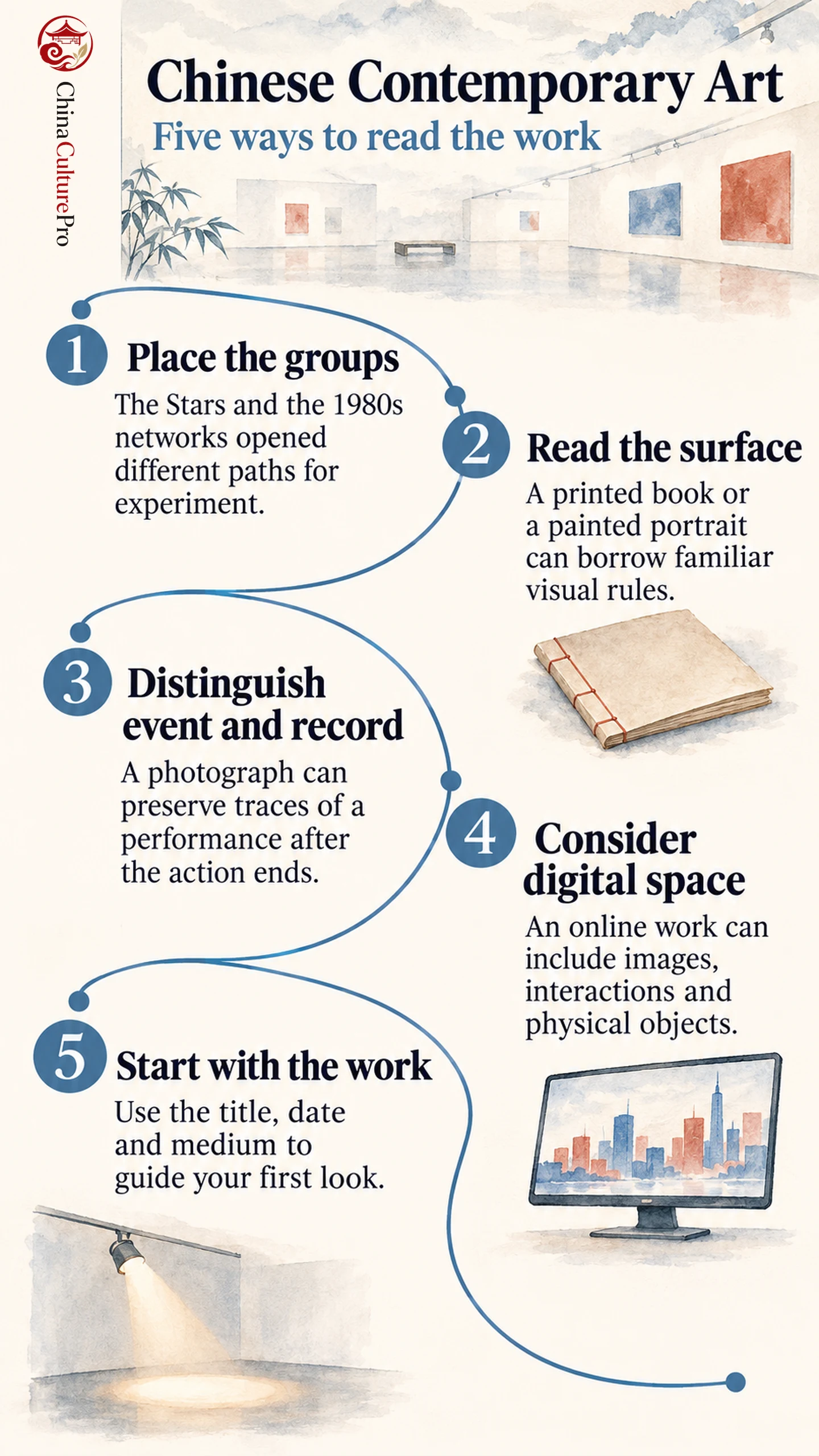
An apparently readable book, an unsmiling family portrait and an online city each ask the viewer to recognize a familiar form. The details soon complicate that first impression. This guide follows five works that show how contemporary artists made those forms carry new meanings within the longer history of Chinese art.
From the Stars to the ’85 New Wave
The Stars Art Group (星星画会, Xīngxīng Huàhuì) was active in the late 1970s and early 1980s. Founding member Wang Keping (王克平, Wáng Kèpíng) worked in carved wood. His 1979 Chain makes the shape of a clenched hand do much of the expressive work. It gives a concrete sense of what a group committed to individual expression could do with a familiar sculptural medium. [2][3]
The ’85 New Wave (八五新潮, Bāwǔ Xīncháo) describes a broader period of experiment. Artists used oils, photography, collage and actions, and they pursued different questions in different cities. Xiamen Dada’s 1986 burning event survives in documentation, while Geng Jianyi’s The Second Situation of 1987 is an oil painting. Their proximity in date tells you little about how either work should be seen. [2][4]
China/Avant-Garde opened at the National Art Museum of China in Beijing on 5 February 1989. Bringing experimental work into a national exhibition venue gave the preceding decade a visible landmark. [10] It also serves as a starting point for accounts of work made amid growing exchanges with international institutions in the following decades. Exhibitions organized around this date trace multiple directions, including newer uses of documentary material, conceptual art and installation. [4][5]
Two labels help readers recognize painting associated with the 1990s. Political Pop (政治波普, zhèngzhì bōpǔ) includes works such as Wang Guangyi’s Great Criticism series, where figures drawn from propaganda appear alongside consumer branding. Cynical Realism (玩世现实主义, wánshì xiànshí zhǔyì) is associated with painters including Fang Lijun. In his 1995.2, similarly bald figures face each other against a bright, watery landscape. Each label helps place a set of works within the period, while installation, performance and other kinds of painting developed alongside them. [11][12]
How Artists Reworked Familiar Images
For Book from the Sky (1987–91), Xu Bing (徐冰, Xú Bīng) carved invented characters for printing. They look like ordinary writing on the pages of bound books and across long suspended sheets. A viewer can recognize the visual order of Chinese printed text before realizing that the signs cannot be read as ordinary characters. This is an installation as well as a work of printmaking. Compare its use of carved printing surfaces with the different expressive aims of modern Chinese woodcuts. [6]
Zhang Xiaogang (张晓刚, Zhāng Xiǎogāng) started developing the Bloodline series after finding a family photograph in 1993. In Bloodline—Big Family No. 17, a father and mother look out with the composed expressions of studio sitters. The colored faces of the children and thin red connections between figures interrupt the photographic effect. An oil painting can bring details from family memory together in an image that resembles a formal record. The wider history of photography in China helps explain the visual conventions at work. [7]
From Public Performance to Virtual Space
In Breathing (1996), Song Dong (宋冬, Sòng Dōng) breathed onto the pavement in Beijing’s Tiananmen Square, leaving a patch of ice, then repeated the action on the frozen surface of Houhai. On the already frozen lake, the same gesture left no similarly visible trace. The paired photographs taken by Yin Xiuzhen make that difference available to a viewer after the actions have ended. [8]
Cao Fei (曹斐, Cáo Fěi) built RMB City (2007–11) in Second Life, an online world where people could interact through avatars. Its crowded skyline made a space for considering rapid urbanization. Its collection record includes videos, digital files and objects such as a fabric flag. That range helps explain why one view of the skyline conveys only part of the work. [9]
Five Works to Start With
| Work | Artist and date | What to look for |
|---|---|---|
| Chain | Wang Keping, 1979 | Follow the outline of the fist and the way the carving preserves the mass of the wood. [3] |
| Book from the Sky | Xu Bing, 1987–91 | Look at how repeated columns of type give the installation the visual authority of a printed text. [6] |
| Bloodline—Big Family No. 17 | Zhang Xiaogang, 1998 | Find the points where color interrupts the resemblance to a black-and-white studio portrait. [7] |
| Breathing, Tiananmen Square | Song Dong, 1996 | Find the frozen trace of breath that the photograph records. [8] |
| RMB City | Cao Fei, 2007–11 | Compare the city seen in a screenshot with the files and physical objects cataloged alongside it. [9] |
FAQs About Chinese Contemporary Art
When Did Chinese Contemporary Art Begin?
The late 1970s are a useful starting point for the rise of experimental groups such as the Stars. Collections may begin earlier, and exhibitions focused on global exchanges may start at the 1989 landmark. [1][2][5]
Can Ink and Printmaking Be Contemporary Art?
Yes. Contemporary artists can use ink, woodblocks and book formats to ask new questions. Xu Bing used the look of a printed text to turn an ordinary act of reading into the subject of an installation. [6]
Is Chinese Contemporary Art One Movement?
It includes several generations, collectives and individual practices. Labels such as the ’85 New Wave name particular historical developments within that broader field. [1][2][4]
Sources
[1] M+. M+ Sigg Collection
[2] Paul Gladston. ‘Avant-garde’ Art Groups in China, 1979–1989
[3] M+. Wang Keping: Chain
[4] UCCA. ’85 New Wave: The Birth of Chinese Contemporary Art
[5] Guggenheim. Art and China after 1989: Theater of the World
[6] The Metropolitan Museum of Art. Ink Art: Past as Present in Contemporary China
[7] M+. Zhang Xiaogang: Bloodline—Big Family No. 17
[8] M+. Song Dong: Breathing, Tiananmen Square
[9] M+. Cao Fei: RMB City
[10] Yang Zi, M+. Diffused Religion and the Origins of Chinese Avant-Garde Art
[11] M+. Wang Guangyi: Great Criticism: Chanel
[12] M+. Fang Lijun: 1995.2