
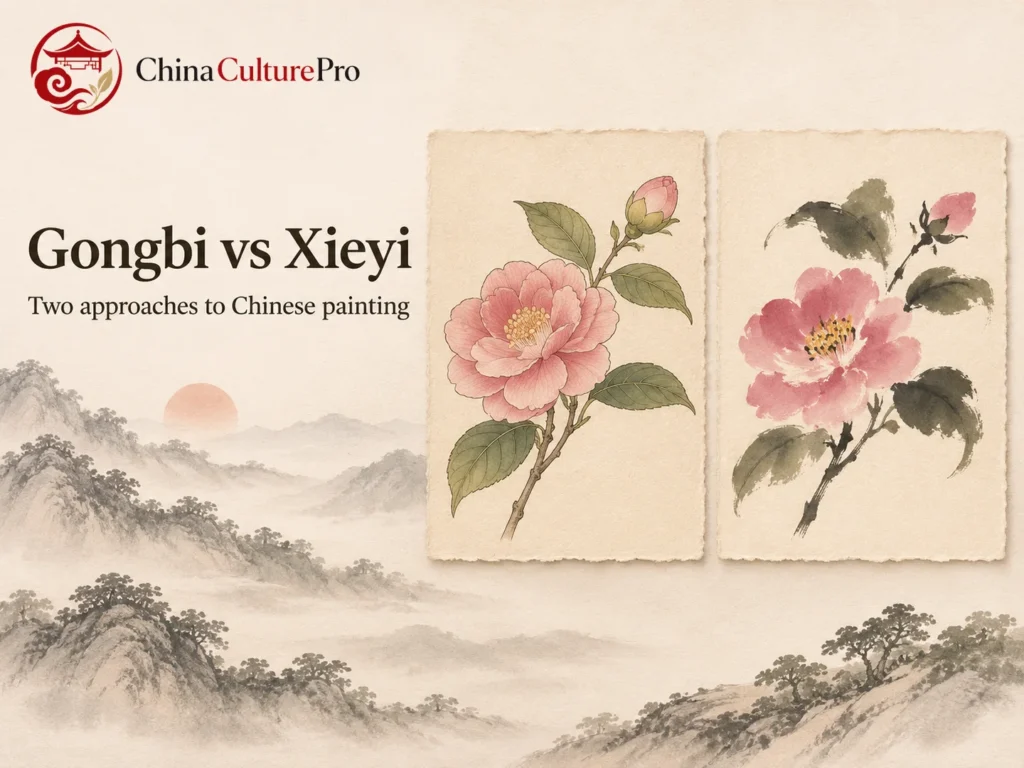

Quick Answer: What Is the Difference Between Gongbi and Xieyi?
Gongbi (工笔, gōngbǐ) builds forms through careful brushwork, often with fine outlines and controlled color. Xieyi (写意, xiěyì) uses more selective, expressive marks to convey the character or movement of a subject. A painter can use ink or color in either approach. [1]
Look at how the brush describes edges, weight and movement. Painters can use detailed strokes for a bird and freer marks for nearby rocks or leaves within the same picture. [1][6]
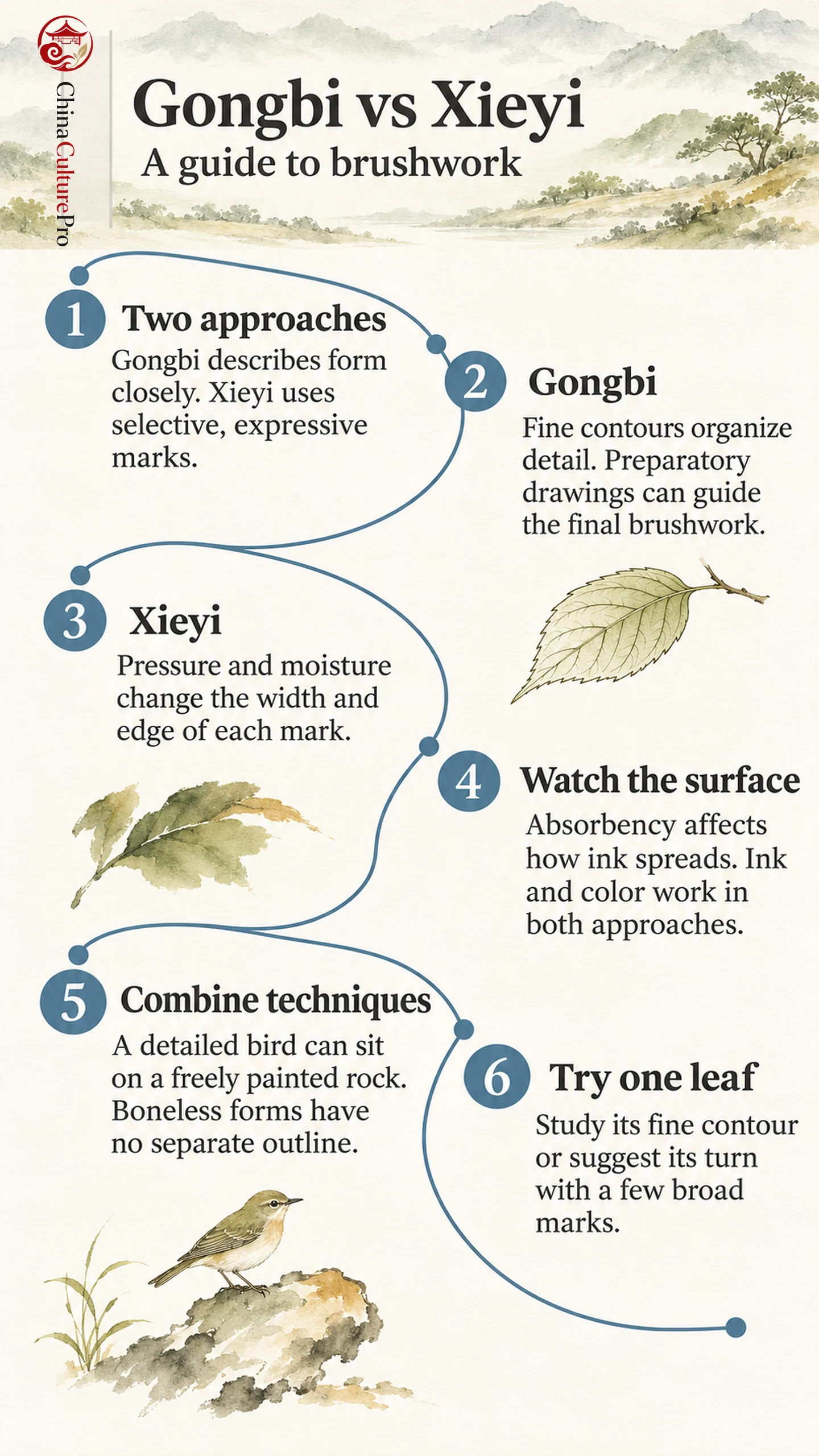
A bird’s feathers may be traced in fine lines while the rock beneath it is laid in with broad, broken strokes. The change in handling tells you what the painter chose to describe closely and what a few marks could suggest. The terms gongbi and xieyi give you a way to describe that difference. [1][6]
How the Two Approaches Look Side by Side
Both approaches depend on decisions about water, brush pressure and the painting surface. The table gives common tendencies. The traits matter together, since one clue can fit more than one approach. [1][2]
| Feature | Gongbi | Xieyi |
|---|---|---|
| Contour | Fine, controlled lines often define the edge and internal structure. [1] | An edge can be suggested with a broad mark, a wash or a broken line. [1] |
| Detail | Separate marks may describe feather groups or the veins of a leaf. [3][6] | A few marks may carry the weight and gesture of the entire form. [1][5] |
| Color and ink | Color is common and can be carefully placed. Ink can carry the drawing. [1][3] | Ink often carries the form. Color can support a freer brush movement. [1] |
| Surface | Less absorbent supports can help a fine line keep its edge. [2] | A more absorbent surface can spread a wet mark as it enters the fibers. [2][5] |
What Gongbi Demands From the Brush
In detailed painting, an outline sets more than the silhouette. It helps position petals behind one another or separate the overlapping parts of a wing. Controlled changes in line width and color can give those parts their individual shapes. When you inspect a bird-and-flower painting, look at an edge where two forms overlap. This is often where the care in the drawing becomes easiest to see. [1][6][7]
A pencil and ink drawing called Hosta and Asters preserves one working method. Xie Zhiliu (谢稚柳, Xiè Zhìliǔ) worked out the turning outlines of leaves in the drawing. His preparatory sketches could serve as guides that he traced onto a new sheet, where he refined the lines and added color. The surviving drawing shows that part of the visual design was worked out before the final brushwork. It documents one artist’s practice. [3][4]
How Xieyi Makes a Few Marks Carry More
When the brush simplifies a form, differences in pressure and moisture become easier to see. A change in pressure can shift a mark from broad to narrow. A wetter brush can leave a spreading edge, while a drier one shows traces of the brush fibers. The painter chooses which marks will carry enough information for the viewer to recognize the subject. Freer brushwork has often been associated with literati painting, where brush control carries much of the image’s expression. [1][2]
In Birds in a Lotus Pond, dated to about 1690, Bada Shanren (八大山人, Bādà Shānrén) uses saturated ink on absorbent satin. An angular dark lotus leaf stands above a rock that is left pale within its outline. Small birds occupy the rock. The relation between dark ink and unpainted areas makes the shapes legible with relatively little surface description. The absorbent satin lets the wet ink spread. The effect depends on how a particular support takes up moisture. [5]
When Painters Combine Methods
A bird-and-flower scroll traditionally assigned to a Yuan artist offers a useful example. The pheasants and flowers have small, finely defined features. In the same image, leaves are laid in more freely and the rocks are described with sketchier strokes. Compare how much of the form is carried by line in each area. The changes in handling help direct attention across the composition. The work has no surviving artist’s signature or seals, so the Yuan attribution follows its older label. [6]
Boneless painting (没骨, mògǔ) describes forms made without a separate enclosing outline. An artist can use a patch of ink or color to shape a petal or leaf directly. A boneless form can still be handled precisely. The term describes how the shape is built, while gongbi and xieyi describe wider approaches to brushwork and depiction. [1][6]
Choosing a Starting Exercise
For a close study, choose one leaf and its stem. A less absorbent sheet can help you see changes in the line before it spreads. Give attention to where the stem meets the leaf and how the contour shifts as the leaf turns. The aim is to observe a small change in form. [1][2]
For a freer study, choose a similar leaf and suggest its turn with a few broad strokes. A more absorbent sheet will make differences in brush moisture apparent. Leave some of the sheet open so you can judge whether the marks alone carry the shape. When you compare marks, keep one variable fixed. Try the same brush and ink on two kinds of xuan paper with different absorbency. Then keep the paper fixed and vary the brush pressure. The exercises isolate two of the variables that shape Chinese painting techniques. [1][2]
FAQs About Gongbi and Xieyi
Is Gongbi Always Painted in Color?
Color is common in gongbi. Fine linework and close control of the form are stronger clues to the approach than the palette alone. [1][3]
Is Xieyi Easier for a Beginner?
A beginner can try a simple motif in either style. Gongbi asks for control of small changes in contour and detail. Xieyi asks for control of pressure, moisture and the shape of each expressive mark. [1][2]
Can One Artist Work in Both Styles?
Yes. Xie Zhiliu used preparatory drawings for meticulous flower painting and freer brushwork in landscapes. An artist can choose the approach to suit the subject and the work. [3]
Sources
[1] Asian Art Museum. A Visual Vocabulary of Brushstrokes
[2] Asian Art Museum. Brushstrokes: Styles and Techniques of Chinese Painting
[3] The Metropolitan Museum of Art. Curator Interview: Mastering the Art of Chinese Painting
[4] The Metropolitan Museum of Art. Xie Zhiliu: Hosta and Asters
[5] The Metropolitan Museum of Art. Bada Shanren: Birds in a Lotus Pond
[6] National Palace Museum. Birds and Flowers, Attributed to a Yuan Artist
[7] National Palace Museum. An Introduction to Paintings in the Museum Collection II