


Quick Answer: What Is Chinese Bird and Flower Painting?
Chinese bird and flower painting (花鸟画, huāniǎohuà) is a genre that includes images of plants and creatures. A picture in this tradition may show birds and blossoms together, or focus on a single flower, an insect, a fish or a group of small animals. [1][2][7]
- Subject: Seasonal plants, feathers and the movement of animals can all give a painter something to observe closely. [1][2]
- Technique: The genre includes fine outlines, forms built directly in color and freer ink marks. [5][6][7]
- Meaning: A combination of motifs may suggest a wish or occasion when the pairing and context support that reading. [8]
Look at how the subject is painted before trying to assign it a symbolic meaning. [2][8]
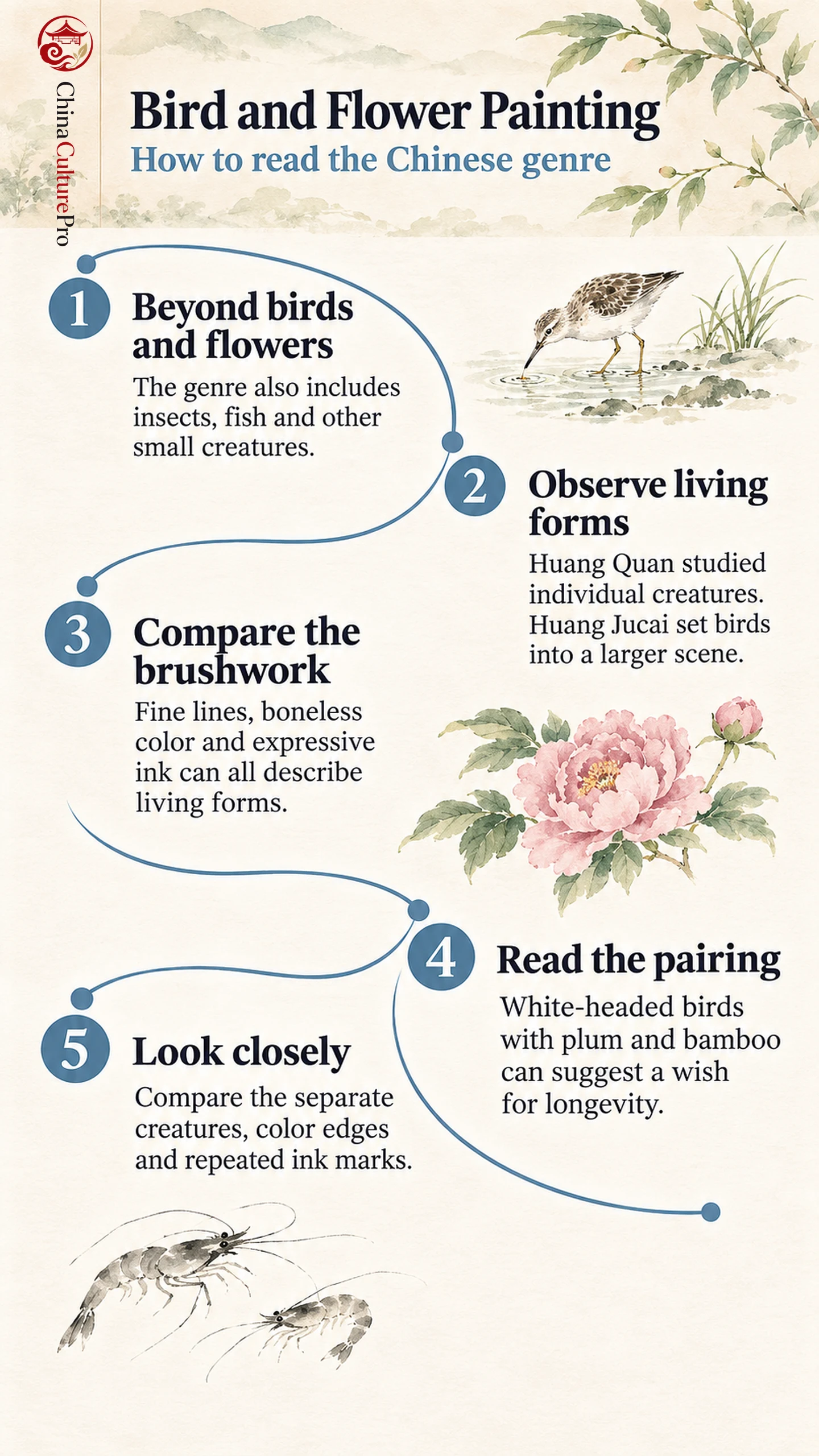
A bird can stretch its neck toward water while smaller birds fly around it. In another painting, a flower bud and an open bloom can carry the whole composition. The genre lets painters organize observations of living things, from the texture of a wing to the timing of a season. [5][9]
A Genre That Includes Insects, Fish and Plants
Huang Quan (黄筌, Huáng Quán) presents twenty-four creatures on silk in Sketches of Rare Birds (写生珍禽图, Xiěshēng Zhēnqín Tú). Some are birds in different poses. Others are insects or turtles. The creatures sit apart from one another, so the eye can compare proportions and small features without following an event in a shared landscape. [2][3]
The fine lines and color make an insect’s wings or a bird’s pose legible at a small scale. The painted silk may have served as a model for Huang’s son to copy, as a short inscription suggests. The date and authorship of that inscription have been questioned. The separately arranged studies are visible even if the scroll’s original purpose remains open. [2][3]
Court Painting and the Study of Living Things
In the tenth century, Huang Quan’s family helped establish a style of precise line and color that became influential at the early Song court. The tradition used close observation, fine lines and color to describe a creature’s structure. In a composed scene these skills also helped arrange motion, quiet and seasonal cues. [4][9]
Huang Jucai (黄居寀, Huáng Jūcǎi), Huang Quan’s son, worked for the Song court after the fall of the Later Shu state. In Pheasant, Sparrows and Brambles, a large bird bends toward a stream while small birds perch or fly above it. Plant stems and rocks fill much of the picture. The different postures and the dense setting bring several observations into one scene. Compare this to the spacing of the studies in his father’s scroll. [2][9]
Detailed Brushwork, Boneless Color and Expressive Ink
A flower or bird can receive fine linework even when other parts of the scene are loosely handled. A scroll traditionally attributed to a Yuan painter renders plumage and flowers in detail, fills leaves more freely and uses rougher strokes for rocks. The distinction between gongbi (工笔, gōngbǐ), meticulous handling, and xieyi (写意, xiěyì), expressive handling, can apply to different passages of the same image. [1][6]
In boneless painting (没骨, mògǔ), patches of ink or color form a shape without a separate enclosing line. In his album leaf Peonies, Yun Shouping (恽寿平, Yùn Shòupíng) uses color to shape an open flower and a bud. The leaf veins are still drawn in. The method determines how the main forms are established and leaves room for line elsewhere. [5]
Ink gives a painter a different set of possibilities. In his 1927 Shrimp, Qi Baishi (齐白石, Qí Báishí) repeats related marks to make several bodies. Differences in tone and spacing give each a position in the group. The joints and tails remain recognizable even where broad ink tones carry most of the bodies. [7]
How Motifs Acquire Meaning in a Painting
In Birds Amidst Blossoming Plum and Bamboo, a Ming scroll catalogued as after Lin Liang (林良, Lín Liáng), the birds’ white head patches evoke a familiar image of old age. They are called báitóuwēng (白头翁), a name that can mean a white-haired old man, and in this pairing they support a wish for longevity. Plum blossoms and bamboo add associations of renewal and moral character in this pairing. The group would suit a birthday or anniversary gift. The scene’s suitability for that use does not establish that it was actually commissioned for a particular celebration. [8]
Start with the particular species or motif, then look at its companions. Inscriptions and seals may help you separate an artist’s stated purpose, a later owner’s response and an interpretation based on the imagery. A single bird has more than one possible role in a painting. [3][8]
Three Works for Looking More Closely
| Work | Look for | What it shows |
|---|---|---|
| Sketches of Rare Birds | Separate creatures and finely drawn edges. | The painter’s close observation of individual forms. [2] |
| Peonies by Yun Shouping | The edge between color and bare paper. | The flower’s shape can come directly from color, with fine veins added where needed. [5] |
| Shrimp by Qi Baishi | Similar marks in different tones. | Repetition can create unity while the placement of each form adds movement. [7] |
FAQs About Chinese Bird and Flower Painting
Does a Bird and Flower Painting Need Both Birds and Flowers?
The genre also includes paintings of plants alone, fish, insects and other small creatures. Huang Quan’s study scroll brings together birds, insects and turtles. [1][2]
Is Flower and Bird Painting Usually Done in Color?
Some court traditions used careful color over fine outlines. Other painters worked in monochrome ink or built forms directly from patches of color. The genre takes its name from the subject area. [1][5][7]
Do All Birds in Chinese Paintings Have Symbolic Meanings?
A bird can be a study from life, part of a scene or an element of an auspicious design. A symbol reading is stronger when other motifs, the inscription or the context supports it. [2][8]
Sources
[1] National Palace Museum. An Introduction to Paintings in the Museum Collection II
[2] Palace Museum, Beijing. Huang Quan’s Sketches of Rare Birds
[3] Palace Museum, Beijing. Digital Gallery: Huang Quan’s Sketches of Rare Birds
[4] Richard M. Barnhart et al.. Peach Blossom Spring: Gardens and Flowers in Chinese Paintings
[5] National Palace Museum. Yun Shouping: Peonies
[6] National Palace Museum. Birds and Flowers, Attributed to a Yuan Artist
[7] The Metropolitan Museum of Art. Qi Baishi: Shrimp
[8] The Metropolitan Museum of Art. Birds Amidst Blossoming Plum and Bamboo
[9] National Palace Museum. Huang Jucai: Pheasant, Sparrows and Brambles