

Quick Answer: What Defines Hong Kong Cinema?
Hong Kong cinema is a filmmaking tradition and production culture associated with Hong Kong. Its history includes Cantonese and Mandarin films, large studios and independent productions, commercial entertainment and more personal work. Action is one prominent strand within a much wider range.[1][7][8]
- Genres: Martial arts, comedy, crime, romance and social drama often overlap.
- Filmmakers: King Hu, Michael Hui, John Woo, Ann Hui and Wong Kar-wai offer different routes into the tradition.
- Context: Language, the production company and the period all help place a film.
To place a film in this history, check its production credits, year and soundtrack alongside its setting.
A sword duel, a miserly detective and two neighbors sharing an unspoken attraction can all lead into Hong Kong cinema. Following those different stories reveals how studios, performers and filmmakers used a busy port city’s languages and everyday life on screen.
Languages, Studios and the City’s Film Culture
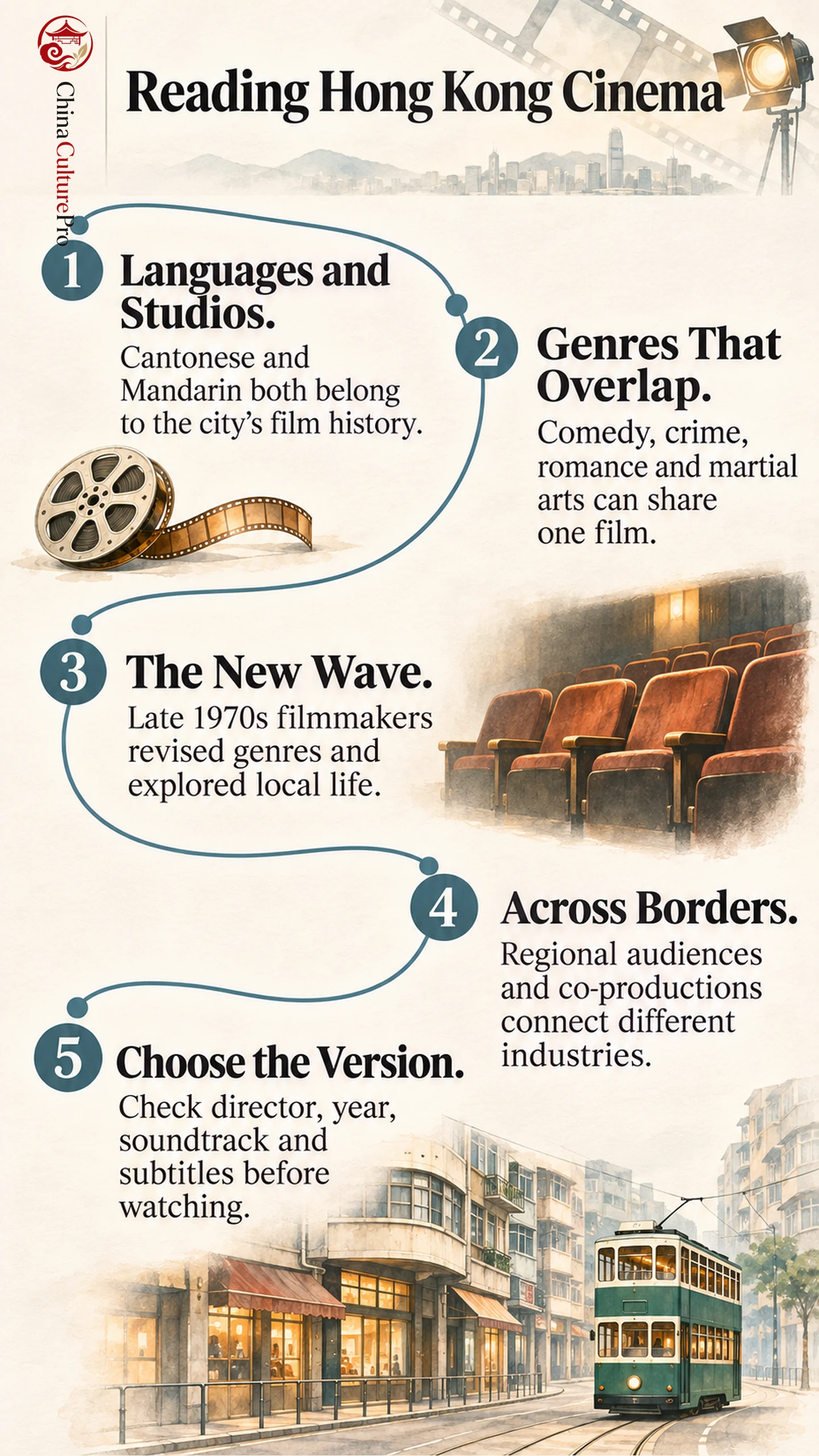
Cantonese gives many Hong Kong films their local speech rhythms, jokes and songs. Mandarin also has a substantial place in the industry’s history. A catalogue can therefore identify a Hong Kong production whose soundtrack is in Mandarin. Spoken language and place of production answer different questions within the broader history of Chinese cinema.[1][2][8]
The studio era built careers across sets, costume departments, editing rooms and distribution networks. Shaw Brothers is closely associated with period films and martial arts. Golden Harvest became a center for action performers and comedy. The studio histories intersected as filmmakers and performers moved between companies and projects. Film culture developed through those working relationships as well as through individual directors.[1][2][3]
Television changed both the audience and the pool of trained talent. The late 1960s and early 1970s brought competition for viewers, while screen comedy and new kinds of action helped renew Cantonese filmmaking. The same performers could appear across film, television and popular music. Chinese popular music provides another way to follow those connections.[1][3]
Cinema also drew on stage performance. The collection includes Cantonese opera films as a major strand in the 1950s and 1960s. Filmed singing and stage-derived gestures connected the two performance cultures.[8]
Genres Beyond Martial Arts
Wuxia (武侠, wǔxiá) centers on martial heroes and a world of loyalties, obligations and exceptional skills. Swordplay is a common part of it. Kung fu (功夫, gōngfu) films foreground bodily training and combat. A film can draw on both, while modern action may move the performance into streets, cars and gun battles. The guide to Chinese martial arts movies develops those distinctions.[1][2][4]
| Film | Director | One point of entry | What to notice |
|---|---|---|---|
| Come Drink with Me (1966) | King Hu | Mandarin swordplay | Watch how pauses, entrances and group choreography prepare the action. |
| The Private Eyes (1976) | Michael Hui | Cantonese comedy | Watch the detective agency as a small workplace shaped by money and hierarchy. |
| A Better Tomorrow (1986) | John Woo | Crime and action melodrama | Follow the conflicts between family duty, loyalty and criminal allegiance. |
| Chungking Express (1994) | Wong Kar-wai | Urban romance | Notice how chance encounters and everyday routines shape two linked stories. |
| In the Mood for Love (2000) | Wong Kar-wai | Romantic drama | Attend to restrained gestures, repeated spaces and what characters leave unsaid. |
| A Simple Life (2011) | Ann Hui | Social and family drama | Watch how Hui builds a social drama around ordinary relationships. |
These are entry points into different kinds of filmmaking. The films in the table vary in pace and subject, and their categories can overlap. A Better Tomorrow carries family melodrama through its crime story. The Private Eyes uses physical comedy to expose a boss’s treatment of his workers.[2][3][4][6]
The New Wave and Its Different Directions
The Hong Kong New Wave (香港新浪潮, Xiānggǎng xīnlàngcháo) emerged around the late 1970s. Filmmakers including Ann Hui and Tsui Hark brought new approaches to local settings, social questions and familiar genres. Their earlier television work was part of the background. The term describes a changing filmmaking environment with several creative directions.[1][5]
Hui’s debut feature The Secret appeared in 1979. Her later work repeatedly returned to family, displacement and the lives of ordinary people. Tsui Hark’s The Butterfly Murders, also from 1979, reworked the conventions of martial-arts cinema. Local realism and genre experimentation could both belong to the movement.[5][6]
Wong Kar-wai came to international attention in the 1990s with films that made memory, missed encounters and urban loneliness central to their form. He belongs to a later moment than the initial 1979 group. The guide to Chinese film directors places such careers alongside other regional movements.[6]
From Regional Audiences to Global Cinema
Hong Kong films circulated through regional cinemas and overseas Chinese audiences, and some acquired much wider followings. A Better Tomorrow is a concrete example. Its combination of gunplay, male friendship and moral conflict became influential beyond Hong Kong, including in Korea. International audiences could encounter both Woo’s action style and Chow Yun-fat’s screen persona through the same film.[4]
After 1997, Hong Kong filmmaking continued through multiple forms, including mainland co-productions, independent work and commercial films focused on local audiences. A co-production can connect talent and finance across borders. A smaller local film can explore a particular neighborhood or social relationship. These paths coexist within the city’s changing cinema.[7]
A director’s career may also move between industries. The place where a scene was shot, a performer’s nationality and the company producing the film can point in different directions. Read the production credits to understand the particular collaboration. Hong Kong culture gives the wider urban context for many of the stories.[6][7]
How to Choose a Film and Its Version
Choose a first film by the kind of attention you enjoy. Physical performance provides one route through action and comedy. Relationships and atmosphere offer another through Wong’s romances. Hui’s social dramas give a different way to watch daily routines and the pressures around them. Use the table to match a film with the kind of viewing you want.
Before watching, check the year, director, soundtrack language and subtitle listing. Use the director and year to confirm the film when translated titles vary. A dubbed edition changes the sound performance even when the images remain the same. A restoration label identifies the version being presented. The language, format and running time describe that particular screening.[2][3][4][8]
Archive catalogue entries are useful starting points because they separate cast, company, language and format. The viewing copy available to you may have different subtitles or a different presentation. Match the catalogue film to the actual edition instead of relying on an English title alone.[8]
FAQs About Hong Kong Cinema
Are Hong Kong movies always in Cantonese?
Cantonese is central to many periods of Hong Kong cinema. Mandarin also has a long history in its studios. Check the soundtrack language for the particular version.
What is the Hong Kong New Wave?
It is a movement associated with filmmakers emerging in the late 1970s, including Ann Hui and Tsui Hark. Their films explored different social subjects and revised established genres.
How are wuxia and kung fu films different?
Wuxia emphasizes martial heroes and their world of obligations. Kung fu films put greater weight on training and physical combat. Particular films can combine elements.
Is a film set in Hong Kong automatically a Hong Kong production?
The location of a story or shoot is only part of the picture. Production companies, collaborators and distribution context help establish how a film belongs to an industry.
Sources
[1] Hong Kong Film Archive. When the Wind Was Blowing Wild: Hong Kong Cinema of the 1970s
[2] Hong Kong Film Archive. Come Drink with Me
[3] Hong Kong Film Archive. The Private Eyes
[4] Hong Kong Film Archive. A Better Tomorrow
[5] Hong Kong Film Archive. Revisiting the New Wave
[6] British Film Institute. Ten Essential Modern Directors from Mainland China, Hong Kong and Taiwan
[7] Hong Kong International Film Festival Society. Making Waves: Navigators of Hong Kong Cinema
[8] Hong Kong Film Archive. Collection and Resources