

Quick Answer: How Does Chinese Animation Retell Mythology?
Chinese animation repeatedly reworks figures such as Sun Wukong (孙悟空, Sūn Wùkōng), the Monkey King, and Nezha (哪吒, Nézhā). Their screen stories draw on older literary and religious traditions, then make new choices about character, conflict and audience.[1][2]
- A classic can emphasize a hero’s confrontation with heavenly authority.[4]
- A later film can reshape that hero around a new relationship and protective role.[5]
- Nezha can appear as a mythic child, a boy resisting an assigned fate or a figure reborn into a futuristic city.[6][7][8]
- Shared characters do not make all these films parts of the same series.
Distinguish an independent retelling from a direct sequel before choosing a viewing order. Familiar names can connect films culturally without joining their plots.
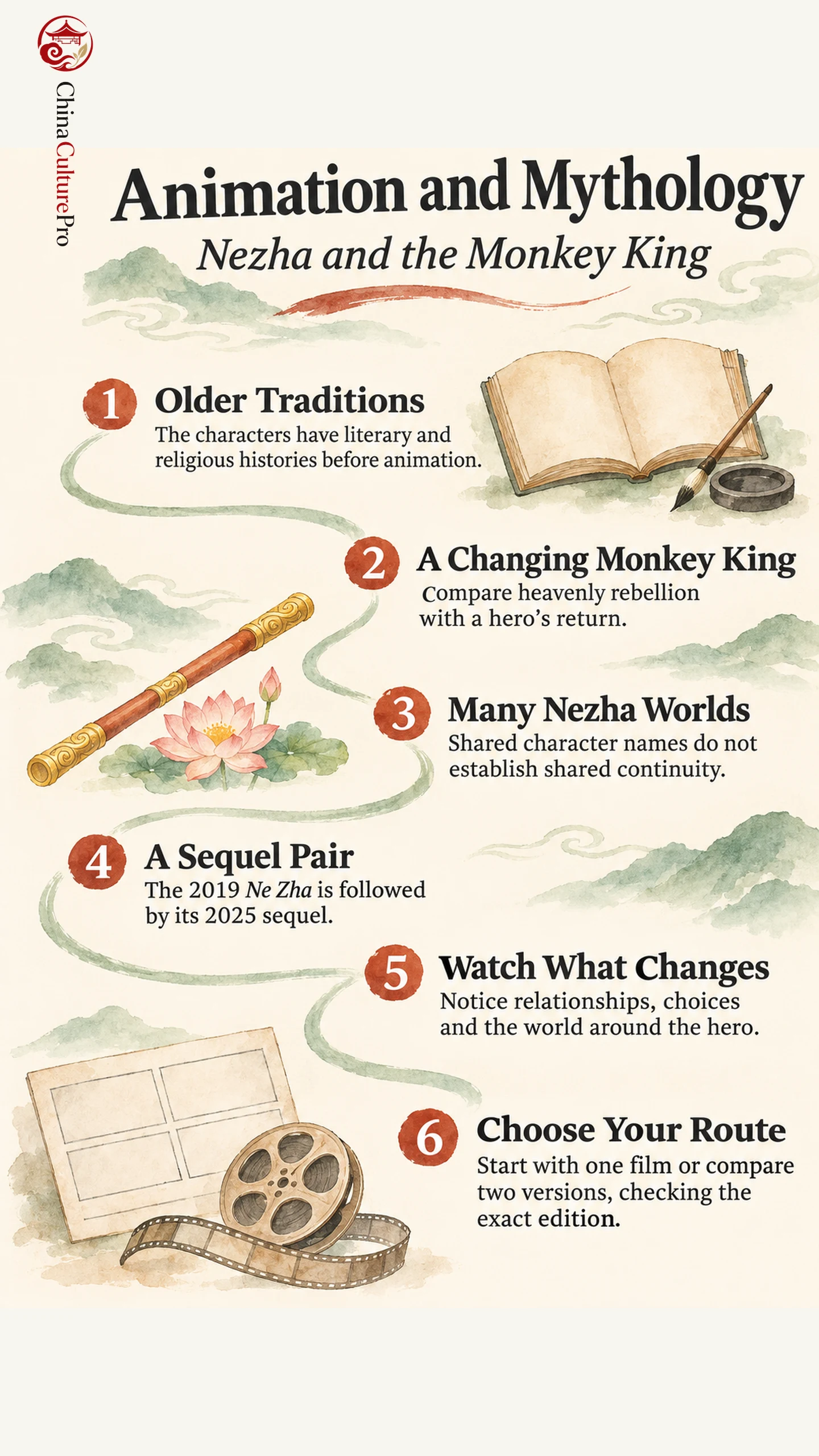
An animated version offers an interpretation, not a final definition of the character. Comparing two versions can reveal more than searching for the one “correct” screen image: notice which conflict matters, who helps the hero and what the ending asks the viewer to value.
The Traditions Behind the Screen Characters
The Monkey King is a central figure in Journey to the West (西游记, Xīyóu Jì). Its early chapters include his challenge to heavenly power; chapter 7 brings that confrontation to a decisive turn.[1] An animated film can select that phase rather than attempt the novel’s whole narrative.
The Investiture of the Gods (封神演义, Fēngshén Yǎnyì), a late imperial novel, is an important literary source for Nezha adaptations.[3] Yet Nezha’s history reaches beyond that book. His Chinese religious and literary life developed through a long process that includes Indian mythological antecedents and transmission through esoteric Buddhism.[2] The modern films participate in an already changing tradition.
A dragon king (龙王, lóngwáng), for example, can appear as a divine opponent in a Nezha story, while each film determines how the conflict unfolds.[6] The guide to the Dragon King in Chinese mythology provides wider context for the figure beyond any single screenplay.
The Monkey King: Rebellion and Return
Havoc in Heaven (大闹天宫, Dà Nào Tiāngōng), also called Uproar in Heaven, belongs to the classic animation of the 1960s. Its Monkey King refuses the demands of heavenly authority and disrupts the celestial order. The movement and percussion draw on Beijing opera (京剧, Jīngjù), making performance style part of the storytelling.[4]
Watch the relationship between posture, rhythm and confrontation. Defiance is not conveyed only by what the character says: the staging gives his encounters a particular energy. When choosing an edition, note that later restorations and conversions have their own dates; those dates do not identify the original production.
Monkey King: Hero Is Back (西游记之大圣归来, Xīyóu Jì zhī Dàshèng Guīlái, 2015) begins from a different dramatic situation. A child accidentally frees the imprisoned Monkey King, and the story brings him back into action against a threat to others.[5]
The useful comparison is rebellion beside return. One film foregrounds a challenge to celestial hierarchy; the other makes a child’s encounter with the hero important to his renewed action. They share a cultural figure without requiring the viewer to treat the later film as a sequel to the earlier animation.
Four Nezha Films, Different Narrative Worlds
The titles and years matter because similar English names can conceal very different premises. The following films are comparison points, not one four-part franchise.
| Film | A defining narrative emphasis | Relationship to the other versions |
|---|---|---|
| Nezha Conquers the Dragon King (哪吒闹海, Nézhā Nào Hǎi), 1979 | A young divine hero’s confrontation with the Dragon King.[6] | An earlier animated treatment of the inherited story |
| Ne Zha (哪吒之魔童降世, Nézhā zhī Mótóng Jiàngshì), 2019 | A child associated with destructive destiny faces a choice about what he will become.[3][7] | A new interpretation, rather than a remake that preserves every earlier plot choice |
| New Gods: Nezha Reborn (新神榜:哪吒重生, Xīn Shén Bǎng: Nézhā Chóngshēng), 2021 | A young courier and motor-racing enthusiast discovers a Nezha identity in a contemporary-futuristic mythic city.[8] | A separately imagined setting, not the next installment of the 2019 film |
| Ne Zha 2 (哪吒之魔童闹海, Nézhā zhī Mótóng Nàohǎi), 2025 | The aftermath of the earlier catastrophe leads into efforts to restore mortal bodies.[9] | A direct sequel to the 2019 Ne Zha, within that film’s continuity.[10] |
This distinction is especially useful for the two newer titles. “Reborn” describes the 2021 film’s premise; it does not mean it continues the 2019 production. The numbered 2025 sequel is the continuation of that earlier story.
What a Retelling Keeps and Changes
A recognizable character can carry a different dramatic problem. Comparative research on the 1979, 2019 and 2021 Nezha films examines changing relationships among fate, personal identity and family obligations.[3] That is a more precise route into the films than assuming each expresses an identical lesson about rebellion.
Three questions make a comparison manageable:
- What has been retained? Look for a recurring character, relationship, conflict or visual reference.
- What has been reorganized? Notice whose choices drive the story and how other characters respond.
- What belongs to this film’s world? Separate its invented setting and plot rules from the wider tradition.
The process can work across media too. The guide to Chinese mythology in video games considers what happens when inherited stories become player actions. Animation makes a different set of choices about movement, voice, timing and the order in which the audience receives information.
Choose a Starting Point Without Inventing a Viewing Order
If you are interested in older animation, begin with Havoc in Heaven or the 1979 Nezha film, then compare one later treatment of the same character. If the character’s changed role interests you more, pair the two Monkey King films or compare the 1979 and 2019 Nezha versions.
If you want the story continued by Ne Zha 2, watching the 2019 film first is a straightforward way to establish its characters and starting situation. Treat New Gods: Nezha Reborn as a separate choice with its own premise. You do not need to insert it between the 2019 film and its sequel.
For broader context, the Chinese animation guide covers techniques, history and stories beyond mythology. For any specific viewing, check the edition, language options and local content guidance. The same character can appear in productions intended for different audiences and with different levels of intensity.
FAQs About Chinese Animation and Mythology
Do I need to read the classical novels first?
You can start with a film and investigate its sources afterward. Reading a relevant episode later can make the adaptation’s choices clearer without requiring you to finish an entire long novel before viewing.
Is New Gods: Nezha Reborn a sequel to Ne Zha?
No. Its motor-racing courier and futuristic mythic city belong to a separately constructed setting. Ne Zha 2 is the direct continuation of the 2019 Ne Zha.[8][10]
Are Nezha and the Monkey King original animation characters?
No. Both have older literary traditions, and Nezha also has a substantial religious history. Animation creates new versions of these figures rather than originating the figures themselves.[1][2]
Are mythological animated films suitable for every child?
Do not assume so from the medium or a familiar character. Check the particular film’s content, local classification and the child’s sensitivity to intense conflict. A broad mythology label cannot settle suitability.
Sources
[1] Journey to the West. Chapter 7, original Chinese text
[2] Meir Shahar, University of Hawai’i Press. Oedipal God: The Chinese Nezha and His Indian Origins
[3] Chengcheng You. The Demon Child and His Modern Fate: Reconstructing the Nezha Myth
[4] New York International Children’s Film Festival. The Monkey King: Uproar in Heaven
[5] Annecy International Animation Film Festival. Monkey King: Hero Is Back—production record and synopsis
[6] China Culture, Ministry of Culture programme. Nezha Conquers the Dragon King
[7] Well Go USA. Ne Zha—film synopsis
[8] Netflix, film announcement. New Gods: Nezha Reborn
[9] CMC Pictures. Nezha 2—film details
[10] Reuters, reporting the distributors’ announcement. English-language release of the sequel to the 2019 Ne Zha