

Quick Answer: How Do the Three Labels Differ?
Wuxia (武侠, wǔxiá), xianxia (仙侠, xiānxiá) and xuanhuan (玄幻, xuánhuàn) help describe Chinese stories about martial heroes, immortals and fantastic worlds. Their boundaries depend on literary history, screen adaptation and the way a label is being used.[1][2][3][4]
- Wuxia commonly centers martial skill and chivalric obligations.
- Xianxia commonly brings immortals, spiritual training and supernatural orders into the story.
- Xuanhuan is a broader fantasy label whose usage can overlap with cultivation (修炼, xiūliàn) fiction and screen romance.
- A costume, a flying sword or a platform category is not enough to settle every case.
Use the labels as orientation, while checking the particular story’s world and dramatic priorities.
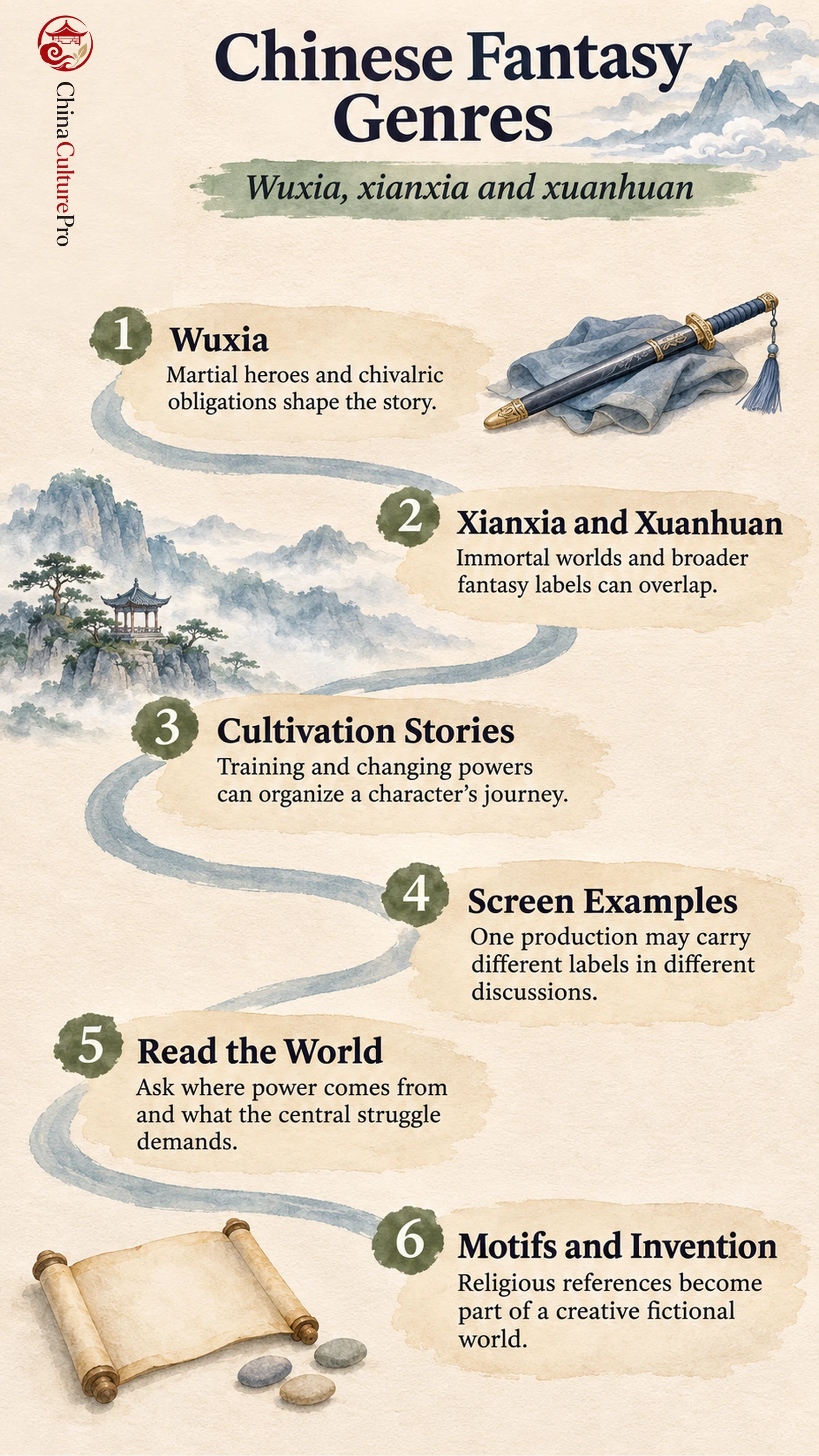
A swordsman crossing a rooftop and an immortal moving between realms may look equally impossible. Their stories can nevertheless ask different questions about power, duty and desire. Understanding those questions is more useful than counting special effects.
Three Labels, Compared by Story Logic
The distinctions below describe common centers of gravity. They are not mutually exclusive rules applying to every novel, film or series.
| Label | Core orientation | A useful question |
|---|---|---|
| Wuxia | Martial heroes navigating chivalry and obligations within human society.[1] | What does a skilled fighter owe to other people? |
| Xianxia | Immortals, cultivation or supernatural realms organize the characters’ possibilities.[2] | How do mortal limits and cosmic rules shape the story? |
| Xuanhuan | Broad Chinese fantasy that reworks inherited motifs through invented worlds and powers.[3][4] | What rules does this particular fantasy world establish? |
Wuxia’s imagined martial world is often called the jianghu (江湖, jiānghú), an arena of relationships, rivalries and obligations.[2]
What Martial Chivalry Passes to Cultivation Fantasy
Wuxia has a literary history preceding its screen forms. Its martial heroes can confront competing loyalties, restrictions and personal desires; extraordinary action belongs to that imaginative tradition.[1] The Chinese martial arts film guide explains its cinematic development within the broader history of Chinese cinema.
Cultivation describes disciplined development of a character’s powers. In fantasy concerned with immortality, training can change the protagonist’s capacities and place within the world. The related literary term xiuzhen (修真, xiūzhēn) identifies immortality-cultivation fiction that draws especially on Daoist alchemical ideas.[3]
The connection is not simply more powerful fighters replacing less powerful ones. A story about acting honorably among other people and a story about transcending mortal limits can place different demands on a protagonist. Both can contain rivalry, love and sacrifice, but the purpose of gaining power may differ. That distinction helps explain why a viewer can enjoy one kind of story while finding another’s priorities unfamiliar.
Screen Examples and Their Overlapping Labels
Three examples make the vocabulary concrete. They illustrate different emphases rather than establish a compulsory label for every viewer.
| Screen work | What it illustrates |
|---|---|
| Crouching Tiger, Hidden Dragon (卧虎藏龙, Wòhǔ Cánglóng), 2000 | A stolen sword, accomplished warriors and conflicts between obligation and desire provide a wuxia entry point.[1][5] |
| Love Between Fairy and Devil (苍兰诀, Cāng Lán Jué), 2022 | A fairy and a powerful supernatural adversary become entwined in a romance explicitly presented as xianxia.[6] |
| Eternal Love (三生三世十里桃花, Sānshēng Sānshì Shílǐ Táohuā), 2017 | Love across multiple lives and immortal realms illustrates fantasy romance whose labels overlap.[2][4] |
Eternal Love appears in discussion of xianxia dramas, while research on its screen world also discusses it as xuanhuan.[2][4] That overlap is useful evidence about how the vocabulary works. The labels can emphasize different aspects of the same production, rather than prove that one description must always be an error.
Film, live-action series and animation are formats; wuxia, xianxia and xuanhuan describe kinds of storytelling. The donghua guide explains Chinese animation, while the drama genres guide places fantasy within a wider television landscape.
Reading the Rules of a Fantasy World
When a synopsis leaves the label unclear, look for what the narrative makes consequential:
- The source of power: learned martial technique, spiritual development, inherited status or a newly invented system.
- The structure of the world: human communities and rival schools, immortal realms, or a cosmology built for this particular work.
- The central struggle: keeping an obligation, changing one’s capacities, surviving a supernatural order or sustaining a relationship.
These questions are a viewing aid, not a mechanical test. A romance can unfold inside a cultivation world, and martial action can support a story whose main concern is neither training nor combat. A synopsis that explains those priorities tells you more than a rigid genre tag.
Religious Motifs, Adaptation and Invented Worlds
Cultivation fantasy reworks ideas associated with Daoist practices and wider Chinese religious culture. It does so through contemporary fiction, including stories shaped by competitive advancement and imaginary social systems.[3] A fictional level, elixir or trial should therefore be understood within its story, rather than treated as a reliable description of religious practice.
Screen adaptation adds another layer. A fantasy romance can turn a literary idea into landscapes, costumes, performance and visual effects. In Eternal Love, an immortal world and a story extending across lives become part of a specifically designed audiovisual setting.[4] Its cultural motifs matter, but its world remains a creative construction.
That distinction leaves room for both recognition and invention. Viewers can ask which motifs have older associations, how a production transforms them and what emotional or dramatic job they perform in this particular story.
FAQs About Chinese Fantasy Genres
Can wuxia include impossible feats or supernatural elements?
Yes. Wuxia is not defined by a total absence of the fantastic. Martial chivalry and the story’s social obligations are more useful points of orientation.[1]
Are xianxia and xuanhuan mutually exclusive?
No. Their usage can overlap, particularly in discussions of screen fantasy. The same work may be described differently depending on the aspect being emphasized.[2][4]
Does every xianxia focus on training toward immortality?
No. Some screen examples foreground romance among supernatural characters rather than a step-by-step progression from mortal life to immortality.[6]
Are costume fantasy dramas accurate historical reconstructions?
A costume setting does not establish historical accuracy. A production can combine older visual references with invented institutions, powers and events.
Sources
[1] Matthew Thrift, BFI. Wuxia Films and the Genre’s Background
[2] Gwendolyn Yap, ISEAS–Yusof Ishak Institute. The Power of Fantasy: Chinese Xianxia Dramas
[3] Zhange Ni. Xiuzhen Fantasy: Science, Religion and Contemporary Chinese Fiction
[4] Jia Tan. Materializing the Digital Landscape: Chinese Fantasy Media
[5] Sony Pictures Classics. Crouching Tiger, Hidden Dragon
[6] iQIYI. Love Between Fairy and Devil: Official Series Details