


Quick Answer: What Is Donghua?
Donghua (动画, dònghuà) is the Chinese term for animation. In English-language viewing discussions, it commonly identifies Chinese animation, encompassing different techniques, running lengths and kinds of story.[1]
- Its history includes early theatrical features and the experiments of Shanghai Animation Film Studio.
- Drawn animation, ink painting, paper cutouts, puppets and digital production create different looks.
- Mythology is important, but it does not account for every animated work.
- A feature film, a short and an online series offer different viewing experiences.
The label alone does not establish visual style, genre or suitability for a particular age.
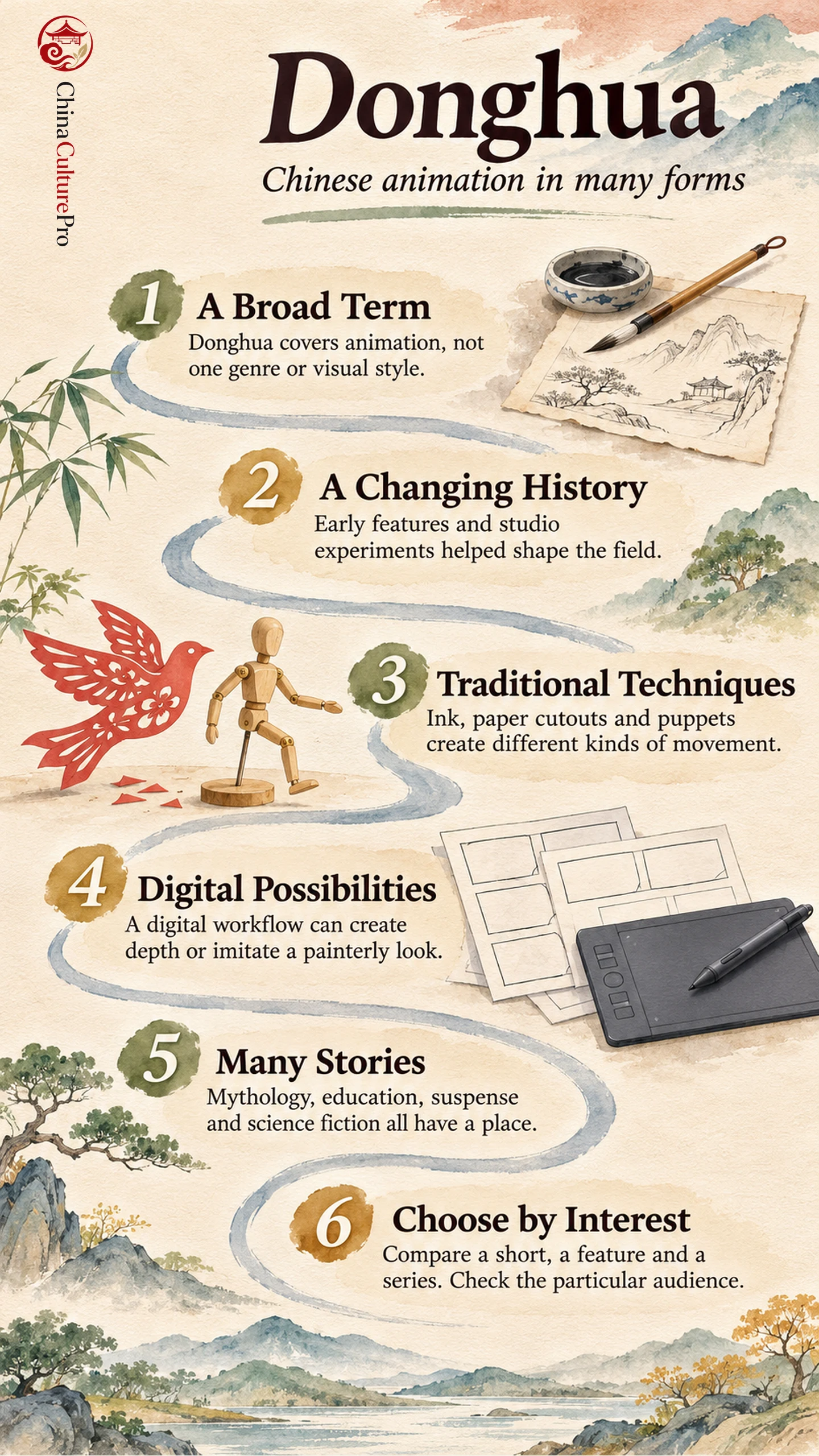
A viewer arriving through a recent fantasy series encounters only one part of the field. A short built around ink-like animals, a paper-cut comedy and a modern animated feature can reveal very different relationships between movement, materials and storytelling.
What the Word Donghua Covers
The word’s scope has changed over time. In the mid-twentieth century, donghua could distinguish conventional cel animation from techniques such as puppet stop motion. It later expanded into a general animation term. Another historical label, meishupian (美术片, měishùpiàn), or fine-arts film, connected animation with a broader family of artistic techniques.[1]
This terminology helps explain why older catalogues and contemporary viewing discussions may organize the same field differently. Donghua is not the name of a particular character design, nor does it mean that every work has been made with the same technology. The Chinese cinema guide supplies the wider film context.
A Historical Route Through Chinese Animation
Princess Iron Fan (铁扇公主, Tiěshàn Gōngzhǔ), completed in 1941, was China’s first animated feature. It adapted an episode from Journey to the West (西游记, Xīyóu Jì), establishing a significant early connection between feature animation and a familiar literary world.[2] Its history also belongs to international exchanges in animation, rather than an art form developing in complete isolation.
Shanghai Animation Film Studio became an independent studio in 1957. The 1950s and 1960s were an important period of technical and artistic experimentation, followed by another productive period in the early 1980s.[3] The emphasis on a Chinese artistic identity involved active choices about source material, movement and design.
Havoc in Heaven (大闹天宫, Dà Nào Tiāngōng), created in the 1960s, became a landmark. Its stylized performance and percussion draw on stage traditions, showing how an animated retelling can transform an older story through its own audiovisual language.[4]
Later production has included new studios and commercial forms.[1] A changing field cannot be reduced to one permanent visual ideal.
Major Techniques and the Looks They Create
Technique concerns how movement is produced; style concerns the particular look and expressive choices. The following categories can overlap, especially in digital production.
| Technique | What to notice |
|---|---|
| Drawn animation | Designed poses, lines and successive images create movement; drawing may be supported by digital tools. |
| Ink-painting animation (水墨动画, shuǐmò dònghuà) | Soft edges, washes and brush-like forms make the behavior of ink part of the moving image. |
| Paper-cut animation (剪纸动画, jiǎnzhǐ dònghuà) | Cut shapes and articulated flat forms generate movement and a distinctive sense of silhouette. |
| Puppet stop motion | Physical figures and sets are moved and photographed in increments. |
| Three-dimensional computer animation | Digital models, lighting and camera movement build depth within a constructed scene. |
Pigsy Eats Watermelon (猪八戒吃西瓜, Zhū Bājiè Chī Xīguā), from 1958, is a key paper-cut example. Where Is Mama? (小蝌蚪找妈妈, Xiǎo Kēdǒu Zhǎo Māma), also known in English through variants of Little Tadpoles Look for Mama, followed in 1960 with ink-inspired animals searching for their mother.[5] Comparing the two shows how a change in material language changes the way movement feels.
Puppet films belong to the same historical variety. A medium combining physical objects, photographed movement and an imagined story is still animation.[3] Conversely, a digital workflow can imitate a flat or painterly appearance; the finished look does not always reveal every production step.
Stories Beyond a Single Mythological Genre
Mythological adaptation is a recurring strand, linking older literary adventures with new screen interpretations. Ne Zha 2 (哪吒之魔童闹海, Nézhā zhī Mótóng Nàohǎi), released in 2025, is one recent feature example centered on a rebellious young figure and extraordinary powers.[6] Its prominence should not make it stand for every kind of Chinese animation.
Historical animation also carried educational interests. Research on mid-century scientific shorts examines how their stories presented observation, problem solving and technology, including the animal-identification theme in Where Is Mama?.[7] Artistic experimentation and instruction could coexist in the same work.
Contemporary series widen the picture further. Link Click (时光代理人, Shíguāng Dàilǐrén) began its original release in 2021 and combines suspense, science-fiction elements and human drama.[8] It offers a different entry point from an ancient costume adventure. The fantasy genres guide explains why cultivation fantasy is a story category rather than another word for animation.
Choosing a Starting Point by Format and Interest
Choose a work according to what you want to notice. A short can reveal a technique quickly, while a feature or series allows a longer dramatic structure.
| Starting interest | A useful example |
|---|---|
| Early feature storytelling | Princess Iron Fan, 1941: a literary adventure expanded into a feature-length animation.[2] |
| Cutout movement | Pigsy Eats Watermelon, 1958: observe how flat shapes and jointed motion carry a comic situation.[5] |
| Ink-inspired movement | Where Is Mama?, 1960: watch soft-edged animals move through a simplified visual world.[5] |
| Contemporary feature spectacle | Ne Zha 2, 2025: compare its dramatic scale with the shorter historical examples.[6] |
| A continuing series | Link Click, beginning in 2021: follow how suspense and human relationships develop over episodes.[8] |
These choices are not an age-rating list. Check the particular work’s synopsis and local classification when choosing for children. For the literary and mythological side, the Chinese animation and mythology guide follows how familiar figures are retold.
FAQs About Donghua
Is donghua a single visual style?
No. It covers animation with different materials, techniques and artistic aims. An ink-inspired short and a contemporary digital feature can both belong to the field.
Is donghua always three-dimensional animation?
No. Chinese animation includes drawn, ink-inspired, paper-cut and puppet works, alongside computer-generated production.
Are Chinese animated films only for children?
Animation describes a medium, not one audience. Choose a particular work by its content and classification rather than assuming that animation makes it suitable for every child.
Is every donghua a cultivation fantasy?
No. The field includes other kinds of story, including educational shorts and contemporary suspense. Cultivation fantasy is one narrative category.[7][8]
Sources
[1] Daisy Yan Du, Association for Chinese Animation Studies. Katong, Meishupian and Donghua: Terms of Chinese Animation
[2] Shanghai International Film Festival. Restoration of Princess Iron Fan
[3] M+ Museum. Chinese Mainland: Revisiting the Classics
[4] American Film Institute. The Monkey King: Havoc in Heaven
[5] Hong Kong Film Archive. Restored Treasures: Classic Chinese Animations
[6] A24. Ne Zha II: Film Details
[7] Association for Chinese Animation Studies. Animating Science and Technology: Little Tadpoles to the Space Monkey
[8] Link Click Official Site. Introduction and Original Release History