
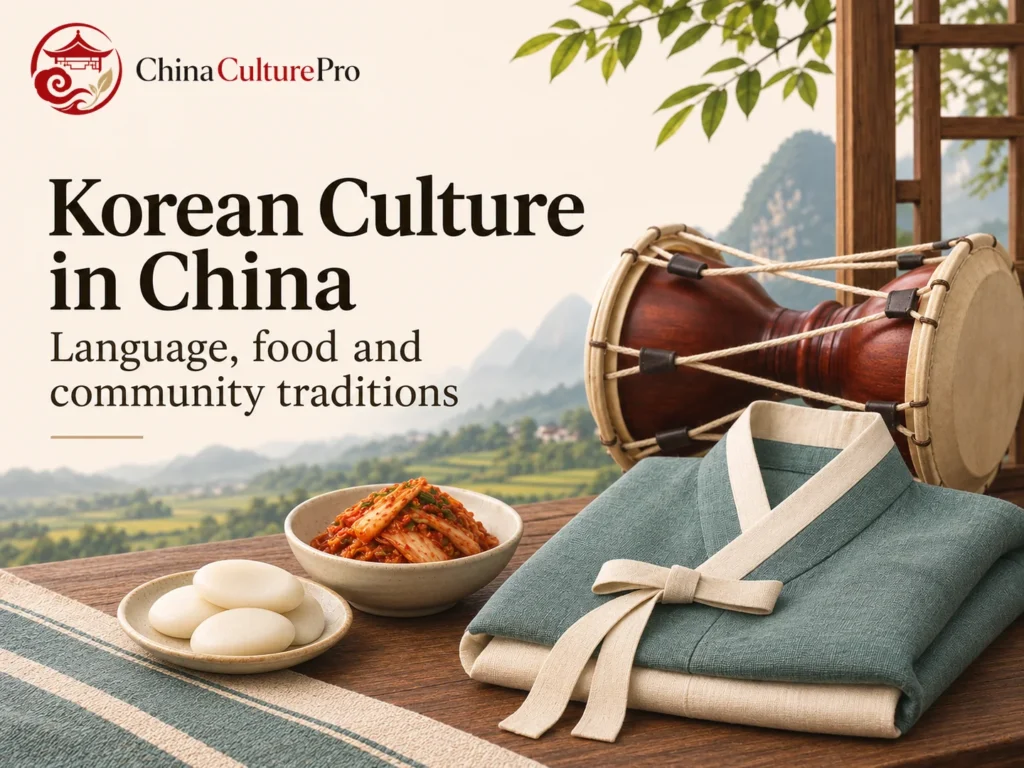

Quick Answer: What Is Korean Culture in China?
Korean culture in China refers to the histories and living practices of China’s Korean ethnic group(朝鲜族,Cháoxiǎnzú), often called Korean Chinese or Chaoxianzu. Important communities are in Jilin, Heilongjiang and Liaoning, with people also living elsewhere in China. [1]
- Language: Korean language, literature and translation remain fields of study and cultural expression.
- Performance: Ensemble traditions combine movement with instrumental music and community occasions.
- Food: Rice, fermented vegetables, noodles and rice cakes take different forms.
- Family life: Clothing, housing and celebrations connect inherited practices with changing circumstances.
These traditions share cultural resources with the Korean peninsula. Ethnicity, citizenship, place of residence and individual practice should be distinguished.

A ribbon hat spinning above a dance ensemble and a bowl of noodles represent different parts of Korean Chinese life. Understanding them means looking beyond a festival costume: communities have migration histories, modern literary institutions and varied family practices within China’s wider ethnic diversity.
Communities, Migration and Regional Life
Yanbian in Jilin is an important cultural center, but it does not contain every Korean Chinese community. Settlements also developed elsewhere in northeastern China, while later migration brought people to major coastal cities. Regional identity therefore involves both established village networks and lives shaped by mobility. [1]
Migration from the Korean peninsula occurred in successive periods. Substantial settlement expanded from the mid-nineteenth century, with farming opportunities, hardship and changing frontier policies among its circumstances. Japanese colonial rule on the peninsula brought further displacement; wartime population movements also included forced migration. A single arrival date cannot explain every family’s history. [2]
This background connects the topic to Dongbei culture, without making Korean Chinese traditions interchangeable with the whole northeast. Regional setting and ethnic belonging describe different, overlapping parts of a person’s life.
Language, Literature and Education
Language belongs to contemporary cultural life as much as to inherited songs. Yanbian University’s Korean language and literature curriculum includes Chinese Korean grammar, writing, Chinese Korean literature, literature from the peninsula and translation practice. These are distinct subjects, rather than one undifferentiated collection of traditional stories. [3]
The combination is useful for understanding cultural continuity. Writing an original work, studying an older text and translating between languages require different skills. A student may engage with several literary histories while working within a Chinese institution. Cultural participation need not mean performing a traditional dance or wearing ceremonial clothes.
Neither a university program nor an ethnic category establishes every person’s language ability. Family language, education and individual experience must be considered separately.
Farmers Dance and Related Performance Traditions
Farmers dance(农乐舞,nóngyuèwǔ)brings together music, movement and community celebration. Agricultural gestures and ritual associations are important to its history. Drums, gongs and wind instruments accompany performers, and the ensemble and costumes have changed over time. The specific element called Farmers’ dance of China’s Korean ethnic group entered UNESCO’s Representative List in 2009. [4]
Two related forms help clarify what audiences see:
| Form | Distinguishing feature |
|---|---|
| Ribbon hat dance(象帽舞,xiàngmàowǔ) | Dancers control a ribbon attached to a hat through coordinated head and body movements; Wangqing is an important transmission setting. [5] |
| Long drum dance(长鼓舞,chánggǔwǔ) | A performer carries a two-headed drum on a shoulder strap and combines playing with dance; it may be performed individually or in a group. [6] |
These examples belong within a broader performing arts context. A hat technique, an instrument and an entire community performance are different units of description.
Research discusses several theories of farmers dance origins, including ritual, farming imitation and military associations. These interpretations should not be compressed into one proven founding event. [11]
Rice, Fermented Vegetables and Cold Noodles
Fermented vegetables are a central food tradition. A national heritage record for Yanji, published in 2014, describes cabbage and radish preparations, seasoning and fermentation, as well as neighbors helping with winter preparation. Garlic, ginger and chili contribute flavor, but the record concerns a particular transmitted practice, not ownership of all Korean fermented vegetables. [7]
This is one example within the wider subject of preserved vegetables. The social work of preparing and sharing food matters alongside the finished dish. Some preparations use fish-derived ingredients, so vegetable-based does not automatically mean vegan. [7]
Cold noodles(冷面,lěngmiàn)may use buckwheat, wheat and starch combinations, with broth and toppings contributing much of the flavor. Pounded rice cakes(打糕,dǎgāo)provide a contrasting, chewy rice-based form. Neither dish is defined simply by red chili seasoning. [8] Comparing ingredients and forming methods is more informative than treating every noodle dish as the same food.
Clothing, Heated Homes and Family Celebrations
Traditional clothing includes short jackets with long skirts and loose trousers. Ties, garment proportions and fabric choices help distinguish forms. Historical associations with white clothing coexist with colorful materials and changing textiles; white is not a rule for every wearer or occasion. [9]
Traditional northeastern homes may use a heated floor linked to the kitchen stove through underfloor flues. The warmed surface supported sitting, eating and sleeping, with low furniture suited to that arrangement. Contemporary homes and furnishings vary. [8]
The first birthday selection rite(抓周,zhuāzhōu)offers a different example of family transmission. Objects such as books, writing tools, rice and thread are placed before a child, whose choice receives a hopeful symbolic interpretation. The interpretations express family wishes; they do not predict an occupation, wealth or lifespan. The objects and scale of a celebration can change between families. [10]
FAQs About Korean Culture in China
Does Chaoxianzu Mean a North Korean Citizen?
No. It is the Chinese name for an ethnic group. In this article, Korean Chinese refers to that community in China; the term should not be used to assign someone citizenship in either peninsula state.
Is Farmers Dance Exclusive to China?
No. The 2009 inscription identifies a particular community tradition in China. It does not grant exclusive ownership of all related Korean music, dance or agricultural celebrations. [4]
Is Korean Chinese Food Always Spicy?
No. Chili is important in some preparations, but rice, rice cakes and other foods have different flavor profiles. Ask about the particular dish and its seasoning rather than assuming a whole cuisine has one heat level. [7][8]
Do All Korean Chinese People Wear Traditional Clothing?
No. Heritage garments describe particular forms and occasions, not a uniform daily appearance. Dress alone cannot establish someone’s ethnicity, citizenship, language ability or participation in community life.
Sources
[1] National Ethnic Affairs Commission. Korean ethnic group overview
[2] National Ethnic Affairs Commission. Korean ethnic group history
[3] Yanbian University. Korean language and literature program
[4] UNESCO. Farmers dance of China’s Korean ethnic group
[5] China Intangible Cultural Heritage. Korean farmers dance ribbon hat tradition
[6] China Intangible Cultural Heritage. Korean long drum dance
[7] China Intangible Cultural Heritage. Korean kimchi making
[8] National Ethnic Affairs Commission. Korean customs
[9] China Intangible Cultural Heritage. Korean clothing
[10] Jilin Provincial Department of Culture and Tourism. Yanbian birthday celebrations
[11] Piao Yongguang. On the Origin of Nongak Dance in the Korean Ethnic Group