


Quick Answer: What Is Jing Culture in China?
Jing(京族,Jīngzú)culture in China connects coastal communities in Guangxi with fishing knowledge, language, ritual gatherings and music.
- Place: Communities around Dongxing and Fangchenggang include three historically island settlements. [1]
- Language: Local speech has close connections with Vietnamese; Chinese also forms part of community life. [1][3]
- Gatherings: A major singing festival brings ritual, shared meals and entertainment together. [4]
- Music: A single-string instrument produces a varied melodic repertoire through skilled technique. [5]
Jing is an ethnic identity, not a synonym for Beijing residents or Vietnamese citizenship. Its maritime associations describe a cultural setting rather than everyone’s occupation.
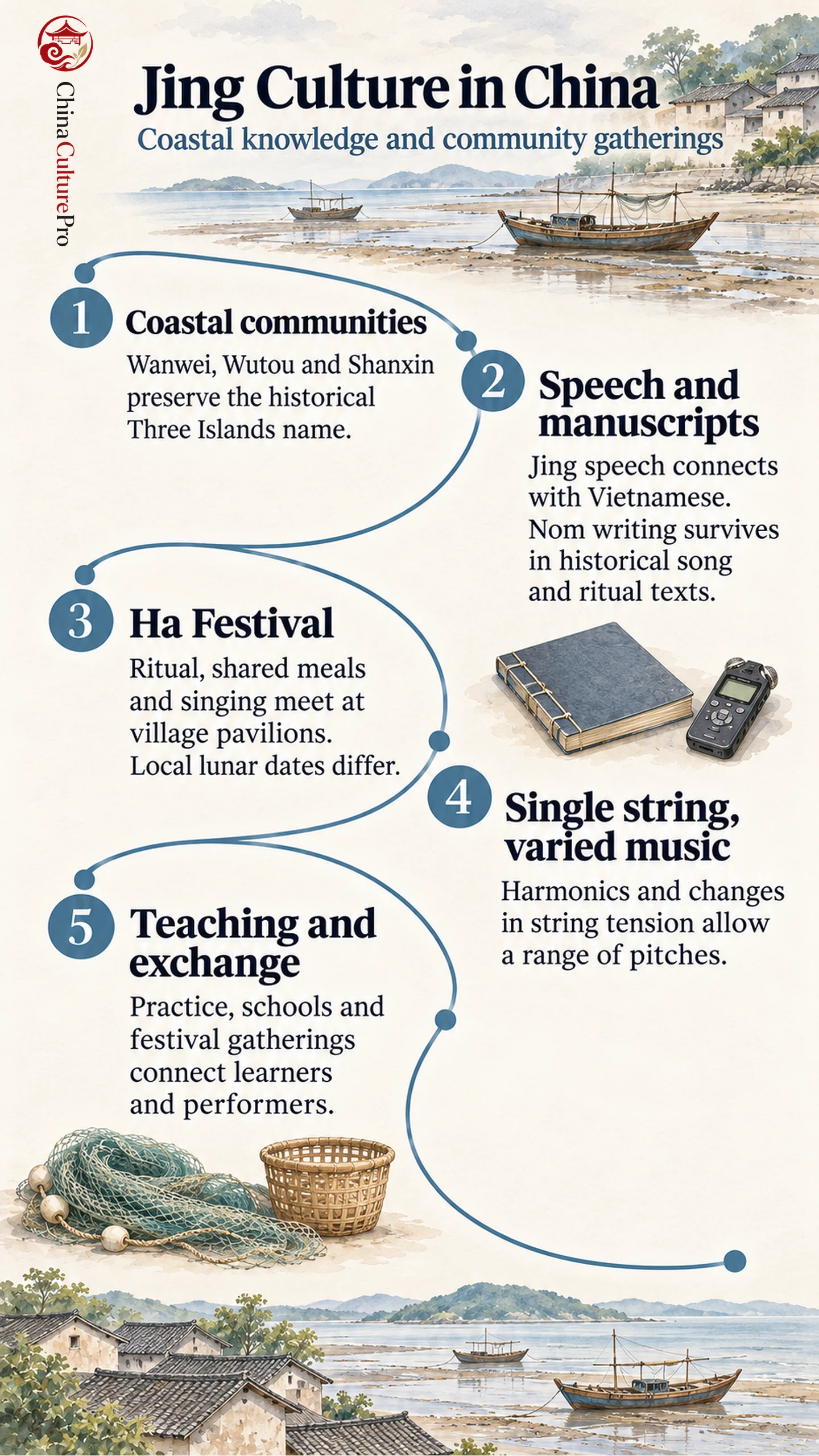
The coastline, village pavilions and single-string music illuminate different parts of Jing culture. Each has a different role: the sea shaped livelihoods, the pavilion hosts community gatherings, and musical skills pass between teachers and learners.
Coastal Communities and the Jing Three Islands
The Jing Three Islands(京族三岛,Jīngzú Sāndǎo)are Wanwei, Wutou and Shanxin around Jiangping in Dongxing, Guangxi. Other Jing communities live in nearby villages and elsewhere in the Fangchenggang area. This is a specific coastal setting within the broader diversity of China’s ethnic groups. [1]
“Islands” preserves an older geography. Embankment construction and land reclamation in the 1960s connected the former islands with the mainland. The familiar collective name continued after those changes, so an island name does not guarantee an offshore settlement today. [2]
Coastal fishing developed alongside cultivation, while border trade and other work later expanded local livelihoods. Connections with Han and Zhuang communities also place Jing life within a wider network of regional exchange. [1][2]
Jing Language and Nom Writing
Jing speech in Guangxi is closely connected with Vietnamese. Language documentation includes a Fangchenggang survey site, but older speaker estimates should not be read as a count of current speakers. Ethnic membership and language proficiency are separate questions. [3]
Nom writing(字喃,zìnán)uses a character-based tradition associated with Vietnamese-language expression. Historical songbooks and ritual texts preserve its use in Jing communities. The characters record language-specific readings and meanings, so reading a manuscript requires more than recognizing its shapes. [1]
This relationship is easiest to understand by separating spoken language, writing system and reading knowledge. A manuscript can preserve a particular song or ritual text without demonstrating that its script was used for every daily task. Contemporary language documentation and older manuscripts therefore answer different questions. [1][3]
Ha Festival: A Community Gathering with Different Dates
Ha Festival(哈节,Hājié), also called the singing festival, brings ritual observance, ancestor remembrance, communal meals and performance together. A Ha pavilion(哈亭,hātíng)provides a focal space for the village’s activities. The festival entered China’s first national intangible heritage list in 2006. [4]
The calendar differs by community. Recorded dates include the tenth day of the sixth lunar month, the tenth day of the eighth lunar month and the fifteenth day of the first lunar month. A report about one village’s celebration is not a universal date for all Jing communities. [4]
Singers and instrumentalists have particular roles in the gatherings. Story material can include legends, philosophical tales and love stories; dance and rhythmic accompaniment add further layers. Origin stories about a visiting song immortal belong to folklore, rather than a verified account of the festival’s first year. [4]
These activities combine religious and social purposes. The shared meal, a song and a ritual action belong to the same gathering but are not interchangeable parts of it.
How the Single-String Duxianqin Makes Music
The duxianqin(独弦琴,dúxiánqín)has one string, yet its technique allows much more than one note. The player plucks with a small implement, uses harmonic positions and manipulates a flexible rod to change string tension. These coordinated actions create changes of pitch, slides and expressive inflections. [5]
Bamboo and wooden instruments have both been documented. Shapes and construction details also changed during the twentieth century. Players can sit or stand, and the instrument may rest on a table, support or the player’s legs. There is no single decorative outline that defines every instrument. [5]
The Jing art, nationally listed in 2011, includes both making and playing. As with other Chinese performing arts, hearing a polished solo gives only a glimpse of the practical learning behind it. [5]
Fishing Knowledge, Food and Homes
Coastal fishing required tools suited to tides and different catches. Traditional fish weirs used stakes and woven barriers to guide fish into retaining spaces as the water receded. This is knowledge of water movement and materials, not simply a picturesque coastal scene. [6]
Rice, seafood, tubers and glutinous-rice foods appear in local food traditions. Salt-fermented fish sauce adds another connection with fermented foods. Fengchuibing(风吹饼,fēngchuībǐng)is a crisp rice-based cake associated with sesame, drying and subsequent toasting. [6]
Housing changed too: accounts describe earlier bamboo-and-timber dwellings, later stone-built tiled houses and modern concrete homes. Those changes help place Lingnan regional culture in lived environments rather than a fixed historical display. [6]
Learning and Exchange Across Generations
A 2019 field-based study describes instrument teaching in schools and training settings, as well as performers returning home for festival gatherings. It also records changes from predominantly seated male performance to presentations involving both women and men, including standing players. Transmission includes new ways of presenting a skill. [7]
A July 22, 2026 celebration in Dongxing brought together Jing residents, young instrument players and representatives from Mong Cai in Vietnam. This is a concrete example of cross-border cultural exchange; it does not mean that the participants shared one nationality or that all local customs were identical. [8]
Learning through repeated practice remains central. The sound is produced through coordinated hands and listening, while festivals provide occasions to perform that knowledge publicly. [7]
FAQs About Jing Culture in China
Does Jing Mean People from Beijing?
No. Here it names an officially recognized ethnic group with major communities in Guangxi. It does not mean residents of China’s capital. [1]
Are the Jing Three Islands Still Separate Islands?
The name is historical. Embankment and reclamation work connected the former islands with the mainland during the 1960s. [2]
Is Ha Festival Always on the Same Day?
No. Recorded celebrations follow different local dates in the lunar calendar. The name describes a shared festival tradition, not one universal date. [4]
Does One String Mean Only One Musical Note?
No. Harmonics and controlled changes in string tension allow different pitches and expressive effects. [5]
Sources
[1] National Ethnic Affairs Commission. Jing overview
[2] National Ethnic Affairs Commission. Changes in Jing communities
[3] Minzu University language center. Jing language documentation
[4] China ICH Network. Jing Ha Festival
[5] China ICH Network. Jing single-string instrument art
[6] National Ethnic Affairs Commission. Jing customs
[7] Qi Jianling. Embodied transmission of Jing heritage
[8] China News Service. China and Vietnam communities at Ha Festival