


Quick Answer: What Does Zhuang Culture Include?
Zhuang(壮族,Zhuàngzú)culture connects regional languages, written traditions, song gatherings, festivals and craft knowledge. Guangxi is a major center, but cultural identity is more specific than residence in a province.
- Communities: Zhuang people live in Guangxi, Yunnan and other areas, often alongside other ethnic communities.
- Language: Spoken varieties coexist with traditional character-based writing and modern Latin-based writing.
- Song: Gatherings provide settings for exchange, entertainment and different kinds of sung expression.
- Festivals: A shared festival name can include different local rituals, foods and social activities.
- Craft: Weaving, stitching and dyeing create different effects and require different skills.
These strands overlap, but neither one festival performance nor one piece of clothing represents every Zhuang community.
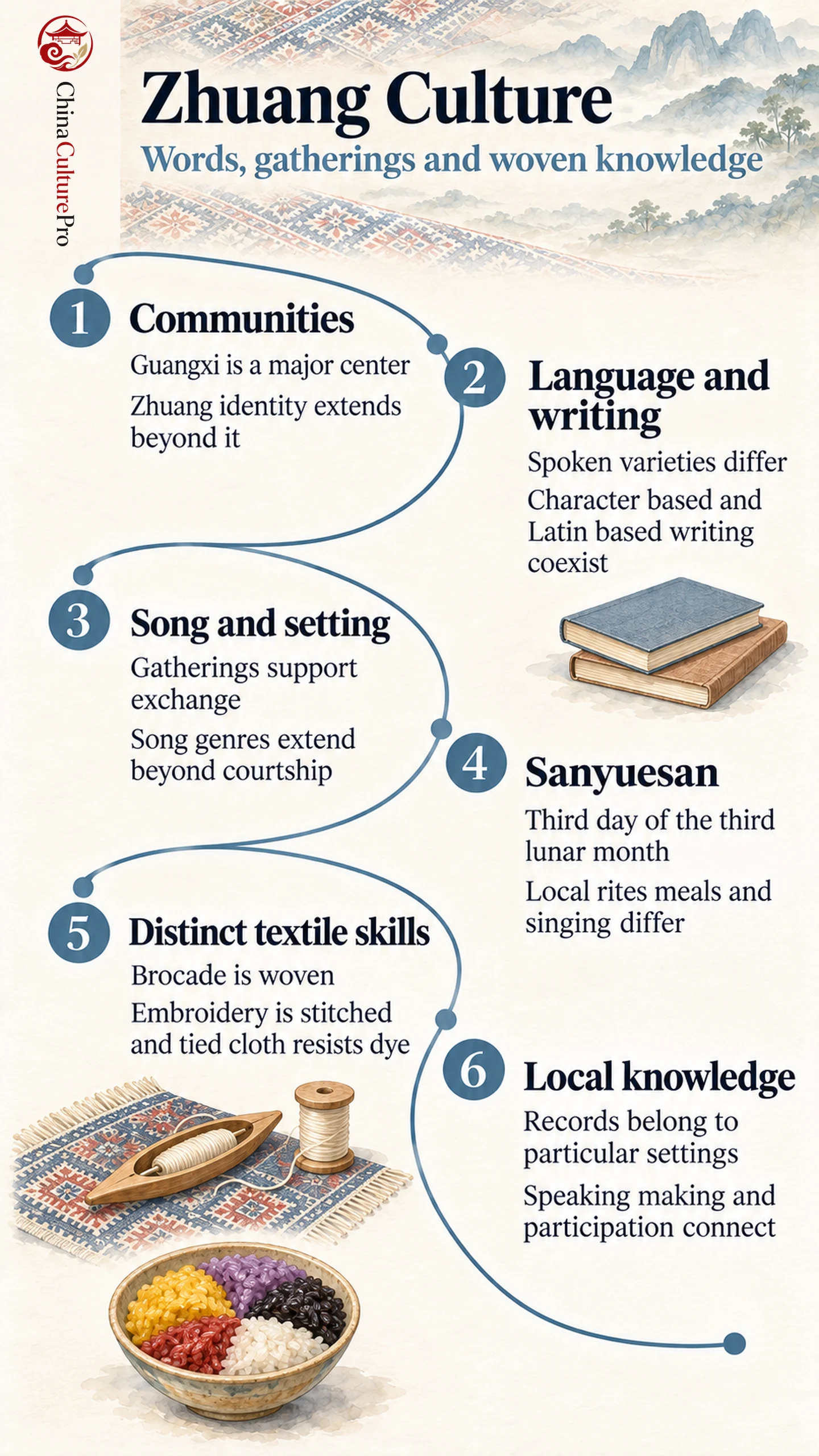
A woven textile, a song exchange and a bowl of colored rice carry different kinds of cultural knowledge. Understanding Zhuang culture means asking where each example comes from, how it is made or performed, and what people do with it. This guide connects those details with their regional settings.
Communities in Guangxi and Beyond
Guangxi is a major center of Zhuang communities, with other important areas including Wenshan in Yunnan and Lianshan in Guangdong. The official overview also describes places where Zhuang people live alongside Han, Yao, Miao, Dong and other communities. [1]
The region and the ethnic category should therefore be distinguished. Not everyone in Guangxi is Zhuang, and Zhuang identity is not confined to Guangxi. The Chinese ethnic groups guide explains why an official category cannot describe all of an individual’s language use, local attachments or daily practices.
Location also helps connect related guides. Wenshan belongs within the wider setting of Yunnan culture, while a specific Zhuang practice there still needs its own community context. Provincial geography and ethnic identity are overlapping frames rather than competing definitions.
Zhuang Languages and Two Writing Traditions
Zhuang languages(壮语,Zhuàngyǔ)include substantial regional variation. Minzu University’s language-resource account distinguishes northern and southern varieties and lists more localized forms documented in Guangxi, Yunnan and neighboring areas. The category does not mean that everyone uses identical speech. [2]
Two writing traditions are especially useful to recognize. Sawndip(方块壮字,fāngkuài Zhuàngzì)is the traditional character-based system. Latin based Zhuang writing(拼音壮文,pīnyīn Zhuàngwén)is a modern alphabetic tradition. The university account records the development and promotion of a Latin-based scheme in the 1950s. [2]
A character-based page and an alphabetic page may therefore both record Zhuang. The appearance of the writing alone does not identify the spoken variety or the writer’s other languages. When comparing texts, language, script and local usage should be considered separately.
Song Gatherings and the Liu Sanjie Tradition
Gexu(歌圩,gēxū)refers to a song-gathering tradition and its associated gathering places. Official custom accounts describe regular assemblies for singing, with the third lunar month’s festival especially prominent. The setting matters: songs gain meaning through exchanges among participants, rather than only through a melody performed on stage. [3]
Liu Sanjie(刘三姐,Liú Sānjiě)is a celebrated figure associated with this singing culture. The national heritage record identifies Yizhou in Guangxi as a representative area for the song tradition bearing her name. It lists genres concerning daily life, work, love, ritual, riddles, stories and creation narratives. [4]
This range helps correct an overly narrow courtship-only description. A love-song exchange is one form within a wider repertoire. The belief that Liu Sanjie spread the songs belongs to folklore; it does not establish a verified individual inventor or a precise date of origin.
The performing arts guide provides a wider framework for distinguishing repertoire, performance format and social occasion. Here, the gathering and the songs are related but have different roles.
Sanyuesan: One Festival Name, Several Local Meanings
Sanyuesan(三月三,sān yuè sān)means the third day of the third lunar month. Its Gregorian date changes from year to year. The name should not be read as a fixed March 3 observance.
A 2020 Guangxi heritage account documents several local emphases. In parts of western Guangxi, activities include visiting ancestral graves, making offerings and sharing meals. Other settings foreground singing and social gatherings. The account explicitly rejects the idea that song exchange is the festival’s only form. [5]
Five colored glutinous rice(五色糯米饭,wǔsè nuòmǐfàn)is one associated food. An official account from western Guangxi describes plant-colored rice and decorated eggs among festival preparations. This is a regional example, rather than a menu every family must reproduce. [8] The food’s grain base is explained further in the sticky rice guide.
Sanyuesan celebrations also involve several ethnic communities. Shared participation does not erase differences in the meanings attached to particular activities. Nor does an ancestral rite, a public concert and a family meal become the same practice merely because they occur around the same festival.
Brocade, Embroidery and Dyeing Are Different Skills
Zhuang brocade(壮锦,Zhuàngjǐn)is a woven textile tradition. A 2017 China National Silk Museum exhibition distinguished it from other forms of fabric decoration. [6]
| Technique | How the pattern is formed |
|---|---|
| Brocade weaving | Patterned threads are incorporated while the cloth is woven. |
| Embroidery | Stitched threads decorate the fabric. |
| Tie-dyeing | Tied areas resist dye, creating contrasting patterns when released. |
The museum describes brocade used for quilt covers, hangings, backpacks and straps, with regional centers including Jingxi, Longzhou, Xincheng and Binyang. These domestic uses broaden the picture beyond festival clothing. [6]
A separate museum catalogue explains a Jingxi loom used for bedcovers with supplementary silk weft. In the catalogue’s Jingxi example, the weaver lifts selected pattern heddles by hand and inserts the supplementary weft into the cloth. This is technical knowledge embodied in equipment and skilled decisions. [7]
A woven motif and a stitched motif may look similar at a distance, yet their structures differ. Identifying the method is more informative than assigning every colorful object the same craft label.
Community Knowledge in Documentation and Daily Use
Documentation provides another setting for cultural knowledge. A May 2024 Guangxi language-resource report describes edited survey materials for Wuming, Du’an and Xincheng Zhuang, alongside work on other regional languages. It also describes recording architecture, utensils, food, ceremonies and oral performance around particular survey sites. [9]
The locality of that work is important. A recording from one community preserves evidence about that setting; it does not become a script for everyone elsewhere. Reading such records alongside cultural geography helps distinguish a widespread association from a specific local form.
Language materials, a loom description and a festival account consequently answer different questions. Together they show how cultural knowledge involves speaking, making, participating and remembering, rather than a checklist of objects detached from their uses.
FAQs About Zhuang Culture
Are All People in Guangxi Zhuang?
No. Guangxi is home to multiple ethnic communities. Zhuang people also live outside Guangxi, including in Yunnan and other areas.
Is Zhuang Written Only with Chinese Characters?
No. Traditional character-based writing and modern Latin-based writing both exist. Script and spoken language are separate aspects of a text.
Is Sanyuesan Always on March 3?
No. The name refers to the third day of the third lunar month. Its date in the Gregorian calendar changes each year.
Are All Zhuang Song Gatherings Courtship Events?
No. Love songs are one part of a broader singing culture. Documented song traditions also include work, daily life, ritual, riddles and storytelling.
Sources
[1] National Ethnic Affairs Commission. Zhuang overview
[2] Minzu University language resource center. Zhuang language use and writing (2024)
[3] National Ethnic Affairs Commission. Zhuang customs
[4] China Intangible Cultural Heritage Network. Liu Sanjie songs
[5] Xu Xiaoming, Guangxi Intangible Cultural Heritage Protection Center. 2020 online Sanyuesan introduction
[6] China National Silk Museum. Brocade and Embroidery Culture of Zhuang Nationality in Guangxi (2017 exhibition)
[7] China National Silk Museum IIDOS. Zhuang Brocade Loom, catalogue page23
[8] National Ethnic Affairs Commission. Zhuang Sanyuesan custom account
[9] Guangxi ethnic affairs authority. Language resource protection measures (31 May2024)