

Quick Answer: What Did Mencius Teach?
Mencius (孟子, Mèngzǐ), also known as Mengzi, was a fourth-century BCE Confucian thinker. His account of human nature (性, xìng) emphasizes innate moral beginnings that need cultivation to become dependable virtues.[1][2]
- Nature: Goodness concerns an endowment and its development, rather than a claim that everyone already behaves well.
- Ethics: Initial responses such as compassion can grow into more consistent judgment and conduct.
- Cultivation: Neglect, harmful conditions and attempts to force development can obstruct growth.
- Politics: Concern for people should shape government, beyond a ruler’s isolated feeling of kindness.
Mencius offers a philosophical account of moral development, not a scientific demonstration that every person responds identically in every situation.
An unexpected feeling of concern is not the same as a dependable way of treating people. Mencius builds his ethics around that gap: how can a moral beginning grow into a character that responds well beyond the first moving encounter?
The Thinker and the Book Called the Mengzi
Mencius lived after Confucius (孔子, Kǒngzǐ), whose teachings he defended and developed. His setting was the Warring States world of competing rulers and rival accounts of how society should be ordered. His precise dates and parts of his early life remain uncertain.[1][2]
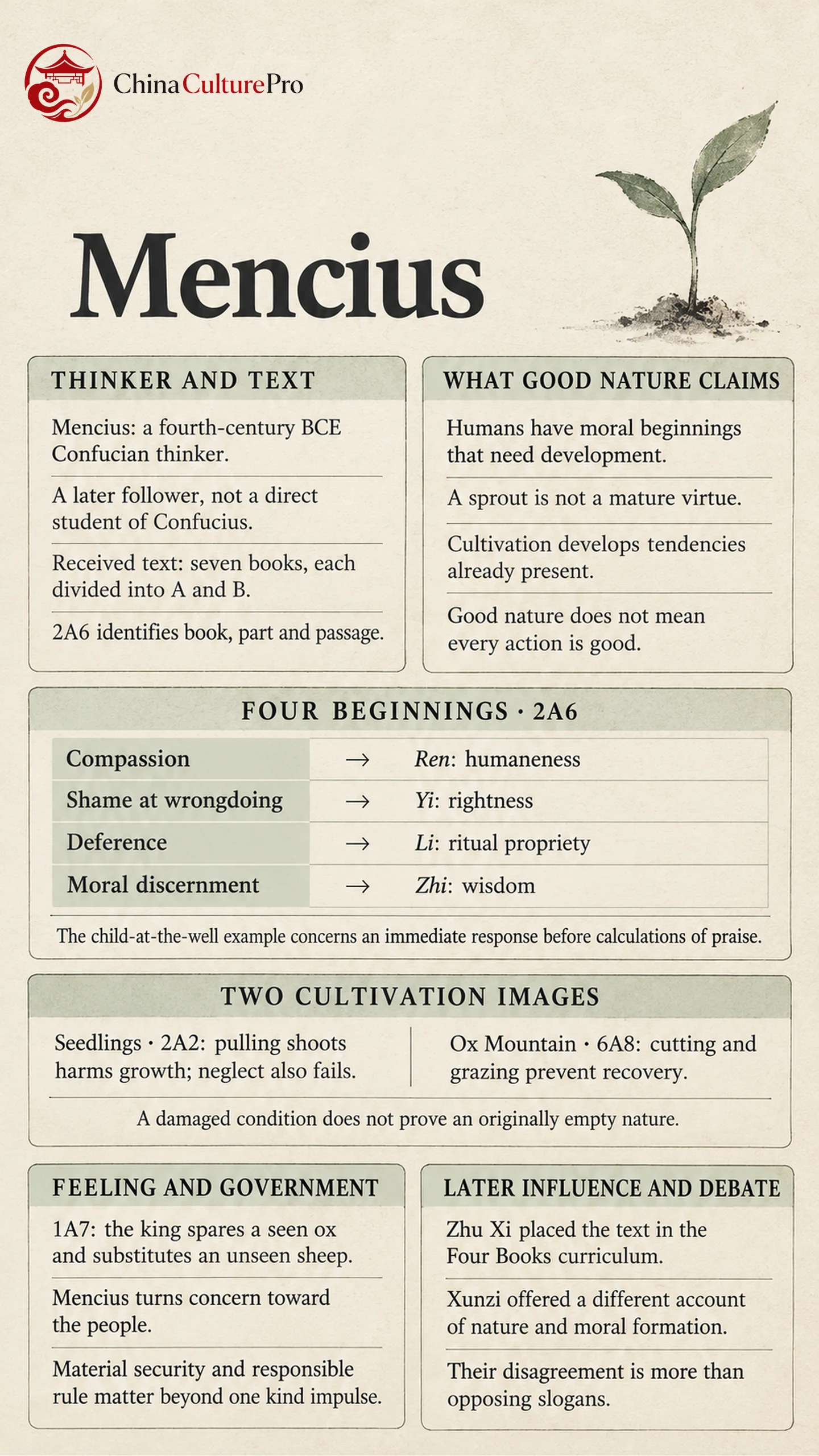
The book bearing his name preserves statements, debates and conversations with disciples and rulers. It should not be treated as a modern treatise demonstrably written in its entirety by one person. The received text has seven books, each divided into A and B parts in common English reference systems: 2A6 identifies Book 2, part A, passage 6.[1]
This format matters because an argument often develops through an exchange. A ruler may begin with a desire for advantage or military success, while Mencius redirects the discussion toward responsibilities and conduct. His place within Confucianism joins ethical cultivation with public order, while his arguments elaborate rather than simply repeat the teaching associated with Confucius.
What the Goodness of Human Nature Claims
The goodness of human nature (性善, xìngshàn) is a claim about the beginnings and proper development of human life. Mencius does not deny that people can act badly. He locates resources for becoming good within ordinary human responses, while acknowledging that they can remain weak, inconsistent or obstructed.[1]
A sprout captures the difference between an initial tendency and its mature form. Having a beginning of compassion is not yet the same as reliably caring for others when doing so is inconvenient. Nor is the argument merely that education can make people good in any way whatsoever. Mencius thinks cultivation develops moral tendencies already present, rather than supplying all moral direction from outside.[1][2]
That makes conduct and conditions part of the explanation. A person’s failures do not automatically show that no moral beginning existed. Yet the account also places a demand on the person: a response must be attended to, extended and expressed in action. Invoking a good nature does not complete that work.
The Four Sprouts and the Child at the Well
The four sprouts (四端, sìduān), also translated as four beginnings, connect initial moral responses with developed virtues. The heart-mind (心, xīn) in this account includes feeling, recognition and judgment, rather than a simple opposition between emotion and reason.[2][3]
In 2A6, Mencius asks readers to imagine unexpectedly seeing a child about to fall into a well. The immediate alarm and concern are not explained as a calculation to win the parents’ favor or gain public praise. The thought experiment directs attention to a moral response that precedes those advantages.[3]
| Beginning | Virtue it can grow into |
|---|---|
| Compassion and concern | ren (仁, rén): humaneness or benevolent concern for others. |
| Shame and aversion at wrongdoing | yi (义, yì): rightness and a sense of what one should not do. |
| Deference and respect | li (礼, lǐ): ritual propriety and fitting respect in conduct. |
| Approval and disapproval of right and wrong | zhi (智, zhì): wisdom in discerning right and wrong. |
The pairings describe growth rather than four isolated compartments. A concrete situation can engage concern, disapproval and judgment together. Repeated practice and appropriate social forms help turn a passing response into a more stable way of acting.[4]
The relationship among ren, li and yi becomes clearer in this developmental setting. Mencius’s question is how a beginning can be enlarged, not how to award oneself a virtue on the strength of one moving experience.
Cultivation Needs Care and the Right Conditions
Two agricultural images explain different obstacles. The second concerns Ox Mountain (牛山, Niúshān), whose damaged appearance becomes an analogy for judging a person’s moral condition.[5]
| Example | What the metaphor shows | A mistaken inference it challenges |
|---|---|---|
| Seedlings — 2A2 | Pulling shoots upward damages the growth that patient cultivation should support. | Faster visible results must mean better development. |
| Ox Mountain — 6A8 | Repeated cutting and grazing explain a barren condition without proving that the mountain never had trees. | What appears absent now could never have been present. |
The farmer’s mistake is not caring about growth, but trying to produce it through an intervention that destroys it. The passage also criticizes giving up the work altogether. Patience therefore differs from neglect.[5]
Ox Mountain puts sustained damage in view. Shoots appear, but repeated cutting and grazing prevent recovery. Mencius uses this to challenge the judgment that a person whose conduct has become degraded must always have lacked a human moral endowment. Present condition and original nature are not the same kind of explanation.[5]
These images guide interpretation of moral cultivation. They do not supply a fixed program whose steps guarantee virtue. The reader must still ask what practices, habits and circumstances support humane conduct in the situation being discussed.
From Compassion to Humane Government
Humane government (仁政, rénzhèng) extends moral concern into the responsibilities of rule. In 1A7, King Xuan of Qi (齐宣王, Qí Xuānwáng) has spared an ox whose distress he witnessed, ordering a sheep to be substituted for the sacrifice. Mencius explains that the king saw the ox but not the sheep. The episode shows how compassion can respond selectively to what is immediately present.[5]
The argument then turns from that encounter to the king’s responsibility for his people. If he can respond to the animal he sees, why should his subjects remain unprotected? The argument asks for extension into conduct and policy, not a judgment that one merciful impulse has already made him a good ruler.[1][5]
Material security also belongs to the political argument. It is unreasonable for rulers to deprive people of stable means of living and then punish the resulting failures as though the rulers’ choices had no part in them. Ethical education and people’s ability to sustain ordinary life are connected concerns.[5]
The demands on authority can be pointed. In 1B6, a king readily condemns people who neglect entrusted responsibilities, then evades the question when it turns to disorder in his own state. Other passages give ministers duties of remonstrance, with different responses depending on their role. The institutional setting remains one of kings, ministers and ranked responsibilities.[6]
Later Influence and the Debate About Nature
Mencius’s later authority was shaped by interpretation. Zhu Xi (朱熹, Zhū Xī) made the text part of the Four Books (四书, Sìshū) curriculum, giving it a major place in the educational inheritance of Neo-Confucianism. Later readers developed the account through new questions about nature, mind and cultivation.[1][2]
It was also contested within the Confucian tradition. Xunzi (荀子, Xúnzǐ) gave deliberate learning and ritual a different role in the formation of goodness. Their disagreement involves different ways of identifying what counts as nature, as well as substantive differences about moral development.[1]
A wider comparison of Chinese views of human nature examines that debate. Reading Mencius alongside the Analects and the broader Chinese philosophy tradition shows how a shared concern with becoming better people generated distinct arguments.
FAQs About Mencius
Did Mencius think people are born morally perfect?
No. He describes innate but undeveloped moral beginnings. Mature virtue requires cultivation, extension and supportive conditions; the claim that nature is good does not mean that every action is already good.[1]
What are the four sprouts?
They are beginnings of humaneness, rightness, ritual propriety and wisdom, expressed through responses such as compassion, shame at wrongdoing, deference and discernment. They need development into stable virtues.[3][4]
Was Mencius a direct student of Confucius?
No. He lived after Confucius’s lifetime and understood himself as a follower of that tradition. Claims about the precise personal chain of teaching require more caution than the fact of his philosophical allegiance.[1][2]
How did Mencius differ from Xunzi?
Mencius describes moral growth as developing good beginnings. Xunzi gives deliberate learning and ritual a different formative role. They also differ over what should be counted as human nature, so their disagreement cannot be captured fully by two opposing labels.[1]
Sources
[1] Stanford Encyclopedia of Philosophy. Mencius
[2] Internet Encyclopedia of Philosophy. Mencius
[3] Columbia University, Asia for Educators. Selections from the Mencius: On Human Nature
[4] Russell Kirkland. Mencius’ Explanation of the Virtues
[5] Robert Eno. Mencius: An Online Teaching Translation
[6] Columbia University, Asia for Educators. Selections from the Mencius: On the Duty of Ministers to Reprove a Ruler