

Quick Answer: What Is Mohism?
Mohism (墨家, Mòjiā) was an influential ancient Chinese movement associated with Mozi (墨子, Mòzǐ) and his followers. It sought dependable moral standards and policies that would benefit people beyond a ruler’s or family’s immediate circle.[1]
- Best-known idea: Impartial care (兼爱, jiān’ài) includes other people’s welfare rather than treating outsiders as expendable.
- Political concern: Capable leadership and shared standards were intended to reduce disorder.
- Public spending: Elaborate displays and funerals were challenged when they consumed resources needed for ordinary livelihoods.
- War: Aggression was condemned, while Mohists could assist communities defending themselves.
- Wider project: Religious authority, argumentation and later technical inquiry all belong to the tradition.
This is a historical movement with internal differences. Its concern for everyone’s welfare should not be equated with modern democratic institutions or a demand for identical personal relationships.[2]
It is easy to condemn a theft and celebrate a conquest without noticing the contradiction. Mohist arguments ask readers to apply a standard consistently, including when their own family, ruler or state stands to gain.
Mozi, the Movement and the Book
Mozi probably flourished in the later fifth century BCE, although his dates and personal background are uncertain. Accounts of craft expertise and military engineering inform interpretations of his social origins; they do not supply a secure modern biography.[1]
The movement developed organized groups of followers, rather than remaining the private reflections of one teacher. In the wider history of Chinese philosophy, it became a major participant in arguments about governing, moral authority and social welfare.[2]
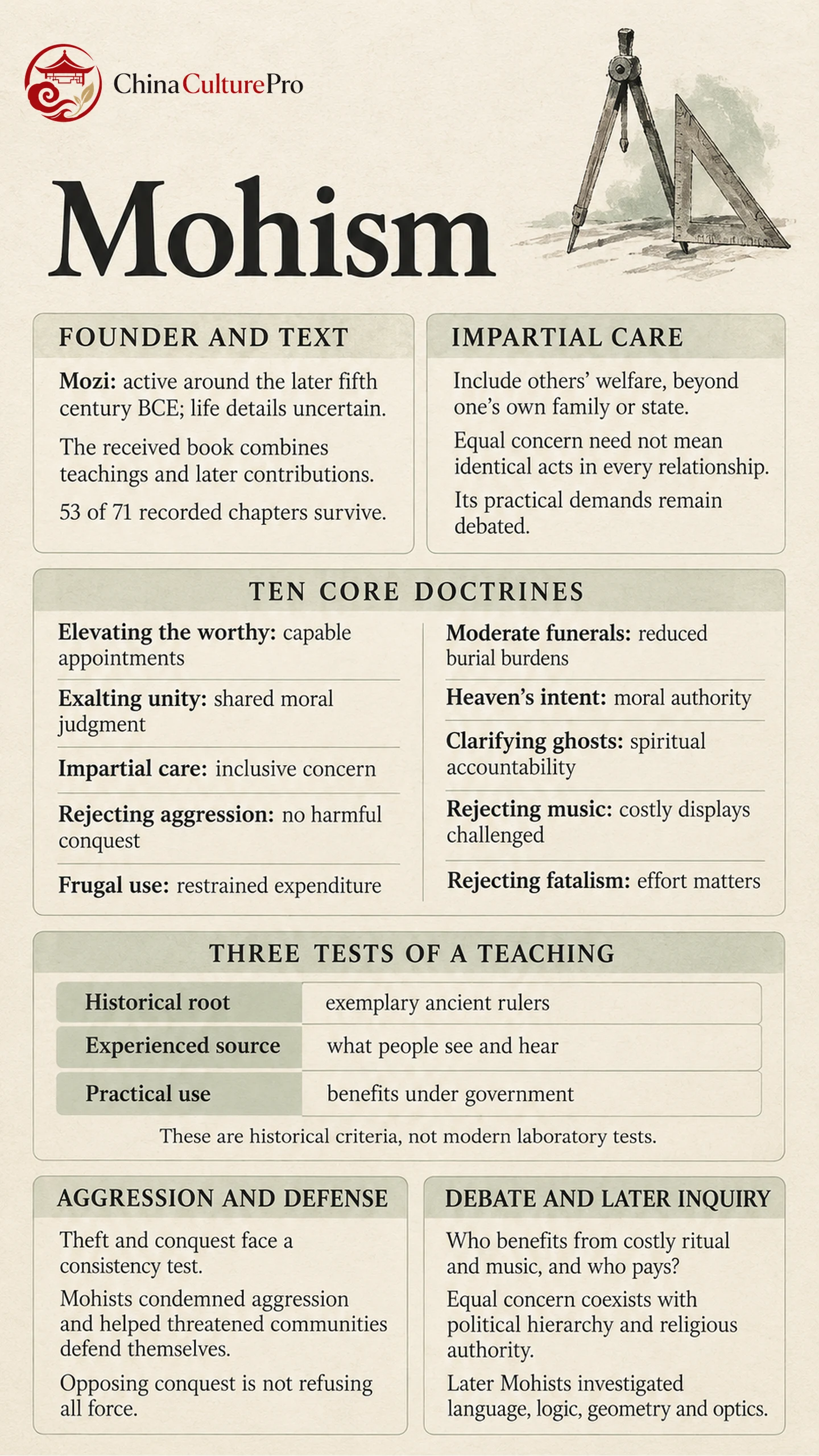
The book called Mozi is a compilation. It contains teachings, dialogues and later material rather than a work securely written throughout by its namesake. Of the 71 traditionally recorded chapters, 53 survive.[3]
Several core teachings appear in parallel essays. Parallel versions need not be separate essays by the historical founder. They show a tradition explaining and defending its position in different forms. When reading an argument, ask which passage is speaking before attributing every detail to a single historical Mozi.
What Impartial Care Asks of People
The central challenge is partiality that permits harm: protecting one’s own household by injuring another, or advancing one state by attacking its neighbors. A passage in the Mozi connects inclusive mutual concern with order, and mutual hostility with disorder.[4]
“Universal love” is a familiar translation, but “impartial care” or “inclusive care” better alerts an English reader to questions of welfare and conduct. Interpreters distinguish an ideal of equal concern from the practical acts through which people fulfill different responsibilities.[1]
Consider an explanatory example. Caring for one’s own elderly parent does not require personally providing every older stranger with the same daily assistance. Yet another family’s need should not become morally irrelevant simply because it is not one’s own. The distinction is between a particular responsibility and permission to disregard everyone outside it.
How demanding the doctrine ultimately is remains open to interpretation. It is safer to explain that problem than to reduce the teaching either to ordinary friendliness or to one identical emotion directed toward every human being.
The Ten Core Doctrines at a Glance
The ten teachings join ethics to political organization and religious authority. Heaven (天, Tiān) supplies a moral authority within this system; it is not merely a decorative word for public opinion.[2]
| Doctrine | Central proposal |
|---|---|
| Elevating the worthy (尚贤, shàngxián) | Appoint capable people rather than relatives and favorites. |
| Exalting unity (尚同, shàngtóng) | Unify moral judgments through a hierarchy of leaders. |
| Impartial care (兼爱, jiān’ài) | Include other people’s welfare in moral concern. |
| Rejecting aggression (非攻, fēigōng) | Condemn harmful wars of conquest. |
| Frugal use (节用, jiéyòng) | Restrain expenditure that burdens livelihoods. |
| Moderation in funerals (节葬, jiézàng) | Oppose costly burials and prolonged mourning. |
| Heaven’s intent (天志, tiānzhì) | Take Heaven’s impartial concern as a moral authority. |
| Clarifying ghosts (明鬼, míngguǐ) | Affirm spirits that reward good and punish wrongdoing. |
| Rejecting music (非乐, fēiyuè) | Oppose costly musical displays as a use of public resources. |
| Rejecting fatalism (非命, fēimìng) | Defend the importance of effort against fixed-destiny claims. |
Read the table as a connected program. Equal moral concern does not remove the hierarchy of rulers and subjects. Opposition to fatalism coexists with belief in Heaven and spirits. Treating the tradition as wholly secular loses part of the explanation of why its standards were considered authoritative.
Benefit, Models and Three Tests of a Teaching
The Mohists sought models or standards, fa (法, fǎ), that could guide judgments. Their craft analogies make the ambition concrete: a measuring instrument provides something against which a disputed shape can be checked.[1]
One formulation evaluates a teaching through three criteria:[1]
| Criterion | What it asks readers to examine |
|---|---|
| Historical root | Look to the conduct of exemplary ancient rulers. |
| Experienced source | Examine what people have seen and heard. |
| Practical use | Consider benefits when a teaching guides government. |
These criteria place pressure on unsupported assertions, but they are not a modern laboratory method. Reports of experience and stories about exemplary antiquity still require evaluation. A claimed benefit also leaves room for disagreement about who benefits and what counts as a good outcome.
To assess an argument, identify its standard, inspect the example and ask whether the conclusion follows. Admiring the use of reasons need not mean accepting every premise or application.
Why Aggression and Defense Are Different
A Mohist argument compares attacking a state with familiar wrongs such as theft and killing. If harming another person is blameworthy on a small scale, why should vastly greater harm become admirable when a ruler commands it?[2]
The argument targets inconsistency, while other passages emphasize war’s losses in lives, labor and resources. Mohist opposition to aggression could also take practical form: followers offered expertise to smaller communities facing attack.[2]
It is therefore misleading to describe the movement as refusing all military resistance. The text also recognizes some wars against tyrants as justified. Those ancient judgments depend partly on religious claims and exemplary rulers, rather than a fully specified modern legal test.[2]
Keep three questions apart: is an attack condemned, is a threatened community entitled to resist, and what justifies a claim that force serves a wider good? Calling every use of force “war” does not answer all three.
Debates, Later Mohists and Historical Influence
Confucian thinkers disputed Mohist judgments about relationships, ritual and cultural life. Mencius challenged impartial care. A further disagreement concerns whether elaborate ritual and music meet emotional and communal needs, or impose unjustifiable costs on the people supporting them.[2]
The spending question should remain visible. An argument against an expensive court performance is not answered simply by observing that music is enjoyable. Conversely, showing that a practice costs resources does not establish that it has no value. The dispute concerns both the good being pursued and its distribution.
Later Mohists developed technical discussions of language, knowledge and reasoning, alongside investigations involving geometry, mechanics and optics. The Mohist Canons are associated with these later anonymous writers, not a single scientific treatise personally composed by Mozi.[5]
The organized movement eventually declined, while ideas and argumentative practices entered a wider intellectual world. Its use of standards also invites comparison with Chinese Legalism, although shared vocabulary does not make the two programs identical.[1][2]
FAQs About Mohism
Does impartial care mean identical feelings for everyone?
It concerns including everyone’s welfare in moral consideration. How equal concern relates to personal attachment and differentiated responsibilities is an interpretive issue; it should not be summarized as one identical feeling or the same action toward every person.
Were the Mohists pacifists?
They opposed aggressive warfare and could help defend threatened communities. Because defense and some justified campaigns were accepted, an unqualified refusal of all force is an inaccurate summary.
Was Mohism a secular philosophy?
No. Its arguments about benefit and standards coexist with Heaven’s moral authority and beliefs about spirits rewarding and punishing conduct.
How did Mohism differ from Confucianism?
Mohists challenged partiality and assessed practices by their contribution to welfare. Confucian thinkers gave different accounts of graded relationships, ritual and cultivation. Both traditions discussed good government, but disagreed over how to justify and organize it.
Sources
[1] Chris Fraser. Mohism
[2] Hui-chieh Loy. Mozi
[3] Russell Kirkland. The Book of Mozi
[4] Key Concepts in Chinese Thought and Culture. Jian ai
[5] Chris Fraser. Mohist Canons