

Quick Answer: What Are the Analects?
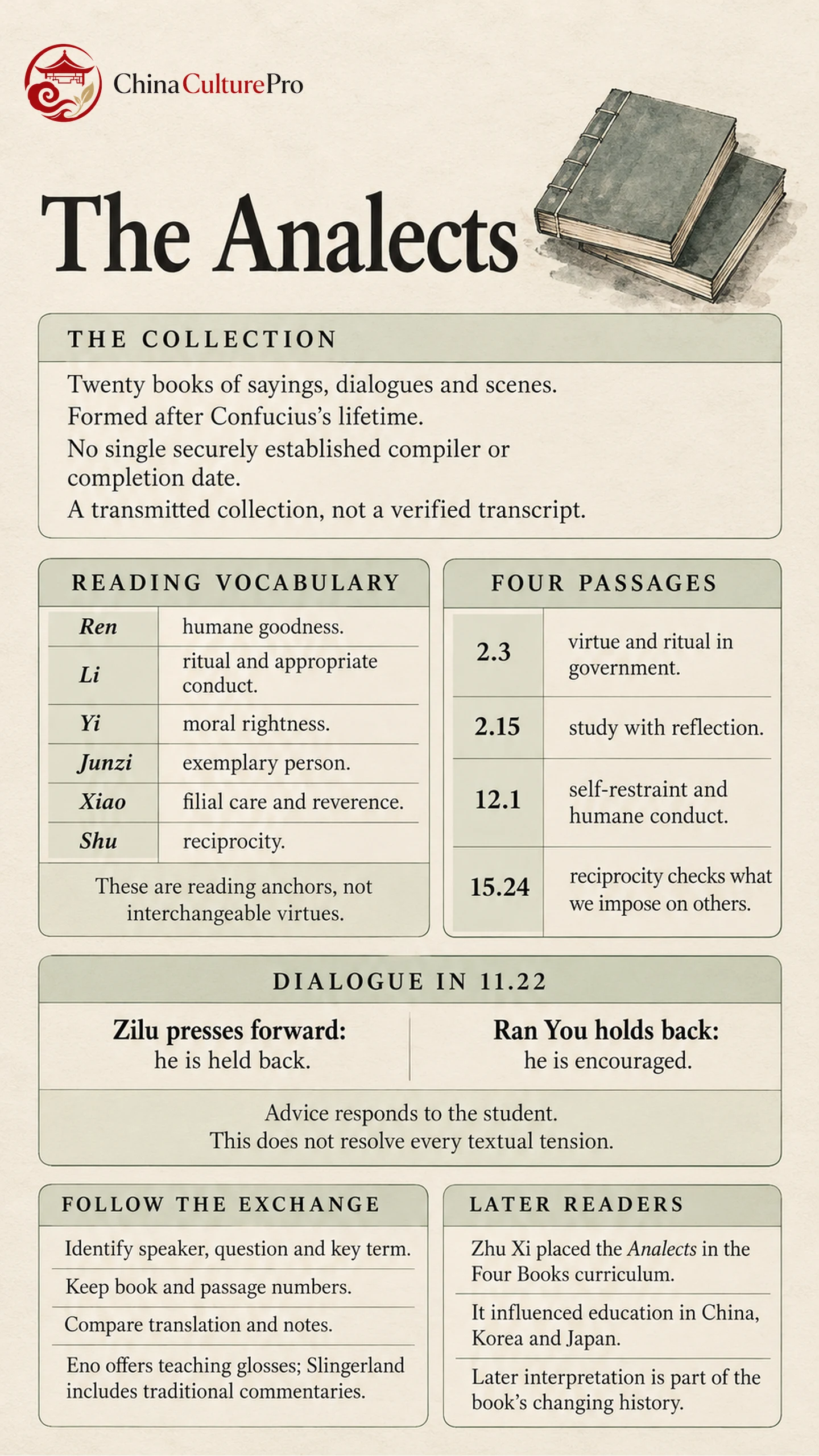
The Analects (论语, Lúnyǔ) is a collection of sayings, dialogues and scenes associated with Confucius (孔子, Kǒngzǐ) and his followers. Its received form contains twenty books. It was compiled after his lifetime, rather than written by him as a finished treatise.[1][2]
- Form: Brief exchanges stand beside observations of conduct and statements by disciples.
- Concerns: Learning, humane relationships, ritual, character and government recur throughout.
- References: A number such as 12.1 usually means Book 12, passage 1.
- Reading: Identify the speaker, question and setting before turning an answer into a general rule.
The surviving collection is evidence for teachings and their transmission; it is not a verified transcript of every conversation it depicts.
A short answer in the Analects may be a correction aimed at one student, a judgment about a ruler or a reflection on learning. Keeping those settings in view makes the book more intelligible than treating every sentence as a rule addressed to everyone.
A Collection Formed After Confucius
The received Analects brings together material with different voices and forms. Some passages begin with a statement attributed to the Master. Others record a question, describe his behavior or present followers speaking in their own right. Twenty “books” organize this material, but they do not function like twenty chapters in a continuous modern argument.[2]
Its formation remains debated. Traditional accounts emphasize disciples collecting teachings, while modern scholarship investigates compilation, rearrangement and changing representations of Confucius over time. There is no securely established single compiler or completion date that resolves all these questions. Shortness does not establish that a saying is early, and a vivid scene is not automatically an eyewitness report.[1]
This uncertainty does not remove the book’s philosophical value. It changes the precision of a claim. “The Analects presents Confucius as saying” identifies the evidence available; “we know exactly what he said on this occasion” claims more. A biographical guide to Confucius addresses the historical teacher, while this guide follows the form and arguments of the transmitted collection.
Six Concepts That Connect the Teachings
These terms are useful reading anchors. They are not six interchangeable virtues or a complete list of the book’s vocabulary.[2]
- ren (仁, rén): humaneness or humane goodness in relationships.
- li (礼, lǐ): ritual forms, appropriate conduct and ceremonial practice.
- yi (义, yì): rightness or what is morally fitting.
- junzi (君子, jūnzǐ): an exemplary person whose character makes the title deserved.
- xiao (孝, xiào): filial care and reverence toward parents.
- shu (恕, shù): reciprocity that checks how one treats other people.
Their relationships matter as much as the English labels. A respectful outward form can be questioned when humane feeling is absent. In 3.3, the text asks what ritual and music amount to in a person lacking humaneness. In 2.7, caring for parents is distinguished from merely supplying material support: reverence makes a difference.[3]
The ren, li and yi guide develops the distinctions in more detail. The junzi ideal concerns the person formed through such judgments and practices. Neither is well understood by replacing every Chinese term with one English word and assuming the explanation is complete.
Four Passages to Read Closely
A small set of passages shows how the collection moves between personal learning, relationships and public life. These thematic examples do not require a particular reading order. The summaries are paraphrases, not quotations from one preferred translation.[3][4]
| Passage | Central point | A question to bring to it |
|---|---|---|
| 2.3: Government | Virtue and ritual are contrasted with reliance on punishments to shape conduct. | Is avoiding punishment the same as learning to act well? |
| 2.15: Learning | Study and reflection need one another. | What goes wrong when either is missing? |
| 12.1: Humane conduct | Self-restraint and returning to ritual are connected with humaneness. | How do cultivated habits affect what someone sees, says and does? |
| 15.24: Reciprocity | One’s own unwillingness to suffer something becomes a check on imposing it on others. | What does another person’s position require me to reconsider? |
The political passage prevents a purely private reading of the book. It links personal example and shared practices with government, rather than treating ethics as a matter of internal feelings alone. The argument is expressed within an ancient hierarchical society; it should not be silently relabeled as a modern theory of equal citizenship.[3]
The reciprocity passage is similarly more useful when treated as a demand on conduct than as a decorative slogan. It asks for a check on what one imposes on others. That concern sits within the wider questions of Confucianism, including obligations shaped by relationships and roles.[4]
Why the Same Question Can Receive Different Answers
Analects 11.22 offers a clear example. Zilu (子路, Zǐlù) asks whether to act immediately on what he has heard. Confucius tells him to consider his father and elder brothers. Ran You (冉有, Rǎn Yǒu) asks the same question and is encouraged to act. Another disciple notices the difference and asks why.[2][5]
The explanation concerns the students: one tends to press forward too readily, while the other holds back. Different advice is meant to correct different tendencies. If each answer were separated from the exchange, a reader could mistakenly extract either “always act immediately” or “never act without consulting others” as the universal teaching.[5]
This example shows why identifying the interlocutor matters. It does not explain away every tension in the collection. Some differences may involve textual history, divergent perspectives or interpretive uncertainty. Context is something to investigate, not a convenient answer to be supplied whenever passages seem difficult.
The dialogue also makes teaching an activity. A student’s question does not merely prompt a definition; it brings an existing habit into view. Reading the exchange as a whole preserves both the advice and the reason it takes that form.
Choosing a Translation and Following a Passage
For a first reading, choose an edition that identifies speakers, numbers passages and explains important terms. Look at how the notes relate to the text. A note may supply historical information, report a traditional commentary or defend the translator’s preferred reading; those are different contributions.
Robert Eno’s openly available teaching translation supplies glosses and commentary. Edward Slingerland’s complete translation includes selections from traditional commentaries, a glossary and other study material. These are verifiable features, rather than grounds for declaring one edition the final or neutral interpretation.[2][6]
Begin with a small cluster, such as the learning passages in Book 2. Write down the question you think each passage addresses. When an answer puzzles you, check who is speaking and compare a second translation before deciding that the text is obvious or inconsistent. With 11.22, preserve the whole exchange instead of copying only the answer addressed to one student.
Keep the book and passage number with any quotation. Numbering can vary between editions, so a few opening words help confirm the match. Also distinguish the translated text from a commentator’s explanation. This practice makes a later comparison possible without requiring fluency in Classical Chinese.
The Analects in Later Education and Debate
The book’s authority developed through transmission and interpretation. In the Song period, Zhu Xi (朱熹, Zhū Xī) integrated its study into a curriculum centered on the Four Books (四书, Sìshū). That approach influenced education and interpretation in China, Korea and Japan.[1]
Its place in Neo-Confucianism is therefore part of its history, not proof that every later explanation was present in the earliest material. For an earlier development of this inheritance, turn to Mencius (孟子, Mèngzǐ), an early successor to Confucius. His arguments precede Zhu Xi’s curriculum by many centuries.
Reading this reception alongside the transmitted exchanges situates the collection within Chinese philosophy. It preserves both the questions in the passages and the history of readers who found new questions to ask of them.
FAQs About the Analects
Did Confucius write the Analects?
He did not write it as the received book. It is a posthumously formed collection associated with his sayings, conduct and followers. Its exact formation and the authority of particular materials remain subjects of scholarship.[1]
Why are there different answers to the same question?
Sometimes the dialogue explicitly gives a reason: 11.22 tailors advice to different students’ tendencies. That example does not settle every apparent inconsistency, which may require attention to context, translation or textual history.[2][5]
What does a reference such as Analects 12.1 mean?
It usually means Book 12, passage 1. Keep opening words as well as the number when comparing editions, since passage divisions can differ.
Which English edition is useful for a first reading?
An edition with clear passage numbers, speaker identification and explanatory notes is useful. Eno’s teaching translation and Slingerland’s edition offer different forms of commentary support; compare a sample passage to see how each explains its choices.[2][6]
Sources
[1] Mark Csikszentmihalyi. Confucius
[2] Robert Eno. The Analects of Confucius: A Teaching Translation
[3] James Legge, translator. The Analects, Part 1
[4] James Legge, translator. The Analects, Section 3
[5] James Legge, translator. The Analects, Section 2
[6] Edward Slingerland. Analects of Confucius: With Selections from Traditional Commentaries