


Quick Answer: Who Was Sun Tzu?
Sun Tzu (孙子, Sūnzǐ), also written Sunzi, is the traditional Chinese strategist associated with The Art of War (孙子兵法, Sūnzǐ Bīngfǎ). His historical identity and relationship to the surviving book remain debated. The text and its influence are much better documented than a precise account of the author’s life.[1][3]
- The name: Sun Tzu means Master Sun; it is an honorific rather than a full personal name.
- The biography: The traditional life story places him in ancient China around 500 BCE.
- The book: The received core text has thirteen chapters.
- The evidence: Early manuscripts help establish textual history while leaving important biographical questions open.
Read the traditional biography, the manuscript evidence and later interpretations as related kinds of evidence with different limits.
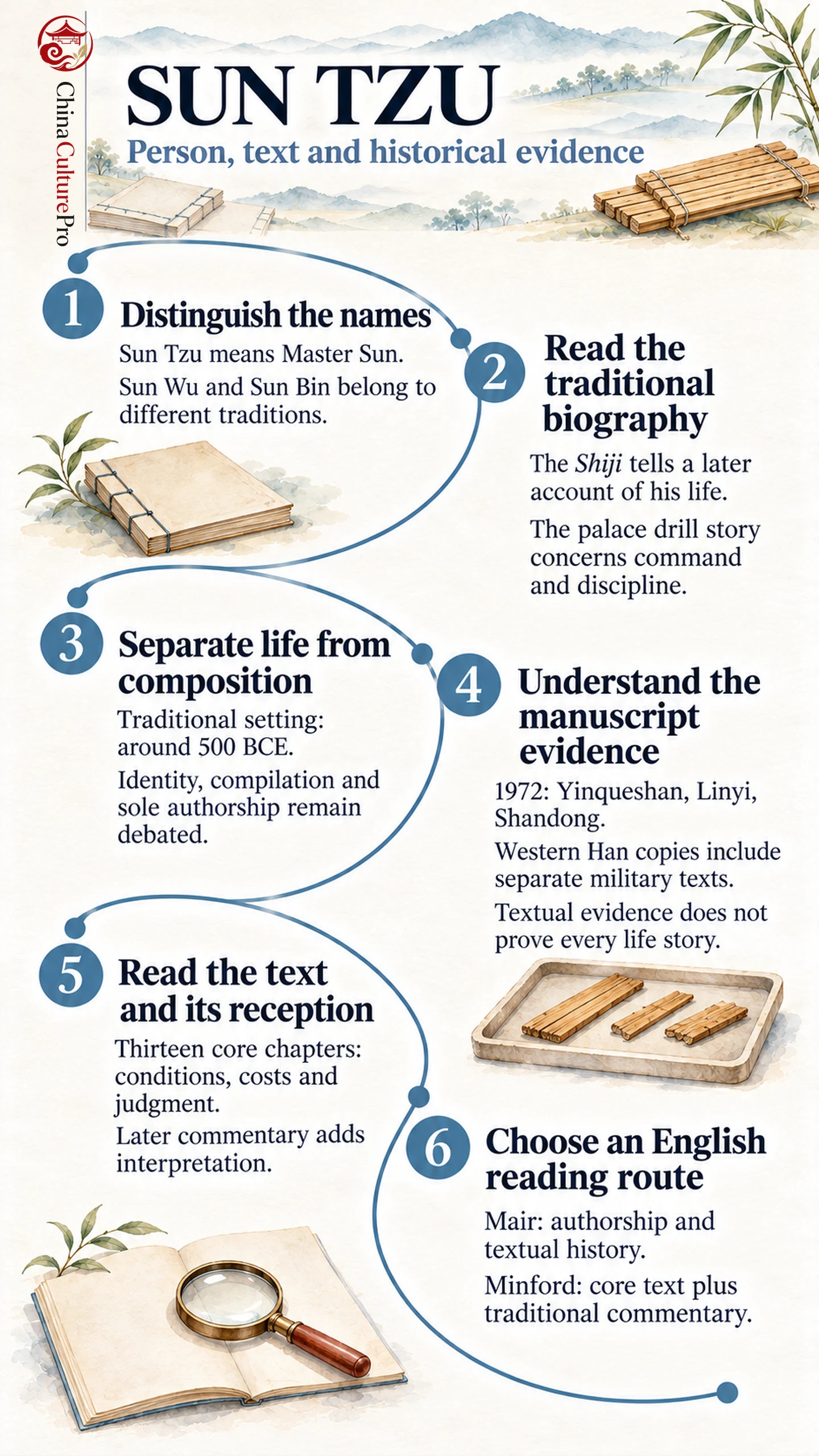
A short quotation attributed to Sun Tzu can make him seem easier to know than he is. The name stands at the meeting point of an influential military text, an ancient biographical tradition and centuries of commentary. Following those strands separately makes both the historical questions and the book more interesting.
This page introduces the person and the tradition. The dedicated Art of War guide explores the book’s text and themes in greater detail, while the Chinese literature overview places it among other kinds of writing.
Sun Tzu, Sunzi and Sun Wu: Names and Context
Sun Tzu and Sunzi are different English spellings of the same honorific. The traditional personal name is Sun Wu (孙武, Sūn Wǔ), as given in the Records of the Grand Historian, or Shiji (史记, Shǐjì). A second name, Sun Bin (孙膑, Sūn Bìn), belongs to a later military figure and a different textual tradition.[2][10]
| Name | Meaning in this discussion |
|---|---|
| Sun Tzu | An honorific meaning Master Sun, used here for the traditional strategist. |
| Sun Wu | A personal name given to that strategist in the Shiji biography. |
| Sun Bin | A later military figure associated with a different military text. |
The traditional setting is the late Spring and Autumn period (春秋, Chūnqiū). It places Sun Wu in the service of the state of Wu (吴, Wú), around 500 BCE. This is the setting of the life story, rather than a securely dated birth certificate or a settled date for every part of the book.[1]
The wider Zhou context helps explain why military expertise mattered. Rival states competed for power, and rulers sought advisers able to explain government, warfare and survival. The book belongs within that world of political competition, even when the exact identity behind its name remains uncertain.[3]
What the Shiji Says About His Life
The central traditional account appears in chapter 65 of the Shiji, written by Sima Qian (司马迁, Sīmǎ Qiān) during the Han dynasty (汉, Hàn). It presents Sun Wu as a native of Qi who brought his military writing to King Helü (阖闾, Hélǘ) of Wu. The king is represented as already having read thirteen chapters.[2]
The famous palace episode follows. Asked to demonstrate his methods, Sun Wu organizes 180 women into two companies, with two favored women of the king as their leaders. After repeated failures to follow commands, he has the two leaders executed despite the king’s objection. The remaining women then perform the drill as ordered.[2]
Within the narrative, the episode tests command, discipline and the relationship between a ruler and an appointed general. Its force depends on the disturbing contrast between the king’s private wishes and the general’s claimed authority. Retelling it as a cheerful lesson in workplace management loses much of that context.
The account is a major source for the traditional image of Sun Wu. It was written centuries after the period in which the story is set, however, and should be introduced as an account transmitted in a historical work rather than an eyewitness report. The Shiji introduction explains why a work of historical writing also requires attention to narrative purpose and source distance.
Why His Dates and Authorship Remain Debated
Three questions are often folded into one: whether a historical Sun Wu existed, when the surviving text took shape and whether one person wrote it all. Evidence relevant to one question may leave the others unresolved.
The Warring States period (战国, Zhànguó) is important to the textual debate. Scholars have argued that the book’s language, military setting and development as a treatise point toward composition or compilation later than the traditional life story. That makes the date of the author-figure different from the possible formation dates of the text.[1]
One specific interpretation is Victor Mair’s account of the work coalescing over roughly seventy-five years, from the middle of the fourth century to the first quarter of the third century BCE. Mair also argues against the existence of the traditionally described Sun Wu. These are identifiable scholarly conclusions, not a reason to present every biographical detail as definitively settled in the opposite direction.[4]
A careful introduction can therefore give the traditional setting around 500 BCE while identifying later textual-formation arguments. Exact birth and death dates require stronger evidence than the familiar shape of a biography. A precise-looking date on a modern chart does not by itself supply that evidence.
For reading purposes, uncertainty does not make the work unusable. It changes the question from what one securely documented man intended in a particular year to how a military text developed, circulated and came to be read under the name Master Sun.
What the Yinqueshan Manuscripts Establish
In 1972, bamboo manuscripts were discovered in Western Han tombs at Yinqueshan (银雀山, Yínquèshān), in Linyi, Shandong. The finds included material corresponding to the Sunzi and a separate military text associated with Sun Bin. The Han dynasty guide supplies the larger historical frame for this material evidence.[5][6][10]
This distinction matters because the existence of two textual traditions cannot be reduced to two English spellings of one author’s name. The ancient biographical tradition also distinguishes Sun Wu and the later Sun Bin. Manuscripts provide a different kind of evidence from that narrative account.[2][10]
| Evidence | What it helps establish | What it does not establish by itself |
|---|---|---|
| A manuscript in a dated burial context | A copy of that text existed by the time of burial. | The exact date of its first composition. |
| Separate Sunzi and Sun Bin material | Two distinguishable military-text traditions were present. | Every genealogical or biographical claim made about their associated figures. |
| Surviving passages with variant readings | An early witness can be compared with received versions. | A complete author-written original with no gaps or later editorial decisions. |
The bamboo witness is fragmentary. Representing the thirteen-chapter tradition does not mean that every word of all thirteen chapters survives intact. Textual scholarship compares surviving passages with later versions and records where the witnesses differ. When two editions disagree, check whether a note identifies a manuscript variant, a later transmitted wording or the editor’s reconstruction.[7]
The discovery is therefore central to the history of the book. A claim that it independently verifies the palace episode, or supplies exact birth and death years, asks the material to answer a different question from the one the surviving text can directly support.
The Art of War’s Ideas and Later Commentators
The thirteen core chapters address warfare as a serious matter of state. A first reading can follow a few connected concerns rather than immediately turn short statements into general rules for every part of life.[8]
| Textual location | A concern to follow |
|---|---|
| Chapter 1 | Assess the situation before acting; planning depends on conditions and comparison. |
| Chapter 2 | Consider what prolonged campaigning consumes and how its burdens affect the state. |
| Chapter 3 | Ask how objectives may be achieved without costly battle, alongside the importance of understanding the parties involved. |
| Chapter 12 | Notice the warning against a ruler or commander initiating action from anger. |
The familiar ideal of subduing an opponent without battle belongs within this military discussion. It does not make the text a rejection of all warfare, and it is not a promise that every conflict can be resolved without costs. Read it beside the book’s attention to danger, expenditure and judgment.[8]
Later commentary is part of the work’s cultural life. Cao Cao (曹操, Cáo Cāo) is one important commentator in the received tradition. His notes are later than the early manuscript witness; a commentator’s explanation should not silently become the original author’s own sentence. The Cao Cao profile offers a separate route into that historical figure.[7]
The work is also discussed within Chinese intellectual history and has attracted modern military and business readers. Such later uses belong to its reception history. An application in a modern boardroom is an interpretation made in a new setting, and its usefulness needs to be considered in that setting.[3]
Reading Sun Tzu in English
Choose an edition that makes its textual and interpretive choices visible. The following two routes serve somewhat different interests.
| Edition | A useful reason to choose it |
|---|---|
| Victor Mair, The Art of War: Sun Zi’s Military Methods | The Columbia edition examines authorship, historical formation and manuscript evidence, with philological annotation. The listed paperback appeared in 2009.[4] |
| John Minford, The Art of War, annotated Penguin Classics edition | The 2003 paperback, ISBN 9780140439199, presents the core text first and then again with running commentary from traditional Chinese interpreters.[9] |
The subtitle Military Methods and the more familiar Art of War identify English approaches to the same text. Before comparing editions, note the translator, passage reference and whether commentary is included. A short version bearing a famous translator’s name may have different supporting material from that translator’s annotated edition.
For close reading, identify the core passage before following its notes. Ask whether a detail comes from the received wording, a manuscript variant, a traditional commentator or a modern editor’s argument. The Chinese classic books guide explains these edition choices more broadly.
The Chinese characters and pinyin introductions can also help with names that differ across English books. You can read the work in translation while retaining enough of those references to recognize when two editions are discussing the same passage.
FAQs About Sun Tzu
Are Sun Tzu’s birth and death dates known?
They are not securely established. The traditional life story places him around 500 BCE, while the formation of the surviving book is a separate historical question.
Is Sun Tzu the same person as Sun Bin?
They are distinguished in the ancient biographical tradition and associated with separate military texts. The similar honorific and shared surname can cause confusion.
Did the 1972 discovery prove the palace story?
No. The manuscripts provide evidence for early texts and their transmission; they do not independently document that episode as an event.
Which English edition includes traditional commentary?
Minford’s annotated Penguin Classics edition presents the core text and a second presentation with running traditional commentary. Check the specific edition’s description rather than relying only on the translator’s name.
Sources
[1] Stephen Morillo, Wiley encyclopedia entry. Sun Zi (Sun Tzu) (ca. fourth century BCE)
[2] Sima Qian, Chinese primary text via Wikisource. Shiji, chapter 65: Biographies of Sunzi and Wu Qi
[3] Columbia University, Asia for Educators. Selections from the Sunzi (Art of War)
[4] Columbia University Press. The Art of War: Sun Zi’s Military Methods
[5] National Museum of China. Yinqueshan Art of War bamboo slips
[6] Robin D. S. Yates, Early China. The Yin-Yang Texts from Yinqueshan
[7] Kidder Smith, Bowdoin College. Sun Tzu: The Art of War, textual overview
[8] Sunzi, Chinese primary text via Wikisource. Sunzi Bingfa
[9] Penguin Random House. The Art of War, John Minford annotated edition
[10] Roger T. Ames, Routledge Encyclopedia of Philosophy. Sunzi