

Quick Answer: What Was the Warring States Period?
The Warring States period (战国时期, Zhànguó Shíqī) was an age of rival kingdoms in ancient China that ended in 221 BCE, when Qin (秦, Qín) defeated its last major rival. A common date range is about 475–221 BCE. Some histories begin earlier or later depending on which political change they use as the dividing point.[1][2][3][4]
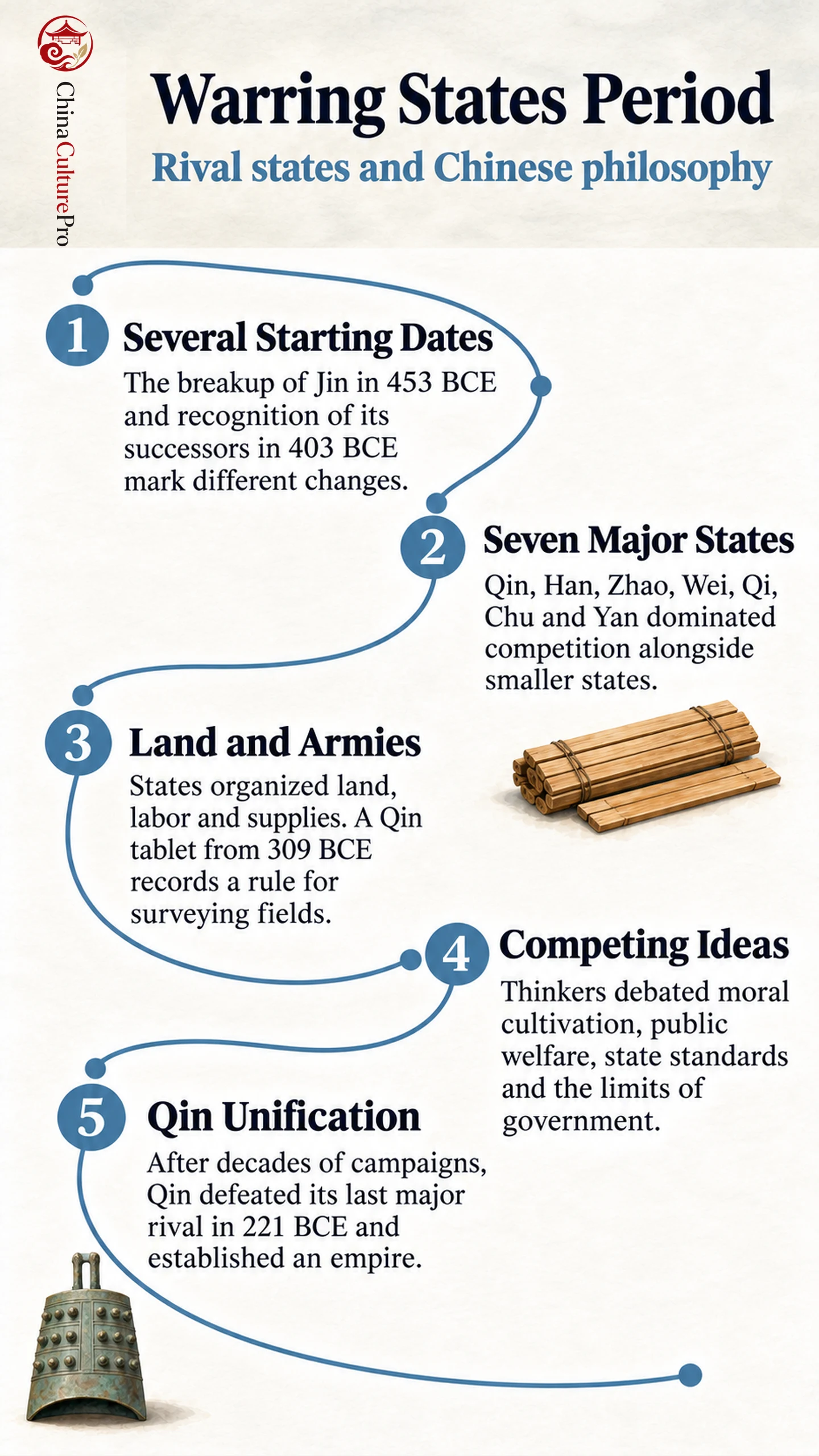
- Dates: The collapse of one major state and recognition of its successors supply two possible milestones, in 453 and 403 BCE.[3][4]
- Rival states: Seven powers came to dominate the competition, alongside smaller states.[3][4]
- Political ideas: Thinkers debated moral cultivation, public welfare and systems for strengthening the state.[8][11][12][13]
The period ended with Qin unification. The Zhou royal line had already ended.[3]
An excavated land regulation shows what a Warring States government wanted officials to measure. A set of bronze bells shows how two courts maintained a relationship. Both records help explain what states did between battles.[5][6][10]
Why the Warring States Period Has Several Starting Dates
The preceding Spring and Autumn period (春秋时期, Chūnqiū Shíqī) also saw warfare and alliances. The change from one era to the other took place over decades. Some historians place the transition around 481 BCE, while others use 476 or 475 BCE as a conventional boundary.[1][2][3]
Two later milestones focus on the breakup of Jin (晋, Jìn). In 453 BCE, the houses that would rule Han (韩, Hán), Zhao (赵, Zhào) and Wei (魏, Wèi) defeated a rival lineage and effectively split control. In 403 BCE, their rulers received formal recognition from the Zhou king. The earlier date marks a shift in who exercised power. The later date marks a change in acknowledged political rank.[3][4]
Many events in the period took place while a king of the Zhou dynasty remained on the throne. Regional courts controlled much of the land and military power. The Warring States continued after the Zhou royal line ended in 256 BCE, so the chronology of the kingdoms extends beyond the chronology of the royal house.[1][3]
The Seven Major States and Their Rivals
Qi (齐, Qí), Chu (楚, Chǔ) and Yan (燕, Yān) were long-established powers. Together with Qin and the three successor states of Jin, they form the usual group of seven. The table gives approximate centers of power, since campaigns and alliances changed the extent of each state.[1][3][4]
| State | Political or geographic context |
|---|---|
| Qin | Western power with its early core in the Wei River basin |
| Han | Successor to Jin with territories in the Central Plains |
| Zhao | Northern successor to Jin and a major military rival of Qin |
| Wei | Successor to Jin and an influential early Warring States power |
| Qi | Eastern power centered around Linzi |
| Chu | Southern power with extensive lands in the Yangtze region |
| Yan | Northeastern power on the edge of the northern plains |
The relative strength of those kingdoms changed. Wei’s armies expanded in several directions in the late fifth century BCE, partly through cooperation with Han and Zhao. As their interests diverged, the three successor states fought each other. The settlement of 403 recognized the new rulers. Their alliance depended on how their interests lined up in later campaigns.[3][4]
Accounts of such alliances survive partly in the Stratagems of the Warring States (战国策, Zhànguó Cè), a later compilation of speeches and anecdotes. A speech can show the arguments a strategist might use to persuade a court. Historians check its description of events against other records, because the speech was preserved for its persuasive force as well as its setting.[3]
Smaller states had their own courts and maintained ties with larger neighbors. The tomb of Marquis Yi of Zeng (曾侯乙, Zēng Hóu Yǐ), for example, held a set of 65 bronze bells. An inscription identifies a bell given in 433 BCE by the ruler of Chu for the ancestral temple of the marquis. A large court could express a political relationship through a ritual object, while the burial preserves evidence of the smaller court’s own wealth and musical culture.[5][6]
How Rival States Mobilized People and Resources
The spread of iron metallurgy, greater agricultural output and wider use of coinage changed what governments could draw on. To sustain military competition, rulers sought more regular control over land, households and supplies. Administrative reforms made officials responsible for recording people and material as well as raising armies.[1][3][7]
Shang Yang (商鞅, Shāng Yāng) is associated with reforms in Qin that encouraged farming and rewarded military service. The received Book of Lord Shang (商君书, Shāngjūn Shū) describes ways to direct labor toward cultivation and war. Its chapters were assembled over time, so the book gives evidence for a developing approach to statecraft rather than a complete report of what one reformer accomplished.[8][9]
Qin expanded into the Sichuan Basin in 316 BCE by conquering Ba (巴, Bā) and Shu (蜀, Shǔ). The campaign required routes through mountainous country. Control of the basin later gave Qin access to more agricultural and mineral resources. The conquest broadened the territory in which Qin could apply its administrative practices.[3]
A wooden tablet dated to 309 BCE and excavated at Qingchuan (青川, Qīngchuān) records a Qin regulation concerning land surveying. The find shows officials addressing how fields should be measured in an area under Qin control before imperial unification. The tablet is evidence that a field regulation circulated far from Qin’s original core. Surveying land gave a government a way to keep track of what was cultivated and who owed obligations. The find documents a written rule in a specific setting. The extent and consistency of enforcement remain separate questions.[10]
How Philosophers Argued About Order
Some rulers sponsored scholars whose views and training differed. The Jixia (稷下, Jìxià) community in Qi offers one example. Patronage provided a setting for writers and teachers to develop and contest arguments. It also connected their work to courts looking for advice on government and social order.[17]
Mencius (孟子, Mèngzǐ) asked readers to imagine seeing a child about to fall into a well. He treated the spontaneous concern a person might feel as evidence of an ability to develop compassion, including in government. Xunzi (荀子, Xúnzǐ) argued that people need instruction and ritual to shape their conduct. Both gave cultivation a role, but differed over what people bring to it. That disagreement runs through Chinese debates about human nature.[11][12]
The movement known as Mohism (墨家, Mòjiā) asked whether conduct benefited people across society. Mohist arguments opposed aggressive warfare and questioned expenditures on elaborate funerals and court music. Courtly artifacts show the resources patrons could devote to ritual. Mohist texts ask whether those resources should be spent that way.[5][13]
Texts associated with Chinese Legalism include work attributed to Han Fei (韩非, Hán Fēi). They consider ways a ruler can judge officials’ performance and limit the influence of personal favoritism. The Zhuangzi (庄子, Zhuāngzǐ) takes up different concerns, questioning fixed social judgments and the desire to impose one way of living. The period’s intellectual history includes critiques of governing ambitions as well as proposals for more effective government.[8][14]
How Qin Won and What Unification Changed
Qin’s victory over Zhao at the Battle of Changping (长平之战, Chángpíng Zhī Zhàn) in 260 BCE was a major shift in the balance of power. Qin still failed to capture Zhao’s capital, Handan, in the next campaign. Capturing a fortified capital demanded a different operation from defeating an army in the field. Zhao continued as a major state for several more decades.[3][15][16]
Qin eventually took advantage of a strong administrative system, accumulated military resources and divisions among its rivals. The final campaigns began with Han in 230 BCE. Qin took the Zhao capital in 228 and Wei in 225. It defeated Chu in 223, suppressed the remaining resistance in Zhao and Yan in 222, and took Qi in 221. The overlap in these dates reflects a series of campaigns rather than six states falling on one day. King Zheng of Qin (秦王政, Qín Wáng Zhèng) then took the title by which he is now known, Qin Shi Huang (秦始皇, Qín Shǐ Huáng).[3][4]
The Qin dynasty extended institutions that its officials had developed during the competition among states. Unification changed the scale on which those practices operated. Local administration and written regulations became tools for governing a much larger imperial territory under one court.[1][3][4][10]
FAQs About the Warring States Period
What were the seven Warring States?
The seven major states were Qin, Han, Zhao, Wei, Qi, Chu and Yan. The list refers to the leading powers over the course of the era. Smaller states such as Zeng also had their own rulers and institutions.[3][4][5][6]
Was the Warring States period part of the Zhou dynasty?
Much of the era overlaps with the Eastern Zhou. The Zhou royal line ended in 256 BCE, and the rival states continued fighting until Qin unification in 221 BCE.[1][3]
Did Qin win solely because of Shang Yang’s reforms?
Shang Yang’s reforms helped Qin mobilize agricultural and military resources. Its eventual victory also depended on later campaigns, diplomacy and the inability of rival states to sustain a common response. Many decades separated the reforms from unification.[3][4][8]
Sources
[1] Cambridge University Press. Warring States Political History
[2] Cambridge University Press. China From Zhou to Tang
[3] Oxford University Press. The Warring States Period: Historical Background
[4] Routledge. Ancient China: The Warring States Period
[5] Hubei Provincial Museum. Chime-Bells From the Tomb of Marquis Yi of Zeng
[6] Hubei Provincial Museum. Introduction to Tomb of Marquis Yi of Zeng
[7] Cambridge University Press. Economic Philosophy and Political Economy
[8] Stanford Encyclopedia of Philosophy. Legalism in Chinese Philosophy
[9] Early China. Dating a Pre-Imperial Text: The Book of Lord Shang
[10] Études Chinoises. Qingchuan Wooden Tablet and Qin Land Regulation
[11] Columbia University Asia for Educators. Selections From the Mencius: On Human Nature
[12] Columbia University Asia for Educators. Selections From the Xunzi: Human Nature
[13] Stanford Encyclopedia of Philosophy. Mohism
[14] Stanford Encyclopedia of Philosophy. Social and Political Thought in Chinese Philosophy
[15] Oxford University Press. The Duel: The States of Zhao and Qin, 307–260 BCE
[16] University of Technology Sydney. A Study on the Battle of Changping
[17] Early China. The Qi Model of Intellectual Participation and the Jixia Patronage Community