

Quick Answer: What Is the Thousand Character Classic?
The Thousand Character Classic (千字文, Qiān Zì Wén) is a Chinese primer composed of 1,000 characters arranged in 250 four-character phrases. Its rhymed text joins an ordered account of the world with moral instruction and cultural references, and it became an important vehicle for calligraphy.[1]
- For reading: Follow connected phrases rather than treating it as a random vocabulary list.
- For education history: It introduces both written characters and a particular cultural view of knowledge and conduct.
- For calligraphy: The same text appears in different scripts and physical forms, including ink writing and rubbings.
- For counting: The traditional nonrepeating design needs qualification when comparing variants and simplified-character copies.
Four characters make a textual unit. A calligrapher’s physical line or column can contain a different number.
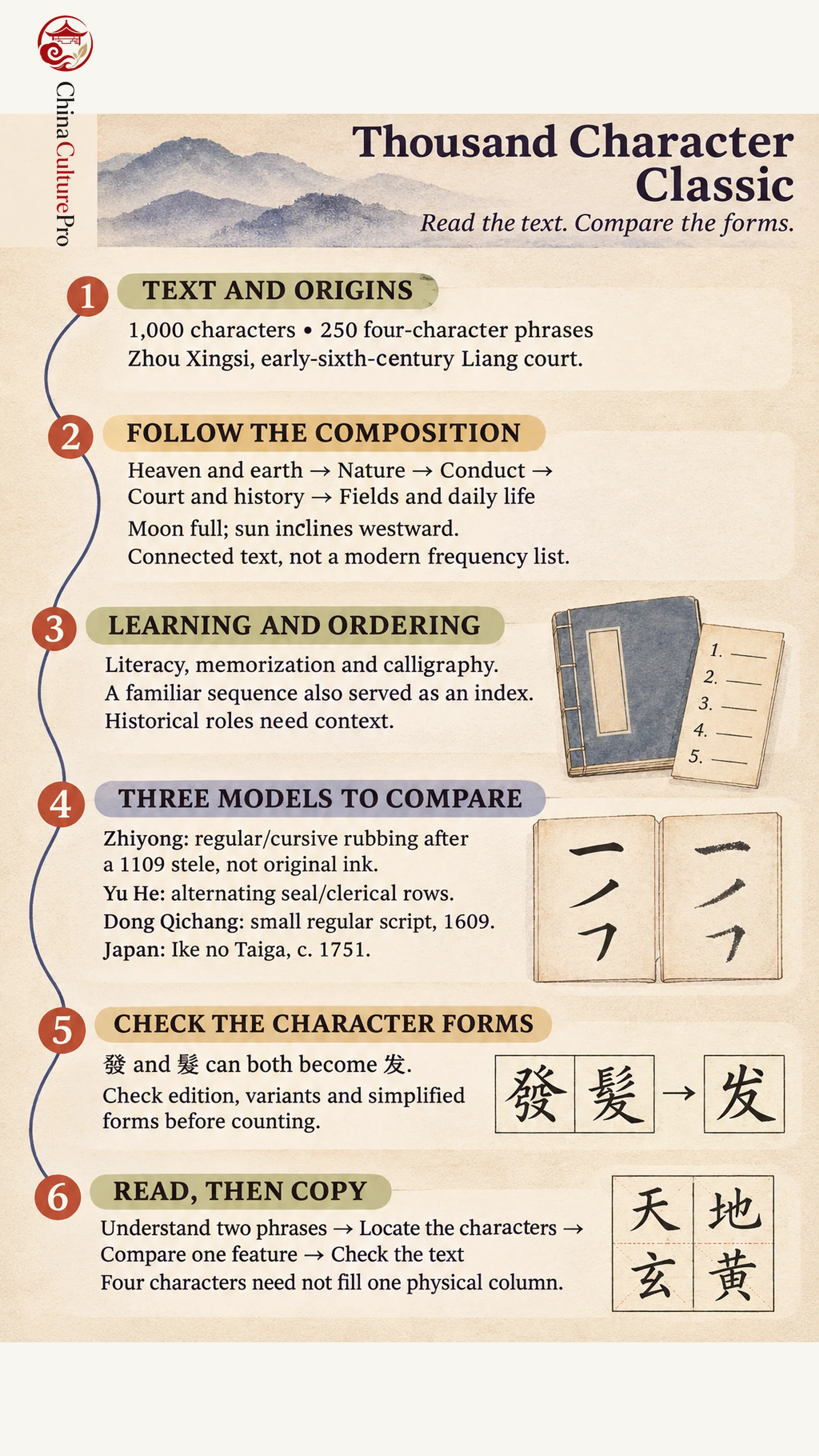
The Thousand Character Classic connects three activities that modern readers often separate: recognizing characters, learning cultural references and studying how writing looks. A four-character phrase can still require an explanation of an unfamiliar name or historical idea.
You can approach it through the text or through a work of Chinese calligraphy. In either case, distinguish the composition from the particular edition or artwork in front of you. A later calligrapher did not thereby become the author of the underlying literary text.
Origins: Zhou Xingsi and the Liang Court
The composition is associated with Zhou Xingsi (周兴嗣, Zhōu Xīngsì), a court writer of the Liang dynasty (梁朝, Liáng Cháo), in the early sixth century. The Liang Shu (梁书, Liáng Shū), or History of the Liang, lists a commissioned work arranging a thousand characters from the writing of Wang Xizhi (王羲之, Wáng Xīzhī) among Zhou’s literary assignments. This early biographical record anchors the connection between the court, the composition and a calligraphic model.[2]
That connection does not make Wang Xizhi the author of the connected primer. A model’s character forms and the writer’s arrangement of those characters into a text are different contributions.
A later anecdotal account says Zhou completed the arrangement in a single night and that his hair turned white. Read it as a story about extraordinary literary effort. A later commentary transmitting the anecdote is evidence that the story circulated, rather than confirmation that the dramatic event happened as described.[4]
Reading the Opening and Following the Text
The opening moves from heaven and earth to celestial patterns. These are the traditional-character phrases, with Mandarin readings and brief English glosses. The glosses explain the imagery without trying to preserve the original rhyme.[3][4]
| Original phrase | Mandarin reading | Brief meaning |
|---|---|---|
| 天地玄黃 | Tiān dì xuán huáng | Heaven is dark; earth is yellow |
| 宇宙洪荒 | Yǔ zhòu hóng huāng | The universe is vast and primordial |
| 日月盈昃 | Rì yuè yíng zè | The moon becomes full; the sun inclines westward |
| 辰宿列張 | Chén xiù liè zhāng | Stars and celestial groupings spread across the sky |
The third gloss unpacks the pairing: fullness describes the moon, while the westward inclination describes the sun. Reading each character as an isolated modern word would miss that compressed relationship.[4]
The text then ranges through seasonal change and natural things, accounts of early rulers, personal conduct, family and court life, historical examples, agriculture and daily activities. It is arranged prose in rhythmic units, not a dictionary sorted by frequency or an uninterrupted narrative with one plot.[3]
Some names and phrases assume stories outside the text. An annotated edition can explain those literary allusions. Its moral and social expectations also belong to a historical setting: recognizing the lesson a passage promotes is different from accepting it as a rule for present-day life.
Literacy and Traditional Education
The primer’s structure offered repeated opportunities to recognize and write a broad range of characters. It was used in elementary learning across East Asia, with memorization as part of its educational life. Its cultural information and language instruction worked together rather than forming two separate books.[5]
It later shared the familiar elementary-learning setting of the Three Character Classic (三字经, Sān Zì Jīng) and the Hundred Family Surnames (百家姓, Bǎi Jiā Xìng). The three were grouped by the opening characters of their titles.[6] The Three Character Classic uses three-character phrases; the surname primer has a different organizing purpose. Their shared place in education traditions does not make their content interchangeable.
A well-known sequence could also serve as an ordering system. The collector Xiang Yuanbian (项元汴, Xiàng Yuánbiàn) used characters from the text to organize his collection. In one documented case, 門, “gate,” marks position 626 in the sequence. This is an indexing use of the primer, separate from the word’s meaning in its original passage.[11]
For today’s language learner, historical usefulness should not be confused with a modern proficiency syllabus. The work includes literary vocabulary and references that require explanation. A guide to classical versus modern Chinese helps set realistic expectations.
Three Calligraphy Examples to Compare
A familiar text lets a viewer compare how different writers shape the same characters. The following examples offer three distinct viewing tasks. The labels identify the model or object type, not three stages through which every learner must progress.
| Example | What the work presents | A useful comparison |
|---|---|---|
| Zhiyong (智永, Zhìyǒng): paired-script rubbing | A rubbing associated with a stele engraved in 1109 after an earlier model, pairing regular script (楷书, kǎishū) with cursive script (草书, cǎoshū) | Match corresponding characters across the paired forms. The museum object is a rubbing, not Zhiyong’s original ink manuscript.[7] |
| Yu He (俞和, Yú Hé): seal-and-clerical album | Alternating rows of seal script (篆书, zhuànshū) and clerical script (隶书, lìshū) for the same passage | Compare the elongated forms with the broader forms, while checking that you have located the same character.[8] |
| Dong Qichang (董其昌, Dǒng Qíchāng): small regular script | An album completed in 1609, identified as an example of small regular script | Notice spacing, proportions and the balance between individual characters. Small writing can still contain substantial stylistic variation.[9] |
The distinction between original ink writing, a carved model and a rubbing matters whenever you use calligraphy copybooks. The object’s record can explain what survives and how it relates to an earlier writer. A famous name on the model does not establish that the object is that person’s untouched manuscript.
The text also has a history beyond China. A Japanese cursive work by Ike no Taiga, dated approximately 1751, shows another artist working with the same composition. The work extends the comparison into the text’s Japanese reception.[1]
Does Every Character Appear Only Once?
The traditional design uses a thousand nonrepeating characters. That is a feature of the composition’s received form, not a promise that every modern file, transcription or script conversion will produce exactly 1,000 different digital characters.[1]
A concrete example is 發 and 髮: both can become 发 in simplified writing. Two historically different written forms then look the same. An apparent repetition may therefore arise from conversion rather than from a writer accidentally inserting an extra character.[10] Comparing simplified and traditional forms is part of checking the count.
Textual variants add another complication. Copies can use different forms such as 潔 and 絜, both encountered in the transmitted text. Notes that list alternative readings are editorial additions, not extra words to include in the 1,000-character body.[3]
When testing a copy, first separate the main text from headings, punctuation, signatures, seals and commentary. Then identify its edition and character forms. The number of symbols in an artwork’s entire image is not a measure of the length of the underlying composition.
How to Read or Copy a Short Passage
Choose a passage short enough to understand and compare. A beginner’s calligraphy guide can help with practice choices, while a guide to reading calligraphy explains direction and context.
- Choose the text and model: Record the edition, calligrapher, script and whether the example is ink, a rubbing or a later reproduction.
- Read before copying: Explain two four-character phrases and identify their relationship.
- Locate the same characters: Match the printed text to the model, following its columns and reading direction.
- Study one feature: Compare spacing, proportions or the relation between separate and joined strokes.
- Check what changed: Distinguish your copying error from a script form, textual variant or conversion to simplified characters.
Pinyin (拼音, pīnyīn), the Mandarin pronunciation system, can support reading aloud. It does not show how a cursive form was constructed or explain an allusion. Keep pronunciation, the structure of characters and brush practice connected without expecting one aid to perform all three jobs.
For a first comparison, the paired-script example above is particularly useful: locate one familiar character in both versions before studying a whole page. Then compare its proportions and the way the brush connects or separates its parts.
FAQs About the Thousand Character Classic
Is the Thousand Character Classic a list of the most common Chinese characters?
No. It is a connected literary composition with a distinctive character selection. Its traditional educational role does not make it a frequency-ranked list of the characters most useful in modern conversation.
Does it contain 1,000 words or 1,000 characters?
The title refers to characters. The text is organized into 250 four-character phrases; characters and words are not equivalent units, and a calligrapher can arrange those phrases into longer physical columns.
Is a cursive copy the easiest model for a beginner?
Cursive forms can be difficult to identify without a clear reference. A paired regular-and-cursive model can help a reader match characters, while an annotated printed text supports understanding their meaning.
Did all versions preserve 1,000 visibly different characters?
No such claim should be made for every copy. Simplification, variant forms and transcription choices can change visible distinctions. Identify the edition and separate the main text from notes before counting.
Sources
[1] The Metropolitan Museum of Art. Ike no Taiga: The Thousand-Character Classic
[2] Liang Shu, Wikisource Chinese text. Volume 49: Biography of Zhou Xingsi
[3] Qian Zi Wen, Wikisource Chinese text. Thousand Character Classic
[4] Wang Xiaoyin and Sun Qianyi, Shidian Guji classical edition. Qian Zi Wen Shi Yi
[5] University of Manchester Library. Qian zi wen: Chinese 24
[6] David K. Jordan, University of California San Diego. The Three-Character Classic: traditional primer triad
[7] National Palace Museum, Taipei. Ink Rubbing of Zhiyong’s Thousand Character Classic in Standard and Cursive Scripts
[8] National Palace Museum, Taipei. Yu He: Thousand Character Classic in Seal and Clerical Scripts
[9] National Palace Museum, Taipei. Dong Qichang: Thousand Character Classic
[10] Jilin Provincial Local Chronicles Office. Research on Qian’an Place Names
[11] Smithsonian National Museum of Asian Art. Documentation for F1931.4, notes 2