

Quick Answer: What Is Chinese Seal Script?
Chinese seal script (篆书, zhuànshū) is a family of early character forms that later calligraphers continued to use. It appears on monuments, stamps and works written with a brush. Small-seal characters often have slender curves and balanced proportions. [1][2][4][5]
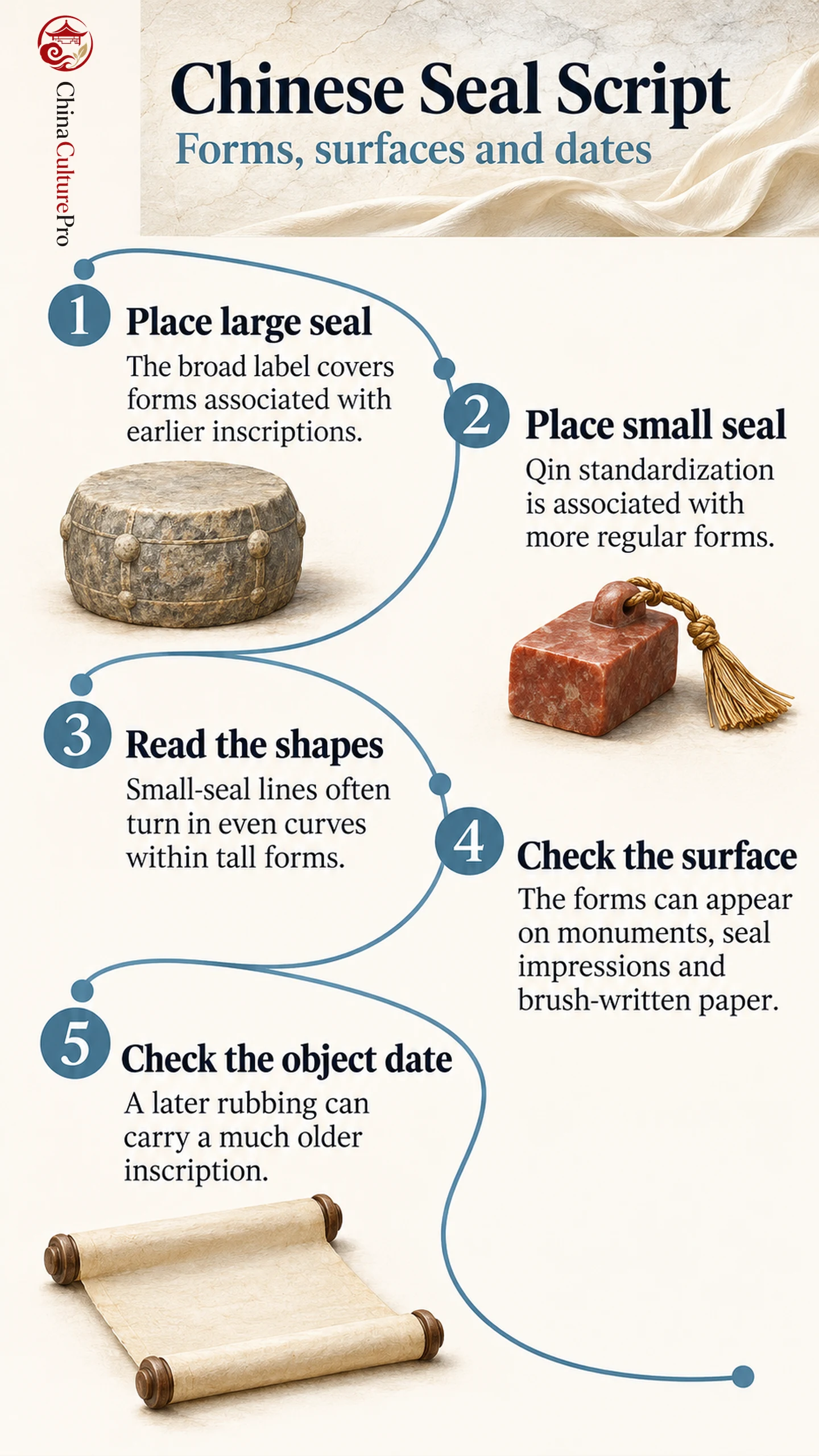
- Large seal (大篆, dàzhuàn): A broad label for forms associated with earlier inscriptions. [1][2]
- Small seal (小篆, xiǎozhuàn): A more standardized form associated with the Qin dynasty. [1][3]
- Surviving examples: An ancient inscription may be seen today in a later paper rubbing, while a later artist might write seal script directly on paper. [2][5]
The word seal names the script family here. The same family can appear on objects other than seals. [1][4][5]
A red stamp on a painting and a tall pair of brush-written scrolls can both use seal forms. The script is one clue. The material, date and purpose of the work tell you how those forms were used.
Large Seal and Small Seal
| Form | Historical association | What to look for |
|---|---|---|
| Large seal | Earlier inscriptions associated with bronze and stone | Expect variation between surviving examples, including different proportions and curved components. [1][2] |
| Small seal | Standardization under the Qin | Look for relatively even lines, elongated forms and carefully balanced turns. [1][3] |
Large seal is a broad historical label. The variation among early inscriptions matters when you compare an individual character with a later standardized form. The Stone Drums preserve texts about royal hunts and are one often-discussed example in the history of these forms. The example you encounter in a museum may be a rubbing many centuries later than the stones. [1][2]
Small seal is associated with the standardization of writing under the first Qin emperor. The official Li Si (李斯, Lǐ Sī) has a traditional place in accounts of that reform. His association with small seal helps explain a particular stage in a history that reaches back beyond the Qin. [1][3]
How to Recognize Seal-Script Shapes
Look for a pattern across several characters. In small seal, a long line may bend around an open space and continue at a similar width. An upper and lower part can balance each other across a narrow form. Compare that with clerical script, where some forms spread horizontally and a stroke may end with a conspicuous sweep. Neither cue identifies every example by itself. [1][6]
A stamp gives the characters a compact space. On a rubbing, pale character lines can be the parts that were cut into a stone. A brush-written scroll lets you see the line on a much larger scale. Use the comparison of Chinese calligraphy styles when the proportions alone leave the script unclear. [2][4][5][6]
From Inscribed Stone to Seals and Scrolls
A seventeenth-century rubbing of the Stone Drums gives viewers access to older carved inscriptions through a sheet of paper. The inscriptions and the sheet belong to different periods. A date on the catalog entry can refer to the paper impression even when the text is ancient. See Chinese stone rubbings for the distinction between the original engraving and its impression. [2]
A carved seal can reverse the relationship of character and ground. Raised text can print red, while an incised legend can leave pale lettering surrounded by red. Seal-script forms can record a person’s name, a studio or a phrase. Their use on paintings with seals also makes it important to ask who left the mark. [4]
On a Qing pair of hanging scrolls by Zuo Zongtang (左宗棠, Zuǒ Zōngtáng), the seven-character lines are in seal script, but the dedication and signature use running script. The work also carries two impressions assigned to Zuo. Here, two scripts appear in ink on the same work. The stamped marks have a third role as impressions, even if their lettering uses forms related to the main text. [5]
FAQs About Chinese Seal Script
Is Seal Script Used Only on Seals?
It appears in carved inscriptions and brush writing as well as on stamps. The name describes a set of character forms that can move between those surfaces. [1][2][4][5]
Did Li Si Invent Seal Script?
He is traditionally associated with small-seal standardization under the Qin. Earlier related forms appear in inscriptions from before Qin unification. [1][2][3]
Can a Modern Chinese Reader Read Seal Script?
Some components may be recognizable to a reader of modern Chinese, but older forms can be unfamiliar and the layout may differ from modern print. A transcription in familiar characters gives you a starting point for comparing the forms. [1][5][6]
Sources
[1] Smithsonian National Museum of Asian Art. Seal Script
[2] The Metropolitan Museum of Art. Inscriptions on the Stone Drums
[3] The Palace Museum. Li Si
[4] The Metropolitan Museum of Art. Mastering the Art of Chinese Painting
[5] National Palace Museum. Zuo Zongtang: Seven-Character Couplet in Seal Script
[6] The Metropolitan Museum of Art. Chinese Calligraphy