

Quick Answer: What Is Chinese Regular Script?
Chinese regular script (楷书, kǎishū), also called standard script, organizes distinct strokes into clearly structured characters. Tang inscriptions became influential examples, but the forms developed earlier and continued in later writing. [1][2][3][4][7]
- Structure: The parts of a character remain easy to locate and compare. [1]
- Strokes: A writer can vary pressure, width and direction while keeping the start and end of a movement clear. [1][3][4]
- Models: Large inscriptions and small literary handscrolls use regular forms at different scales. [2][5][7]
Regular describes the script family. It still leaves room for different proportions and ways of moving the brush. [1][3][4]
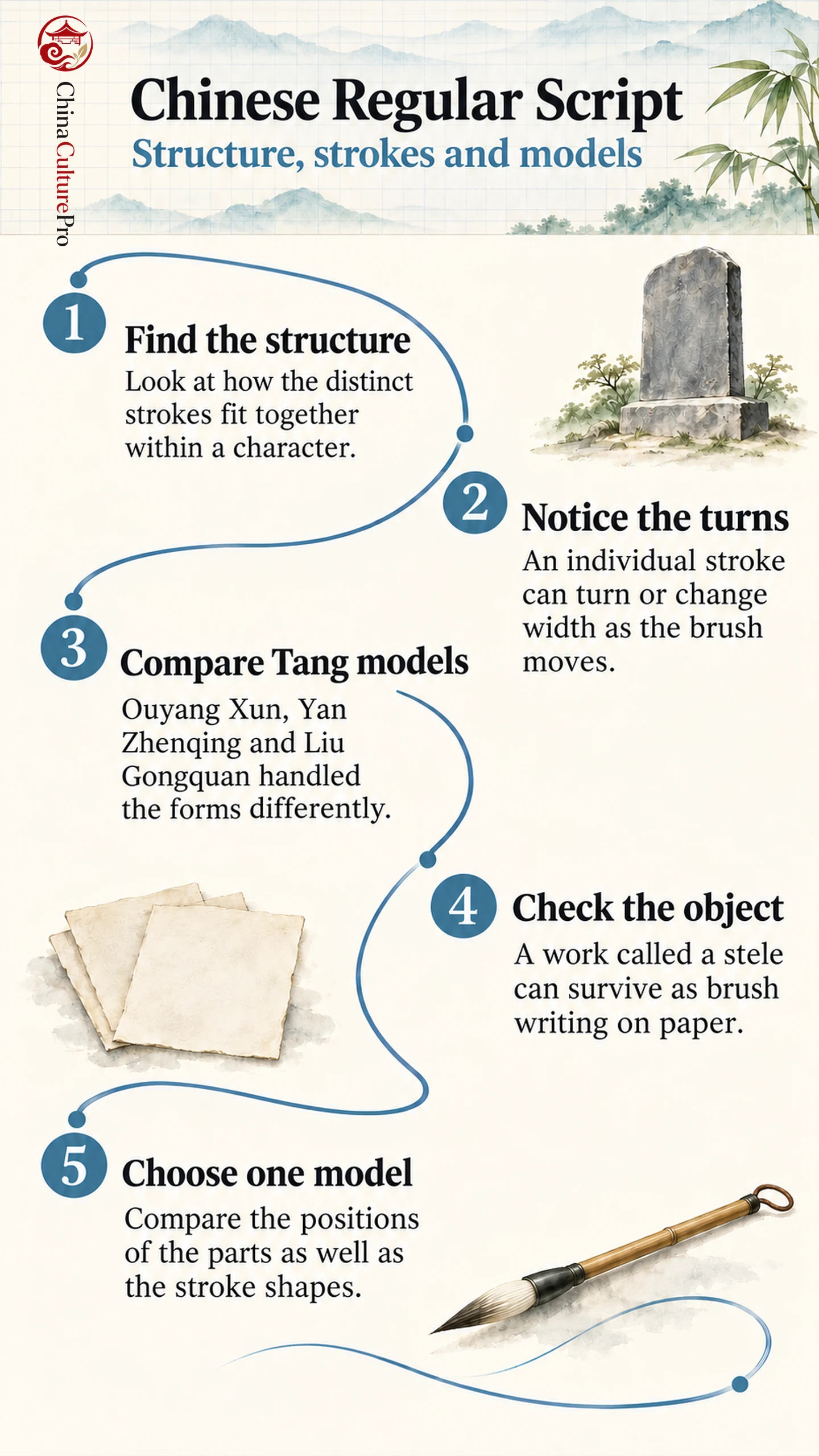
Two clearly written characters can have different weight. One may hold its strokes close to the center, while another reaches farther to the sides. Looking at those differences helps you understand regular script as written form.
What Makes a Character Look Regular
Look at the relationship between the parts of a character. Individual strokes can remain distinct even when a turn occurs inside one stroke. An open space around a component can clarify its shape, while a firmer ending can make a corner or hook easier to see. These are useful cues within the broader set of Chinese calligraphy styles. [1][3][4]
Compared with running script, regular writing usually leaves more of the strokes distinct. That visibility makes a model helpful when you are learning where each component goes. Differences in line width and pressure still show individual handling of the forms. [1][3][4]
Three Tang Steles, Three Ways of Shaping a Character
| Model | Date of original inscription | What to look for |
|---|---|---|
| Inscription on the Sweet Wine Spring at Jiucheng Palace by Ouyang Xun (欧阳询, Ōuyáng Xún) | 632 | Compare how the turns and surrounding spaces hold a character together. One surviving rubbing comes from a Qing re-engraving. [2] |
| Duobao Pagoda Stele by Yan Zhenqing | 752 | Look at the compact layout and the contrast between full strokes and clearly articulated turns. [3] |
| Xuanmi Pagoda Stele by Liu Gongquan (柳公权, Liǔ Gōngquán) | 841 | Look for lean, sharply defined marks and how they extend from a compact center. [4] |
A reproduction may show a stone rubbing, with details affected by the condition of the carving and the date of the impression. Compare the object records before taking a pale or broken area as a choice made by a writer such as Yan Zhenqing. [2][3][4]
Regular Script at Other Scales
The Danba Stele Scroll by Zhao Mengfu is a 1316 work on paper. Although the text is an inscription, the surviving object is a brush-written scroll, with a heading in seal script and body text in regular script. The main writing measures 33.6 centimeters high by 563 centimeters long. Read the material field as well as the title when a label uses the word stele. [5][6]
Wen Zhengming’s transcription of Lu Ji’s Essay on Literature, dated 1544 and 1547, gives another comparison. Its small regular script (小楷, xiǎokǎi) keeps components distinct in much smaller characters. In a small character, a shift in spacing can make the parts look crowded even when each stroke is clear. Compare several characters at the same magnification before using a work as a calligraphy copybook model. [7]
FAQs About Chinese Regular Script
Is Regular Script the Same as a Printed Font?
Some printed forms reflect the regular-script structure. Brush writing also gives you the writer’s pressure, turns and handling of ink. A printed character can be useful for recognition, while a calligraphic model helps show the movement. [1][7]
Why Do Beginners Often Learn Regular Script?
Clearly placed strokes make it easier to see whether the parts of your character sit where they do in the model. Choose a model with the forms you want to practice, and compare both the positions of components and the brush movements. [1]
Did Regular Script Begin in the Tang Dynasty?
Its forms developed after the Han period. Tang writers produced especially influential versions, including the dated stone inscriptions in the comparison above. [1][2][3][4]
Sources
[1] Smithsonian National Museum of Asian Art. Standard Script
[2] National Palace Museum. Inscription on the Sweet Wine Spring at Jiucheng Palace
[3] The Palace Museum. Ming Rubbing of the Duobao Pagoda Stele
[4] The Palace Museum. Song Rubbing of Liu Gongquan’s Xuanmi Pagoda Stele
[5] The Palace Museum. Zhao Mengfu: Danba Stele Scroll
[6] The Palace Museum. Zhao Mengfu Chronology
[7] The Metropolitan Museum of Art. Wen Zhengming: Lu Ji’s Essay on Literature