

Quick Answer: Who Is Yu Hua?
Yu Hua (余华, Yú Huá) is a contemporary Chinese novelist, short-story writer and essayist. His writing ranges from unsettling experimental fiction to family narratives, expansive satire and stories told from beyond death. One book’s voice does not define his whole career.[1][8][9]
- For a first novel: Start with To Live (活着, Huózhe) if you want a concentrated family story about endurance and loss.
- For a broader comparison: Choose a different form next—social satire, an afterworld narrative or essays.
- For English reading: Check the translator and edition, as well as the title.
- For cultural context: Read the characters as particular people within crafted stories, rather than representatives of every Chinese life.
These are adult works that can include violence, bereavement, sexual material and severe hardship. Choose by subject and reading preference, not simply by length.
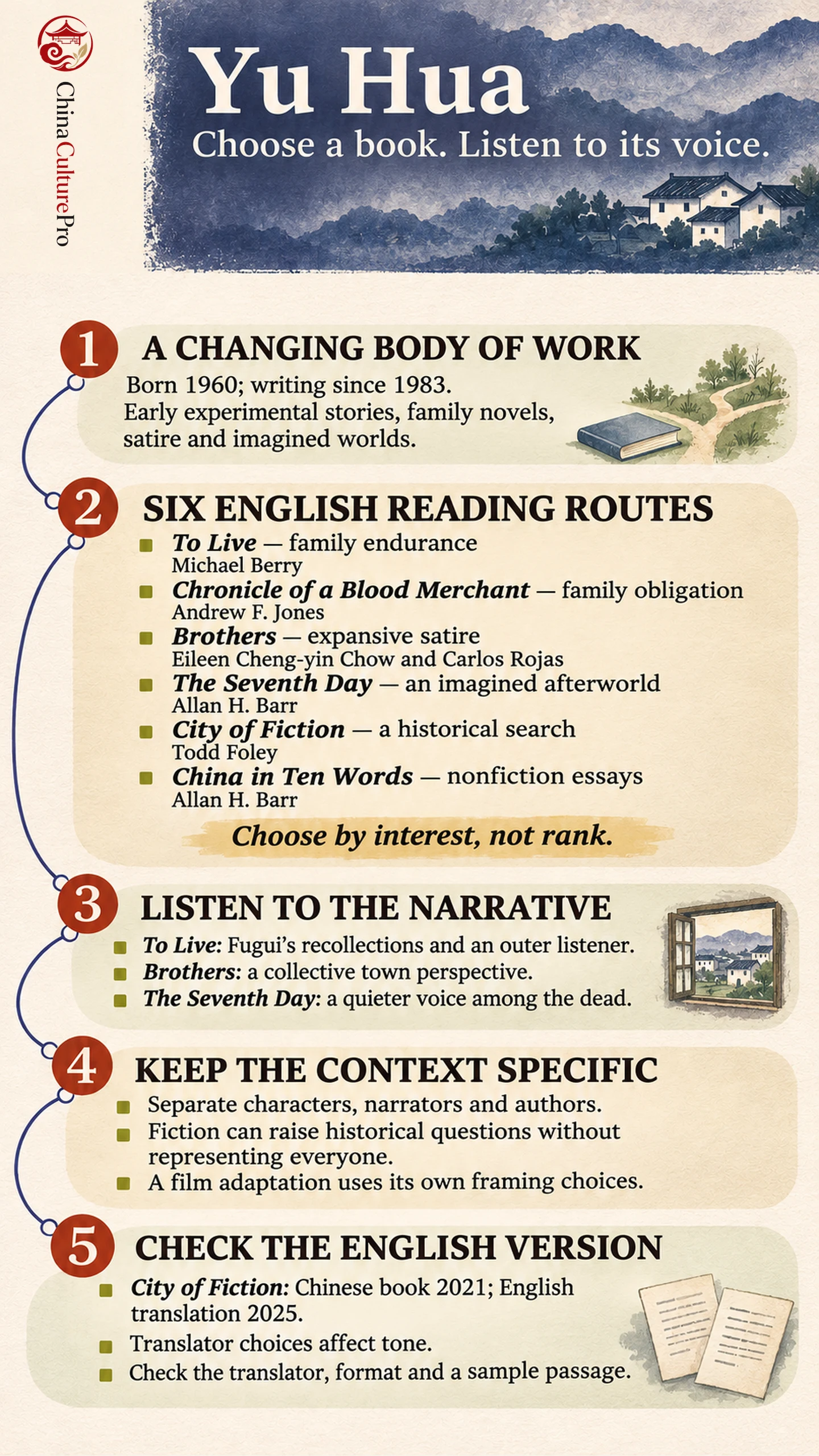
Yu Hua often comes to English readers through a reputation for devastating stories. A reader can also encounter coarse comedy, a collective town voice or a quiet account of the dead.
A useful reading path begins with a book that suits your interests, then compares it with one that sounds different. The six routes below place him within modern and contemporary Chinese literature, while keeping the novels and the nonfiction distinct.
From Early Stories to Long Novels
Born in 1960, Yu Hua grew up in Haiyan (海盐, Hǎiyán), in Zhejiang (浙江, Zhèjiāng). He worked as a dentist for five years and began writing in 1983. Later in that decade, his experimental fiction could make ordinary situations violent, strange or difficult to explain.[1][2][8][9]
The English collection The April 3rd Incident takes its name from the story The April 3rd Incident (四月三日事件, Sì Yuè Sān Rì Shìjiàn). It offers an entry into early work from the late 1980s and early 1990s, including fractured realities and a narrator investigating a possible conspiracy. The later date of an English collection is not the date when all its stories were written.[8][11]
Cries in the Drizzle (在细雨中呼喊, Zài Xìyǔ Zhōng Hūhǎn) offers another route through childhood, memory and exclusion within a family and village. It is a novel, not a transcript of the author’s childhood. The English edition is translated by Allan H. Barr.[11][12]
These earlier routes matter because the move toward family-centered novels did not erase an interest in experiment. Later works use different relationships between realism, exaggeration, memory and the fantastic. Treating the career as a simple journey from difficult stories to straightforward realism makes those changes harder to hear.
Six Books and English Reading Routes
The choices below are organized by reading interest, not by a ranking of literary quality. Translator credits identify the English versions discussed. The premises remain brief to leave room for discovery.
| Book | English translator | Reading route |
|---|---|---|
| To Live | Michael Berry | Fugui (福贵, Fúguì) recounts a life transformed by gambling, poverty, war and family loss. Start here for an intimate narrative with a clearly identifiable central voice.[2][10] |
| Chronicle of a Blood Merchant (许三观卖血记, Xǔ Sānguān Mài Xuè Jì) | Andrew F. Jones | Xu Sanguan (许三观, Xǔ Sānguān), a silk-mill worker, sells blood as family pressures intensify. Choose it for a different account of obligation, bodily cost and belonging.[3][13] |
| Brothers (兄弟, Xiōngdì) | Eileen Cheng-yin Chow and Carlos Rojas | Two stepbrothers move through upheaval, rivalry and the pursuit of wealth, from the Cultural Revolution (文化大革命, Wénhuà Dà Gémìng) into the economic boom. Expect a larger, bawdier and more exaggerated social panorama.[4] |
| The Seventh Day (第七天, Dì Qī Tiān) | Allan H. Barr | Yang Fei (杨飞, Yáng Fēi) encounters people from his life during seven days after death. Choose it for an imagined afterworld through which loss, inequality and attachment can be reconsidered.[5] |
| City of Fiction (文城, Wén Chéng) | Todd Foley | Lin Xiangfu (林祥福, Lín Xiángfú) travels south with a baby in search of the child’s mother and an elusive city. Choose a historical tale of searching, community and upheaval. The Chinese book appeared in 2021; the English translation appeared in 2025.[1][6] |
| China in Ten Words (十个词汇里的中国, Shí Gè Cíhuì Lǐ de Zhōngguó) | Allan H. Barr | Ten word- or phrase-centered essays connect personal experience with social commentary. Choose this for nonfiction and the writer’s reflective public voice.[7][11] |
If you begin with To Live, follow it with Brothers for a pronounced contrast in scale and tone, or with the essays for a change of form. This is an editorial reading suggestion, not a required sequence. Readers drawn to historical adventure can begin with City of Fiction instead.
How the Narrative Voices Differ
Three questions help move beyond a list of recurring themes.
- Who is speaking? To Live includes an outer listener, a collector of folk songs, and Fugui telling his own life. Notice the difference between an encounter being narrated and the recollections it opens up.[10]
- How loud is the narrative? Brothers can draw on a collective small-town perspective and a raucous manner. The Seventh Day approaches its world of the dead with a quieter voice. This contrast is part of the author’s account of how he shaped the two works.[9]
- What does the structure let you see? An afterworld encounter, an extended search and a family recollection create different ways of connecting people and events. Ask what becomes possible because of the chosen form, rather than treating the form as decoration around a message.
Family obligations recur, but they are not identical in every work. Caring for another person can be entangled with resentment, humiliation or a mistaken belief. Likewise, humor need not cancel suffering: a grotesque situation or repeated exchange can make a painful social relationship more visible.
An apparently plain sentence can therefore do complex work. Its effect depends on who says it, what the reader already knows and where it falls within a scene. Avoid equating direct language with a simple moral or a single authorial opinion.
Historical Context Without Flattening the Fiction
A little orientation helps distinguish the worlds of these books. The Cultural Revolution and the later transformations discussed in modern Chinese cultural history provide background for different parts of the fiction. City of Fiction looks further back, toward the upheavals of the early twentieth century.[4][6]
Keep three levels separate: what happens to a character, how the narrator presents it and what the author has chosen to construct. A blood-selling plot is not evidence of an ordinary family custom; an imagined afterworld is not a survey of religious belief. Fiction can sharpen questions about social life without supplying a representative sample of a population.
The nonfiction requires a related distinction. China in Ten Words combines memory, anecdote and argument; it is the author’s situated account, not a current statistical handbook. Read its chapter subjects as ways of organizing experience and criticism.[7]
Screen adaptations add another layer. Zhang Yimou (张艺谋, Zhāng Yìmóu) directed the 1994 film To Live, in which shadow-puppet performance becomes Fugui’s livelihood. The novel’s framing encounter with a folk-song collector offers a different way into his life.[2][14] Explore Chinese cinema for the screen context, and keep a director’s choices distinct from those of the novelist.
Choosing an English Edition
The translator is part of the reading experience. The table credits are worth retaining when borrowing a book, buying an edition or discussing a passage. A paperback’s publication date may identify a reissue; it does not necessarily date the Chinese original or the first English translation.
For City of Fiction, the English title is an interpretive choice that emphasizes narrative invention within the story. The translator also describes preserving an oral quality through particles and sometimes expanded phrasing. A shorter English formulation would not automatically have achieved the tone he wanted.[6]
In translating To Live, attention to cadence and spoken register helped distinguish the narrator’s voice from the character’s. Reading a passage aloud was one practical way of testing the English dialogue.[10] These choices are a reason to compare voices and passages, rather than assume one fixed style passes unchanged between languages.
Before choosing, inspect a sample for the experience you want: sustained family narration, crowded comic scenes, an uncanny encounter or an essay’s argument. A content description can help you anticipate difficult themes without requiring a full plot summary. Page count alone will not tell you how emotionally demanding a book may feel.
Finally, Yu is the family name and Hua the given name. A brief guide to Chinese names can clarify references, while Chinese language diversity gives background when local speech becomes part of a story.
FAQs About Yu Hua
Which Yu Hua book should I read first?
To Live is a useful first choice for a concentrated family narrative. Choose Brothers if you want expansive satire, City of Fiction for a historical search story, or China in Ten Words if you prefer essays. These are alternatives based on interest, not a mandatory order.
Is China in Ten Words a novel?
No. It is a nonfiction essay collection organized around ten words or phrases, combining personal stories with social commentary. Its voice and claims should be read differently from those of a fictional narrator.
Is To Live the same as the film?
The 1994 film is an adaptation. Shadow-puppet performance shapes the screen version, while the novel frames Fugui’s recollections through a meeting with a folk-song collector. Discuss each version’s choices separately.[2][14]
Are Yu Hua’s novels documentary accounts of China?
They are crafted fiction, even when historical events and recognizable social pressures matter. Distinguish characters, narrators and authorial construction, and use historical sources for factual questions beyond the story.
Sources
[1] China Writers Association, publisher presentation. Wencheng: Chinese edition
[2] National Endowment for the Arts. To Live: reading guide
[3] Penguin Random House. Chronicle of a Blood Merchant
[4] Penguin Random House. Brothers
[5] Penguin Random House. The Seventh Day
[6] Todd Foley, World Literature Today. Answering New Questions: Translating Yu Hua’s City of Fiction
[7] Penguin Random House. China in Ten Words
[8] Penguin Random House. The April 3rd Incident
[9] Yu Hua interviewed by Zhang Ying, China Writers Association. Literature, the Times and My Writing
[10] Michael Berry interviewed by Jo Reed, National Endowment for the Arts. Michael Berry: translating To Live
[11] Allan H. Barr interviewed by Wang Baorong, China Writers Association. Yu Hua’s Works in the United States
[12] Penguin Random House. Cries in the Drizzle
[13] University of Leeds Centre for New Chinese Writing. Chronicle of a Blood Merchant: edition and translator
[14] Zhang Yimou interviewed by Tony Rayns, British Film Institute. Loosening the Knot: On the Set of To Live