

Quick Answer: Who Is Liu Cixin?
Liu Cixin (刘慈欣, Liú Cíxīn), published in English as Cixin Liu, is a Chinese science-fiction writer born in 1963 and a former power-plant engineer. His fiction often follows an invention or discovery from its effects on individuals to consequences for whole civilizations. His alien-contact trilogy is the best-known entry into a much wider body of work.[1][2]
- For the trilogy: Begin with its first novel and follow publication order; the later volumes depend on earlier revelations.
- For one complete novel: Choose a standalone centered on scientific investigation or a society facing catastrophe.
- For shorter reading: Choose a story collection; the English title on its cover may also name one story inside.
These books use science as a starting point for imaginative fiction. Their technologies, civilizations and strategic arguments are not established predictions.
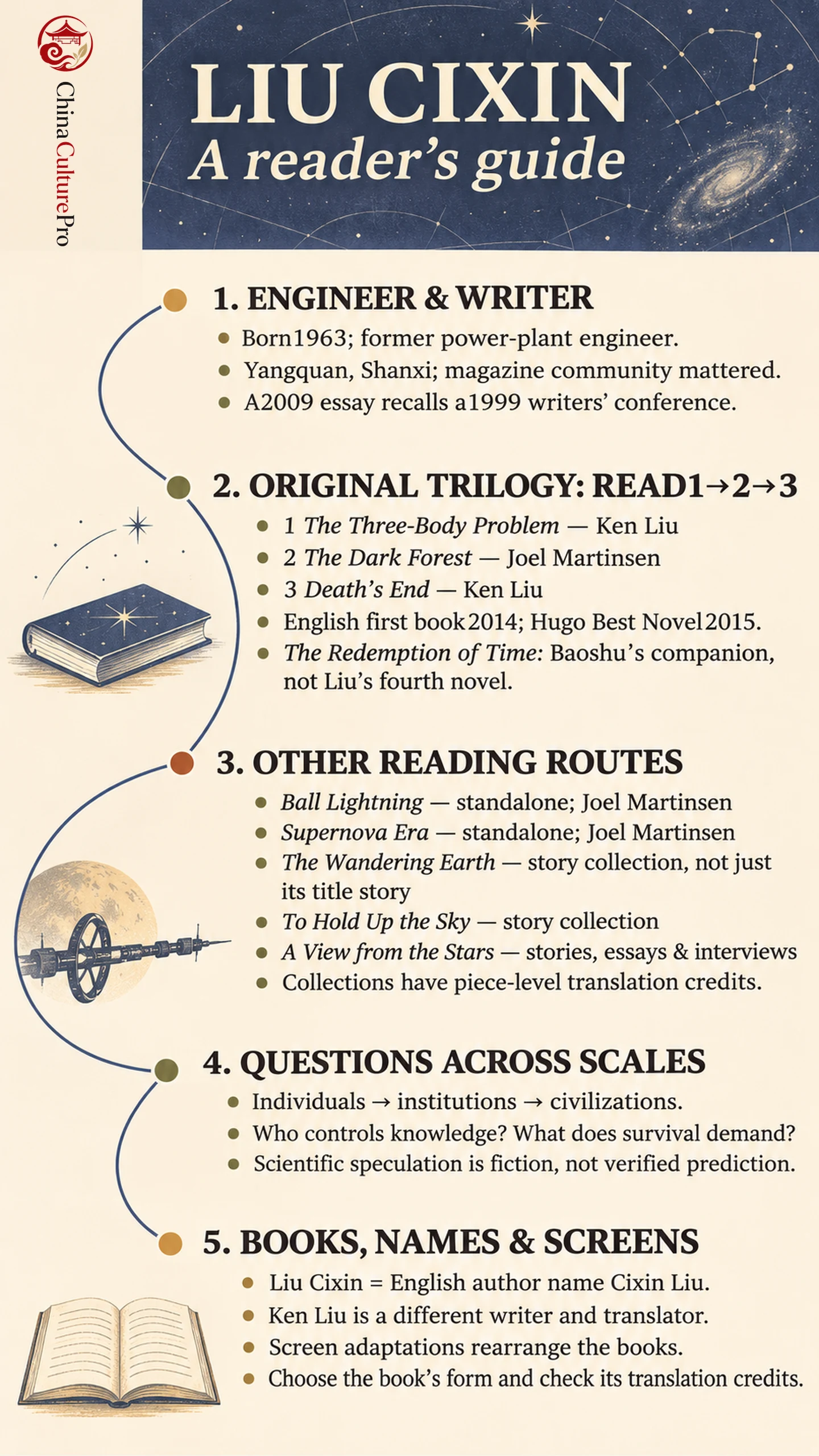
A screen title can be a misleading shopping list. An English shelf of Liu’s work contains three connected novels, separate long fiction, selected stories and a mixed collection of fiction and nonfiction. Identifying the form first is more useful than treating every title as another installment of one series.
This guide gives a spoiler-light route through those choices. For the wider field around this author, explore Chinese science fiction and its different writers, generations and literary approaches.
An Engineer Writing Across Human and Cosmic Scales
Liu worked as an engineer at a power plant in Yangquan (阳泉, Yángquán), Shanxi (山西, Shānxī). That background helps explain the relevance of energy, machines and large systems to his fictional interests, without turning his invented devices into engineering proposals. His own discussion of a possible energy-industry novel connects the subject with his professional familiarity.[2][12]
His career also belongs to a literary community. In a 2009 essay later collected in English, he recalls preparing The Wandering Earth (流浪地球, Liúlàng Dìqiú) for a 1999 writers’ conference organized by the magazine Science Fiction World (科幻世界, Kēhuàn Shìjiè). Meeting its writers and editors made a previously distant community tangible to him. The recollection connects an apparently solitary technical imagination with magazines, conversation and fellow practitioners.[10]
This is a useful corrective to an award-only biography. The international breakthrough matters, but it does not mark the beginning of either Liu’s writing or Chinese speculative fiction. His place within modern Chinese literature involves local publishing networks as well as later translation.
The Three Novels in Reading Order
The trilogy is also known as Remembrance of Earth’s Past (地球往事, Dìqiú Wǎngshì). Read its three original novels in the sequence below. The English translations divide between Ken Liu and Joel Martinsen.[4][12]
| Order and book | English translator | What the book adds |
|---|---|---|
| 1. The Three-Body Problem (三体, Sān Tǐ) | Ken Liu | Historical trauma, scientific puzzles and the discovery of contact with another civilization establish the conflict. |
| 2. The Dark Forest (黑暗森林, Hēi’àn Sēnlín) | Joel Martinsen | The story widens into humanity’s preparations and strategic uncertainty about other civilizations.[13] |
| 3. Death’s End (死神永生, Sǐshén Yǒngshēng) | Ken Liu | The narrative pushes the conflict toward more distant futures and larger questions of survival.[14] |
The first book appeared in English in 2014 and won the 2015 Hugo Award for Best Novel. Those are different events; the award year should not be substituted for the English publication year. The award record also distinguishes the Chinese book’s 2008 publication from its later translation.[3]
Start with book one even if a television adaptation has introduced some characters. A screen version can rearrange people, settings and discoveries, leaving gaps that matter in the sequels. The separate Three-Body novel guide explores the first book in more detail.[5][11]
The Redemption of Time (三体X:观想之宙, Sān Tǐ X: Guānxiǎng Zhī Zhòu) is a related work by Baoshu (宝树, Bǎoshù), translated by Ken Liu. A publisher’s series page may place it beside the trilogy, but that placement does not make it a fourth original novel by Liu Cixin. Finish the original three before deciding whether to explore the companion.[15][16]
Other Books: Standalone Novels and Collections
The alternatives below separate continuous novels from collections. Choose by reading interest: an investigation, a social experiment, short fiction or the writer’s reflections.
| Book and form | A useful reason to choose it | Translation or edition distinction |
|---|---|---|
| Ball Lightning (球状闪电, Qiúzhuàng Shǎndiàn), standalone novel | An investigation begins with a devastating encounter with an unexplained phenomenon and becomes entangled with military uses of research. | Joel Martinsen’s English translation appeared in 2018. Scientific obsession and weaponization make it a different entry from the trilogy.[6] |
| Supernova Era (超新星纪元, Chāoxīnxīng Jìyuán), standalone novel | A stellar catastrophe leaves a world in which people over thirteen will die, forcing children to inherit its institutions. | Joel Martinsen translated the English edition published in 2019. Young protagonists do not by themselves make this a children’s book.[7] |
| The Wandering Earth, story collection | Sample ten stories, including the title story’s attempt to move Earth itself using enormous engines. | The collection and its individual title story are different objects; check the contents of the edition you select.[8] |
| To Hold Up the Sky, story collection | Explore scenarios ranging from a rural classroom to industrial danger and far-future change. | The publisher’s sample credits Adam Lanphier for “The Village Teacher”; do not assume every translated story is Ken Liu’s work.[9] |
| A View from the Stars, fiction and nonfiction collection | Read stories alongside essays and interviews that reveal the writer’s reflections on his craft. | The English collection first appeared in 2024. Individual pieces are older: its conference recollection was written in 2009.[10] |
The last two English collection titles should not be read as proof of identically organized Chinese originals. For a collection, the contents and the individual translation credits are more informative than the cover title alone.
Science, Survival and Cultural Context
Three questions help make sense of these books without reducing them to one message.
- What happens when scale changes? A private investigation, a classroom or an entire planet can become the point from which a story considers humanity’s vulnerability. The shift in scale is part of the imaginative effect.[6][8][9]
- Who controls knowledge? Research can offer discovery and beauty while also attracting military or political power. Ball Lightning makes that tension central; the trilogy extends questions about knowledge into contact between civilizations.[6][13]
- What does survival demand? Fictional emergencies make familiar moral choices harder. A reader can test the characters’ reasoning without accepting it as the author’s prescription for actual societies.[7][14]
Historical settings also have specific jobs. The first trilogy novel’s account of political violence during the Cultural Revolution (文化大革命, Wénhuà Dà Gémìng) gives personal weight to later choices about humanity and contact. Its historical setting informs those choices; it does not make every character an allegory for China.[5]
Scientific vocabulary can invite curiosity while leaving room for scrutiny. A recognizable physical concept can lead into an invented mechanism, and a compelling strategic argument can depend on conditions the story has constructed. Read these transitions as literary choices. Their imaginative force does not establish that the technology is feasible or the social conclusion universal.
Translation and Screen Adaptations
The English author name Cixin Liu reverses the order seen in Liu Cixin. The family name remains Liu; the variation does not identify a different writer. Chinese names and name order provide useful background when comparing catalog records.
Translation is another distinction worth checking. Two people share responsibility for the trilogy’s English volumes, while collections can bring together more translators. In A View from the Stars, for example, the sample credits S. Qiouyi Lu for “Whale Song” and Henry Zhang for the conference essay. Keep those piece-level credits separate from authorship of the volume.[10][13][14]
The 2024 English-language television adaptation of the trilogy uses an international present-day cast and setting alongside its historical material. It offers its own arrangement of the story. The title story behind The Wandering Earth also remains a separate reading experience from the film associated with it. When moving from Chinese cinema or television to a book, check whether you are buying a novel, a story collection or an adaptation-related edition.[8][11]
FAQs About Liu Cixin
Which Liu Cixin book should I read first?
Start with the first trilogy novel if you want the connected alien-contact story. Choose Ball Lightning for a standalone investigation, or The Wandering Earth collection if you prefer several shorter fictional experiments.[5][6][8]
Is Ken Liu the same person as Liu Cixin?
No. Liu Cixin is the author discussed here. Ken Liu is a different writer and translator who translated the first and third trilogy novels into English; Joel Martinsen translated the second.[4]
Are there three or four Three-Body books?
Liu Cixin’s original trilogy contains three novels. The related The Redemption of Time is by Baoshu. Its inclusion on a series sales page does not change the original trilogy’s authorship or length.[4]
Do I need a science degree to read Liu Cixin?
No particular qualification is required. Expect passages that develop scientific ideas and imagined technologies. Focus first on what a premise changes for the characters, and distinguish the novel’s invented consequences from verified scientific knowledge.
Sources
[1] China Writers Association. Liu Cixin: introduction
[2] Arthur C. Clarke Foundation. Cixin Liu: 2018 award citation
[3] World Science Fiction Society. 2015 Hugo Awards
[4] Tor Publishing Group. The Three-Body Problem series
[5] Tor Publishing Group. The Three-Body Problem
[6] Tor Publishing Group. Ball Lightning
[7] Tor Publishing Group. Supernova Era
[8] Tor Publishing Group. The Wandering Earth
[9] Tor Publishing Group. To Hold Up the Sky
[10] Liu Cixin, Tor Publishing Group. A View from the Stars: excerpt and book details
[11] Netflix. 3 Body Problem: adaptation introduction
[12] China Writers Association. Liu Cixin: writing a science-fiction novel for Chinese readers
[13] Tor Publishing Group. The Dark Forest
[14] Tor Publishing Group. Death’s End
[15] Baoshu interviewed by China Writers Association. Chinese science fiction: an author interview
[16] Tor Publishing Group. The Redemption of Time