
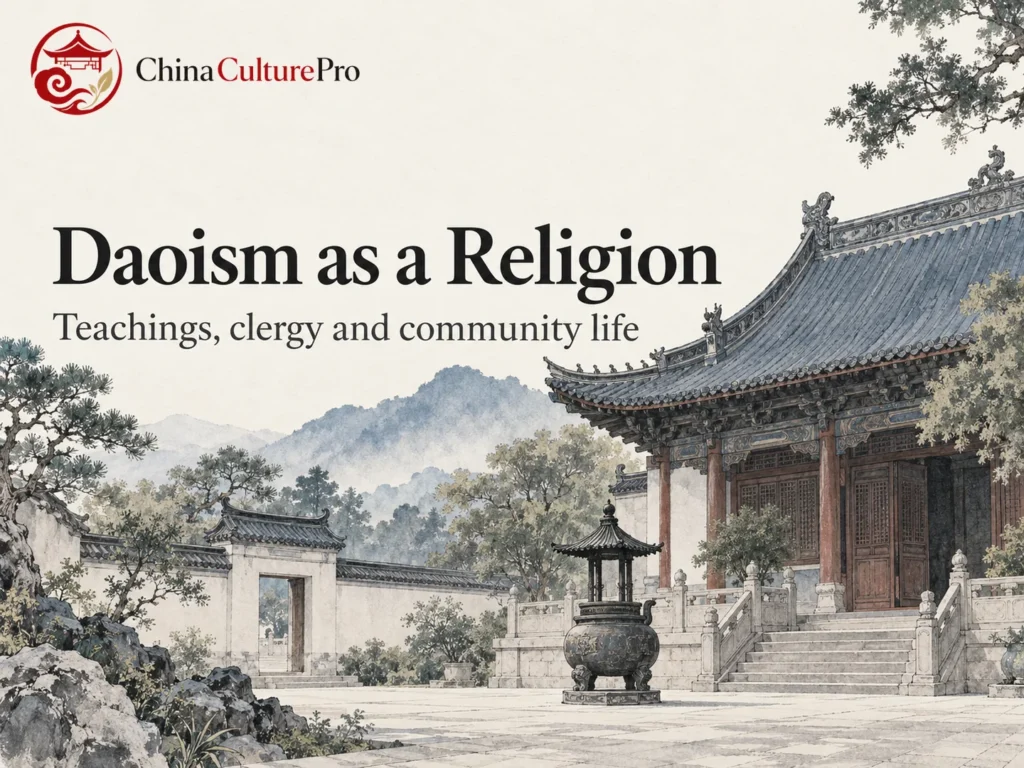

Quick Answer: What Is Daoism as a Religion?
Daoism (道教, dàojiào), also spelled Taoism, is a Chinese religious tradition encompassing teachings, scriptures, deities, trained clergy, ritual services and personal cultivation. It cannot be reduced to a philosophy of effortless living or to a collection of folk customs.
- Religious life: worship, ethical commitments and cultivation connect people with the sacred.
- Institutions: temples, lineages and household specialists provide different forms of continuity.
- Community: lay supporters and local associations help organize religious occasions.
The modern distinction between religious and philosophical Daoism is useful for orientation, but it does not describe two completely separate traditions. This page focuses on religious life within the wider Chinese religious landscape.[1]

A Daoist temple is only one setting in which this religion is lived. A household priest serving a village, a monastic community studying scriptures and lay supporters organizing a festival can participate in related traditions while doing different work.
Texts, Early Communities and a Long Religious History
Laozi (老子, Lǎozǐ) and the Daodejing (道德经, Dàodéjīng) are important reference points for Daoist identity. Religious communities have drawn on the text alongside later revealed scriptures, liturgies and transmitted teachings. The Daodejing’s themes therefore belong within religious history as well as the study of philosophy.
Organized communities associated with the Celestial Masters emerged in the later Han period. Their tradition links Zhang Daoling (张道陵, Zhāng Dàolíng) with a revelation conventionally dated to 142 CE. That is a traditional sacred-history date, not independently demonstrated proof of a divine appearance. Subsequent lineages developed different scriptures and practices over many centuries.[1]
Reading Daoist thought helps explain the tradition’s language, but reading one early text does not reveal everything about a later temple, priestly training or community rite. These historical layers help explain why institutions and practices differ.
The Dao, Deities and Personal Cultivation
The Dao (道, dào), commonly translated as the Way, is the central concept around which Daoist accounts of reality and cultivation are framed. It should not simply be translated as the name of one creator god. Daoist religious explanations connect living well and cultivating oneself with alignment with the Dao.[2] The meaning of Dao deserves attention beyond a slogan about nature.
The Three Pure Ones (三清, Sānqīng) occupy a high position in many Daoist theological accounts. They are associated with primordial reality, sacred teaching and transmission. Laozi is also honored in a divine form. Other deities have roles in celestial administration, protection or particular communities; a temple’s principal deity need not be the highest figure in a general theological hierarchy.[3]
Personal cultivation belongs alongside communal worship. Prayer, study, ethical conduct and forms of contemplative discipline can have different importance in different communities. Religious language about transcendence or immortality expresses spiritual ideals and interpretations; it does not establish a medical promise that a practice prevents death or cures illness.[2]
Priests, Monastics and Major Lineages
A daoshi (道士, dàoshì) is a Daoist priest or religious specialist with a place in a transmitted tradition. This is different from simply being interested in Daoist ideas. Lineage affiliation, training, ritual authority and residence describe related but separate aspects of a person’s religious work.
| Major tradition | Useful orientation | Important limit |
|---|---|---|
| Quanzhen (全真, Quánzhēn) | Strongly associated with monastic institutions and celibate religious discipline | Its history also includes nonmonastic transmission; the label does not identify every individual’s residence |
| Zhengyi (正一, Zhèngyī) | Strongly associated with transmitted liturgical traditions and services for communities | Many priests live in households; this does not mean all household ritual or every local specialist is identical |
Northern Chinese fieldwork documents household priests as well as temple-based clergy, challenging a simple map of monastic north and household south. Ritual practice can also cross neat school labels.[4] The detailed comparison of Quanzhen and Zhengyi develops these institutional differences.
Temples and the Communities Around Them
Temples provide space for divine images, offerings, scripture recitation and religious services. Robes, paintings and ritual implements help make religious relationships visible. Images should be read through their names, attributes and setting rather than identified solely by a shared roof shape or the presence of incense.[5]
A temple is also sustained by people: resident clergy where present, donors, committees, worshippers and specialists invited for particular occasions. Not every person maintaining a shrine is an ordained priest. Nor does every worshipper need to adopt one exclusive institutional identity before making an offering.
The guide to Daoist temples explains halls and deities in more detail. The wider Chinese temple architecture tradition includes shared forms and artisans, so a visually similar building may belong to a different religious community.[5]
What Daoist Rituals Are For
Daoist rites address particular relationships and occasions: a community’s obligations to its deities, the opening or renewal of a sacred place, thanksgiving and care for the dead. Jiao (醮, jiào) is a name used for offering rites, often involving an organized community. It is not a synonym for every festival or every act of burning incense.[1]
- Communal occasions: Hong Kong Zhengyi traditions include jiao festivals and the installation or consecration of sacred sites.
- Celebratory services: one urban ritual classification distinguishes auspicious occasions from funerary services.
- Funerary services: rites address the dead and the concerns of their families, with trained officiants and local liturgical conventions.
These are concrete regional examples, not a compulsory sequence for all Daoist communities. Even within Hong Kong, New Territories and urban ritual systems have distinct histories.[6] Hong Kong’s heritage record also documents locally developed Quanzhen liturgical music, including influences from Cantonese singing traditions.[7] Public temple festivals may surround rites that have more restricted participation.
Understanding Daoism as a Living Tradition
Daoist religion interacts with local religious traditions without being interchangeable with every local cult. A community may support a deity temple and engage Daoist priests for a particular service. That relationship is more informative than assigning every participant one identical label.[4]
When observing religious life, ask who maintains the place, which tradition the officiants follow and what the occasion means to its participants. Follow local temple etiquette and ask before photographing a service or entering a restricted ritual area. Respectful observation does not require performing a rite whose meaning or conditions you do not understand.
FAQs About Religious Daoism
Is Daoism a religion or a philosophy?
It includes religious and philosophical dimensions. The modern labels help organize a discussion, but scriptures, ideas, cultivation and ritual have intersected throughout the tradition’s history.
Do all Daoist priests live in monasteries?
No. Some belong to monastic communities; others live in households and serve local communities. Residence alone does not fully identify lineage or ritual training.
Is every Chinese local temple Daoist?
No. Local temples can belong to different or overlapping religious settings. Look at the deity, the community and the officiants rather than assuming that all Chinese shrines have one affiliation.
Do Daoists worship Laozi?
Many do honor Laozi in a divine form as well as valuing the text associated with him. This religious role is distinct from proving every story about the historical author.
Sources
[1] Fabrizio Pregadio, Stanford Encyclopedia of Philosophy. Religious Daoism
[2] Taoist Mission (Singapore), practitioner explanation. Taoism
[3] Taoist Federation (Singapore), practitioner explanation. Taoist Gods
[4] Stephen Jones, original field research. Yinyang: Household Daoists of North China and Their Rituals
[5] Birgitta Augustin, Metropolitan Museum of Art. Daoism and Daoist Art
[6] Hong Kong Intangible Cultural Heritage Office. Taoist Ritual Tradition of the Zhengyi School
[7] Hong Kong Intangible Cultural Heritage Office. Quanzhen Temples Taoist Ritual Music