


Quick Answer: What Is the Tao Te Ching?
The Tao Te Ching (道德经, Dàodéjīng) is a short Chinese classic traditionally attributed to Laozi (老子, Lǎozǐ). Its familiar received form has 81 chapters exploring the Way, virtue, conduct and government through compressed sayings, images and paradoxes.[1]
- Names: Tao Te Ching and Daodejing are different romanizations of the same Chinese title; the work is also called the Laozi.
- Structure: The familiar two-part arrangement is a useful reference system, while early manuscripts show other arrangements.
- Ideas: Questions about language, desire, restraint and effective action recur across chapters.
- Translations: Wording, punctuation, textual basis and commentary shape the English version a reader encounters.
A fluent English sentence is already an interpretation. Read it with the surrounding chapter and the edition’s notes in view.
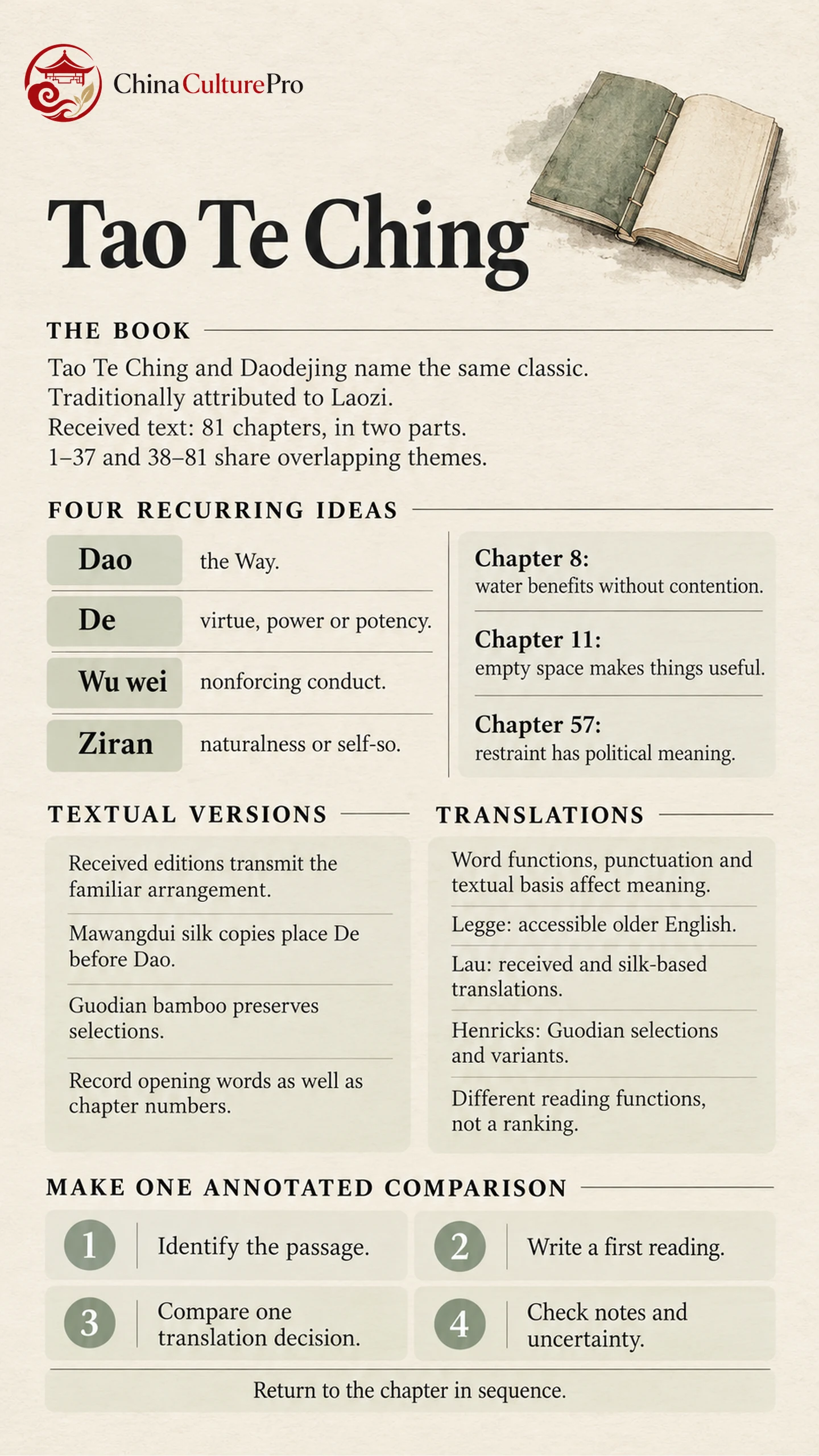
Two translations of the same short chapter can sound like different books. One presents a cosmic source; another emphasizes a way of acting or speaking. A useful first reading keeps the text’s recurring images in view while asking which choices belong to the translator.
The Book, Its Name and Its 81 Chapters
The title is often rendered “Classic of the Way and Virtue.” Its last element indicates canonical standing. The familiar arrangement places chapters 1–37 in the first part and 38–81 in the second; their opening words help explain the division. Themes overlap, so the parts should not be treated as self-contained books on metaphysics and politics respectively.[1]
These “chapters” are usually short passages rather than continuous arguments like chapters in a modern textbook. Their images recur, their subjects shift, and the reader often has to work out a connection that the text leaves unstated. Chapter 1 questions naming, while chapter 2 moves among paired distinctions and the conduct of a sage. A quotation detached from those shifts can lose the question the passage is addressing.[2]
The traditional attribution does not supply a securely documented composition history. A guide to Laozi examines the author question; for reading, the immediate task is to identify the version and passage in front of you.
Four Ideas to Follow Across the Chapters
Four recurring concepts are useful anchors. Their English equivalents remain provisional, especially where one word carries several related senses.[1][2][3]
- Dao (道, dào): the Way, whose source and course exceed a fixed verbal definition.
- de (德, dé): virtue, power or potency associated with the Way.
- wu wei (无为, wúwéi): nonaction or nonforcing conduct rather than simple inactivity.
- ziran (自然, zìrán): naturalness, literally what is self-so.
Chapter 8 compares excellence with water: it benefits things, occupies low places and avoids contention. The image unsettles the assumption that superiority must display itself through dominance. Chapter 11 considers a wheel, a vessel and a room; in each, an unoccupied space helps make the object useful. Reading the examples together gives a more precise question than a general celebration of emptiness: how can what appears absent contribute to what something does?[2]
The same care is needed with wu wei. Chapter 57 links the ruler’s restraint with people changing and ordering their lives themselves. The political setting matters. Turning this into a promise that every personal wish will come true if one stops trying removes the passage’s concern with government and intervention.[3]
For a first encounter, follow one image or concept across several passages. A closer explanation of Dao can clarify its range, while a chapter comparison shows how that range works in actual sentences. The book invites attention to both the words and the relations they establish.
Why Manuscripts and Editions Do Not Always Match
Later editions associated with commentators such as Wang Bi (王弼, Wáng Bì) helped transmit the familiar text. The silk manuscripts from Mawangdui (马王堆, Mǎwángduī) put the second, virtue-related part before the first, Way-related part. The bamboo material from Guodian (郭店, Guōdiàn) preserves selections corresponding to portions of the work, rather than a complete equivalent of today’s 81-chapter book.[1]
This matters when someone says “the opening chapter.” An edition following the silk order may open with material corresponding to chapter 38 in the familiar received arrangement. Record a few opening words as well as the number when comparing versions. A numbering mismatch need not mean that a translator has invented a passage.
Variation also affects wording and interpretation. Henricks’s Guodian volume explicitly compares bamboo readings with other versions and supplies notes on their differences. The surviving selections have a different sequence and incomplete correspondence with the familiar work. Their earlier physical date does not make them a complete authorial original.[4]
Why English Translations Differ
Classical Chinese compresses information that English often makes explicit. The same character can serve different functions; Dao, for example, can be a noun referring to a way or a verb involving speaking or telling. Punctuation and sentence division also involve interpretive decisions. Translators may therefore disagree even when working with the same characters.[5]
The opening passage illustrates the stakes. If a translation treats the first line chiefly as a statement about speech, the reader encounters a warning about verbal expression. A rendering centered on following a way can emphasize practice or guidance. Before deciding that one version is clearer, ask what its clarity commits it to. Notes can expose the choice that smooth English may conceal.[5]
Three editions illustrate different reading functions; they are not a ranking.
| Edition example | Useful feature | Limit to keep in view |
|---|---|---|
| James Legge’s translation | A freely accessible older English translation with an explicitly visible interpretive style. | Older diction and explanatory insertions need to be distinguished from the Chinese wording. |
| D. C. Lau’s bilingual edition | An edition pairing the received-text translation with a second translation based on the silk manuscripts. | Specify which of the two translations you are citing. |
| Robert G. Henricks’s Guodian volume | A translation of the bamboo selections with comparisons and notes on textual variants. | The surviving bamboo material does not cover the whole familiar book. |
Legge’s text makes its explanatory additions visible through parentheses. Lau’s bilingual edition retains his earlier received-text translation and adds a translation based on the two silk manuscripts. Henricks’s Guodian study provides a different task again: examining the bamboo material and its relationship with later readings.[2][6][4]
Choose by the question you want answered. A readable translation can support an initial encounter; Chinese text and explanatory notes help investigate differences. No edition removes the need to distinguish the base text, the translator’s decisions and a commentator’s argument.
A Four-Step First Reading
Use one short passage to produce an annotated comparison. Chapter 8 is a manageable starting point because its water image has concrete details, while chapter 1 offers a more demanding example of translation choices.[2][5]
- Identify the passage: Record the chapter number and a few opening words so editions with different ordering can be compared.
- Make a first reading: Write one sentence about the passage’s question, image or apparent tension without turning it into a life rule.
- Compare one decision: Read a second translation and mark one meaningful difference in a key term, subject or sentence division.
- Check the explanation: Consult the notes and record what supports each reading and what remains uncertain.
For chapter 8, an annotation might ask why water’s low position is connected with excellence. It could then compare how two versions express contention or timing. The result is a specific interpretive question, not a demand to resolve the whole book before continuing.
Afterward, return to the chapter in sequence. A second pass may change the first one-sentence reading. The wider Daoist tradition and the related Zhuangzi offer further contexts, while the Chinese philosophy overview situates the work among other debates about conduct and order.
FAQs About the Tao Te Ching
Are Tao Te Ching and Daodejing the same book?
Yes. They are different romanizations of the same Chinese title. Editions can still differ in wording, order, translation and commentary, so matching the title does not establish an identical text.
Did Laozi write all 81 chapters?
That is not established. The traditional attribution and the received chapter arrangement should be distinguished from the complex history of the work’s compilation and transmission.[1]
Which English translation should a beginner choose?
Choose an edition with a named translator, a clearly identified textual basis and notes that explain important choices. Read a sample chapter, then compare a second version. Lau’s bilingual edition and Henricks’s Guodian study serve different purposes, so identify the kind of reading you want to do.[6][4]
Is the Tao Te Ching a religious or philosophical text?
It has both religious and philosophical histories of reading. Its discussions of conduct, the Way and government do not require excluding its place in Daoist religious traditions.[1]
Sources
[1] Alan K. L. Chan. Laozi
[2] James Legge, translator. Tao-te Ching, Part 1
[3] James Legge, translator. Tao-te Ching, Part II
[4] Robert G. Henricks, translator. Lao Tzu’s Tao Te Ching: A Translation of the Startling New Documents Found at Guodian
[5] David K. Jordan. Eleven Translations of the Daodejing
[6] D. C. Lau, translator. Tao Te Ching: Bilingual Edition