

Quick Answer: What Does Wu Wei Mean?
Wu wei (无为, wúwéi) is often translated as nonaction, nonforcing action or effortless action. In Daoist texts, it questions activity driven by imposed schemes and self-serving desire; it does not simply prescribe permanent inactivity.[1]
- Action: The issue includes how and why someone acts, rather than just how much they do.
- Naturalness: Responsive conduct is understood through its relationship with the Way.
- Politics: Restraint concerns rulers and the effects of their interference, as well as individual life.
- Skill: Classical stories illuminate responsiveness, but skill or an easy feeling alone does not settle the concept.
The English phrase “effortless action” is a useful interpretation, not a guarantee that a difficult situation will require no work.
A skilled movement can look easy while depending on years of attention. A ruler can make matters worse by intervening at every turn. Wu wei brings questions about action, desire and control into the same discussion, but its classical settings deserve more care than a general instruction to relax.
Why Nonaction and Effortless Action Need Explaining
Three terms provide a starting vocabulary for Daoist thought.[1]
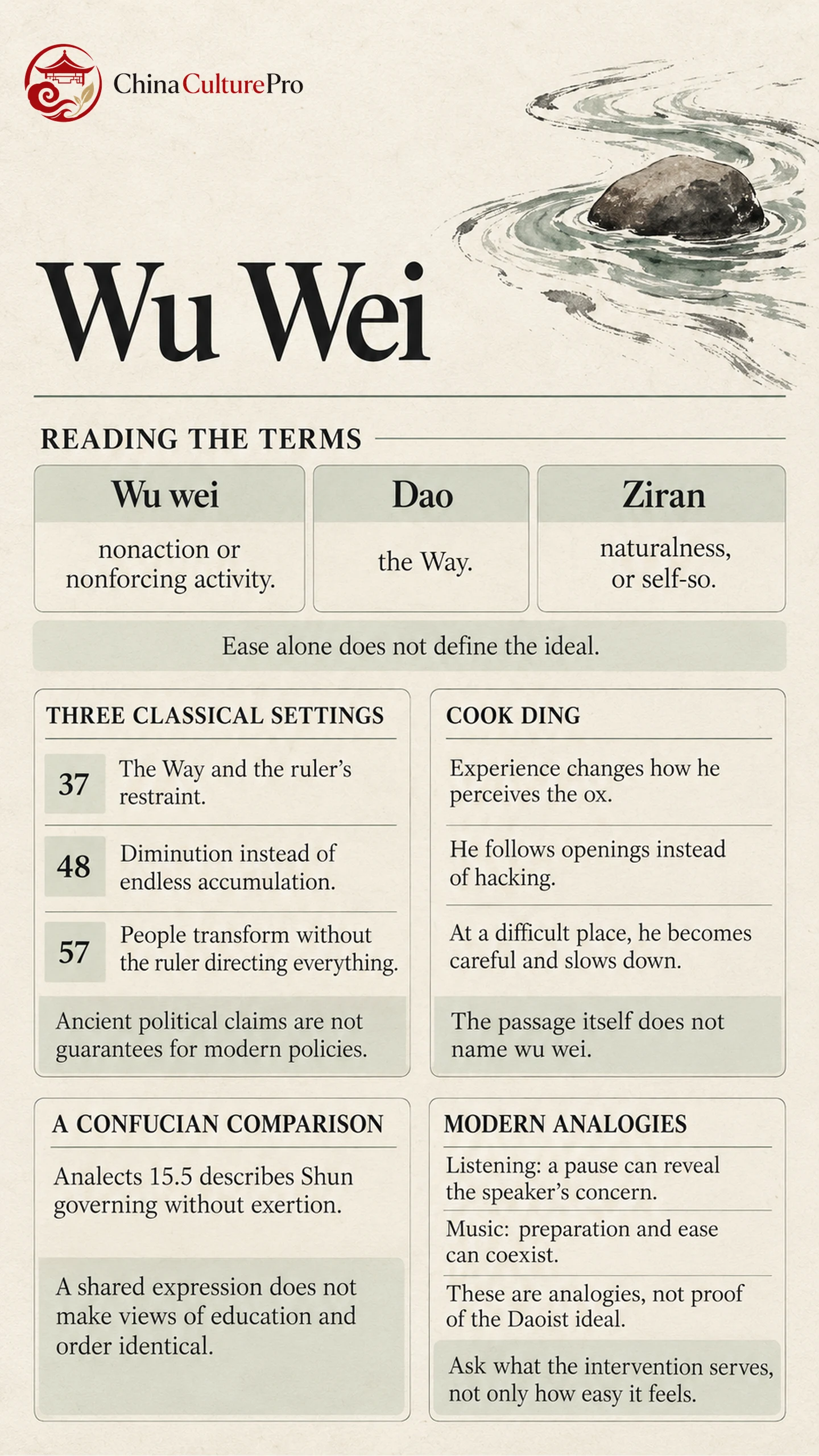
- wu wei: nonaction or nonforcing activity, whose meaning depends on the text and context.
- Dao (道, dào): the Way to which Daoist accounts of action and naturalness refer.
- ziran (自然, zìrán): naturalness, literally what is self-so.
The link with Dao matters: wu wei is more than a technique for using fewer muscles. It belongs to reflection on how human conduct relates to a larger order and on what happens when people demand that everything conform to their ambitions.[1]
“Effortless action” emphasizes ease and reduced self-conscious strain. Scholar Edward Slingerland develops that interpretation across early Chinese thought. Other scholars question whether effortlessness identifies the defining feature, or whether it groups different ideals too readily under one label. The disagreement makes a practical difference: a calm, highly efficient act is not automatically an instance of wu wei.[2][3]
A reader should therefore ask what a passage treats as unnecessary or distorting activity. That question is more precise than assuming that all exertion is wrong or every spontaneous impulse is wise.
Wu Wei in the Tao Te Ching: Desire and Government
The Tao Te Ching (道德经, Dàodéjīng), traditionally associated with Laozi (老子, Lǎozǐ), places nonaction in discussions of the Way, cultivation and government. Three passages show how those settings connect.[4][5]
| Passage | What it emphasizes | Question for the reader |
|---|---|---|
| Chapter 37 | The Way does not force its activity, yet things develop; rulers are asked to preserve this orientation. | How does the ruler’s desire alter what could develop of itself? |
| Chapter 48 | Pursuing the Way is presented through repeated diminution rather than endless accumulation. | What is being relinquished, instead of added? |
| Chapter 57 | The ruler’s restraint is linked with people transforming and ordering their lives themselves. | Can intervention create the disorder it aims to remove? |
Chapter 57 makes the political setting explicit, linking the multiplication of restrictions and clever contrivances with poverty and disorder. The sage’s restraint allows people to change without the ruler’s ambition directing everything. This is a claim in an ancient philosophical text, not an empirical guarantee that any reduction in modern regulation will improve society.[5]
Chapter 8 offers a related image: water benefits things, occupies low places and avoids contention. Its usefulness lies partly in challenging the prestige of dominance. The comparison does not instruct readers to drift regardless of circumstances; the same passage connects appropriate movement with timing.[4]
These examples give a Tao Te Ching reading more substance than an isolated inspirational line. They also distinguish the text’s arguments from claims about the uncertain life of Laozi.
Cook Ding: Skill, Attention and Knowing When to Slow Down
In the Zhuangzi (庄子, Zhuāngzǐ), Cook Ding (庖丁, Páo Dīng) cuts up an ox with extraordinary coordination. He explains that his perception changed through experience: he learned to follow openings in its structure rather than hack against what resisted him. The ruler listening to the account understands it as a lesson about caring for life.[6]
The story includes a detail easily lost in summaries. When Ding encounters a complicated place, he becomes cautious, fixes his attention and moves slowly. His responsiveness includes a change of pace. It is not a permanent trance in which difficulty disappears.[6]
That combination makes the episode useful in explaining unforced activity: developed sensitivity can replace indiscriminate force. Yet the passage itself does not name wu wei, and scholars dispute whether all celebrated skill stories express the same ideal. Reading it alongside nonaction is an interpretation, not proof that the two expressions are interchangeable.[3]
The distinction also preserves the story’s larger purpose. Its listener learns about caring for life, not simply how to finish a task faster. A fuller guide to the Zhuangzi places such skills beside the book’s questions about perspective and the value of worldly achievement.
A Related Ideal in Confucian Thought
Wu wei is especially prominent in Daoist discussion, but the expression also appears in the Analects (论语, Lúnyǔ). In 15.5, Confucius presents Shun (舜, Shùn), a legendary sage ruler, as governing without exertion while occupying his position reverently.[7]
The passage offers a comparison with the Daoist ruler’s restraint. It does not establish identical explanations of ritual, education or political order. Similar descriptions of exemplary conduct can rest on different views of education and social order.[3]
When reading the Analects, the immediate setting should control the interpretation. A wider comparison of Confucianism and Taoism can then examine differences without assigning either tradition a single slogan.
Using Modern Examples Without Losing the Classical Question
Modern analogies can make the question tangible, provided they are identified as analogies. Imagine a conversation in which someone prepares a reply while the other person is still speaking. Pausing to listen may reveal that the planned reply answers the wrong concern. The pause matters because it allows attention to the speaker’s concern; silence by itself would not do that.
Consider a musician who has practiced a difficult phrase. During performance, extra tension or attention to every finger may interrupt the musical phrase. Familiarity can allow a more responsive movement. This example illustrates how preparation and ease can coexist; it does not establish that any polished performance embodies a Daoist ethical ideal.
Both comparisons invite a question: is the next intervention answering the situation, or serving the actor’s wish to control it? They offer no fixed test for every decision. A missed responsibility does not become wise by being effortless, and necessary action may still be demanding. Returning to the classical passage helps keep this Chinese philosophical concept connected with its arguments rather than turning it into a promise of effortless success.
FAQs About Wu Wei
Does wu wei mean doing nothing?
It does not generally mean total inactivity. Daoist discussions concern activity, motivation and naturalness; literal restraint can matter, but counting actions alone does not explain the ideal.[1]
Is wu wei the same as psychological flow?
Absorbed skill can provide an analogy, but the concepts are not interchangeable. Wu wei has ethical and political settings, and scholars debate how far effortlessness or skill defines it.[2][3]
Can practicing deliberately be compatible with wu wei?
Practice and ease need not exclude each other, as Cook Ding’s account of developing skill suggests. Whether a particular practice realizes wu wei depends on the interpretation and textual context; it is not guaranteed by repetition alone.[6][3]
Does wu wei belong only to Taoism?
It is closely associated with Daoist texts, but the expression also appears in Analects 15.5 about Shun. That occurrence supports comparison while leaving differences between the traditions intact.[7]
Sources
[1] Alan K. L. Chan. Laozi
[2] Edward Slingerland. Effortless Action: Wu-wei as Conceptual Metaphor and Spiritual Ideal in Early China
[3] Chris Fraser. Review of Effortless Action
[4] James Legge, translator. Tao-te Ching, Part 1
[5] James Legge, translator. Tao-te Ching, Part II
[6] Columbia University, Asia for Educators. Zhuangzi, Chapter 3: The Secret of Caring for Life
[7] James Legge, translator. The Analects, Section 3