
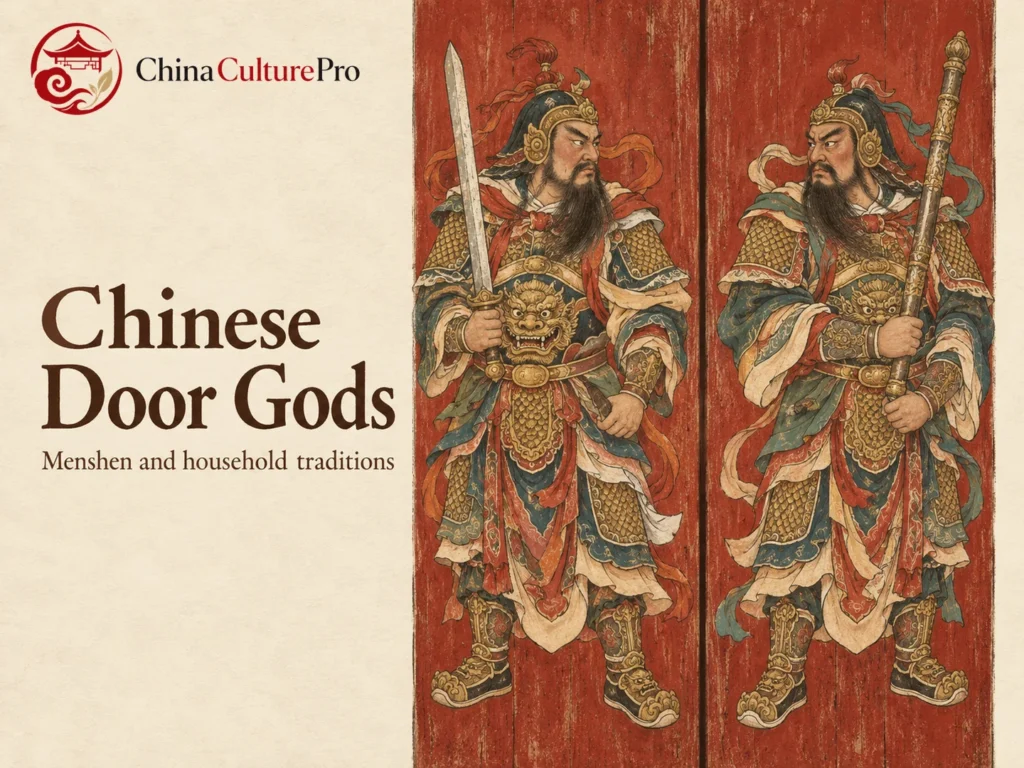

Quick Answer: What Are Chinese Door Gods?
Chinese door gods, or Menshen(门神,ménshén), are protective figures associated with entrances. Their images express hopes for household security and good fortune. The term describes a function shared by several deities and legendary figures, rather than one universally fixed pair.
- Older guardians: Shenshu(神荼,Shén Shū)and Yulü(郁垒,Yù Lǜ)belong to an early account of spirits guarding a supernatural gate. [1]
- Familiar generals: Qin Qiong(秦琼,Qín Qióng)and Yuchi Gong(尉迟恭,Yùchí Gōng)form a widely depicted martial pair. [4]
- Other images: Civil officials and auspicious children also appear in doorway prints. [5][6]
- Materials: Paper images and guardians painted directly onto doors have different display lives. [6][7]
A fierce expression or weapon alone does not identify a particular guardian. Read the names, complete pair, doorway setting and local tradition together.
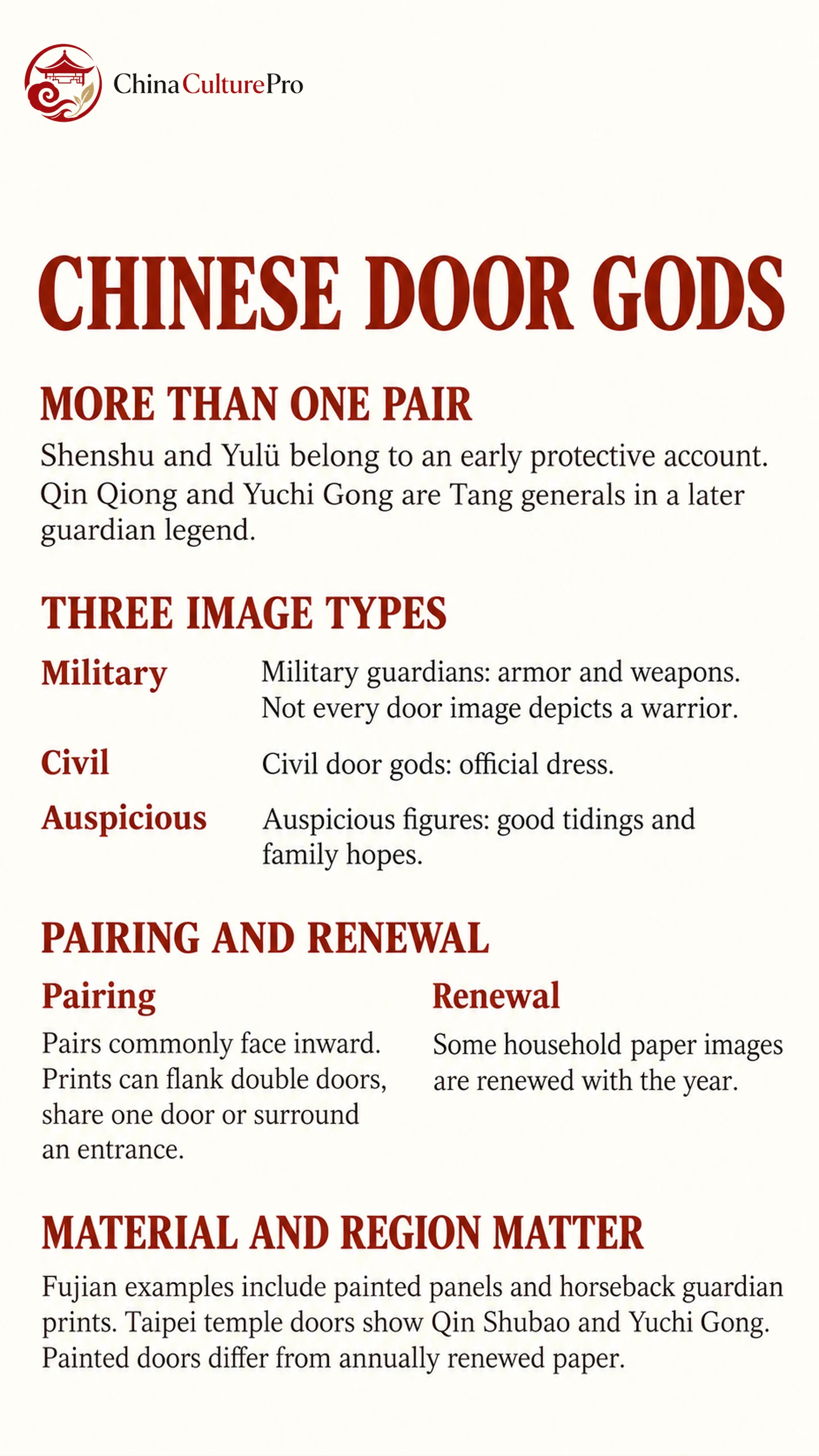
Two armored figures facing one another on red door panels are a familiar doorway image. Yet another entrance may carry civil officials or children. Understanding these differences reveals how protection, family hopes and the visual language of the threshold meet in Chinese household traditions.
Older Guardians: Shenshu and Yulü
Shenshu and Yulü are an older guardian pair. Their names are also encountered in English museum titles as Shentu and Yulei. The unusual characters have specialized readings: the final syllable of Yulü is lǜ, rather than the ordinary lěi reading of the simplified character. [2][7]
The Eastern Han work Lunheng(论衡,Lùnhéng)preserves an account of a huge peach tree and a gate through which spirits pass. Two divine guardians inspect the spirits and bind harmful ones with reed ropes. The passage also connects their images with entrances. It records a protective narrative already circulating long before the Tang generals became door guardians. [1]
The story establishes an early textual layer, rather than an exact invention date for household door images. A late-nineteenth- or early-twentieth-century Yangliuqing print identifies its two warriors with this older pair and places another protective figure above the entrance. [3]
Qin Qiong and Yuchi Gong: Generals in a Protective Legend
Qin Qiong, also called Qin Shubao(秦叔宝,Qín Shūbǎo), and Yuchi Gong, also called Yuchi Jingde(尉迟敬德,Yùchí Jìngdé), were Tang generals. Their later role as divine guards belongs to a different kind of narrative from their military careers. [4]
In the protective legend, the generals stand watch while the emperor sleeps without disturbance from spirits. Their portraits are then placed on his doors so that the men can rest. This explains their role within the story; it does not establish that door-god worship began with that emperor. The older guardian tradition prevents that simple origin claim. [1][4]
Facial colors and weapons help distinguish the generals in some prints. Use these with the complete pair and any inscription, rather than assuming every workshop follows one identification checklist. [4]
Military, Civil and Auspicious Door Images
Doorway images combine different wishes. An armed figure can emphasize guarding the entrance, while official dress or children can turn attention toward status and family continuity. One early-twentieth-century print from Zhuxianzhen presents paired civil door gods with five children, demonstrating that armor is not essential to the genre. [5]
Zhong Kui(钟馗,Zhōng Kuí)can protect an entrance as a demon queller. Guan Yu(关羽,Guān Yǔ)also appears as a door guardian. Their wider religious identities extend beyond this use, so “door god” need not replace a figure’s individual name. [3][4][6]
| Image type | What to look for |
|---|---|
| Military guardians | Armor and weapons foreground protection; several named pairs share this visual role. [3] |
| Civil door gods | Official dress and associated children can connect the doorway with hopes for family advancement. [5] |
| Auspicious doorway images | Gentler figures and happy children express good tidings and family hopes rather than martial confrontation. [6] |
How Door God Prints Are Displayed and Renewed
Door gods are an important subject in nianhua(年画,niánhuà), New Year pictures often produced as woodblock prints. Paired figures commonly turn toward each other. The composition helps them act as guardians of a shared entrance, rather than as unrelated portraits. [3]
Recorded placements include adjacent leaves of a double door, two images side by side on one door, and walls beside the entrance. The architectural setting matters: a printed pair need not have been made for an imposing temple gateway. [6]
In documented household practice, display prints could remain through the year and be burned and replaced at its end. That annual rhythm should not be extended to every doorway image. A painted wooden door has a different material life from a sheet of paper. [6][7]
The Kitchen God has a separate domestic role, commonly linked with the kitchen and an annual report to heaven. Recognizing the placement of an image helps distinguish household deities whose prints may otherwise share a similar colorful format. [6]
Painted Temple Doors and Regional Traditions
Regional materials change the appearance of the threshold. Described examples from southern Fujian include guardians painted directly on door panels, while traditional Zhangzhou prints can present Shenshu and Yulü on horseback against red paper. These are regional examples, not evidence that all Fujian households use one design. [7]
At Taipei’s Xia-Hai City God Temple, the central door panels depict Qin Shubao and Yuchi Gong in martial dress with bows and arrows. The documented paintings belong to a particular building and artistic tradition; they are not annually renewed household paper prints. [8]
These distinctions place door guardians within the overlapping practices of religion in China. A print can be a devotional object, a seasonal household image and a work of regional craft. Its function becomes clearer when identity, material and location are considered together.
FAQs About Chinese Door Gods
Who Are the Two Chinese Door Gods?
Several pairs are used. Qin Qiong and Yuchi Gong are familiar military guardians, while Shenshu and Yulü belong to an older protective narrative. The label “door gods” does not select one pair automatically. [1][3][4]
Why Do Door Gods Face Each Other?
Inward-facing figures form a coordinated pair around the entrance. This is a common compositional convention; local images and the available doorway determine the actual arrangement. [3][6]
Are Door God Images Replaced Every Year?
Some household paper prints are renewed with the year. Guardians painted onto wooden doors follow a different material and maintenance cycle, so annual replacement is not a universal rule. [6][7]
Are Door Gods Always Warriors?
No. Civil officials and auspicious figures also belong to doorway imagery. Their dress and accompanying children can express hopes different from those emphasized by armed guards. [5][6]
Sources
[1] Chinese Text Project. Wang Chong, Lunheng: Ding Gui, Chinese primary text
[2] Ministry of Education, Taiwan. Revised Mandarin Dictionary: Yulü
[3] Nelson-Atkins Museum of Art. Door Gods, Shentu and Yulei, F88-44/423
[4] Ashmolean Museum. Chinese New Year Prints: Good Fortune All Year Long, 2018
[5] The Metropolitan Museum of Art. New Year Picture of Paired Civil Door Gods with Five Children, CP455
[6] Columbia University Libraries. Chinese Paper Gods: For Display
[7] Fujian Folk Museum. Door God Culture: Shenshu and Yulü, 2020
[8] Ministry of the Interior, Taiwan. Taipei Xia-Hai City God Temple: painted door guardians